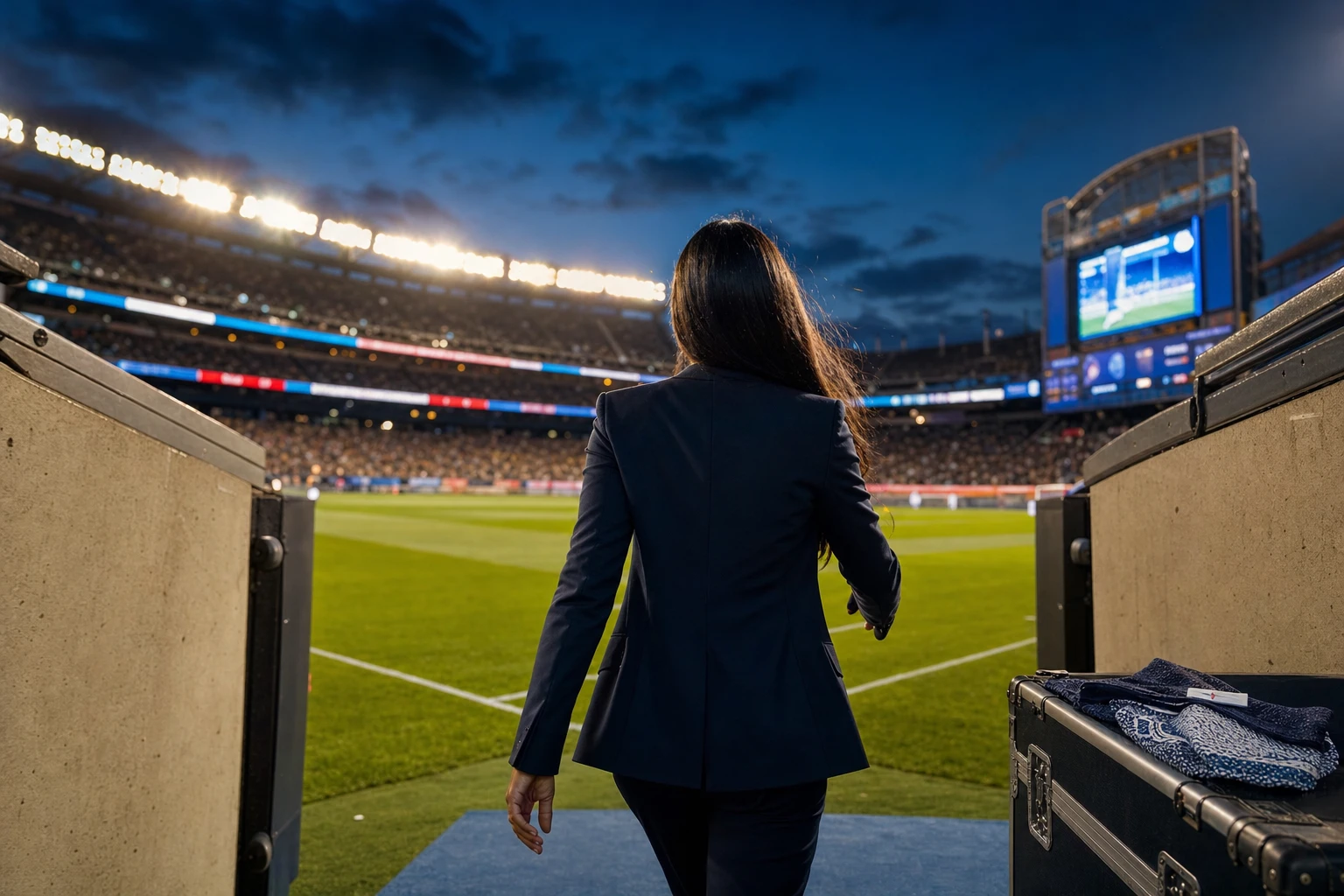
Gotham FC beat the Washington Spirit at Citi Field on July 15, a rematch of last year’s National Women’s Soccer League (NWSL) championship and the first professional women’s sporting event ever staged at the ballpark. Watching from the sideline was Ginny Seymour, chief executive of the London fashion label Aligne, who signed her small brand onto that roster two years before this particular crowd existed.
Seymour calls herself a non-sports person. She built Aligne around the idea that female athletes are the clearest picture of confidence that fashion can sell, and she placed that bet in October 2024, before Dove signed the largest back-of-jersey sponsorship in NWSL history and before revenues raced toward $3 billion in 2026, a 340% jump from 2022.
The Buyer Turned Founder
Seymour spent years climbing the buying ranks at Saks and at Holt Renfrew, a homecoming of sorts for the Canada native. Buyers, she says, secretly want to design.
“There’s a saying that every buyer wants to be a designer,” Seymour said. When she got the chance to take over Aligne, an existing, trademarked label with some infrastructure already built, she wrote a business plan in two weeks.
She was nostalgic for Vince and Theory, contemporary labels that were at their peak during her buying years before they pushed upmarket and left a gap behind. “I just wanted contemporary fashion. Where did it go?” Seymour said, describing a market squeezed between fast fashion and $795 blazers.
She pulled Aligne out of wholesale entirely, took it direct to consumer, and spent the first year, in her words, “data obsessed,” using online sales to figure out fast what worked and what did not.
A Match On Screen Started It All
The pivot into sports came from a single image. Seymour was watching a match when Lucy Bronze, the Chelsea and England defender widely considered one of the best players in the world, caught her eye running the length of the pitch.
“I was watching a match and was mesmerized by Lucy Bronze on the screen, the way she was running up and down the pitch, and I thought, that is confidence to me,” Seymour told Forbes. Bronze was “strong, powerful, and determined,” she said, and female athletes, in her view, “articulate what confidence truly is.”
Aligne built a capsule collection around Bronze, who had already starred in the brand’s earlier campaign work. That collaboration caught Gotham FC’s attention, and in October 2024 the club named Aligne its first official style partner in a multi-year deal covering tunnel looks and Fashion Week.
“With the rapid growth of women’s sports, game day has become more than just competition,” said Nan Vogel, Gotham FC’s senior vice president of partnerships, game day experience and community, in the announcement. Gotham FC, one of 14 clubs in the NWSL, had won its first NWSL Championship in 2023, a year before the Aligne deal began.
Gotham FC’s Kit Now Carries Dove’s Name Too
Seymour was not the only one who saw the opening. Skims and Coach have partnered with the Women’s National Basketball Association (WNBA), while Anthropologie, Sephora, and Dove have put their names on jerseys and stadiums across women’s sports.
“As a small brand that didn’t exist, that had no followers, when I looked at the landscape, I thought, oh, wow, there are a lot of really big, big names in this,” Seymour said of muscling onto the same field as those companies.
Gotham FC’s own jersey now proves the point. Dove’s partnership is the largest back-of-jersey sponsorship in NWSL history, and it marked the consumer giant’s first major investment in a women’s sports team, a sign that new entrants are committing serious money upfront instead of testing the water first.
A quick look at how a handful of brands have staked their claim shows how differently those bets are sized and structured.
| Brand | Women’s Team or League | Deal Type | Notable Detail |
|---|---|---|---|
| Aligne | Gotham FC (NWSL) | Official style partner | Signed October 2024; includes tunnel styling and a Lucy Bronze capsule collection |
| Dove | Gotham FC (NWSL) | Back-of-jersey sponsor | Largest back-of-jersey deal in NWSL history; Dove’s first major women’s sports investment |
| Sephora | Unrivaled (basketball) | Beauty and tunnel-walk sponsor | Expanded its partnership in December after tunnel-walk videos went viral |
| Nuuly | KC Current (NWSL) | Match-day arrivals sponsor | Now in its second year backing the league’s top-ranked club |
Aligne’s slice of that field is tiny by comparison, but it was there first, and Seymour has kept the account through two full seasons while bigger names cycle in around her.
How Big Is Women’s Sports Sponsorship Right Now?
Global elite women’s sports revenue is projected to hit at least $3 billion in 2026, a 340% jump from 2022, according to Deloitte Global. Commercial deals, including sponsorships and merchandising, are expected to account for the largest single share of that money, and the number of Fortune 500 companies sponsoring women’s leagues has grown sharply in just the past year.
- $3 billion: projected global revenue for elite women’s sports in 2026, up 340% from 2022, according to Deloitte Global.
- Sixfold: year-over-year growth in Fortune 500 companies sponsoring women’s sports leagues, per platform data cited by Fortune 500 sponsors entering the space in a single year.
- $9 million: added sponsorship-dollar growth from financial-sector brands alone across the WNBA and NWSL, according to SponsorUnited.
- 13%: average annual value appreciation for major US sports franchises over the past two decades, against roughly 8% for the S&P 500, per sports franchises outpacing S&P 500 returns.
Money is not just arriving in bigger volume. It is concentrating in specific categories: financial services, healthcare, and consumer products are now driving the largest dollar increases into women’s leagues, according to financial brands adding roughly $9 million in sponsorship dollars. Mellody Hobson, co-CEO of Ariel Investments, has called this a “once-in-a-generation inflection point,” pointing to data showing women’s leagues have built an independent fan base that barely overlaps with men’s leagues, a finding that undercuts the old fear that women’s sports would simply cannibalize the men’s audience. She backed that view with Project Level, a $1 billion fund built specifically around women’s sports assets.
Consistency Is Seymour’s Whole Strategy
Media coverage has historically been the biggest obstacle for women’s leagues. Fans cannot watch a sport they cannot see, and major broadcasters are only recently signing the deals that give these leagues real airtime.
Seymour treats brand partnership as a substitute for that missing coverage, one that cannot go quiet between big moments.
We haven’t just shown up when someone’s in the finals. We’ve been there day in, day out.
Seymour told Forbes, describing how Aligne uses slower stretches of the season to keep building both its own voice and the visibility of the players and teams it sponsors.
The payoff shows up in spending habits. More than one in four fans of women’s soccer have made a purchase because of a brand’s sponsorship of the sport, according to an August 2025 report cited by trade outlet Glossy, making them 58% more likely to buy from a sponsor than fans of other sports. Streaming has widened that same funnel, with more women’s league games now reachable without a cable package than even a year or two ago.
“The brands that support women’s soccer show they believe in authenticity and connection with fans, communities, and making a difference,” Bronze told Forbes.
The Compensation Gap Still Runs Through The Athletes
Seymour is blunt about what the job actually demands of the women wearing the clothes.
“Female athletes have to give so much more of themselves than male athletes,” she said, contrasting the 360-degree way female athletes interact with fans against a male athlete’s profile, which she says might show “some game highlights, but it’s not their whole life.”
That imbalance shows up in the data too. Much of the visibility work driving the current boom falls not to broadcasters or leagues but to individual athletes, often on their own time and their own accounts, frequently without compensation for the labor involved, according to Sporting Goods Intelligence Europe.
The gap between rising budgets and what actually reaches athletes is not confined to fashion sponsorship. Nigerian sports officials recently found themselves in a similar bind, where promised bonuses arrived as nylon bags instead of cash even as national sports budgets grew.
Two Different Business Models Share One Scoreboard
Seymour rejects the idea that women’s sports should simply copy the men’s playbook.
“You simply cannot scale it the same way as a 100-year-old football club… It’s two different business models,” she said.
Men still matter to that build-out, in her telling. She points to former Arsenal striker Ian Wright, who has used his broadcasting platform to champion the women’s game, and to Denmark’s men’s national team, which gave up its own raises to help secure equal pay for the women’s team. “You have to work with the system that exists, and that means we’re having the men champion us alongside it,” Seymour said.
It has been a landmark stretch for women’s sports attendance across disciplines in the United States, from Citi Field’s soccer crowd to the US women’s curling team’s historic upset of Canada at the Winter Olympics. Back at Citi Field, Seymour’s guests, including Bronze, entrepreneur Hannah Bronfman, and actor Ella Travolta, had plenty to celebrate. Gotham FC won.
Frequently Asked Questions
What Is Aligne, and Who Founded It?
Aligne is a London-based, female-led fashion label founded in 2020 and now led by chief executive Ginny Seymour, a former retail buyer at Saks and Holt Renfrew. The company describes itself as rooted in sustainability, running its small team out of a net-zero office in East London alongside local makers.
Why Are Dove, Sephora, and Other Big Brands Sponsoring Women’s Sports Now?
Commercial revenue, including sponsorships, partnerships, and merchandise, is projected to account for 45% of all women’s sports revenue in 2026, according to Deloitte, the largest share of any category. Brands are chasing that share along with a fan base that data shows is largely independent of men’s sports audiences.
Does Sponsoring Women’s Sports Actually Change Fan Behavior?
Yes, based on athlete-level engagement data. During the 2025 Rugby World Cup, one player’s Instagram content drove 41% engagement among women aged 13 to 34, far outperforming the official tournament account’s 15%, according to Women’s Sport Trust data cited by Sporting Goods Intelligence Europe.
Is Women’s Sports Sponsorship Actually Profitable Yet?
It is growing fast but still small in absolute terms. McKinsey estimated the total US sports market at $75 billion in 2024, with women’s sports accounting for less than 2% of that figure, according to the less than 2% share of a $75 billion market cited by the World Economic Forum.
How Does the NWSL Itself Make Money From Sponsorships?
The NWSL had 16 active league-level sponsors as of September 2025, the most in league history, after roughly quadrupling its sponsorship revenue over five years.