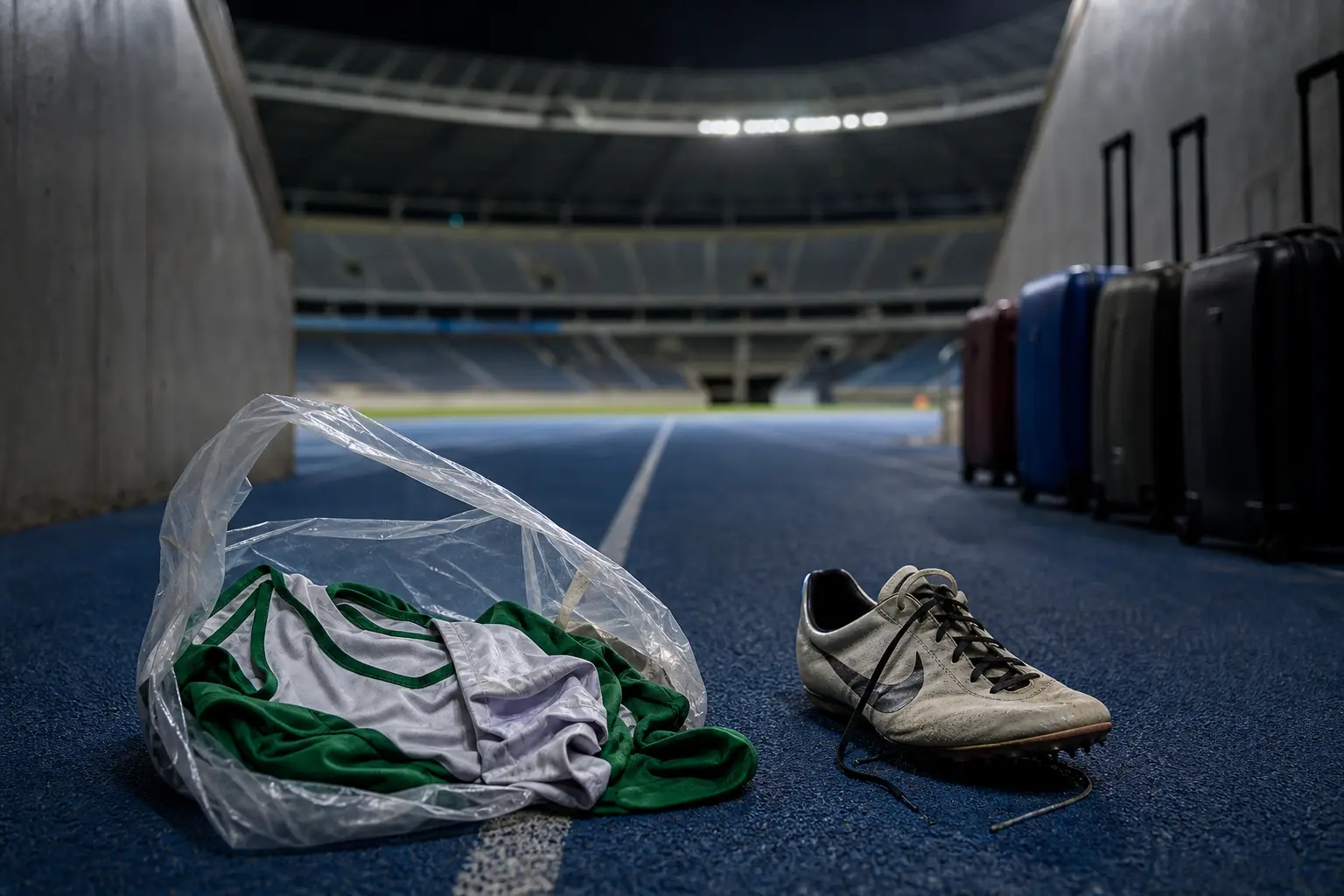
Tobi Amusan pulled a nylon bag out of her hotel room in Tokyo this past September and showed the world exactly what Nigeria gave its track team. No shoes were inside, even though officials had collected everyone’s sizes weeks earlier. She still won silver days later.
The same complaint, the same denial, and the same silence had already played out once at the Olympics in Paris and once before that in Tokyo. Nigeria’s sports budget has climbed past ₦210 billion a year, and its athletes are still fighting the federation over kits, unpaid bonuses, and debts some retired stars have carried for three decades.
Nigeria Hands Its Track Star Another Nylon Bag
Amusan is Nigeria’s world record holder in the 100 meter hurdles and the country’s most consistent track medalist of the past few years. Days before the 2025 World Athletics Championships opened in Tokyo, she posted a video showing what her federation had packed for her: two competition outfits of uncertain quality, stuffed into a small nylon bag.
See what Nigeria used to pack kits for athletes. Every year, that’s how we collect it. Inside one small nylon bag.
Amusan said it in a Snapchat video posted hours before her opening heat, comparing her bag to the suitcases she said other national teams received. “This country will steadily embarrass you,” she added, threatening to compete in her own training tights instead.
The Athletics Federation of Nigeria (AFN) denied anything was wrong. AFN President Tonobok Okowa told Sunday PUNCH that Amusan had received the same kit as her teammates and had, if anything, gotten preferential treatment. “All other athletes came on economy class, but Tobi alone flew business class,” Okowa said. “We got business class for her because that was what she demanded.”
National Sports Commission (NSC) Chairman Shehu Dikko offered a similar defense a day later, framing the complaint as a matter of delivery rather than substance. “Probably she has an issue with the packaging, the quantity, yes,” Dikko said, adding that the kits were “not inferior or whatever people are trying to say.”
The kits were part of a deal with Hiracer, a sportswear company outfitting 20 countries at the championships, including Nigeria, Algeria, Zambia, Tunisia, Uzbekistan and Myanmar. Under that arrangement, Okowa said, a Nigerian gold medalist would earn $30,000, a silver medalist $20,000 and a bronze medalist $10,000, separate from anything the government paid. Amusan won silver in 12.29 seconds days later.
The Cycle Repeats at Every Major Games
Amusan’s bag was not a one-off embarrassment. It was the latest entry in a pattern stretching back years, repeating in similar shape at nearly every major tournament Nigeria enters.
- 2021: Ten Nigerian track and field athletes are disqualified from the Tokyo Olympics after Nigeria fails to meet World Athletics doping-test protocols.
- 2024: Nigeria leaves the Paris Olympics without a single medal. Sprinter Favour Ofili misses her 100 meter race after the AFN fails to register her in time.
- September 2025: Amusan films the nylon bag of kits in Tokyo. The AFN and NSC both call it a packaging problem, not a quality one.
- November 2025: Super Eagles players and officials boycott training in Morocco over bonuses and allowances they say stretch back years, ahead of a World Cup playoff against Gabon.
- January 2026: A near identical bonus dispute freezes Super Eagles training again, this time during the Africa Cup of Nations. The government resolves it mid tournament by routing roughly $30,000 per player through the Central Bank after officials blamed cash transport rules for the delay.
- February 2026: Dikko declares that “the days when national teams are owed bonuses are over,” pointing to new presidential directives on fund disbursement.
State federations have faced their own version of the same scrutiny. In Kebbi State, football officials had to publicly deny misappropriating funds from a $1.8 million FIFA-funded mini-stadium project after online rumors claimed it was never finished.
A Budget That Multiplied, Facilities That Didn’t
Nigeria has never lacked money for sports on paper. In 2016, the Ministry of Youth and Sports Development had a total budget of ₦75.4 billion. A breakdown at the time found that only ₦4.6 billion went to facilities, the capital spending line meant for pitches, tracks and equipment. The remaining ₦70.8 billion covered salaries and other recurring costs.
“We cannot move forward as a society if we continue this way,” sports analyst Sadiq Ahmed said at the time, arguing the ministry was spending on items irrelevant to athlete welfare while facilities crumbled.
A decade later, the headline number is much bigger, and the imbalance looks familiar. Nigeria’s 2026 sports sector allocation reached roughly ₦210 billion, worth an estimated $130 million at an exchange rate near ₦1,600 to the dollar. The National Sports Commission headquarters alone commands ₦203.6 billion of that. The Nigeria Football Federation (NFF), the body at the center of most bonus disputes, received just ₦2.31 billion, about 1.1% of the total.
The National Institute for Sports (NIS) was allocated ₦4.12 billion, months after a House of Representatives committee had pushed to lift the institute’s budget to ₦60 billion, citing decades of neglect that left the country reliant on foreign-born talent.
| Budget Cycle | Headline Figure | Where It Was Aimed | The Catch |
|---|---|---|---|
| 2016 Ministry Budget | ₦75.4 billion total | ₦4.6 billion for facilities and equipment | ₦70.8 billion went to salaries and recurrent costs instead |
| 2026 Sports Sector | Roughly ₦210 billion | ₦203.6 billion to NSC headquarters | NFF, which runs the national teams, got just ₦2.31 billion |
| 2026 National Institute for Sports | ₦4.12 billion appropriated | Coach training, completing the Athletes Development Centre | Lawmakers had pushed for ₦60 billion weeks earlier |
The gap between totals and what reaches athletes showed up again in June 2026. An investigation examining Nigeria’s public payments portal, Govspend, and published by Sahara Reporters found the National Sports Commission had committed nearly ₦5 billion in consultancy contracts for sports centers that had not yet broken ground, with more than ₦1.49 billion disbursed in a single day. Lawyer Festus Ogun called the spending “suspicious and faulty,” arguing the commission had no business paying such sums for consultancy alone.
Nigerian athletes still won a record 373 medals across international competition in 2025, without much help from the budget lines meant to support them.
Why Do Nigeria’s Fastest Athletes Keep Switching Flags?
Poor pay, no insurance and weak post-career support are pushing Nigerian stars toward federations that pay on time. Sprinter Favour Ofili has switched to Turkey, hammer thrower Annette Echikunwoke competes for the United States, and sprinter Francis Obikwelu won Olympic silver for Portugal after switching allegiance back in 2002, proof the pattern predates this generation of athletes.
“Your peak years are short, and if there is no insurance, no proper welfare, and no security for life after sports, people will naturally look for better options,” former Olympic long jump champion Chioma Ajunwa said, explaining why she believes athletes keep leaving.
Former sprinter Blessing Okagbare has gone further, accusing officials of active sabotage rather than simple neglect. She said a shoe sponsorship deal secured ahead of the Tokyo 2020 Olympics was undermined from within the federation, and that the gear eventually reached Tokyo but never reached the athletes it was meant for.
Nigeria’s football side will also watch the 2026 World Cup from home after a qualifying campaign that ended in playoff defeat, one more disappointment for a federation that has run its senior men’s team without a permanent head coach for long stretches. Nigeria is not alone in that kind of reckoning. Indonesia’s federation went further after its own qualifying miss, sacking coach Patrick Kluivert after the World Cup failure rather than absorb the blame internally.
Retired Heroes Wait Decades to Get Paid
Unresolved bonuses are one problem. Decades old debts to retired stars are another, and the Senate says the scale is larger than anyone had admitted.
The Senate Committee on Sports and Youth Development found that more than 100 retired athletes across various federations are owed benefits dating back over three decades, a list that includes Olympic medalists, former national team players and coaches.
- Peter Rufai, the former Super Eagles goalkeeper, died in July, and his burial was delayed until late August because his family had to raise funeral costs from former teammates, according to ex-defender Taribo West.
- Christian Chukwu, the late Super Eagles captain, still has benefits owed by the NFF that his son has raised publicly.
- Sam Okparaji, a late international, reportedly never received the match bonuses or travel allowances he was owed while playing for Nigeria.
- Chioma Ajunwa, Nigeria’s first individual Olympic gold medalist, waited 25 years for the housing reward promised after her win at the 1996 Atlanta Games.
- Patience Avre, a former Super Falcons player, says 13 years of national service earned her “empty promises, golden handshakes, golden cards” and a ₦300,000 payout.
West did not soften his conclusion. “With the type of example that they have shown with Shofoluwe, Stephen Keshi, Thompson Oliha, Rashidi Yekini, I’ll never advise my son to put his feet for this country,” he said, blaming the NFF and the Lagos State government for abandoning Rufai’s family.
Not everyone accepts that framing. A separate commentary in Punch argued Nigerian football has drifted into an entitlement mentality, contrasting the country’s crisis-driven payouts with South Africa’s structured post-career programs in education and entrepreneurship, and with England’s stronger player unionization.
The Senate’s proposed Athlete Welfare and Entitlements Act would require every federation to run a Retired Athletes Welfare Unit and keep an annual welfare budget, backed by a national database tracking former athletes. “We are not just seeking to repay debts; we are building a system where such injustices can’t repeat themselves,” said Senator Ahmed Ningi, chairman of the Senate Committee on Sports and Youth Development.
Glasgow Is the Next Test
Nigeria says it is finally trying to close these gaps. The National Sports Commission earmarked ₦4 billion in its 2026 budget for active and retired athletes, split between overdue pledges to former internationals and rewards for current teams.
In June 2025, the government delivered on a three decade old promise, handing houses to members of the 1994 Africa Cup of Nations winning squad. Ajunwa welcomed the broader plan. “Our athletes and veterans will not have to wait endlessly for whatever has been promised to them. By that, there will be no backlog,” she said.
Sports consultant Victor Adebiyi wants the commission to go further, pushing for a dedicated National Sports Rewards Fund with quarterly public reporting and a 90 day delivery window for any pledge made publicly. A separate retired athletes’ association, RENISA, founded in 2019, has also started meeting with commission and Olympic committee leadership to press its members’ case.
Nigeria’s National Assembly is weighing a comparable welfare framework for a different group entirely. Lawmakers are advancing a bill to support retired military personnel with a dedicated healthcare center and cost of living program, evidence that Nigeria’s habit of promising welfare only after public pressure builds is not unique to sports.
The next real test arrives in days. Nigeria’s team leaves for the Commonwealth Games in Glasgow, running July 23 to August 2, with NSC Director General Bukola Olopade promising enhanced daily allowances, full medical care and psychological support for every athlete who makes the trip. “This is about the athletes who will step onto that track, into that pool and onto that podium,” Olopade said.
Amusan is expected to compete in Glasgow. Her teammates will be watching to see if the bag comes with shoes this time.
Frequently Asked Questions
Why Do Nigerian Athletes Keep Complaining About Their Kits?
Nigerian athletes, most visibly Tobi Amusan at the 2025 World Championships, have repeatedly said the gear their federations hand out arrives late, incomplete or packed in nylon bags instead of proper luggage. The AFN and NSC have denied any quality problem both times the complaint went viral, with officials from both bodies independently blaming packaging and delivery timing rather than the kits themselves.
How Much Does Nigeria Spend on Sports Each Year?
Nigeria’s 2026 sports sector allocation reached roughly ₦210 billion. The National Sports Commission headquarters alone received ₦203.6 billion of that, while the Nigeria Football Federation, the body at the center of most bonus disputes, got only ₦2.31 billion, about 1.1% of the total.
Why Are Nigerian Athletes Switching to Other Countries?
Athletes and former officials point to poor pay, no insurance and weak post-career support. Sprinter Favour Ofili moved to Turkey and hammer thrower Annette Echikunwoke now competes for the United States, following a path sprinter Francis Obikwelu set in 2002 when he won Olympic silver for Portugal after switching allegiance.
What Is Nigeria Doing About Retired Athletes’ Unpaid Benefits?
The Senate Committee on Sports has drafted an Athlete Welfare and Entitlements Act that would force every federation to run a Retired Athletes Welfare Unit and keep annual welfare budgets, backed by a national database tracking former athletes. A separate group, RENISA, founded in 2019, is pressing the same case outside the legislative process.
Will Nigeria’s New Welfare Promises Hold Up at the Commonwealth Games?
Nigeria’s National Sports Commission has pledged enhanced daily allowances, full medical care and psychological support for the team traveling to the Commonwealth Games in Glasgow, running July 23 to August 2, 2026. Similar promises preceded Tokyo 2020 and Paris 2024, both of which ended in the same complaints, making Glasgow the first real test of whether this round is different.