W Social opened its Brussels beta last month with 55,000 users, and the presidents of the European Commission, European Council and European Central Bank were already posting on it. The Swedish startup is betting that mandatory identity checks and European-hosted servers can pull users away from Elon Musk’s X. It arrives just as Brussels rolls out a far bigger wager on technological independence.
That confidence carries a catch. The verification system built to prove every W Social poster is a real human also hands the company a pile of biometric data, exactly the kind of asset security researchers say can never be reset once it leaks. And the code running underneath the whole platform comes from an American company.
A Verified Human Network Launches with Brussels’ Blessing
W Social first surfaced at the World Economic Forum in Davos in January, then opened its public beta in Brussels last month. W Social chairman Ingmar Rentzhog also founded the climate media outlet We Don’t Have Time. Chief executive Anna Zeiter previously led data protection at eBay.
“The EU has been lagging behind,” Rentzhog told CNA. “It also needs to help companies to succeed, it can’t only regulate them.”
The pitch is simple. Anyone can read posts on W Social, but only accounts verified through a companion app, W Identity, can post, comment or like anything. Data sits on European infrastructure, including Swiss encrypted email provider Proton and Finnish cloud host UpCloud, and the company says it earns money through advertising compliant with the EU’s Digital Services Act plus reader micropayments.
Roughly 80 European investors are backing the venture, according to EUobserver, and one economic analysis of the launch pegged its starting capital at just 2.5 million euros, a rounding error next to the war chests of Meta or X. X itself was fined 120 million euros last December under the Digital Services Act for failing to meet transparency rules, a penalty Musk publicly criticized.
W Social is not alone in trying anyway. A Finnish manufacturer recently relaunched its own Linux-based smartphone built as a European alternative to Android and iOS, part of the same wave of homegrown challengers to American platforms.
Europe Imports Four-Fifths of Its Digital Backbone
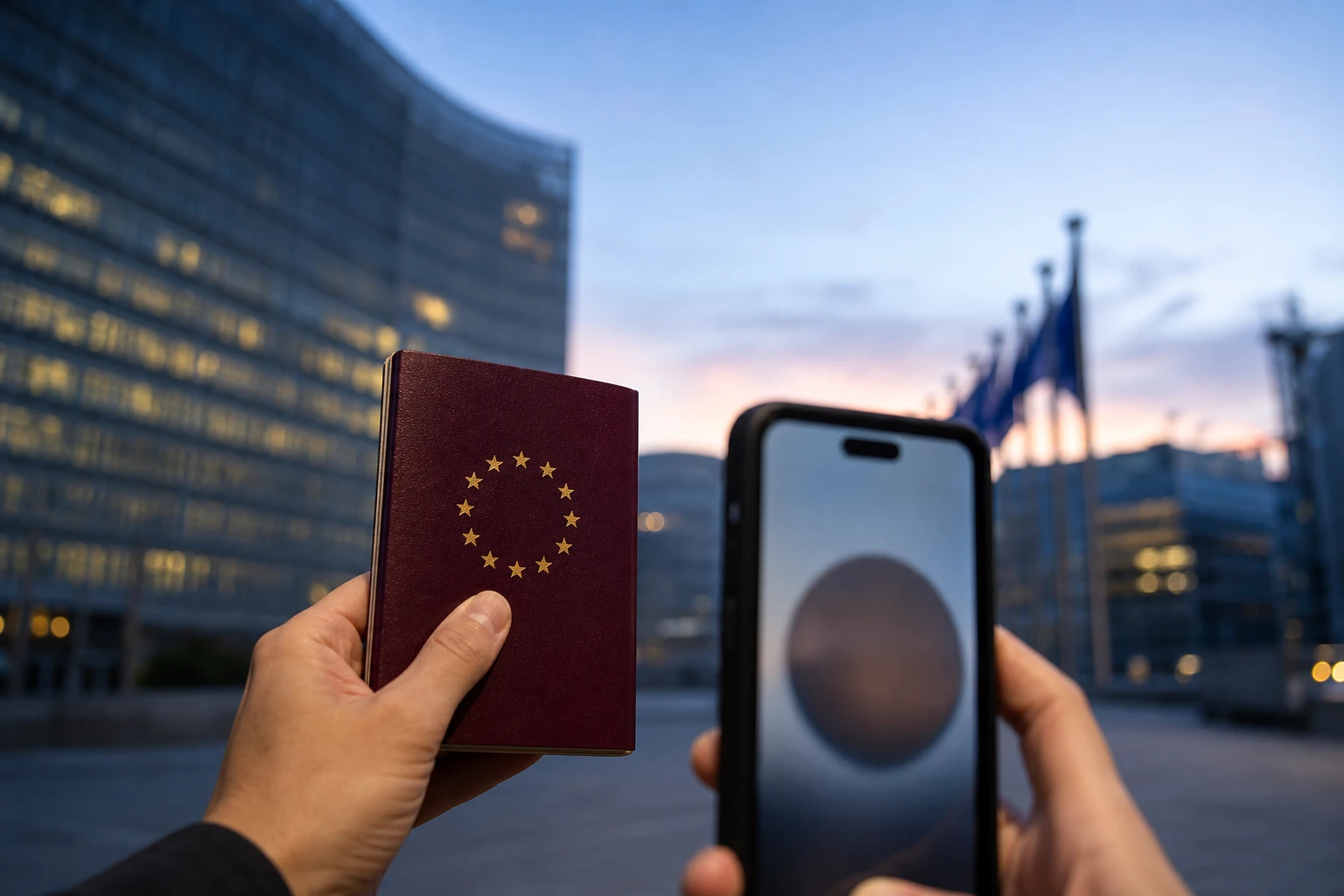
W Social’s launch lines up with a much larger EU document. On 3 June, the European Commission adopted its European technological sovereignty package, a set of measures covering chips, cloud computing, artificial intelligence and open source software.
The starting point for all of it is one repeated figure. The EU relies on non-EU countries for more than 80 percent of its key digital products, services, infrastructure and intellectual property.
“We cannot afford to depend on others for the technologies that keep our hospitals running,” Commission President Ursula von der Leyen said when the package was unveiled.
The package breaks into four main pieces.
- Chips Act 2.0 – aims to grow Europe’s semiconductor manufacturing and caps permitting approvals for new plants at twelve months.
- Cloud and AI Development Act – sorts cloud and AI providers into four sovereignty tiers based on where data sits and who controls the supply chain.
- EU Open Source Strategy – pushes public agencies toward open source software to cut licensing dependence on foreign vendors.
- Strategic Roadmap for Digitalisation and AI in Energy – ties new data centre capacity to grid capacity and sustainability rules.
The ambitions attached to that list are large. A Belfer Center policy brief estimates the plan aims to at least triple EU data centre capacity within a decade, from around 12 gigawatts today to as much as 60 gigawatts, backed by roughly 300 billion euros in investment.
Private capital is moving in the same direction. Defence contractor BAE Systems recently put fifty million euros behind two European defence tech funds, a smaller but parallel bet on homegrown capacity.
The Same Verification That Sells Trust Also Stores It
W Social’s answer to bots is simple in concept. No verified identity, no posting. Users download a companion app called W Identity, scan a passport or national ID card, record a short selfie, and the system checks that a real, adult human sits behind the account.
The company says none of that sensitive material touches its main servers. W Social’s own privacy notice for the platform states it does not receive a user’s passport, selfie, full date of birth or legal name from W Identity as part of standard account creation. Rentzhog has said identity data is wiped from company servers immediately once verification finishes.
Security researchers are not convinced that removes the risk. Cybernews, which got early access to the platform, quoted security researcher Arnoldas Radišauskas questioning the setup.
you can’t reset your face or your passport number
Radišauskas made that point after reviewing how W Identity handles documents. His broader argument is that any system processing passports and biometric scans creates a permanent record somewhere, no matter how quickly it claims to delete it. Cybernews drew a comparison to Tea, the dating safety app that suffered a breach exposing roughly 72,000 images, including passports and selfies submitted for its own identity checks.
The EU is not leaving identity verification entirely to private platforms either. Brussels has its own age verification app, unveiled by Commission President Ursula von der Leyen earlier this year, built on open source code that individual member states can adapt and issue through their own governments.
How W Social’s Reach Compares
Numbers show how far W Social has to travel. Meta’s Facebook and Instagram reach roughly 259 million monthly users across Europe, TikTok claims about 135.9 million and X sits near 115.1 million, according to EU figures cited by AFP. W Social launched its beta with 55,000 users worldwide.
| Platform | Monthly Users in Europe | Headquarters | ID Verification to Post |
|---|---|---|---|
| Meta (Facebook and Instagram) | About 259 million | United States | Not required |
| TikTok | About 135.9 million | China (ByteDance) | Not required |
| X | About 115.1 million | United States | Not required |
| W Social | 55,000 worldwide at beta launch | Sweden | Required, via W Identity |
Outside Europe, the scale gap looks even wider. Chinese platform Weibo counts more than 600 million monthly users, and Russia’s VK draws around 75 million, according to EUobserver.
The gap is not only about audience size. W Social was built on the AT Protocol, the same open standard that powers Bluesky, which gives it a shortcut around the cold start problem every new network faces. Because the protocols interconnect, W Social users can already see and interact with accounts on Bluesky and similar services without waiting for millions of people to sign up first.
Why Does a Sovereignty Project Run on American Code?
W Social runs on the AT Protocol because it was free, proven and already connected to tens of millions of accounts, even though the protocol was built and released as open source by Bluesky Social PBC, based in the United States. Borrowing it let W Social launch fast and tap an existing network instead of building one from zero.
That choice sits oddly next to the sovereignty pitch. A platform marketed as Europe’s answer to Silicon Valley depends, at a technical level, on infrastructure invented in San Francisco.
Bluesky’s own network had around 40 million accounts when W Social launched, one economic analysis found, exactly the scale problem the protocol let W Social skip. Open source developers noticed the contradiction too, pointing out that W Social’s founders built the platform quietly and unveiled it as a surprise in Davos, skipping the usual practice of engaging publicly with the community whose code they were using.
Where Brussels and Its Critics Split
Not everyone agrees on what tech sovereignty should mean in practice, or what it should cost.
- Sabine Muscat, a senior digital policy fellow at the Brussels Institute for Geopolitics, argues the goal is finding partners who share Europe’s standards, not sealing the continent off. “The future for the EU is going to be finding other partners,” she said.
- Michal Kobosko sits in the European Parliament for the Renew Europe group and frames the same technology as a tool of power between nations. “IT solutions can be used as a tool, if not a weapon,” he said.
- CEPA’s analysis of the plan puts a price on full self-sufficiency, estimating it near 3.6 trillion euros, about 4.19 trillion dollars, over a decade, and argues that scale of fortress-style technological independence is not realistic.
A Two-Year Fight over Tariffs and Rare Earths
The package still has to survive Brussels’ own machinery. It has gone to the European Parliament and the Council of the EU for negotiation, with one legal analysis predicting no final sign-off before the end of 2027. France wants a stronger European preference written into procurement rules. Germany wants a more open approach that keeps international partners inside the tent.
Outside the EU’s own institutions, the terrain gets rockier. Kobosko warned that Europe still depends on Chinese exports of rare earth materials essential to advanced technology, with no guarantee that access continues. Washington adds its own pressure, since President Donald Trump has threatened tariffs on European countries that impose digital services taxes, tying trade policy directly to how Brussels regulates American platforms.
“If we don’t step up, all our innovations are going outside to other places,” Rentzhog told CNA in a televised interview from Brussels.
W Social’s 55,000 users are a rounding error against Meta’s 259 million. Closing that gap, Brussels is betting, will take more than a passport scan and a server on European soil.
Frequently Asked Questions
What Is W Social?
W Social is a Brussels-launched, Swedish-run social network that requires identity verification before users can post, built to compete with X. It runs on the open AT Protocol, and according to chief executive Anna Zeiter, the name plays on the words We, Values and Verified.
How Does W Identity Verification Work, and What Happens if You Skip It?
Users scan a passport or ID card and record a selfie through the separate W Identity app, designed to keep that data on the user’s own device rather than a central server. People who skip verification can still join, browse and like content, but Cybernews reported that unverified activity is not counted by the platform’s recommendation system, and those users cannot post or comment.
What Is the EU’s Tech Sovereignty Package?
It is a set of laws the European Commission proposed in June 2026 covering chips, cloud computing, AI and open source software, responding to the finding that Europe imports more than 80 percent of its digital products and infrastructure. The Commission’s own tech sovereignty strategy page outlines a four-tier sovereignty ranking for cloud providers, and only the strictest tier, reserved for defence and national security data, fully excludes non-EU firms.
Why Was the Package Delayed Three Times Before Its June Launch?
The Commission originally targeted 25 March for the package, then pushed the date to 15 April and later to 27 May, before finally presenting it on 3 June 2026. Officials pointed to the difficulty of coordinating chips, cloud and energy rules across all 27 member states in one package.
Will the Package Ban American Cloud Providers like Amazon or Microsoft?
No outright ban is planned. American hyperscalers can still qualify for the lower sovereignty tiers, and even the stricter third tier allows exceptions if the Commission grants an adequacy decision, so the rules are designed to raise requirements rather than lock providers out entirely.