Aina, a hardware startup with offices in Bengaluru and San Francisco, has raised $5.5 million to build devices that control AI agents. Apoorv Shankar, Aina’s founder and a former vice president of hardware at wearable ring maker Ultrahuman, says the money will fund a device the company has not shown anyone outside a small test group yet.
Shankar built Aina after watching two of the most hyped AI gadgets of the past two years flop in public. “Devices like Rabbit and Humane Pin had launched, and I had my own disappointments with them,” he told TechCrunch. “However, I was just excited that we are seeing interfaces being a thing now.”
Redstart, 360 One and Cred’s Kunal Shah Fill Out the Cap Table
The round was led by Redstart Labs, the venture arm of India’s Info Edge, and 360 ONE Asset. MIXI Global Investments, Antler and Blume Founders Fund joined them.
A cluster of well-known founders came in as individual backers too: Kunal Shah, the Cred founder recently tapped to lead WhatsApp globally; Scribd founder Tikhon Bernstam; and Razorpay co-founders Harshil Mathur and Shashank Kumar.
Aina says the cash will bring its still-unnamed flagship interface to market and grow the team split across San Francisco and Bengaluru. The company was incorporated in May 2025 and spent its first year operating as a human-computer interaction lab under the name Project Mirage.
Abhishek Nag, 360 ONE Asset’s head of venture capital, pointed to the arc of computing history to make his case. “Every leap in computing has demanded a new hardware interface, from punch cards to the GUI to the smartphone,” he said. “As AI agents become the primary way for people to interact with computers, the world once again needs a new generation of interfaces built for how we’ll actually compute.”
The check size is tiny next to some of Aina’s peers in the same personal AI hardware category. Hark, a startup building consumer devices around what it calls personal intelligence, hit a $6 billion valuation on a $700 million round earlier this year.
From Three Prototypes to One Shipped Keypad
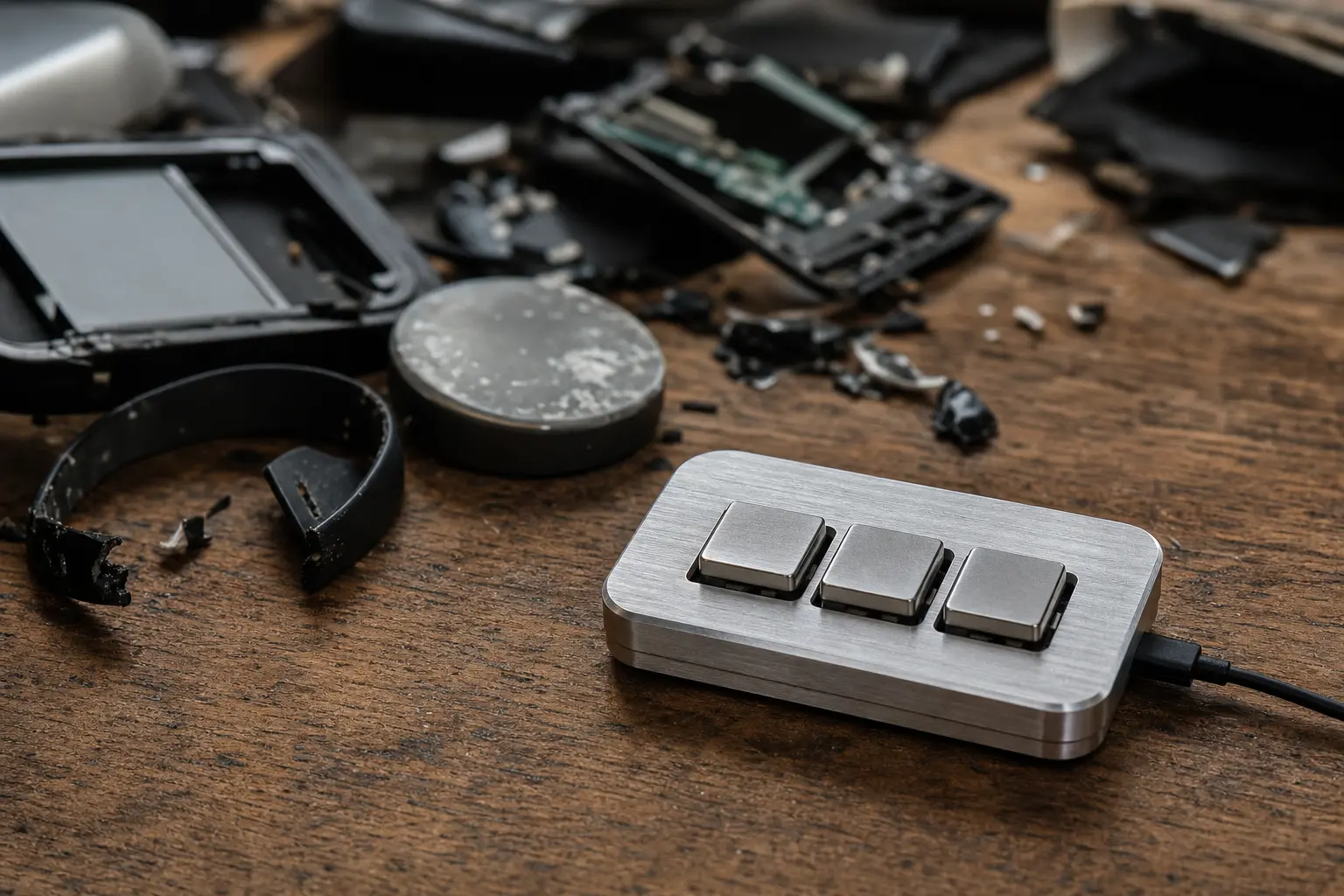
Aina showed three experimental interfaces at CES 2026 in Las Vegas, then built three actual devices from what it learned. Only one has shipped.
- Dune – a three-key, context-aware keypad that plugs into a MacBook’s USB-C port and changes what each key does depending on the app running in front of it. It sells for $119.
- Radiance – a tabletop remote for video calls, with a volume dial and buttons for mic, camera, an AI notetaker and voice modulation.
- Shift – a single-tap button that triggers an AI agent to carry out one repeated task, connected to a user’s phone.
In early testing, Dune won. Aina found it was the most popular of the three and realized it could fold Radiance’s and Shift’s features into the same small keypad, so it shipped Dune first and treated the other two as research.
Hundreds of Dune keypads are now in the hands of early adopters, mostly developers and people who live in back-to-back video calls. Aina says it is studying their daily workflows to decide what its next, still-secret device should do.
Humane Burned Through $230 Million. Rabbit Still Owes Paychecks.
Shankar’s caution is earned. Humane’s AI Pin and Rabbit’s R1 remain the two clearest cautionary tales in consumer AI hardware, and both launched promising to replace the smartphone rather than sit next to one.
Humane raised about $230 million, then sold the company to HP for $116 million after shipping fewer than 10,000 devices. Every AI Pin was bricked on February 28, 2025. Rabbit sold about 100,000 units of the R1, then faced a wave of returns and, by early 2026, reports of unpaid staff.
| Device | Price | What Happened |
|---|---|---|
| Dune (Aina) | $119 | Launched April 2026; hundreds shipped to early adopters, feeding the next device |
| AI Pin (Humane) | About $700 plus $24 a month | Servers shut down Feb. 28, 2025; company sold to HP for $116 million |
| R1 (Rabbit) | $199, no subscription | 100,000 units sold; mass returns and reported payroll troubles by early 2026 |
Both devices shared one pattern Aina is explicitly trying to dodge. Each promised a smartphone replacement on day one. Dune never claimed to replace anything. It just adds three keys.
A $6.5 Billion Rival Chases the Same Interface
Aina is not the only outfit betting the smartphone interface is overdue for a rewrite. OpenAI paid about $6.5 billion in an all-stock deal last year for io, the hardware startup co-founded by former Apple design chief Jony Ive, and has spent months building toward its own device.
OpenAI’s chief global affairs officer, Chris Lehane, said the company is on track to unveil its first device in the second half of this year, though he stopped short of promising a 2026 sale date. Bloomberg has reported the product looks like a screen-free smart speaker for the home, built to answer questions and run appliances by voice.
The field around both companies is already loud. Rings, pins and desktop pucks built to capture what people say now compete with wearables from Bee and Friend and smart glasses from Meta and Even Realities, all chasing pieces of the same shift in how people give computers instructions.
What Is Aina’s “Context-Aware Layer”?
Aina calls its core idea a “context-aware layer,” a system that reads what app or task a person is already doing and offers the one action they’re likely to want next instead of making them dig through menus. Shankar built Dune, and its unannounced successor, to test that idea on real desks.
“Phones and computers today are still primarily designed for browsing,” Shankar said in the funding announcement. “You put in the same effort whether the task is something you do daily or once a year, and when you are doing hundreds of tasks a day, every unnecessary step adds up to real cognitive load.”
He wants people spending less time deciding what to click and more time simply confirming an action. “I think you have enough context, you have in your phone and your laptop all the time, and we haven’t even started using that well,” he told TechCrunch. “We are building an action-oriented device that will use the context to help you control and trigger workflows.”
The instinct echoes a broader industry debate over how much AI should try to hold a user’s attention versus quietly get out of the way, one that has also shaped Apple’s anti-engagement approach to Siri.
The Next Device Stays Behind a Waitlist
Aina’s waitlist for its next launch is open now, and the company says small-group testing will begin within weeks. Shankar has stayed quiet on what the device looks like, saying only that it builds on the context-based approach Dune started.
The company is also equipping a small production line at its Bengaluru offices, betting it can manufacture its next device in-house rather than hand the work to an outside contractor from day one.
None of this happens in a vacuum. Money keeps pouring into hardware and chips generally, even if very little of it reaches companies Aina’s size.
- $202 billion – what AI startups raised across 2025, near half of all global venture capital that year, according to Crunchbase data
- $242 billion – AI startups’ haul in the first quarter of 2026 alone, about 80% of that quarter’s global venture capital
- $10.7 billion – poured into semiconductor startups so far in 2026, already on pace to beat last year
Aina’s $5.5 million barely registers next to those totals. What it bought instead was a keypad people already use every day, and hundreds of data points about what they actually press it for.
“If we get it right, we’ll be legendary,” Shankar says.
Frequently Asked Questions
What does Aina’s Dune keypad actually do?
Dune is a three-key, context-aware keypad that plugs into a MacBook’s USB-C port and changes what each key does based on the app in the foreground. It works with recent MacBook Air and Pro models, and its keys trigger shortcuts in GitHub, VS Code, Claude and video call apps like Zoom and Google Meet.
How is Aina’s approach different from Humane’s or Rabbit’s?
Aina’s devices are built to trigger and control AI agents rather than passively capture audio and video the way many wearable AI recorders do. Shankar has said the Rabbit R1 and Humane AI Pin were his own disappointments, and Aina shipped a $119 accessory that sits beside a laptop rather than a $700 device meant to replace one.
What ultimately happened to the Humane AI Pin?
Every AI Pin was bricked on February 28, 2025, when Humane shut down its servers for good. Customers received refunds, and HP paid $116 million for the company’s patents and part of its design team, about half of the roughly $230 million Humane had raised.
Is the Rabbit R1 still for sale?
Yes. Rabbit still sells the R1 and pushed a software overhaul called RabbitOS 2 in September 2025 that redesigned its interface around card-based navigation and repositioned the gadget as an AI agent assistant rather than a fully autonomous one. Reports early this year pointed to unpaid salaries and financial strain at the company.