Xpeng priced its new L03 electric SUV at €35,600 (about $41,700) in Germany this week, undercutting Tesla’s own defensive price cut on the Model Y by €3,370. The Guangzhou based automaker unveiled the coupe SUV in Munich on July 16, staging what it billed as its first simultaneous global launch across 65 markets.
Behind the sticker sits a car whose most advanced driving features stay switched off in Europe until regulators sign off, and a home market where Xpeng has already cut the price twice in two weeks.
Xpeng Undercuts Tesla’s Own Defensive Price Cut
Tesla rolled out a stripped down Model Y Standard trim in Europe last year specifically to hold the line against Chinese rivals, pricing it at €39,990. Tesla’s German configurator now lists that trim from €38,970 after a cut last month. Xpeng’s L03 still comes in €3,370 cheaper, at €35,600, while adding a heat pump, vehicle to load power and a panoramic roof as standard kit the base Tesla doesn’t include.
The Xpeng L03 also undercuts the Hyundai Ioniq 5, which starts at €41,900 in Germany, and the Skoda Elroq, from €37,390. Its entry motor makes 180 kW, more than the Elroq’s 140 kW and the Ioniq 5’s 125 kW at their respective starting trims. The Tesla still wins on range, at 534 km WLTP against the L03’s 445 km, though the Xpeng charges faster, peaking at 236 kW against the Model Y’s 175 kW.
That price also absorbs the European Union’s tariff on Chinese built electric vehicles, which analysts at Electrek peg at 30.7% for Xpeng, since the L03 currently ships in from China rather than from the automaker’s kit assembly line at Magna Steyr in Austria.
| Model | Starting Price (Germany) | WLTP Range | Peak DC Charging |
|---|---|---|---|
| Xpeng L03 RWD Standard Range | €35,600 (~$41,700) | 445 km | 236 kW |
| Xpeng L03 RWD Long Range | €38,600 (~$45,200) | 520 km | 236 kW |
| Tesla Model Y Standard | €38,970 | 534 km | 175 kW |
Higher trims push the price up quickly. The dual motor AWD Performance version, with 285 kW and a 4.5 second 0 to 100 km/h time, starts at €41,600 in Germany, and the range topping AWD Performance Ultra reaches €46,600.
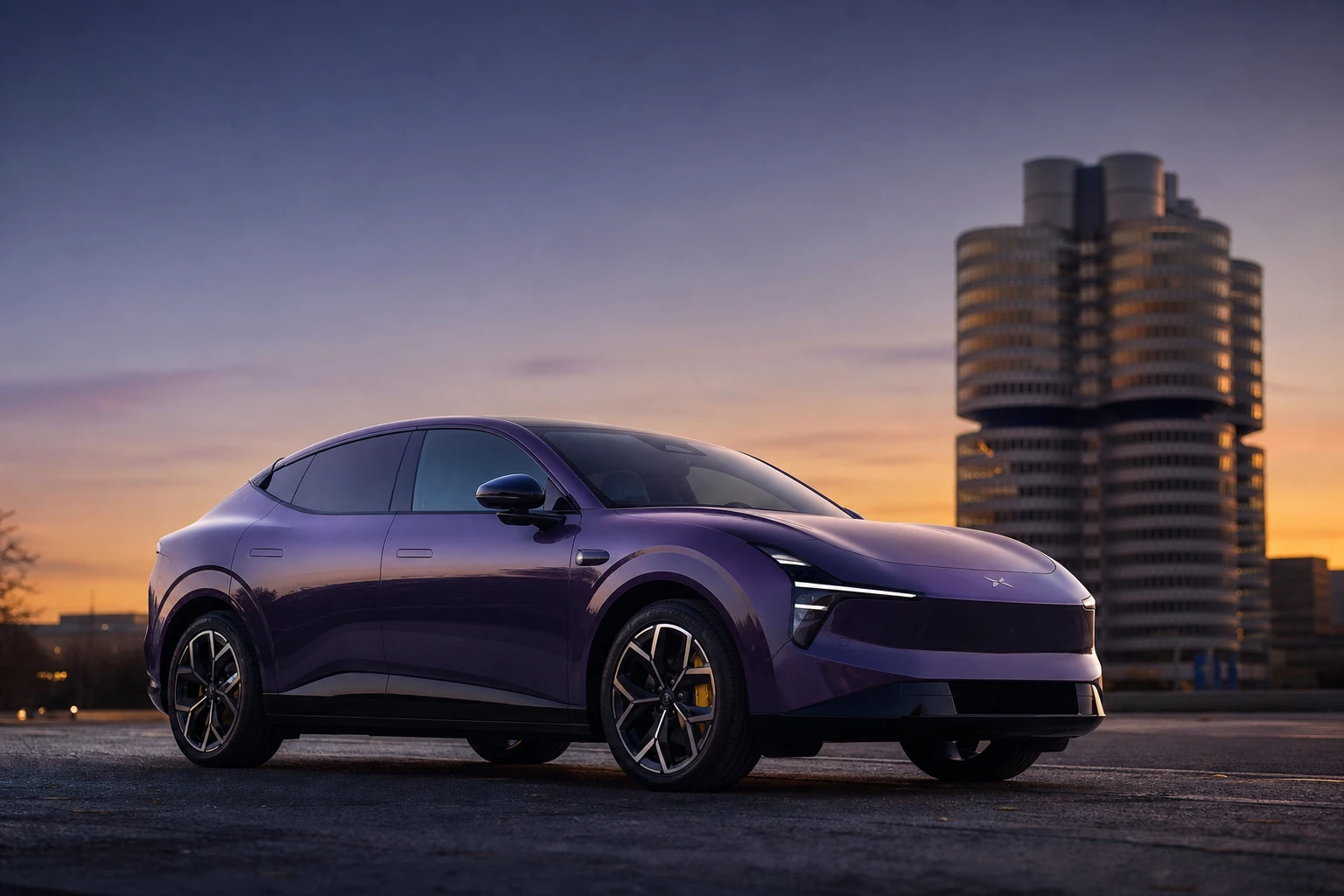
The Fine Print Behind a €35,600 Sticker
Xpeng isn’t treating the L03 as a stripped out budget car. Standard equipment across the range includes:
- A heat pump and 6 kW vehicle to load power output for running external devices
- Heated and ventilated front seats plus a panoramic glass roof
- A 20 speaker audio system built around a 1,000 watt amplifier
- 37 interior storage spaces, including a 10 litre pull out drawer under the rear seat
- 539 litres of boot space plus a 102 litre front trunk on the BEV version
Xpeng backs the car with a seven year, 160,000 km vehicle warranty and an eight year battery warranty. Safety kit includes seven airbags, driver monitoring and what Xpeng calls Blowout Stability Control and Driver Incapacitation Assist, alongside a Reverse Trace Assist function that retraces the car’s path out of tight parking spots. Xpeng is targeting a five star Euro NCAP rating, though independent crash testing had not been completed as of the Munich launch.
A Second Price Cut, and 46,859 Orders in an Hour
In China, where the car sells as the Mona L03, Xpeng opened pre-sales on July 2 with prices from 143,800 yuan ($21,200) to 165,800 yuan across six trims. At the formal launch on July 16, the entry BEV trim opened even lower, at 123,800 yuan ($18,290), CarNewsChina reported, a 20,000 yuan cut from the pre-sale figure announced two weeks earlier. The range extender version opened from the same 123,800 yuan up to 146,800 yuan.
Xpeng said the L03 drew 46,859 orders within its first hour on sale, according to CarNewsChina. Internationally the Mona badge disappears entirely; the car sells simply as the Xpeng L03, the automaker’s fourth model in Europe after the G6, G9 and P7+ sedan.
How Much of the L03’s AI Actually Works at Launch?
Every L03 ships with at least one of Xpeng’s in-house Turing chips running its second-generation Vision-Language-Action (VLA, a system that turns camera footage directly into steering and speed decisions) software. But the fullest version of that system won’t drive hands-free in Europe when cars start arriving. Regulators there still have to approve it, and Xpeng is targeting 2027.
The base trim carries a single Turing chip at 750 tera operations per second (TOPS), enough for a distilled version of VLA 2.0. The dual-chip Ultra SE reaches 1,500 TOPS with the full system, and the range-topping global Ultra variant adds a third chip for 2,250 TOPS combined. It is, as TheNextWeb noted, the first mass-market vehicle from a Chinese automaker where every trim ships with in-house autonomous-driving silicon standard, running on cameras alone with no LiDAR.
We are building a Physical AI company. We want to use technology to change how people move and how people live. We believe technology should be for everyone.
He Xiaopeng, Xpeng’s founder and chief executive, said this at the Munich launch. He later said on LinkedIn that VLA 2.0 is fully locked in for global markets pending regulatory sign-off, CleanTechnica reported, with that 2027 timeline attached. TechTimes separately flagged that Xpeng, like all companies operating under Chinese law, falls under Article 7 of China’s National Intelligence Law, which can require cooperation with state intelligence requests regardless of where data is stored, a point the outlet said prospective European buyers should weigh.
What We Know
- Europe’s price list is set. BEV pricing runs across eight markets and the range-extender across four, with deliveries beginning in the fourth quarter of 2026.
- China’s launch-day price undercut its own pre-sale figure. The entry trim fell to 123,800 yuan, and orders topped 46,000 in the first hour.
- The chip tiers are confirmed. 750 TOPS on base trims, 1,500 on Ultra SE, 2,250 on the top global Ultra.
What’s Unconfirmed
- A firm date for hands-free driving in Europe. Xpeng has named 2027 but regulatory approval isn’t locked in.
- Right-hand-drive market timing. Markets including Singapore and Australia are confirmed destinations, but Xpeng has not released local pricing or on-sale dates.
- Final WLTP figures for the range extender. Xpeng calls the roughly 1,000 km combined figure provisional pending homologation.
Google Maps Comes Standard, but Xpeng Wasn’t First
Xpeng says the L03 is the first vehicle from any Asia-Pacific automaker to ship with Google Maps’ Auto SDK built in, replacing its overseas navigation stack and feeding live map data into its driver-assistance systems outside China. Drivers keep Xpeng’s own map interface and voice controls; Google supplies the routing, traffic data and place search underneath, with no phone mirroring required.
The claim comes with an asterisk. Rivian launched its own Google Maps-based navigation using the same Auto SDK in July 2025, a full year before Xpeng got there. Xpeng’s version is a regional first, not an industry first, and it won’t apply in China, where the company runs its own mapping stack.
Not every automaker is running toward Google’s data. Ride-hailing firm Ola pulled its fleet off Google Maps entirely, launching its own in-house navigation system instead of leaning on an outside map layer the way Xpeng now plans to across dozens of countries.
Xpeng’s Bet on One SUV
Xpeng needs the L03 to work. The Mona M03 sedan, launched in August 2024, delivered 175,689 units in 2025, or 40.91% of the company’s total deliveries that year. In the first half of 2026, cumulative M03 deliveries fell 27.63% year on year to 62,488 units. Deutsche Bank analysts, cited by CnEVPost, expect the L03 to average roughly 12,500 units a month and help replicate that earlier success in the SUV segment.
There are early signs of a turnaround. Xpeng delivered 40,126 vehicles in June, its strongest month of 2026 and a 15.93% year on year gain that snapped five straight months of annual declines. Even so, the company’s global deliveries for the first half of 2026 totaled 165,977 units, down 15.8% year on year, according to China EV DataTracker data cited by CarNewsChina. Xpeng is targeting 550,000 to 600,000 deliveries for the full year, on the way to a stated goal of one million annual sales by 2030.
Xpeng isn’t alone in circling Tesla’s turf. Another Chinese manufacturer, Li Auto’s first fully electric SUV takes direct aim at the Model Y in China, while in Europe, legacy brands are racing to defend the same price band; Renault’s own electric SUV aims to undercut €30,000 entirely. Xpeng currently runs 290 retail outlets across 28 European countries and is in talks with shareholder Volkswagen about a second European manufacturing site to reduce its tariff exposure. For now, the L03 still arrives from China, and European buyers won’t see the first ones in driveways until the fourth quarter.
Frequently Asked Questions
How much does the Xpeng L03 cost?
Pricing starts at €34,990 in France and Belgium and €35,600 in Germany for the entry BEV trim, rising to €41,600 for the AWD Performance version and €46,600 for the range-topping AWD Performance Ultra. In China, the entry trim opened at 123,800 yuan ($18,290) at the July 16 launch.
When can buyers actually get one?
European deliveries begin in the fourth quarter of 2026. China’s cars went on sale immediately after the Munich event. Right-hand-drive markets including Australia have been confirmed as destinations, but Xpeng has not released local pricing or a specific on-sale date there.
Is the Xpeng L03 the same car as the Mona L03?
Yes. Mona is Xpeng’s internal Chinese sub-brand name, reportedly standing for Made Of New AI and developed out of Xpeng’s 2023 acquisition of Didi’s EV development program. Every market outside China drops the Mona name and sells the car simply as the Xpeng L03.
Can the Xpeng L03 drive itself?
Not hands-free, not yet. The car uses 11 cameras, including two high-resolution front-facing binocular units, plus 12 ultrasonic sensors and no LiDAR, running Xpeng’s VLA 2.0 software as a Level 2+ assisted-driving system that still requires driver supervision in Europe.
Will the Xpeng L03 be sold in the United States?
No. Current US tariffs on Chinese-built vehicles leave Xpeng with no path into the American market, so the price and technology fight playing out in Europe has no US equivalent for now.
What is the Xpeng L03’s driving range?
The battery-electric version reaches 445 km to 520 km on Europe’s WLTP cycle depending on battery size, or up to 625 km on China’s more optimistic CLTC cycle. The range-extender version can travel up to 1,017 km combined, according to CarNewsChina, including roughly 215 km in pure electric mode before its petrol generator engages.