A 2026 review of the research on elite athletes finds that anxiety and depression show up in this population at twice the rate seen in the general public. The figure sits inside a narrative review in Annals of Medicine & Surgery, a peer-reviewed medical journal, and it lines up with earlier meta-analyses that put the gap in the same range. It lands as a stark reminder that the body of work in front of the cameras carries a quieter cost behind it.
Most coverage of elite competition focuses on the scoreboard, the trophy lift, and the sponsors. The athletes themselves are the party whose health is on the line, and that line is rarely drawn in public. A growing body of research, along with athletes speaking in their own words, is starting to name the toll.
The Performance Paradox
Elite sport forces the body to do two contradictory things at once. An athlete has to stay healthy enough to keep competing, and they have to push hard enough to win, often while training or competing through pain and injury. The 2025 narrative review on elite athlete stress by Barbara Nuetzel, published in Frontiers in Sports and Active Living, names the tension directly. Elite sport is built on a health paradox, the paper argues, in which protection and risk sit on the same bench.
That paradox is not new. What is newer is how researchers frame it. Mental health problems in elite athletes tend to surface under continuous pressure to perform, fear of exclusion from a team, and a culture that treats disclosure as weakness. The 2025 review tracks the same pattern that earlier work has, and adds a sharper warning: the developmental process of mental health problems is often kept secret.
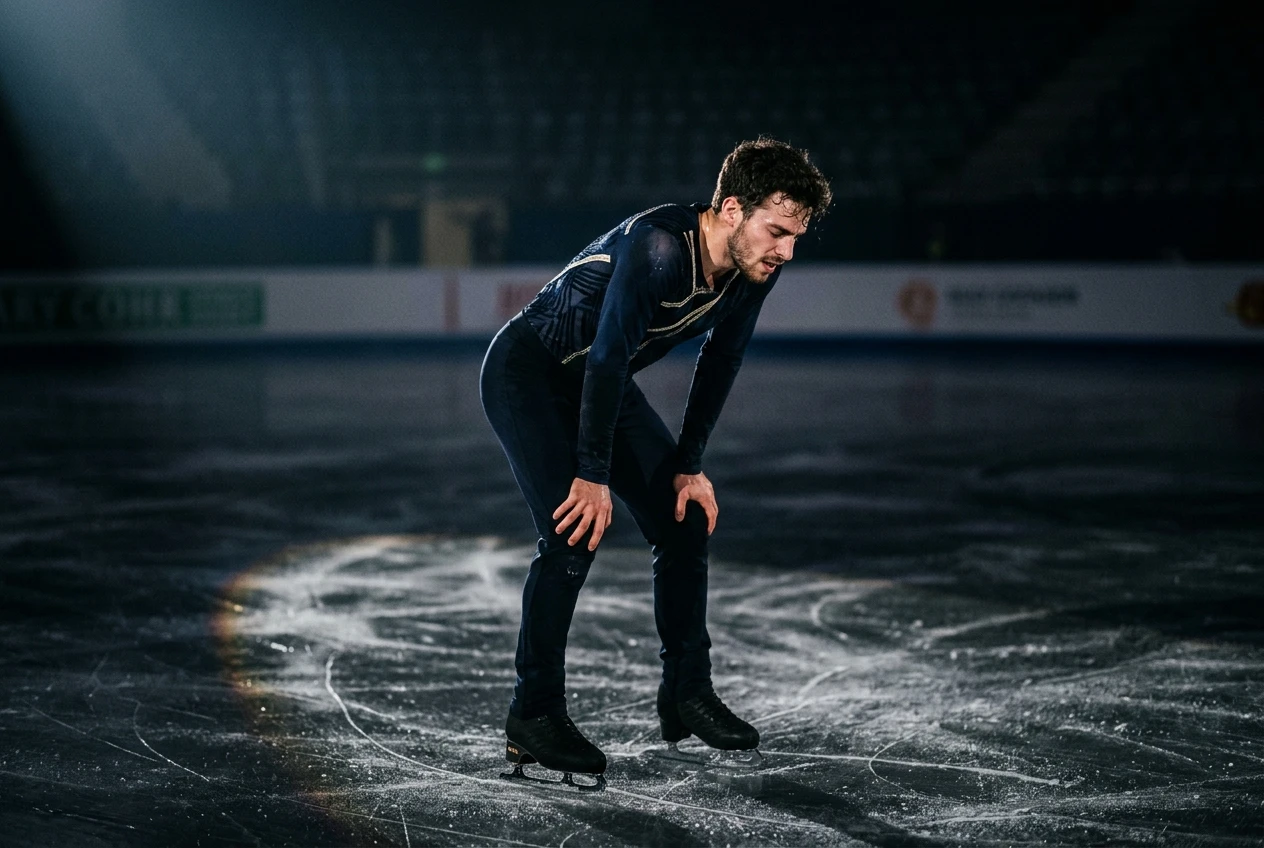
A figure skater sits down before a competition, gets marked down for a fall, walks into the mixed zone, and smiles for the camera. The person behind the smile may be running on fumes. The 2025 review documents the conditions that lead there, including pressure from coaches, sponsors, federations, and a public that watches every move. The 2025 narrative review on elite athlete stress lays out the loop in plain language.
What the Numbers Show
The headline figure from the 2026 literature is the gap between athletes and everyone else. Anxiety and depression in elite athletes appear at twice that of the general population. The number comes from a narrative review by Iftikhar Khan and colleagues in Annals of Medicine & Surgery, an independent peer-reviewed medical journal.
That finding is not standing alone. A 2024 systematic review and meta-analysis of former elite athletes, published in the British Journal of Sports Medicine and indexed on PubMed Central, found that the time-point prevalence of both anxiety and depression in former elite athletes was over twice that of the general population. The two reviews, written about a year apart, look at active and former athletes separately and reach the same order of magnitude. Sport-specific differences exist in the underlying data, with some disciplines showing higher rates than others. The shape of the curve is consistent enough that researchers no longer describe elite athletes as a low-risk group for mental health symptoms. Some context on the scale: the 256 athletes Singapore named for the 2026 Asian Games shows the size at which a national program tries to manage the same set of pressures.
A separate 2025 mixed-methods study by Mitchell Andersson and colleagues, published in Psychology of Sport and Exercise, looked at the experience of athletes seeking care at an elite-sports-centered mental health clinic. The takeaway is that the athletes who do show up face distinct barriers to treatment, even when a specialist clinic exists for them.
The pattern in the data also includes a quieter story. Mental health problems in this population are frequently equated with weakness, both inside the locker room and outside it. That framing pushes athletes away from the very services designed to help them. Researchers describe this as a culture of risk that hides overload until something breaks.
- Khan et al. (2026): prevalence of anxiety and depression in elite athletes is twice the rate in the general population.
- 2024 systematic review and meta-analysis: time-point prevalence of anxiety and depression in former elite athletes over twice that of the general population.
- Andersson et al. (2025): mixed-methods study on barriers to treatment at an elite-sports-centered mental health clinic.
- Nuetzel (2025), Frontiers in Sports and Active Living: documents a culture of risk in which mental health disclosure is treated as weakness.
The Digital Pressure Cooker
Visibility is part of the job now, even when an athlete would rather not be seen. Skating’s global governing body, the International Skating Union, calls online abuse one of the fastest-growing challenges in sport. The body’s own 2026 announcement on digital welfare lays out the scale. The ISU’s digital welfare initiative at the 2026 Tenerife Congress describes the moment when the 60th ISU Congress sat down in Tenerife in June 2026 and put skaters on stage to talk about what their phones are doing to them.
The conversation moved beyond abstract statistics. The athletes used their own words, and those words mapped a pressure environment that athletes in the social media era did not sign up for. The shape of the burden breaks into a small number of repeated patterns:
- Death threats and homophobic abuse, sometimes aimed at a single athlete’s identity.
- A drip of negative comments that wears down even skaters who consider their skin thick.
- The expectation of a constant, brand-ready presence online, framed by some athletes as the modern equivalent of a CV.
- The need to physically hand a phone to a friend mid-competition, including at the Olympic Winter Games, to keep the noise out.
What Athletes Say Out Loud
The only thing I want to do is skate and represent my country. I never signed up to receive death threats.
The line came from Kevin Aymoz, the French figure skater, during the Athletes’ Panel at the 60th Ordinary ISU Congress in Tenerife in June 2026. The panel sat skaters from across the disciplines in front of delegates from member federations and asked them to describe what their public lives actually look like. Aymoz described the deeply personal impact of receiving homophobic abuse and death threats online.
He was not alone in being blunt. Ivanie Blondin, the Canadian long-track speed skater and short tracker, recalled deliberately handing her phone to a friend during the Olympic Winter Games so she could stay focused on racing and ignore the comments piling up. The move was practical, not dramatic.
Olivia Smart, the British-Spanish ice dancer, framed the trade-off in career terms: if you are not on social media, it is not really an option anymore. That is how you get brand sponsors, that is how you get noticed. Evan Bates, the retired American ice dancer and chair of the ISU Athletes’ Committee, took a longer view. Social media is such a powerful tool when used correctly, he said, and the younger generation wants to hear the backstory. Educating young skaters on both the opportunities and the pitfalls is really important. The common thread across the four athletes was that the visibility is not optional, the abuse attached to it is real, and the trade-offs are theirs to absorb.
The Culture of Silence
Athletes who do speak up tend to be the exception, not the rule. The 2025 Nuetzel review describes a culture of risk in which stressor-induced overload is not necessarily visible to the people around the athlete. Neglecting, ignoring, or trivialising states of overload is a typical response from teammates, coaches, and the wider environment. Under that culture, the developmental process of mental health problems is often kept secret. Disclosure can carry a price, including fear of exclusion from the team, fear of exclusion from competitions, and fear of losing the athletic identity that defines the person.
The Andersson 2025 mixed-methods study, conducted at a psychiatric clinic designed specifically for elite athletes, tracked the same dynamic from the other side of the desk. The athletes who did walk in had often tried to manage on their own first. Many came in late.
The result is a population where the visible story is the trophy, and the invisible story is the cost. Researchers describe it as a hidden health burden attached to elite performance. The athletes carry it. The institutions around them are starting to.
The 2025 review is unusually direct about the reason. Developing mental problems is frequently equated with weakness and incapacity to deal with pressure in elite sport. That equation is the one athletes have to push back against before any other progress is possible.
A Famous Line and What It Costs
Pressure is a privilege and champions adjust.
Billie Jean King said it during the 2000 Fed Cup in Las Vegas, in a U.S. locker-room huddle with a 24-year-old Lindsay Davenport who was about to play Arantxa Sanchez Vicario, a rival against whom Davenport had a losing head-to-head. Davenport was 6-foot-3 and visibly unhappy. King, who stands 5-foot-4, looked up and said the line out loud for the first time. The locker-room moment where Billie Jean King first said it captures the moment in Davenport’s own words years later, including her description that King changed everything for me in believing in me when I did not yet believe in myself. The line has since been printed on a plaque near the entrance to Arthur Ashe Stadium, used as the title of King’s memoir, and repeated by every generation that comes after.
Read one way, the quote is a useful tool. It reframes pressure as a signal that the moment matters. Read against the 2026 prevalence data, it also describes an environment in which disclosure carries risk and overload hides in plain sight. The $1.2 billion Enhanced Games wager on performance is one recent example of a sports culture that has decided to push harder into the same gap. The line stays useful, and so does the question of what it costs the people who try to live by it.
What’s Changing on the Sidelines
The international federations are starting to build structures around the problem. The International Skating Union’s Vision 2030 strategic framework treats safeguarding and wellbeing as central pillars, alongside competition. The ISU Council approved comprehensive wellbeing measures for the 2025-26 season, including expanded Calm Zone implementation at major events and a social media monitoring program designed to protect athletes from online harassment. The ISU’s World Mental Health Day announcement lays out the rollout in detail, including the Calm Zone’s debut at the 2025 World Figure Skating Championships in Boston, its continuation at the ISU Skate to Milano qualifier in Beijing in September 2025, and its installation at the ISU Short Track World Tour in Montréal in October 2025.
A Calm Zone is a quiet, dog-friendly space set up behind the scenes at a major competition. Polish Hussars short tracker Kornelia Wozniak described it this way: the idea of a Calm Zone at the venue is really nice, athletes get stressed, it is a high pressure situation, she gets anxious before racing, and it is fun to relax. On the digital side, the ISU has rolled out an AI-powered cyber safety programme that monitors public social media channels of skaters who register, detects harmful and abusive content in real time, and enables timely moderation during major events. How a chiropractic partnership aims to keep athletes healthier is a separate example of an institution trying to give athletes more tools to stay in the sport.
The pattern in the table below is a slow shift from reactive to proactive. Calm Zones are reactive in spirit, AI monitoring is proactive, education is both. None of it removes the underlying pressure, and the ISU’s own announcement does not pretend it does.
| Support | At the venue | Online |
|---|---|---|
| Quiet space | Calm Zones at major events | None listed |
| Athlete input | Athletes’ Panel at ISU Congress | Athletes’ Panel on digital welfare |
| Monitoring and tools | Support staff and Calm Zone setup | AI cyber safety programme, real-time detection |
Frequently Asked Questions
How common are anxiety and depression in elite athletes?
A 2026 narrative review in Annals of Medicine & Surgery puts the prevalence at twice the rate in the general population, and a separate 2024 meta-analysis of former elite athletes found a similar gap. The numbers vary by sport, and the studies cover different populations, but the order of magnitude is consistent across both.
Why do elite athletes struggle to disclose mental health problems?
The 2025 review in Frontiers in Sports and Active Living describes a culture of risk in which disclosure is treated as weakness, and where fear of exclusion from team or competition discourages athletes from speaking up. The Andersson 2025 mixed-methods study found that athletes who did seek help often arrived late, after long periods of managing on their own.
What is the ISU’s Vision 2030 athlete welfare plan?
Vision 2030 is the International Skating Union’s strategic framework. It places safeguarding and wellbeing, including digital welfare, alongside competition as central pillars. The 2025-26 season added expanded Calm Zones and an AI-powered cyber safety programme that monitors skaters’ public social media for harmful content.
Who was Billie Jean King speaking to when she said "pressure is a privilege"?
She said it to Lindsay Davenport during the 2000 Fed Cup in Las Vegas, before Davenport faced Arantxa Sanchez Vicario. King has called the line her favorite quote, and it has since appeared on a plaque near the entrance to Arthur Ashe Stadium and as the title of her memoir.
What practical support exists for skaters facing online abuse?
The ISU’s 2025-26 rollout includes an AI-powered cyber safety programme that monitors public social media channels of skaters who register, real-time detection of harmful content, and education initiatives aimed at young skaters. The ISU also runs Athletes’ Panels at major events to put athletes’ own experiences in front of member federations.