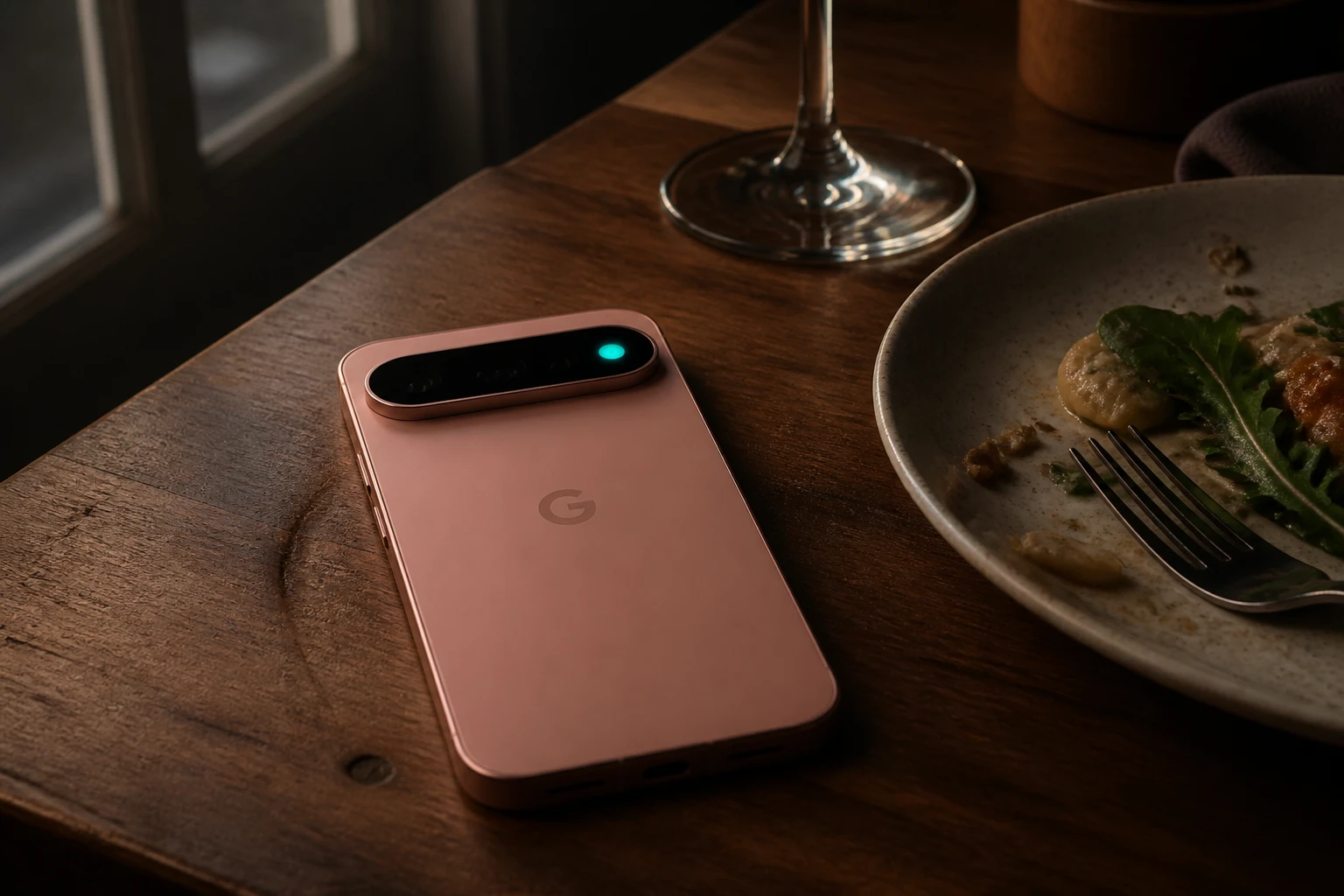
Google’s Pixel 11 Pro HiLight rear RGB ring glows for Gemini listening patterns and five preset favorite-contact call colors, and almost nothing else, at a launch that left the hardware feeling throttled on day one.
The feature sits exclusively on the Pro, Pro XL and Pro Fold models that go on sale August 20. Preorders started after the August 12 Made by Google event. The pitch is simple: keep the phone face down, stay present, and still catch the signals that matter. In practice the signals are tiny.
That thinness is not a hardware limit. The ring can already render full-spectrum RGB. The software simply refuses most of the jobs buyers expect from a rear light on a flagship. The result is a premium exclusive that feels finished only in the demo reel.
Two Jobs and a Closed Door
HiLight is an array of ambient LEDs built around the rear flash. When the phone lies face down it can do exactly two things right now.
- Gemini conversation indicator: different glow patterns show listening, thinking and responding so you know the assistant heard you without flipping the device.
- Favorite contact calls: assign one of five Google-chosen colors in the Contacts app; the ring lights that color for incoming calls from those people via the Phone app or WhatsApp.
That is the full launch set. Tapping the power button dismisses a call glow. Users can toggle the Gemini patterns off in settings. Future messaging support for the same favorite colors is promised, with RCS mentioned as a coming first-party addition. Third-party apps are out. Google told reporters it has no plans to open an API.
Pre-launch leaks floated nine colors. At launch Google locked the palette to five chosen for visibility across skin tones and lighting. You cannot pick free custom hues or map Instagram pink or Slack purple.
The two launch jobs share one trait: both keep the user inside Google’s own stack. Gemini is first-party. Favorite colors work through the Contacts app and the Phone app, with WhatsApp as the sole outside exception. Everything else waits behind a closed door that Google has already said it does not plan to unlock.
That choice shapes daily use more than the LED hardware itself. A glow that only fires for the assistant and five chosen callers trains the owner to ignore the ring most of the time. Habit formation depends on frequent, useful cues. Two narrow jobs cannot supply them.
The Presence Promise Meets Its Own Limits
The official HiLight stay-present description talks about color-coded lights for timely information so you stay informed without looking at the screen. The irony is sharp. Most timely information never reaches the light.
General notifications from Slack, Teams, Instagram, Uber, email or banking apps stay silent. Battery low or charging progress stays silent. Camera timer feedback stays silent. The hardware can render full-spectrum RGB, yet the software treats it like a locked parlor trick. Face-down dinners, UNO games or theater seats still leave most real interruptions invisible, so the phone gets flipped anyway.
| Capability | HiLight at Launch | Nothing Glyph (mature) |
|---|---|---|
| Favorite calls | Yes, 5 fixed colors, Phone + WhatsApp | Yes, patterns + more context |
| AI assistant | Gemini patterns only | Not primary focus |
| General app notifications | No | Yes, customizable |
| Charging / battery | No | Yes, progress strips or matrix |
| Third-party / open | No plans | Supported across generations |
| Live updates (rides, deliveries) | No | Yes via Glyph Progress / Matrix |
The closed design undercuts the very habit Google wants to encourage. If the ring rarely lights for the things that actually interrupt life, the face-down ritual loses its point.
Presence only works when the channel covers the interruptions people already care about. A dinner table glow for a favorite call helps. Silence from every other app does not. The stay-present pitch therefore collides with a feature set that still forces the flip for almost every real alert.
Even the two supported jobs stay narrow. Gemini patterns confirm the assistant is active, yet they say nothing about other on-device events. Favorite colors cover calls only, and only from the short list a user bothers to tag. The rest of the notification stream stays on the front glass, exactly where Google hoped owners would stop looking.
Nothing Already Raised the Bar Years Ago
Nothing introduced rear Glyph lights in 2022. Early strips showed calls, messages and charging. Later phones added more strips, custom patterns, Glyph Progress for live updates, and eventually the Glyph Matrix of hundreds of mini-LEDs that can show numbers, letters and symbols. The Nothing Glyph Interface evolution details track that steady expansion from basic indicators to contextual tools.
Users on X immediately noted the gap. One reaction put it bluntly: after seeing Pixel’s implementation, respect for Nothing’s Glyph rose. Others called HiLight the dumbest gimmick, LEDs on a thousand-dollar phone that Google simply called a day on. The comparison is fair on utility even if the designs differ. Glyph is expressive and open enough to feel daily. HiLight feels like a demo mode.
Google’s version is quieter and less bright by design, which some will prefer. Quiet does not equal useful when the feature set is this thin.
The maturity gap matters because both systems chase the same face-down habit. Nothing spent years turning basic strips into progress cues and a matrix that can carry real context. Google arrives later with a ring that still cannot show charging state or a generic message alert. Buyers who already tried Glyph will measure HiLight against that longer arc, not against a blank slate.
Design taste can still split the audience. Some will like HiLight’s calmer glow over brighter Glyph strips. Preference on brightness does not erase the missing jobs. A quieter light that almost never fires still loses to a brighter one that fires for the right reasons.
Who Feels the Squeeze
Pro buyers pay the premium. The Pixel 11 Pro starts at $1,099, the Pro XL at $1,299 and the Pro Fold at $1,899 according to Pixel 11 Pro series preorder pricing. The base Pixel 11 skips HiLight entirely. That exclusivity lands harder next to the recent Pixel 11 Pro XL price hike ecosystem play and the ambitious Pixel 11 Pro Fold 2nm hardware bet.
| Model | Starting price | HiLight |
|---|---|---|
| Pixel 11 Pro | $1,099 | Yes |
| Pixel 11 Pro XL | $1,299 | Yes |
| Pixel 11 Pro Fold | $1,899 | Yes |
| Pixel 11 (base) | Not listed here | No |
Power users who live in third-party apps lose the most. Anyone who once relied on old Nexus-style notification LEDs or Nothing Glyphs loses the flexible awareness those systems gave. Gemini-heavy users gain a neat visual confirmation, but that is a narrow slice.
Developers get nothing to build on. The hardware sits ready; the software wall stays up.
Exclusivity also sharpens the disappointment. Buyers who stepped up to Pro, Pro XL or Pro Fold did so for a package of upgrades. HiLight arrives as one of the visible differentiators, then delivers two jobs and a promise of later messaging work. The price tiers make the thin software feel more expensive than it would on a midrange device.
A Short List of Blocked Everyday Wins
None of these require reinventing the ring. All stay out of reach at launch:
- Color or pulse for low battery or charging complete
- App-specific hues for messaging or social (beyond the future first-party messaging promise)
- Timer or selfie-countdown feedback on the rear camera
- Ride or delivery live-status pulses
- Custom color wheel instead of five locked options
Google could ship any of them in a software update. The hardware already supports it. The decision to keep the feature Gemini-centric and closed is what freezes progress.
Google put LEDs on a $1,000 phone and called it a day
That X take captures the launch mood among enthusiasts who watched the leaks. Hands-on reports from CNET and others echo the same thinness: cool in a demo, thin after a week.
Each blocked win maps to a common face-down moment. Low battery at a restaurant. A ride share update during a meeting. A camera timer while the phone rests on a shelf. None of those moments need new LEDs. They need permission for the existing ring to speak. Until that permission arrives, the list above stays a catalog of avoided usefulness.
Launch Dates Locked a Narrow First Cut
The calendar itself helps explain the thin day-one set. The sequence ran tight and public.
- August 12: Made by Google event introduces HiLight; preorders open the same day.
- August 20: Pro, Pro XL and Pro Fold go on sale with the two-job feature set.
- Later: promised first-party messaging support, with RCS named as an early addition.
Eight days separate the stage reveal from store shelves. In that window Google shipped Gemini patterns, five fixed favorite colors, Phone and WhatsApp call support, a power-button dismiss, and a settings toggle. It did not ship general notifications, charging cues, camera feedback, live status pulses, custom hues, or an API.
Leaks had already primed buyers for nine colors. The final five arrived framed as a visibility choice across skin tones and lighting. That framing may be sincere. It still reads as a last-minute trim when the rest of the feature list is equally tight. A longer software runway might have carried more of the everyday wins onto the same August 20 hardware.
The dates also freeze expectations. Owners who preorder after the event receive the closed version first. Any expansion arrives as a later update, if it arrives at all. Habit formation therefore starts on the narrow cut, not on the fuller channel the stay-present language describes.
Closed Software Caps the Hardware Ceiling
Full-spectrum RGB around the rear flash can already show patterns, solid colors, and progress-style cues. The launch software uses only a fraction of that range. Gemini gets distinct listening, thinking and responding glows. Favorite contacts get five fixed colors. Everything else stays dark by policy, not by physics.
The no-API stance makes the ceiling structural. First-party messaging and RCS can widen the favorite-color path without letting outside developers in. That path still leaves Slack, Teams, Instagram, Uber, email, banking, and live ride or delivery status outside the ring. Each of those apps already interrupts people who keep phones face down. None of them can reach HiLight under the current rules.
Battery and charging indicators sit in the same gap. They are pure first-party work, need no partner approval, and map cleanly to a rear glow. Their absence at launch underscores the Gemini-centric priority. The ring is allowed to confirm the assistant. It is not yet allowed to confirm the battery.
Camera timer feedback follows the same logic. The rear camera and the rear ring share a surface. A countdown pulse would give face-up and face-down shooters the same cue. Launch software withholds it. The pattern is consistent: hardware ready, software refused.
Until that refusal softens, HiLight’s ceiling stays where Google set it on stage. Quiet glows and careful color choices cannot compensate for jobs the code will not run.
Google Still Owns the Fix Path
RCS messaging support is already on the radar. Expanding favorite colors to more first-party apps would help. Opening a controlled API later would unlock the rest. Color customization beyond the five presets is pure software. Battery and charging indicators are obvious.
The company does not need to match Glyph Matrix density. It needs to stop treating the ring as Gemini jewelry and start treating it as a genuine low-attention channel. Until then the face-down promise remains half-kept. Users who want the full version of this idea already have a phone maker that shipped it years earlier and kept iterating.
Software updates can move several items without new silicon. Favorite colors can spread to more Google apps. Battery and charging states can gain simple pulses. A modest custom palette can replace the hard five-color lock. Each step would make the face-down habit more credible without copying any rival matrix.
An API decision remains the larger fork. Keeping the door shut preserves a tidy first-party story. Opening a controlled path would let the ring cover the apps people already use. Google has already told reporters it has no plans for that path. Owners will measure future updates against that statement.
HiLight is not broken hardware. It is deliberately unfinished software wearing a bright new ring. The irony writes itself every time the phone stays dark while a real notification waits on the other side of the glass.