Pakistan open the 2026 Men’s FIH Hockey World Cup ranked 12th after a Pro League season of 16 straight losses and a goal difference of -57. The four-time champions who helped invent the tournament and donated its trophy now sit in Pool D with England, India and Wales, meeting India on 19 August in Amstelveen.
The numbers arrive with no soft landing. The green shirts return after missing the 2023 edition, their first appearance since 2018.
Pool D Meets a Team Last in Everything Recent
The 2026 World Cup pools and schedule place Pakistan alongside England (pre-drawn), India and Wales at venues in Wavre and Amstelveen from 15 to 30 August. Only the top two from each pool advance toward the later stages.
Official FIH data list Pakistan’s current FIH outdoor ranking of 12th with 2549.86 points. In the 2025-26 FIH Pro League the side finished ninth of nine, zero wins, zero points, 16 losses and a -57 goal difference. Recent results include 1-7 and 3-4 defeats to India and heavy losses to England.
Qualification came the hard way. In the March 2026 Ismailia qualifiers Pakistan topped its group then lost the final 1-4 to England, both sides advancing. Former captain Salman Akbar has publicly blamed the missing domestic rebuild that India undertook after failing to reach the 2008 Olympics. The gap shows in every metric.
| Era or competition | Pakistan record | India contrast |
|---|---|---|
| Hockey World Cup titles | 4 (1971, 1978, 1982, 1994) | 1 (1975) |
| Olympic gold medals | 3 (1960, 1968, 1984) | 8 |
| 2025-26 FIH Pro League | 0-16, GD -57, 0 pts | Mid-table, multiple wins |
| FIH ranking (Aug 2026) | 12th | Inside top 10 |
| World Cup appearances since 1994 win | Missed semis; missed 2014 & 2023 | Regular contender |
Crowd talk on X and in Pakistani sports circles treats the Pro League clean sweep as confirmation rather than shock. The Australia trip earlier, when players were left to manage themselves without federation support, still stings in the replies.
Pool D therefore opens with three opponents who already know how to beat this side. England arrived via the same Ismailia final. India arrives unbeaten against Pakistan for more than a decade. Wales completes a group in which every point will be earned against recent form, not history.
The Tournament They Invented and the Trophy They Gave
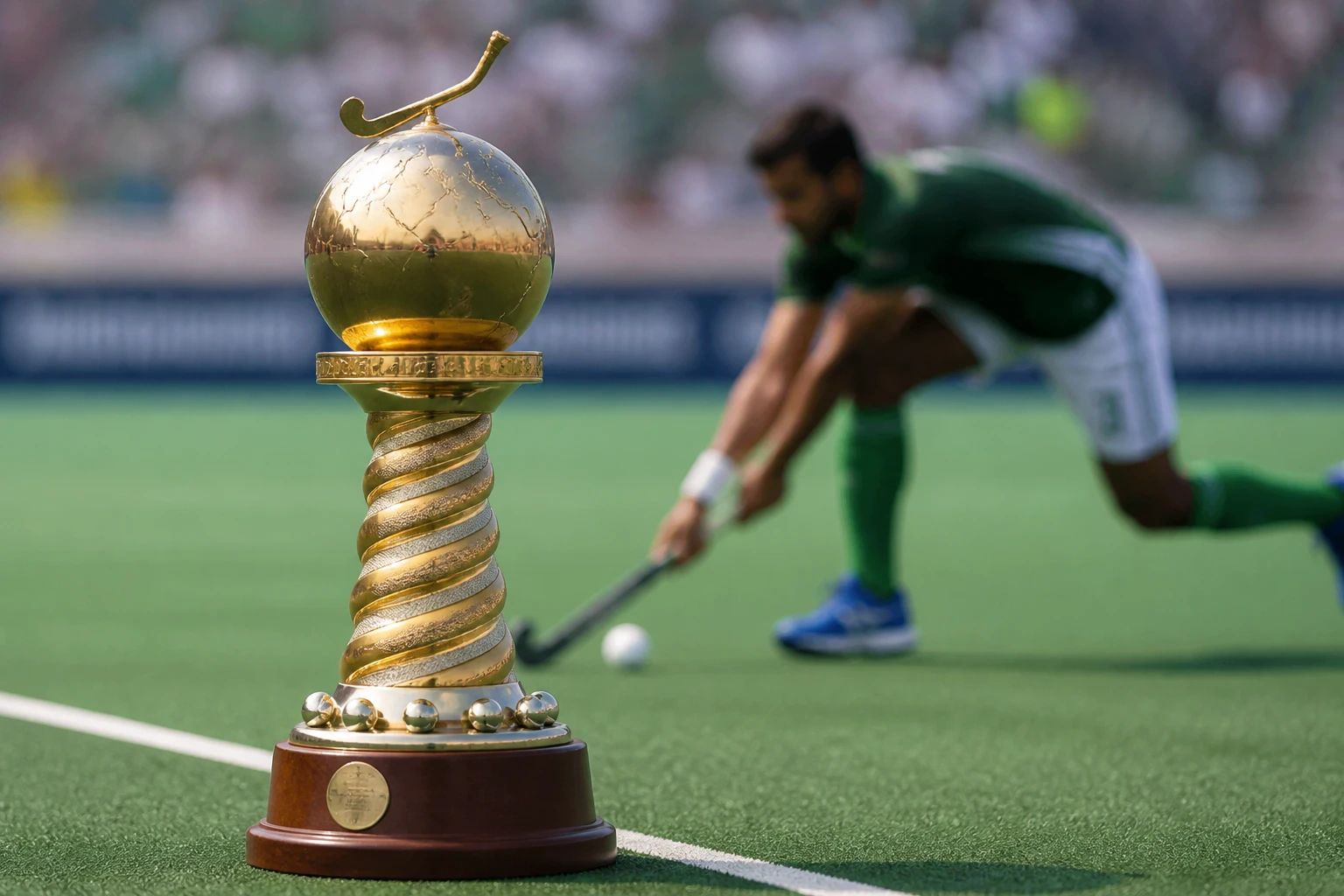
Air Marshal Nur Khan, while president of the Pakistan Hockey Federation, pushed the International Hockey Federation to create a World Cup beyond the Olympics. The Nur Khan role in creating the World Cup is official history: he argued one global event every four years was not enough. Pakistan donated the trophy itself, crafted from gold, silver, ivory and teak.
Pakistan won the inaugural 1971 edition in Barcelona after the original Pakistani hosting plan collapsed amid the Bangladesh war and political pressure. Further titles followed in 1978 in Buenos Aires, 1982 in Mumbai and 1994 in Sydney. Three Olympic golds (Rome 1960, Mexico City 1968, Los Angeles 1984) bookended an era Tauqeer Dar, Olympic champion and academy founder, still calls comparable to Brazil in football.
- 1971 – inaugural World Cup title in Barcelona
- 1978 – second title in Buenos Aires
- 1982 – third title in Mumbai
- 1994 – fourth title in Sydney
Journalist Ijaz Chaudhry has written that finishing second used to mean disaster. Argentine coach Cesar Luis Menotti later credited Pakistan’s 1978 World Cup tactics for helping his side win the football World Cup the same year in Buenos Aires. That level of influence feels distant now.
The trophy still carries Pakistani gold and teak. The pool tables no longer carry Pakistani favourites. The distance between those two facts is the story of the next fortnight.
The Syllabus That Never Updated
Modern hockey runs on sports science, multi-role players, GPS data and fluid systems. Dutch coach Siegfried Aikman arrived in 2021 with a long-term plan and met resistance.
Nowadays, hockey’s changed a lot, and it’s about technical, physical, mental, and social aspects. It’s about sports science… They still play with the left outside, left inside, centre forward, right inside, right forward… That system doesn’t work anymore.
Aikman said the Olympians killed progress. They wanted the national coach or selector posts without updating the game at club and school level. Dar, whose father and uncle were also Olympic champions, agrees the country has a hundred conflicting syllabuses.
- Fixed 1980s-style positions still taught in many towns
- MVP awards still go almost exclusively to goalscorers and penalty-corner flickers
- Defenders and midfielders who enable play rarely recognised
- No single national coaching curriculum from junior to senior
- Players arrive at camps with incompatible habits and no clear structure
Aikman watched state tournaments that still looked like the eighties. India, he noted, now values the injector, the trapper and the midfielder who makes others rich. Pakistan still celebrates only the final touch.
That mismatch travels into every camp. Players raised on fixed positions meet coaches who want rotation. Habits formed in town tournaments collide with GPS targets and multi-role drills. Without one syllabus, each new staff starts from argument rather than shared ground.
Domestic Pillars That Once Paid the Bills
After partition the departmental teams (police, railways, army, then Customs, banks, steel mills, WAPDA, PIA) gave players jobs and security. Dar calls that structure the envy of the hockey world. Austerity after 1994 gutted it. Most teams vanished. Players shifted to short contracts.
Dar runs the successful Dar Hockey Academy and says graphite sticks, shoes and goalkeeping kits (an Obo set can cost $1500) make hockey the most expensive team sport he knows. Without subsidy there is little logic for a family to choose it over cricket. Fake clubs pad association numbers for votes while genuine clubs shrink. Ijaz Chaudhry has documented Lahore’s real active clubs versus the inflated lists used for elections.
If Pakistan was once the only fully professional set-up, Dar now calls it the only amateur national team among serious nations. India gives stars such as Manpreet Singh police jobs and stability. That gap compounds every year.
Cost, status and pathway now pull in the same direction: away from the turf. A talented teenager sees cricket salaries and departmental silence. The academy pipeline thins before the national coach ever sees the player.
PHF Revolving Door and the Money Trail
No account of the fall skips the Pakistan Hockey Federation. Aikman was unpaid after six months of a long-term deal and left still waiting. At the 2022 Commonwealth Games the squad prepared with 18 balls and no GPS or proper gym access.
Audits and reports have flagged large cash withdrawals, a women’s camp billed at two million rupees that Olympian Saeed Khan said he never managed, and allegations around former secretary Asif Bajwa involving properties, a Land Cruiser and fictitious commissions. Presidents have been appointed by prime ministers on political lines rather than hockey expertise. Ijaz Chaudhry summarises the pattern as incompetent and insincere office-bearers whose main aim was the post and the trips.
Hours before departure for this World Cup the coaching structure shifted again: Herman Kruis moved to an advisory role while goalkeeping coach Bob Johan Veldhof was elevated, according to reporting around the squad. Earlier in August the PHF announced a five-member foreign-led panel (Kruis, Australian fitness coach David Dwyer, Adnan Zakir for juniors, Veldhof, psychologist Chris Bowen) and GPS use in camp. An Ijaz Chaudhry detailed Pro League autopsy in Dawn on 9 August called the panel a long-term step while warning that results in Belgium and the Netherlands cannot be the only test.
The pattern is familiar: late announcements, role changes, and tools promised just as the plane boards. Sports science on paper does not rewrite years of unpaid coaches and 18-ball preparation. The panel’s value will show only if it outlasts one tournament cycle.
India Unbeaten and the Rivalry That Lost Its Balance
India have not lost to Pakistan in more than a decade. One detailed head-to-head review puts Pakistan’s longest winless run at 17 matches dating from April 2016. Overall historical lead still sits with Pakistan (roughly 82-69 with draws), but the 2010s and 2020s flipped hard toward India. Recent Pro League meetings finished 7-1 and 4-3 to India.
| Measure | Detail |
|---|---|
| Longest Pakistan winless run | 17 matches from April 2016 |
| Historical series lead | Pakistan, roughly 82-69 with draws |
| Recent Pro League results | India 7-1, India 4-3 |
| Pool D meeting | 19 August, Amstelveen |
The India-Pakistan fixture once defined Asian and world hockey. Now it is billed as a one-sided nostalgia date inside Pool D. Dar still insists the match has a life of its own and that temperament can erase records on the day. Aikman is less hopeful about results yet insists the sport itself needs a strong Pakistan: otherwise major events become a western show.
That second effect is already visible in the draw. Euro and Oceanic depth dominate the top of the rankings while the original Asian powerhouses split into one rising and one stalled.
When Asian Power Split Across the Rankings
The same draw that pairs Pakistan with India also maps a wider shift. Euro and Oceanic sides hold the upper rankings. Asia’s old twin powers no longer travel as equals. India sits inside the top 10 with mid-table Pro League wins. Pakistan arrives twelfth after a winless league season and a goal difference of -57.
Aikman’s warning follows from that split. If one half of the historic rivalry stays stalled, major championships lose a crowd engine and a tactical tradition that once shaped coaches as far afield as Menotti’s Argentina. The sport becomes narrower even when the venues stay full.
Pool D makes the imbalance concrete. England and India bring recent wins over Pakistan into the same group. Wales faces a side still rebuilding basic camp logistics. Only two teams advance. History does not award the second ticket.
What a Franchise League and One Syllabus Could Still Fix
Ijaz Chaudhry and Dar both land on the same practical path. A franchise league modelled on the Pakistan Super League (and the Hockey India League) would give players salaries, visibility and high-level weekly competition. Some PSL owners have already signalled interest. The 2026 PSL window left calendar space. Foreign coaches and stars would raise standards the way they did in India.
A single modern coaching syllabus taught from school to national level would stop the confusion Dar describes. The new PHF panel has selection power and sports-science tools on paper. Consistency past one World Cup cycle is the missing piece. Departmental revival looks unlikely after public-sector right-sizing; the professional league is the cleaner model.
Pakistan’s players reached the Netherlands with recent advance allowances paid and logistics claimed complete. That is basic. The deeper repair (uniform methods, secure careers, honest administration) will decide whether this World Cup is a brief return or the start of something less lonely at the bottom of the table.
On 19 August the green shirts meet India again. Records say one outcome. The day itself still belongs to whoever shows up ready for the game that no longer looks like 1982.