California regulators voted unanimously on May 21 to start banning engineered stone, the quartz material tied to a fatal silicosis epidemic among the workers who cut it. Anyone drafting a plan to launch a wholesale stone business this year is stepping into a supply chain being rewritten twice over: once by a public health emergency, once by a tariff fight one manufacturer’s own chief executive is waging against the rest of the trade.
Most startup guides for this trade cover market research, supplier contracts, and warehouse logistics. Few mention that one of the product lines on the shelf is now moving through the same regulatory pipeline that led Australia to ban it outright in 2024.
A Product Line Sitting Under a Ban Clock
Engineered stone, often sold as quartz surfacing, is not mined. It is manufactured: crushed quartz and other minerals bound with resin and pigment, poured into molds, then cut into slabs for kitchen and bathroom countertops. The global engineered stone market is projected to reach $45.2 billion by 2033, up from an estimated $26.5 billion in 2025, according to Grand View Research.
That growth outpaces natural stone by a wide margin, which is exactly why so many wholesale guides list engineered stone alongside granite and marble as a staple. The chemistry is also why regulators are circling it. Engineered stone can run 90 to 95 percent crystalline silica, compared with about 30 percent in granite and just 2 to 3 percent in natural marble. Cut, ground, or polished dry, that silica turns into a dust fine enough to lodge permanently in a worker’s lungs.
California Votes to Begin Banning Its Best-Selling Countertop
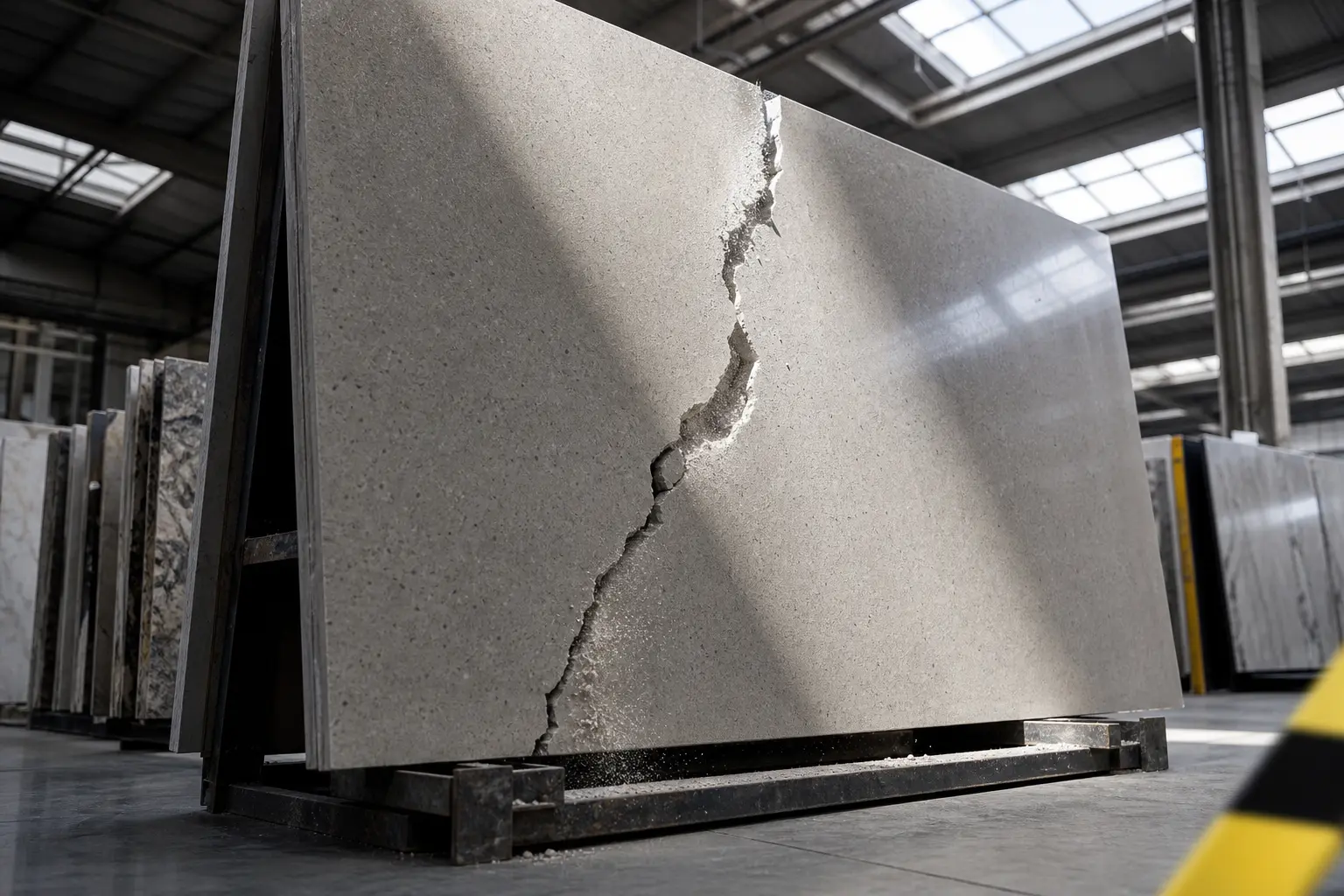
On May 21, California’s Occupational Safety and Health Standards Board voted unanimously to advance a petition directing Cal/OSHA, the state’s Division of Occupational Safety and Health, to draft an emergency rule prohibiting the fabrication and installation of engineered stone containing more than 1 percent crystalline silica. If the rule survives the process, California would become the first US state to effectively ban the material, following Australia’s nationwide ban in 2024 after an estimated 1,000 silicosis cases there.
More than 560 California stoneworkers have contracted silicosis since 2019, and at least 31 have died, according to state data reported by KQED. About three-quarters of those cases were confirmed in just the last three years, and physicians expect roughly 1,000 more over the next two. Nearly all the patients are Latino men, many of them low-income immigrants who fabricated countertops in small shops.
A newer state law, often called the STOP Act, already requires wet-cutting methods, ventilation, and respirators as of January 1. Health officials told the board that still was not enough to stop the outbreak.
It comes as a huge relief to me and to many of my colleagues that are still working with this highly dangerous material.
José Andrade Peña, a stone fabricator diagnosed with advanced silicosis who testified before the board while carrying the oxygen machine he now needs to breathe, told KQED after the vote.
Is Engineered Stone Too Dangerous to Cut Safely?
Public health researchers and plaintiffs’ lawyers say no safety protocol makes high-silica engineered stone safe to fabricate, pointing to Australia’s total ban as proof the industry can switch materials. Cambria and Cosentino, the two largest manufacturers, say the material is safe when shops follow wet-cutting rules and blame noncompliant fabricators, not the product. California’s own regulators reviewed both arguments and sided with the first camp, though the rulemaking is not finished.
The legal record is already piling up. In August 2024, a jury awarded $52.4 million against 34 manufacturers, the first verdict of its kind in the country. Attorney Raphael Metzger, who worked the case, told Public Health Watch, “Artificial stone is too toxic to be safely fabricated.” More recently, a Denver jury awarded former stone fabricator Tyler Jordan $17.45 million in a suit against Cambria and Hyundai USA LLC, a quartz-surfacing manufacturer unrelated to the carmaker.
- Doctors and injury lawyers say there is no safe exposure threshold, and that Australia’s experience shows fabricators can shift to lower-silica alternatives without the industry collapsing.
- Cambria and Cosentino blame noncompliant shops, not the material. Cambria executive Micah Aberson told InvestigateTV, “The ban will not solve the problem. It’s a process issue, not a product issue.”
- California’s regulators weighed both positions and concluded enforcement and engineering controls alone were not sufficient, voting to fast-track rulemaking anyway.
Cosentino pushed back just as hard through its North American arm. “Banning a product to compensate for failed enforcement is irresponsible,” said Matt Thurston, a regional director for the company, whose parent is headquartered in Spain, a country that has recorded roughly 2,500 silicosis cases of its own, more than any other nation.
A Tariff Fight Splits the Supply Chain
One CEO’s Trade Case
Cambria chief executive Marty Davis has spent the past year asking Washington for more tariffs on imported quartz, and Washington has largely obliged. The US International Trade Commission ruled Chinese quartz slabs had injured domestic manufacturers and imposed duties as high as 178 percent back in 2018, with later increases pushing some rates past 300 percent, according to the Freedonia Group.
Manufacturers simply shifted sourcing to India and Turkey, and those countries now supply most of the quartz entering the country. This year, Davis is going after them too. NPR reported in May that Davis, a major Republican donor, has repeatedly pressed the government to tax quartz imports from India and other countries, raising costs for rivals who depend on that supply. “It’s so unfair when you have to compete against a foreign government, not another company,” Davis told NPR.
Kyle Keck, general manager of Marble Uniques, an Indiana quartz fabricator with about 30 employees, told NPR, “I don’t believe that our customers will absorb the full cost,” and warned the tariffs could cost jobs at his shop. MS International, a California-based stone distributor with roughly $2.5 billion in annual sales, about five times Cambria’s, helped organize opposition to the latest tariff request.
India’s Exposure
India supplies more than a quarter of the US quartz-surface market, with Vietnam a distant second at just over 10 percent, according to data compiled by Hard Surface Report. Roughly 95 percent of India’s engineered stone production, worth more than $700 million a year, ships to the United States. The Federation of Quartz Surface Manufacturers of India has warned that without government intervention, the industry risks collapse at a critical growth stage, with more than $570 million already invested in production facilities and $456 million in bank loans on the line.
Fabricators are already bracing for the bill. Axios Pittsburgh reported in January that quartz countertop prices could jump 30 to 50 percent if the pending tariffs land, and one Pennsylvania fabricator estimated 65 percent of his commercial work uses imported quartz. Caesarstone and Cosentino have already raised list prices 11 to 15 percent, citing tariff surcharges directly. Trade publication reporting in early June said quartzite and other natural stone varieties would likely be exempt from a separate proposed 25 percent duty, with the US Trade Representative holding a hearing on remedies in mid-June.
The Numbers Still Point Up
None of this means the underlying market is shrinking. Natural stone alone was worth an estimated $39.64 billion this year and is projected to reach $49.66 billion by 2031, according to Mordor Intelligence, which tracks the category at a 4.62 percent compound annual growth rate. Granite leads with just over 31 percent of that market, while marble is growing fastest.
The supplier base is fragmented enough that a new entrant is not fighting a monopoly. Polycor, Levantina, and Cosentino together held an estimated 18 percent of the global natural stone market in 2024, leaving the rest split among thousands of smaller quarriers, importers, and regional wholesalers. Asia-Pacific accounts for roughly 48 percent of global demand, driven by infrastructure spending in China and India.
| Segment | 2026 Market Size | Growth Path | Overhang This Year |
|---|---|---|---|
| Natural stone (granite, marble, limestone, sandstone) | $39.64 billion | 4.62% CAGR to $49.66B by 2031 | Price competition from cheaper engineered slabs |
| Engineered or quartz stone | $28 billion | 7.1% CAGR to $45.2B by 2033 | California rulemaking and pending US tariffs |
The growth curves alone would tell a new wholesaler to stock both categories. The regulatory calendar complicates that math.
Demand is not uniform everywhere, either. Saudi Arabia’s construction sector, long a dependable source of bulk stone orders for hotels and mega-projects, is adjusting as the kingdom’s construction and oil-sector hiring slows while tech and healthcare grow, a shift that changes which regional buyers a new wholesaler can count on.
Redundancy Is the New Sourcing Rule
Everything above points to the same operational answer: build in redundancy before the regulatory and trade calendars force it.
- Document silica content before you buy, not after. California’s proposed threshold is 1 percent crystalline silica, so a supplier’s environmental product declaration or safety data sheet is no longer optional paperwork.
- Budget for a tariff range, not a tariff number. Estimates run from the 11 to 15 percent already applied by Caesarstone and Cosentino to the 50 percent some fabricators fear if the pending petition succeeds.
- Keep two countries per product line. The industry’s post-2018 shift from China to India and Turkey shows what happens when a single source gets tariffed out of the market.
- Track state rules, not just federal ones. California’s board could set a template other states copy, the same way Australia’s 2024 ban became the reference point for US petitioners.
Some established players are answering the same pressure by getting bigger. Holcim’s acquisition of Thames Materials extended the cement giant’s push into recycled aggregates around London, a reminder that consolidation and vertical integration become live options once a wholesaler has a track record, not just a workaround for smaller competitors. The broader crushed stone and aggregate market is projected to grow from $4.41 billion this year to $6.1 billion by 2030, an 8.5 percent compound annual growth rate that helps explain the appetite for deals like it.
Environmental positioning is shifting from a marketing line to a procurement requirement. One AI startup’s push to cut embodied carbon from construction supply chains reflects contractors increasingly demanding traceable, lower-emission material data before placing bulk orders, the same documentation habit the silica rules are about to require for a different reason.
Cal/OSHA’s next scheduled step, drafting the emergency standard itself, is expected within months, well before any final vote on a ban.
Frequently Asked Questions
Is Engineered Stone Actually Banned in the US Right Now?
Not yet. California’s Occupational Safety and Health Standards Board voted on May 21 only to start a rulemaking process, directing Cal/OSHA to draft an emergency standard against engineered stone above 1 percent crystalline silica. That draft still needs review and another board vote, a process expected to take several months, and regulators could choose to phase in any restriction rather than impose it all at once.
What’s the Difference Between a Wholesale Stone Distributor and a Fabricator?
A wholesale distributor sells raw slabs, tiles, and blocks in bulk to fabrication shops, builders, and retailers, while a fabricator is the shop that cuts, grinds, and polishes those slabs into finished countertops or panels. The silicosis crisis centers on fabrication, where dry-cutting releases silica dust, but lawsuits so far have named manufacturers alongside fabricators, a sign that liability exposure can travel up the supply chain.
Does the Silicosis Crisis Affect Natural Stone Wholesalers Too?
Less directly. Natural stone such as granite and marble carries far less crystalline silica, roughly 30 percent and 2 to 3 percent respectively, compared with 90 to 95 percent in engineered stone, so it falls outside the proposed California threshold. That gap is already part of how natural stone suppliers pitch themselves as the lower-risk alternative while the engineered-stone rulemaking plays out.
What Does California’s STOP Act Actually Require?
The law, in effect since January 1, mandates wet-cutting methods, proper ventilation, and respirator use for anyone fabricating engineered stone, and it requires certification for shops handling the material. It applies only in California for now, though health experts who pushed for the May 21 vote argue those rules alone have not stopped the rise in new cases.
What Happens Medically to Workers Who Get Silicosis?
There is no cure. Treatment is limited to supplemental oxygen and, in advanced cases, a lung transplant that can cost $1 million or more and, on average, extends life by only about six years, according to physicians who treat patients in Southern California’s silicosis epicenter.
What Happened to Chinese Quartz Imports After the 2018 Tariffs?
They collapsed. Imports of Chinese quartz slabs fell to under 1 million square meters by 2021, down from a dominant share of the US market before 2019, as duties exceeding 300 percent made Chinese material uncompetitive. Production shifted almost entirely to India, Turkey, and Vietnam, the same countries now facing fresh tariff petitions.