Vint Cerf retired from Google effective July 7, 2026, after serving as vice president and chief internet evangelist since 2005, a departure confirmed by a Google spokesperson to TechCrunch. He left with a prediction, not a valediction: the rise of AI agents will force the technology industry back toward formal, open interoperability standards, the kind he and Robert Kahn designed in 1974. The argument landed at the same moment Google was restructuring search around AI Overviews and a billion-user AI Mode. Seven weeks before his exit, on May 19, 2026, Google’s I/O keynote had rebranded the world’s dominant search engine as an answer engine, and the publishers whose content feeds it were already losing more than half of their organic referral traffic.
What Vint Cerf Said on His Way Out
The announcement came on June 30, 2026, almost as a footnote, in a video appearance at the Open Frontier conference hosted by the Laude Institute. UC Berkeley professor Dave Patterson, who has known Cerf since the 1970s, told the room that his old friend was leaving Google. “Vint has been at Google more than 20 years, and he is retiring a week from today, and so I think we ought to give him a round of applause for a relatively good career,” Patterson said, to cheers from the audience.
Cerf was speaking on a panel alongside four other builders of durable open systems: Patterson, Keras creator François Chollet, Tcl author John Ousterhout, and Databricks co-founder Matei Zaharia. Their brief was to discuss what it takes to build open infrastructure that survives, and the discussion kept coming back to the centralization of advanced models in a handful of well-resourced labs. Cerf’s contribution was to argue that the model is about to break open again, for the same reason it broke open in the 1970s.
The relevant facts about Cerf at his departure:
- 21 years as Google’s chief internet evangelist, a role he held since 2005
- Age 83, still active on standards bodies and conference panels until his final appearance
- Effective retirement date: July 7, 2026
More on Patterson’s introduction and Cerf’s panel remarks is available in the retirement announcement reported by TechCrunch at the Open Frontier conference.
Why Natural Language Will Fail at Machine Speed
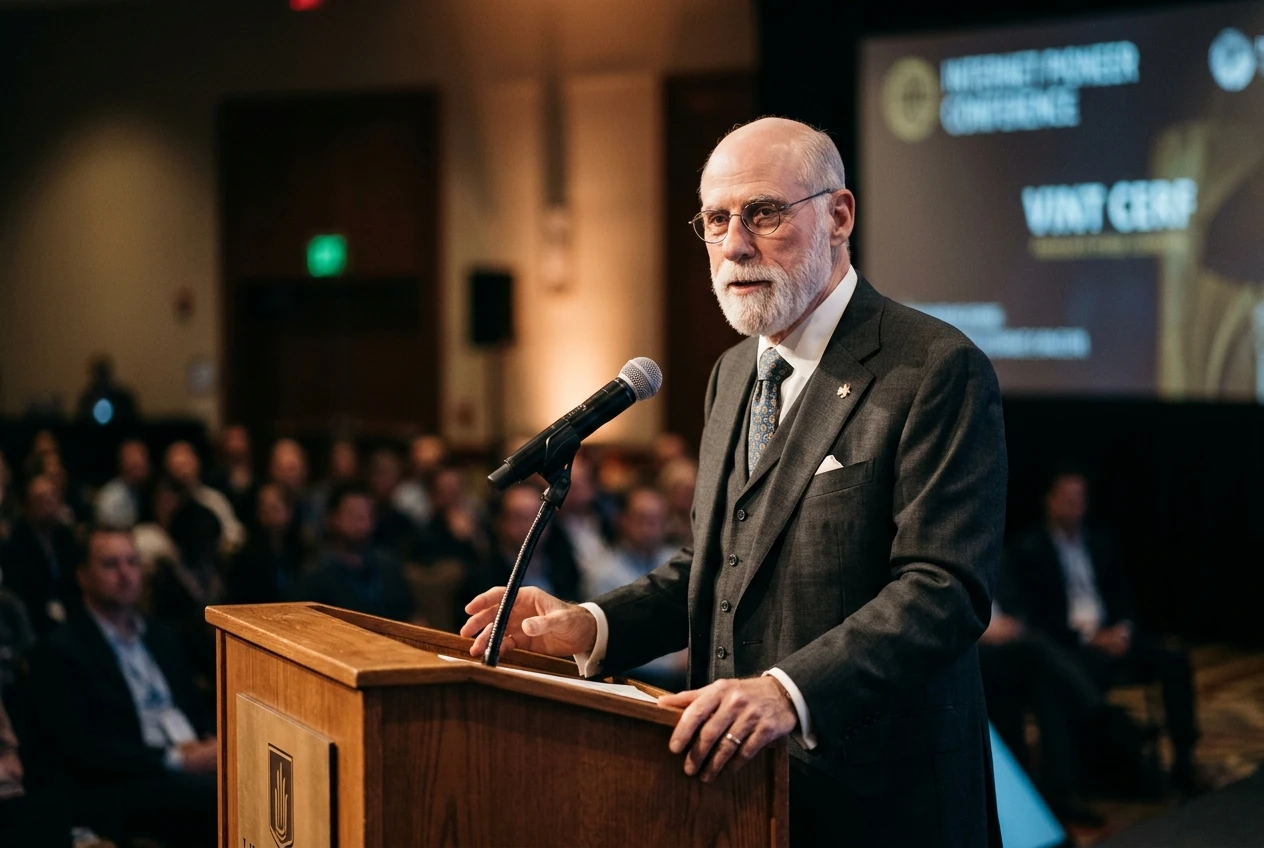
Cerf did not look back at his own work. He described the live problem: AI agents from different vendors, built on different models, will need to coordinate without a human in the loop.
“The agentic model of AI, with multiple agents from multiple sources interacting with each other, is going to force composability, and a requirement for interoperability and standardization,” Cerf said at the panel.
He was direct about why some of his co-panelists’ instinct toward natural-language communication would fail. Ambiguity compounds. A message that drifts across ten humans in the old telephone game arrives broken; a message that drifts across ten autonomous software agents, running thousands of times per second, fails the system in ways a human operator cannot patch.
Remember the old telephone game where you wished you’d whispered in somebody’s ear and then by the time it got to 10 people away the message was totally different? Imagine a bunch of agents talking to each other in natural language; you know, that’s kind of terrifying.
Cerf, vice president and chief internet evangelist at Google, offered that comparison via video feed at the Open Frontier conference hosted by the Laude Institute. His prescription was the same architectural move he made in 1974 when he and Kahn published their transmission-control specification in the IEEE Transactions on Communications: build a formal, neutral protocol that any implementation can adopt and no operator can bend to favor one kind of traffic over another. That protocol was TCP/IP. Its rival at the time, OSI, was arguably more rigorous on paper. As IEEE Spectrum recounts in its history of the protocol wars, OSI stalled in the early 1990s in the face of “a cheap and agile, if less comprehensive, alternative,” and one of the Internet’s advocates, Einar Stefferud, summed the outcome in a sentence: “OSI is a beautiful dream, and TCP/IP is living it.” Details of Cerf’s full remarks at the Open Frontier panel and of the IEEE Spectrum account of those rivalries appear in Cerf’s remarks at the Open Frontier panel and IEEE Spectrum’s history of how TCP/IP beat OSI.
The New Protocol Stack: MCP and A2A
Two protocols being built this year track Cerf’s blueprint almost line for line. One solves the connection problem; the other solves the cooperation problem.
Anthropic released the Model Context Protocol in November 2024 as an open standard for connecting AI systems to external data sources and tools, what MCP’s own documentation calls a replacement for the N times M proliferation of custom AI connectors. Anthropic later donated MCP to the Linux Foundation’s new Agentic AI Foundation, a directed fund co-founded by Anthropic, Block and OpenAI with support from Google, Microsoft, AWS, Cloudflare and Bloomberg. As of the donation announcement, the protocol’s official SDKs for Python and TypeScript together registered 97 million monthly downloads. Google’s Agent2Agent protocol, announced in April 2025, addresses the adjacent coordination problem: where MCP connects agents to tools and data, A2A connects agents to other agents across organizational boundaries, using HTTP, Server-Sent Events, and JSON-RPC 2.0 as the underlying transport. Google transferred A2A to the Linux Foundation on June 23, 2025. By April 2026, the project had crossed 150 supporting organizations (including AWS, Cisco, Google, IBM, Microsoft, Salesforce, SAP and ServiceNow) and more than 22,000 GitHub stars.
| Attribute | Model Context Protocol (MCP) | Agent2Agent (A2A) |
|---|---|---|
| Defined by | Anthropic | |
| Released | November 2024 | April 2025 |
| Solves | Connecting agents to tools and data | Agents coordinating with other agents |
| Foundation host | Linux Foundation’s Agentic AI Foundation | Linux Foundation |
| Method of transfer | Donated, joined AAIF as a founding project alongside goose and AGENTS.md | Transferred to Linux Foundation, June 23, 2025 |
| Latest scale markers | 97M+ monthly SDK downloads across Python and TypeScript | 150+ supporting organizations, 22,000+ GitHub stars |
The founding-transfers are documented at Anthropic’s donation of MCP and the Agentic AI Foundation launch and A2A crossing 150 supporting organizations at its one-year mark.
Who Now Writes the Rules
Cerf’s original protocol succeeded because the organization that governed it, the Internet Engineering Task Force, had no commercial interest in which implementation won. It operated on the principle of “rough consensus and running code,” and it belonged to no one. The new agent protocols inherit a different, but not necessarily hostile, structure: a Linux Foundation that is officially neutral, but protocols that were written first by the largest AI companies and only then placed under foundation governance.
MCP arrived at the Linux Foundation as a founding project of a new directed fund, the Agentic AI Foundation, jointly co-founded by Anthropic, Block and OpenAI. A2A arrived at the same foundation six months earlier, on June 23, 2025, and was immediately joined as a founding member by AWS, Cisco, Google, Microsoft, Salesforce, SAP and ServiceNow, according to the Google Cloud announcement of the transfer.
The industry framing of the new structure is the same one Cerf grew up under: vendor-neutral stewardship through an open-governance foundation. “By joining the Linux Foundation, A2A is ensuring the long-term neutrality, collaboration and governance that will unlock the next era of agent-to-agent powered productivity,” said Jim Zemlin, executive director of the Linux Foundation, in the announcement of the A2A transfer. Whether foundation governance produces the same neutrality TCP/IP enjoyed depends on rules written by the same companies that funded and built the protocols in the first place, an arrangement those companies would describe as collaborative, and that critics would describe as capture. The announcement of Google’s A2A transfer and its Linux Foundation framing sits at Jim Zemlin’s framing of the A2A transfer to the Linux Foundation.
What Google Did to Search Seven Weeks Earlier
On May 19, 2026, seven weeks before Cerf’s effective retirement, Google held its annual I/O keynote. The announcements, four in number and bracketing search, agents and commerce, described what the company’s head of search called “the biggest upgrade to our iconic search box in over 25 years.”
Google replaced the default model inside AI Mode with Gemini 3.5 Flash and, according to its own I/O disclosures, told the audience that 1 billion people now use AI Mode each month.
Queries inside AI Mode run on average three times as long as conventional search queries, the company said, and the total volume has more than doubled every quarter since launch. Information agents run continuously in the background, monitoring the web for changes related to a question the user has previously specified and pushing synthesized updates without any new query. Google search VP Liz Reid summarized the direction in a single sentence: “Google search is AI search through and through.” The architecture Cerf built in 1974 treated search as a routing mechanism: here is what you asked, here is where to find it. The architecture now being shipped treats search as an answer delivery system: here is what you asked, here is the answer, you do not need to go anywhere else. According to SparkToro’s January-to-April 2026 study of US Google searches, based on Similarweb clickstream data and reported by Search Engine Land, 68.01% of queries ended without a click to any external site, up from 60.45% in 2024. Details of every change to Search at I/O 2026 and of the SparkToro study appear in the full run-down of Google I/O 2026 search changes and Search Engine Land’s reporting on the 2026 SparkToro zero-click study.
The Recursion That Awaits
AI-generated answers still rely on the work of publishers, journalists, researchers and independent writers. The AI reorganizes that content into a conversational layer, serves it to users, and retains the advertising revenue. This is the recursion problem Cerf left behind: AI consumes the content it depends on while eliminating the economic reward for producing it.
The damage is no longer a forecast. Business Insider’s organic search traffic dropped 55% between April 2022 and April 2025, according to Similarweb data, a fall that led the company to cut 21% of its workforce, with CEO Barbara Peng citing “extreme traffic drops outside of our control.” HuffPost’s organic search traffic has dropped by more than half over the past three years. The travel blog The Planet D shut down after its traffic fell 90% following Google’s launch of AI Overviews. Chegg, the publicly traded education platform, filed an antitrust suit against Google on February 24, 2025 alleging that AI Overviews cut non-subscriber traffic and used its content to compete with the publishers that produced it, a complaint that the company said drew on Chegg’s library of 135 million questions and answers. A Google spokesperson told CNBC, in the company’s standard rebuttal, that “Every day, Google sends billions of clicks to sites across the web, and AI Overviews send traffic to a greater diversity of sites.” The publisher-side documentation of the 55% and 90% traffic falls is gathered in Business Insider, HuffPost and Washington Post traffic figures compiled by The Keyword, in NPR’s reporting on publishers facing an extinction-level event, and in Chegg’s antitrust complaint against Google over AI summaries. The agent-protocol negotiations now under way across Linux Foundation sub-foundations will, over the next several months, determine whether the next internet is open or vendor-controlled, the same way the OSI versus TCP/IP fight once decided this one.
Frequently Asked Questions
When did Vint Cerf retire from Google, and what role did he hold?
Vint Cerf stepped down from Google on July 7, 2026, after holding the role of vice president and chief internet evangelist since 2005, according to TechCrunch’s account of his Open Frontier panel appearance. A Google spokesperson confirmed the departure to TechCrunch.
Why did Cerf warn that AI agents need formal protocols?
Cerf said the rise of multiple AI agents from multiple sources coordinating together will force composability and standardization, the same interoperability problem TCP/IP solved between isolated networks in 1974. Natural language is too ambiguous for machine-speed interaction, he argued, comparing the risk to a game of telephone run through ten agents simultaneously.
What is MCP, the Model Context Protocol?
MCP is an open standard Anthropic released in November 2024 for connecting AI systems to external data sources and tools, designed to replace the N-times-M proliferation of custom AI connectors with a single interface. Anthropic donated it to the Agentic AI Foundation, a directed fund under the Linux Foundation, with the foundation co-founded by Anthropic, Block and OpenAI and supported by Google, Microsoft, AWS, Cloudflare and Bloomberg.
What is A2A, the Agent2Agent protocol?
A2A is a Google-developed open standard for agent-to-agent communication and task delegation across organizations, announced in April 2025. Google transferred it to the Linux Foundation on June 23, 2025. By April 2026 the project counted more than 150 supporting organizations including AWS, Cisco, Google, IBM, Microsoft, Salesforce, SAP and ServiceNow, with more than 22,000 GitHub stars and SDKs in five production languages.
How does Google’s AI search change affect websites and news publishers?
According to SparkToro’s January-to-April 2026 study of US Google searches based on Similarweb clickstream data, 68.01% of queries ended without a click to any external site, up from 60.45% in 2024. Independent publisher data shows similar damage: Business Insider’s organic search traffic dropped 55% between April 2022 and April 2025, and travel blog The Planet D closed after a 90% traffic loss following Google’s launch of AI Overviews. Chegg filed an antitrust suit against Google on February 24, 2025 alleging AI Overviews deprived it of traffic.