
The International Olympic Committee confirmed Tuesday that freeride skiing and snowboarding will make their Olympic debut at the 2030 Winter Games in the French Alps, the centerpiece of the biggest reset to the Winter Olympic program in a generation. To make room for the discipline the IOC Executive Board voted Nordic combined out of a sport that had been on every Winter Olympic program since the inaugural 1924 Games in Chamonix, France.
The decision makes Alpes 2030 the first gender-equal Winter Olympics, with a 50/50 athlete split across 3,046 athletes and 126 events. Beyond the swap, the board approved 16 new events across three added disciplines, retained snowboard parallel giant slalom after a parallel review, and confirmed ski mountaineering as a full sport with five events.
What the IOC Approved on Tuesday
Per the IOC’s release on Alpes 2030, the Executive Board approved three new disciplines and 16 new events spread across biathlon, figure skating, speed skating, and ski and snowboard. The two largest cultural pieces are freeride and synchro9, a nine-skater team figure skating event.
The program also achieves gender parity for the first time at a Winter Games: 56 women’s events, 55 men’s events, and 15 mixed events, with 1,525 female athletes and 1,521 male athletes including the OCOG-proposed sport of ski mountaineering.
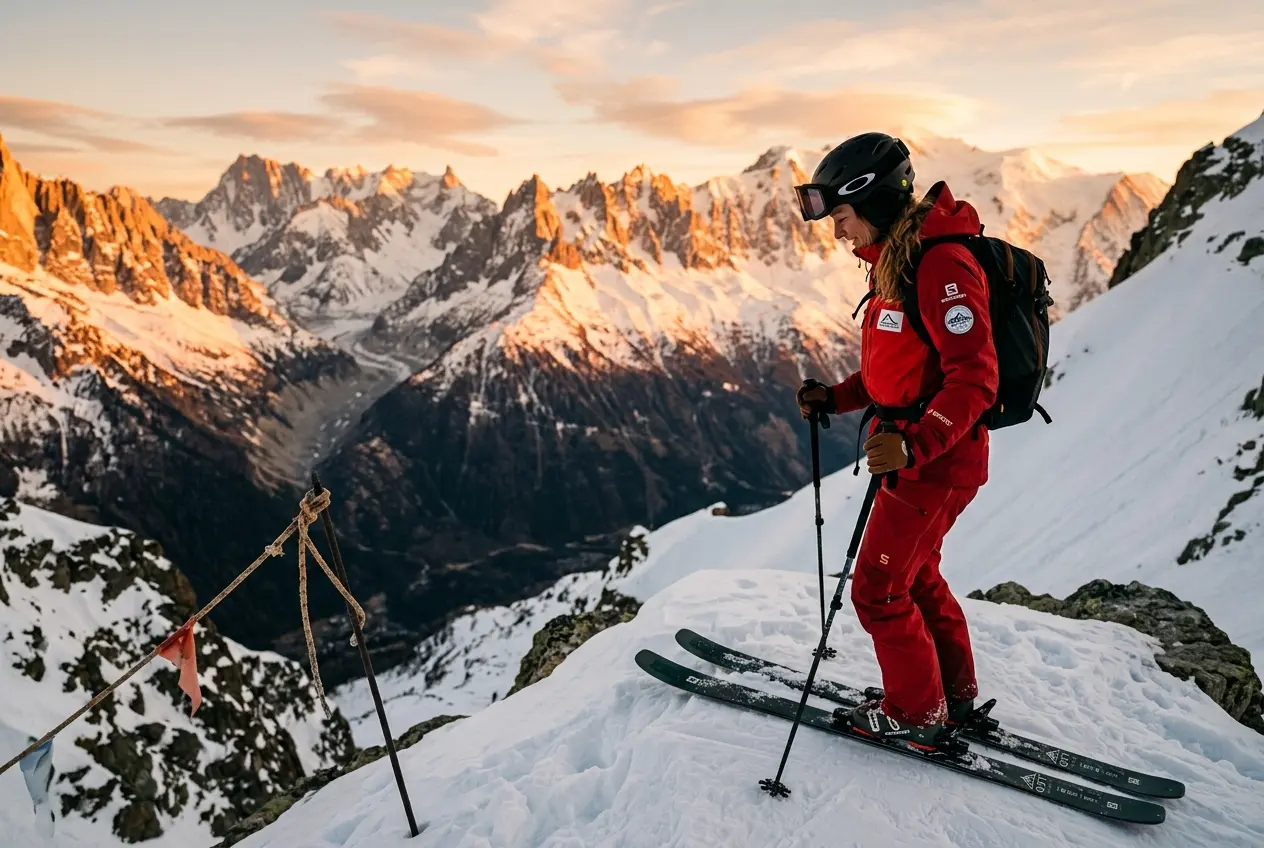
The board also retained snowboard parallel giant slalom after the same review considered cutting it, with the IOC noting PGS had “demonstrated significant improvement since Beijing 2022 across a number of popularity indicators.” Freeride’s Olympic field will use the discipline’s hallmark terrain: ungroomed, unmarked faces where athletes pick their own lines.
| Sport | Change | Athletes | Notes |
|---|---|---|---|
| Biathlon | Added mixed singles relay | — | 1 event added |
| Figure Skating | Added Synchro9 | — | Existing venue; central to gender parity |
| Ski & Snowboard: Freeride | Added as a discipline | 44 (22 women, 22 men) | 4 events; natural field of play |
| Ski & Snowboard: Nordic Combined | Removed | — | Was in every Winter Games since 1924 |
Why Nordic Combined Came Out
The IOC’s review runs on a quadrennial global study the organization conducts during every Games. The version fielded at Milano Cortina 2026 measured 14 popularity indicators across broadcast coverage, digital media, general public interest, ticketing, and press, drawing on up to 50-plus markets per indicator.
The release stated that across those 14 indicators, Nordic combined “ranked lowest among all Olympic Winter Games disciplines at Sochi 2014, PyeongChang 2018, Beijing 2022 and Milano Cortina 2026.” At the most recent Games, the IOC found, it was the lowest-ranked discipline in 11 of the 14 indicators.
A second problem was reach. The IOC’s release noted that “only five National Olympic Committees (NOCs) won medals in Nordic combined across the last four editions of the Olympic Winter Games,” and the discipline remained men-only at the Games, the only sport at Milano Cortina 2026 with no women’s competition. IOC sports director Pierre Ducrey told reporters after the announcement that the data did not show “a progress that would justify keeping the discipline,” citing both low popularity and the concentration of medals among a few countries. IOC President Kirsty Coventry told Nordic combined athletes the organization understands the decision “may come as a disappointment,” and said there have been “very good conversations with FIS on what expectations would be in the future,” adding that “the possibility could always remain open for 2034.”
The Crack That Opened in Steamboat Springs
For a sport that the IOC just measured and weighed, the human weight is in Colorado. Steamboat Springs has produced generations of U.S. Nordic combined athletes, and the town’s reaction set the rhetorical temperature for the week.
Jill Brabec, president of Nordic Combined USA, told The New York Times that the eight-year gap without an Olympic stage will reshape the work her organization does to support athletes. Her daughter, Alexa Brabec, finished the 2025-26 World Cup season second overall with eight podiums in 14 races, including her first career win in Seefeld, Austria, on January 30, the first U.S. women’s Nordic World Cup victory since 2020. Alexa’s rise had anchored the U.S. argument that women’s Nordic combined deserved a chance at the Olympics; the IOC denied the request for 2026 and never admitted a women’s event in time for 2030.
I think the reaction through the whole Nordic combined community, everyone from athletes, coaches, parents, fans, has been heartbreak. But I’m also seeing a lot of resiliency. We’re going to pull ourselves up by our bootstraps, and we are going to move forward into a season of World Cups and world championships.
The day the program was cut, Brabec said the family and the community are pivoting. The Velocity Ski League, a private coed competition founded by U.S. Olympic champion Bill Demong and other supporters and run in partnership with FIS, is now the most visible effort to grow the sport outside the Games.
How Freeride Reached the Olympic Door
If Nordic combined was a reckoning for a 102-year incumbent, freeride’s elevation closes an Olympic pipeline that FIS has been building since 2022. The discipline began in 1996 as a snowboard-only contest at Verbier, grew into the Freeride World Tour under founder and CEO Nicolas Hale-Woods, and joined FIS when the federation acquired the tour in December 2022. On June 5, 2024, in Reykjavik, the FIS General Assembly voted unanimously to recognize freeride skiing and snowboarding as an official FIS discipline, the second step in a chain that pointed directly at the IOC.
This isn’t just another chapter, it’s a turning point. The performances, the venues, the energy around freeride right now reflect a sport coming into its own on the world stage.
Alpine skiing debuted at the Winter Olympics in 1936 in Garmisch-Partenkirchen, Germany, and is now a marquee event. Hale-Woods told SKI Magazine his team is “dedicated to keeping the soul of freeride” and that he does not expect significant rule or format changes under the Olympics. He also drew a direct line from surfing, added to the Summer Olympics in 2016 after similar debates about subjectivity and venue requirements.
The IOC’s release framed freeride the same way Hale-Woods does. The sport “has experienced rapid international growth, benefitting from a strong youth fanbase and visually spectacular competition,” the release stated, and “uses a natural field of play, which minimises its impact on the Games.” The path from the FWT to the Olympics gives the Games a discipline judged on five criteria: line, control, technique, fluidity, and air and style, with 22 men and 22 women contesting four events.
The U.S. Pipeline Restarts This Winter
U.S. Ski & Snowboard moved on the same day, adding freeride skiing and snowboarding as a new discipline under its high-performance umbrella. President and CEO Sophie Goldschmidt said “Freeride’s addition to the Olympic program confirms that these athletes belong on the biggest stage in the world,” and chief of sport Anouk Patty said bringing the discipline into the high-performance system means “our coaches and sport scientists can start supporting these athletes now, well ahead of 2030.”
The federation has partnered with the International Freeskiers & Snowboarders Association to keep overseeing the grassroots circuit. Selection criteria and elite team naming arrive in the 2026-27 season. Skiers joining the discipline land on the Stifel U.S. Freeski Team; snowboarders on the Hydro Flask U.S. Snowboard Team, with the same commercial and performance support the organization provides its existing 230 athletes.
- 44 Olympic freeride athlete quota at Alpes 2030 (22 women, 22 men across four events).
- 3,046 athletes at Alpes 2030 (1,525 women, 1,521 men, including ski mountaineering).
- 16 new Olympic events approved, with three new disciplines and ski mountaineering added with five events.
- 14 popularity indicators measured at Milano Cortina 2026; Nordic combined was lowest in 11.
- More than 300 annual events on the current FWT calendar across four continents.
What’s Undecided Before the Alps
The IOC’s program is confirmed; the Olympic experience is not. The IOC did not specify which Alpine venues will host the four freeride events, and Hale-Woods has confirmed only that the two towns identified in site visits are Montgenevre and La Grave, each about a four-and-a-half-hour drive from Verbier, Switzerland.
Qualification pathways will be shared “as they are confirmed,” per the FWT. The proposed format, drawn from the inaugural FIS Freeride World Championships in Andorra this past winter, plans to feature 22 men and 22 women across four events. The IOC has not published a precise athlete allocation, qualification paths, or which stops on the current FWT calendar will double as Olympic qualifiers.
The next test could be Utah. Hale-Woods told The Salt Lake Tribune that organizers of the 2034 Salt Lake City Games confirmed they “are very interested in putting freeride in the program.” Utah 2034 organizers have said they expect to release their sports program in 2028. Whether the venue question will be easier in 2034 is itself open: the most obvious freeride terrain near Salt Lake City sits in the Cottonwood Canyons, and Utah 2034 organizers have promised they would not put events there.
the IOC’s Alpes 2030 program announcement lays out the full event list and quotas. Athletes such as Alexa Brabec and Norwegian skier Ida Marie Hagen, a two-time overall World Cup champion who called the IOC news “a shock that will take time to process,” now know the length of the gap between them and the next Olympic stage.
Frequently Asked Questions
When will the Olympic qualification pathway for freeride be set?
The Freeride World Tour has said details will be shared “as they are confirmed.” The IOC released the event count and athlete quota but left qualification mechanics for a later announcement.
Where in the French Alps will the freeride events be held?
Hale-Woods has confirmed that two candidate venues, Montgenevre and La Grave, were identified during April site visits with FIS and 2030 organizers.
Could Nordic combined return in time for the 2030 Games?
No. The IOC Executive Board voted to drop the discipline from the Alpes 2030 program. IOC President Kirsty Coventry said the possibility could remain open for 2034 in Salt Lake City.
How are Olympic freeride runs judged?
Per U.S. Ski & Snowboard, runs are scored on five criteria: line choice, control, fluidity, technique, and air and style, rather than on time, on natural ungroomed terrain.
Will current U.S. freeriders be on the Olympic team?
U.S. Ski & Snowboard said it will publish selection criteria for freeride and name elite teams within the 2026-27 season, with skiers on the Stifel U.S. Freeski Team and snowboarders on the Hydro Flask U.S. Snowboard Team.
U.S. athletes who want to track the qualifying pathway can read U.S. Ski & Snowboard adding freeride as a discipline, and the reaction from the Nordic combined side is mapped in how Nordic combined athletes reacted to the cut as well as Jill Brabec on the future of U.S. Nordic combined. The 30-year arc from Verbier to the Olympics is traced in the 30-year pursuit that put freeride on the Olympic stage, and Utah 2034’s interest is laid out in how Utah 2034 is already eyeing freeride.