
NEWS
Google Home Display Code Wires the Screen to Nest Cam
App strings set the rumored Google Home Display up as a Nest Cam, so Home Premium, not the glass, is what Google is selling.

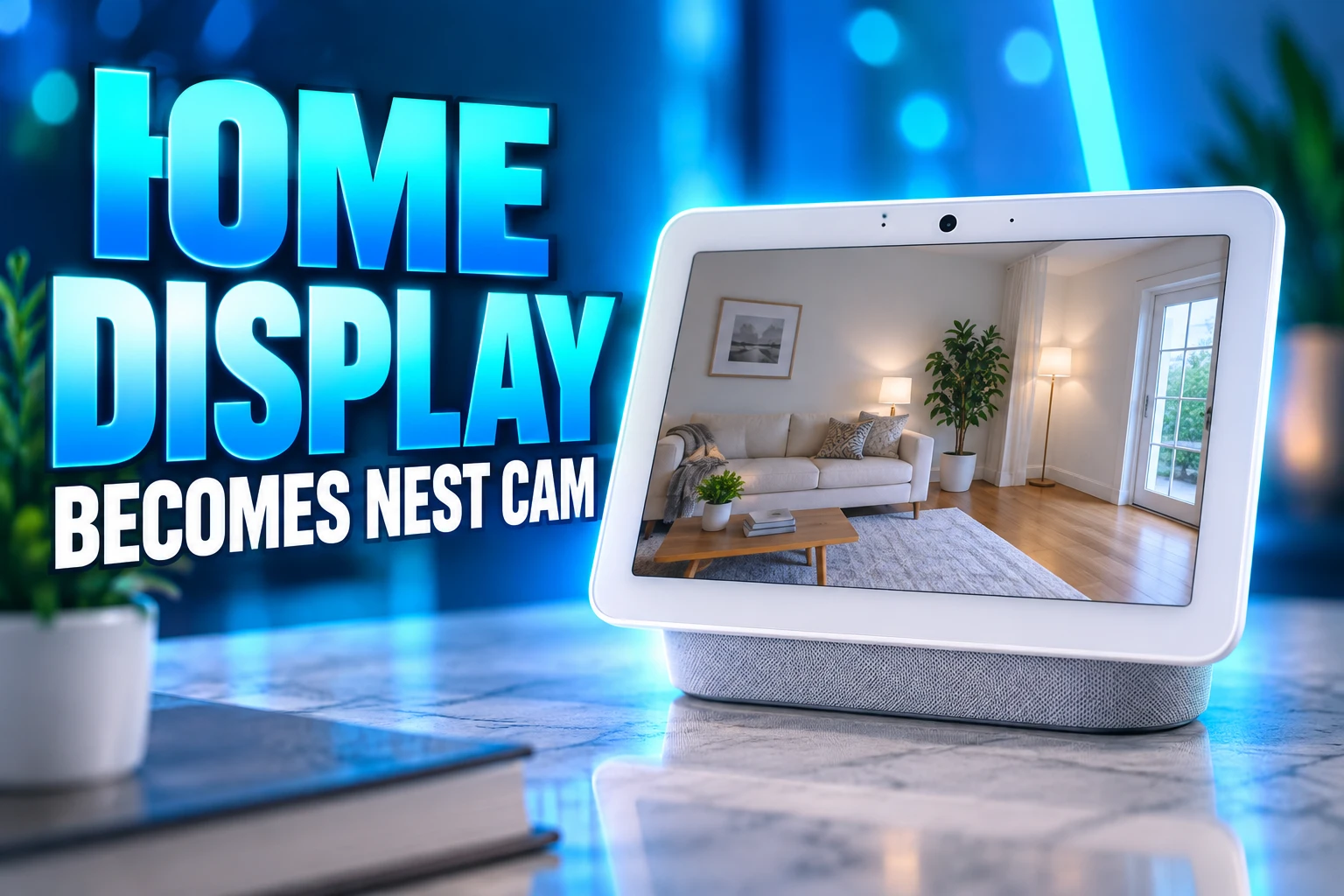
Strings inside the Google Home app, found on July 13, 2026, prepare the rumored Home Display to run as a Nest Cam, with 3 hours of free event recording. Longer clips sit on Google Home Premium, and the 60-day and 10-day caps in those strings match the paid Advanced plan, not the cheaper Standard tier.
Google has not announced the device, a price, or a ship date. The code still tells you what the company wants the next kitchen screen to be: another camera seat on a plan that already covers doorbells and indoor cams.
App Code Treats the Screen as a Nest Cam
The product name itself showed up in Google Home app code in May 2026. The July strings go further. They describe camera setup, event recording, and a path to set the Home Display’s camera up as a Nest Cam that watches the room.
That is a different job from a screen that only does video calls. A Nest Cam in Google’s own catalog is a security device with live view, motion and sound events, and cloud history that grows when you pay. The Home Display is being taught the same nouns.
Google Home head Anish Kattukaran said in 2025 that the company still wanted to make smart displays, without confirming a new model. By July 2026 the Home Speaker was already out. The Display is the missing screen in that rename, and the camera work is the first feature the app is willing to spell out.
WHAT WE KNOW
- The setup path: App strings describe configuring the Home Display camera as a Nest Cam for indoor monitoring.
- The free window: Default event recording is 3 hours, the same short clip window Google already uses on several battery Nest devices.
- The paid caps: The strings name 60 days of event history and 10 days of round-the-clock recording, which is the Advanced plan’s camera package.
- The microphone: The device is described with a mic for voice control and for logging noise-triggered events.
WHAT IS UNCONFIRMED
- The hardware: Sensor resolution, field of view, night vision, and a physical shutter do not appear in the published strings.
- The ship date: Google has not confirmed that Home Display exists as a finished product, or when it would go on sale.
- The call stack: The July find does not show video calling, Face Match, or the old Hub Max gesture controls.
An APK teardown can describe work in progress that never ships. These strings are specific enough, down to legal recording notices and a live-view-only switch, that they read as product copy rather than leftover test labels.
Three Hours Free, Then the Advanced Plan
The leak’s “Premium catch” flattens two paid plans into one. Google’s store sells Google Home Premium as a home-wide plan with a Standard tier and an Advanced tier. The 60-day event window and the 10-day continuous window are Advanced benefits.
The Standard plan at $10 a month ($100 a year, a $20 saving against 12 monthly bills) keeps 30 days of event-based video history, intelligent alerts, and Gemini for Home on speakers and displays. Advanced is $20 a month or $200 a year, a $40 saving on annual billing, and it is the tier that adds 60 days of event history plus 10 days of 24/7 history on eligible wired cameras and doorbells.
THE RECORDING TIERS ON GOOGLE HOME PREMIUM
| Plan | US price | Event history | 24/7 history |
|---|---|---|---|
| No paid plan (Home Display strings) | $0 | 3 hours | None named |
| Standard | $10/month or $100/year | 30 days | Not included |
| Advanced | $20/month or $200/year | 60 days | 10 days on eligible wired devices |
Those paid figures are the current Nest Cam card, not a Display-only menu. Google’s help pages already split event video history and 24/7 recording the same way. Event history saves clips when the camera sees or hears something. 24/7 history is a rolling tape, and it is limited to wired cameras and doorbells.
One wrinkle for anyone matching the leak to the store: current wired Nest Cams advertise 6 hours of event video previews (clips up to 10 seconds) with no plan. Battery Nest Cams advertise 3 hours of event-based history (clips up to 3 minutes). The Home Display strings use the 3 hour figure. Until Google publishes a spec sheet, that is the free window to plan around.
Gemini features ride the same bill. Standard includes Gemini Live on speakers and displays and a typed “Help me create” flow for automations. Advanced adds searchable history, longer event descriptions, descriptive alerts, and Gemini daily summaries. A kitchen screen that is also a camera gives those tools something to watch, which is the quiet reason to put Nest Cam software on a display.
Why the Hub Max Camera Never Left
This is not Google’s first display with a security camera inside. The Nest Hub Max went on sale on September 9, 2019 for $229. It had a 10-inch screen and a 6.5MP camera with a 127-degree field of view, sold from day one as a Nest Cam that also ran Assistant.
Google said so in public, on the day it unveiled the Max.
Meet #NestHubMax, a smart display from @googlenest and @madebygoogle. With a 10-inch screen, premium stereo sound, a camera with built-in Nest Cam features, and the power of the Google Assistant, welcome to your helpful home. #io19 pic.twitter.com/oApBljAupD
— Google (@Google) May 7, 2019
Meet #NestHubMax, a smart display from @googlenest and @madebygoogle. With a 10-inch screen, premium stereo sound, a camera with built-in Nest Cam features, and the power of the Google Assistant, welcome to your helpful home. #io19
Google, official announcement, May 7, 2019
The smaller Nest Hub (2nd gen) arrived in 2021 with no camera, using Soli radar for sleep sensing instead. That was the privacy pitch: a bedside screen with nothing to cover. Amazon kept shipping Echo Show models with cameras and shutters. Google let the camera-equipped Max age out of the Google Store without a named successor.
Help pages still list the built-in camera on Nest Hub Max among devices that can keep event history under a Home Premium plan. In November 2024, Google began moving that camera into the Home app, the same app now holding Home Display strings. The software home for a display camera is already Nest Cam, not a separate “smart display” silo.
FROM HUB MAX TO HOME DISPLAY
- May 7, 2019: Google announces Nest Hub Max with a camera that includes Nest Cam features.
- September 9, 2019: Hub Max goes on sale at $229 with a 10-inch screen and 6.5MP, 127-degree camera.
- 2021: Nest Hub (2nd gen) ships without a camera, leaving Max as the only Google display that can watch a room.
- November 2024: Hub Max camera support begins rolling into the Google Home app.
- May 2026: “Google Home Display” appears in Home app code.
- July 13, 2026: New strings describe Home Display camera setup, 3 hours of free event recording, and Premium history caps.
- August 21, 2026: Google Store listings for Nest Hub, Hub Max, and Pixel Tablet show as unavailable.
Owners who still run a Max often keep it because the screen is a camera, not because the interface aged well. Apps on Nest Hub hardware have been stripped back for years. Meet and Zoom support on the Max ended in September 2023. The dual-life idea survived the feature cuts. That is what the new strings put back on the roadmap.
Recording Can Be Turned Off
The July code is not only a sales ladder. It also describes an off switch for storage. Users can disable recording and keep a live feed, which avoids the history tiers altogether. Live view and talk-and-listen are already free on current Nest Cams. The Display is being aligned with that split: watching is included, keeping tape is the paid layer.
A second Display-specific line matters in shared rooms. The screen would have to show a message when video recording is on, depending on local laws. That is a kitchen and living-room problem, not a doorbell problem. A porch cam is outside. A display cam sits where people eat.
WHAT THE APP STRINGS SPELL OUT
- Nest Cam setup: The Home Display camera can be added as a Nest Cam for indoor monitoring.
- Noise events: The microphone is described as logging events when it hears sound, not only as a wake-word mic.
- Legal notice: The screen may have to warn that recording is on, based on local rules.
- Live-only mode: Recording can be switched off while the live view remains.
The Hub Max never got a sliding shutter. It used a switch that cut camera and mics together, plus a software control to kill the lens while leaving the mic on. The new strings do not mention a shutter. Anyone who wants a covered lens is still looking at Amazon’s Show hardware, or at a piece of tape, until Google shows the chassis.
Night vision is the other blank. The Max’s indoor camera was a daylight, face-front sensor, not a dedicated security imager. The July find is silent on infrared, so a Display used as a night nanny cam would be a guess, not a spec.
A Household Plan for Every Extra Lens
Google Home Premium is sold as one plan for the home, not a new bill for each camera. Add a doorbell, an indoor cam, and a display that records, and the history window does not triple. The extra lens is free incremental hardware for a house that already pays. For a house that does not, it is a reason to start.
That is the second effect hiding in a camera leak. A standalone Nest Cam has to justify its own hook on the wall. A display is already in the room for timers, photos, and Gemini. Once that panel is a Nest Cam, Google does not have to win a second placement. It has to win the plan.
Nest Aware is now Google Home Premium, the same two-tier structure with Gemini layered on. Familiar face alerts, package detection, and sound detection on speakers and displays (glass break, smoke alarms) already sit on that bill. A Display mic that logs noise is consistent with features Google already sells on screens, not a new surveillance idea invented for this device.
The $10 Standard plan is enough if you only want 30 days of event clips and Gemini on the speaker stack. The leak’s 60-day and 10-day figures are the $20 Advanced pitch. Households that buy the Display as a recipe screen can ignore recording. Households that treat it as a hallway cam will feel the Advanced gap the first time they need yesterday’s tape, not this afternoon’s 3 hour buffer.
Google Has Nothing New on the Display Shelf
On August 21, 2026, the Google Store showed Nest Hub, Nest Hub Max, and Pixel Tablet as unavailable. Pixel Tablet was already about 3 years old by the July leak. The 2nd-gen Hub has not been replaced since 2021. For a company that still talks about smart displays, the shelf is empty.
Amazon never stopped putting cameras in kitchen screens. Echo Show 8 hardware in the current crop uses a 13MP camera with a cover, video calling, and Drop In. Google’s answer for years was a 7-inch Hub with no lens, plus leftover Max units. The Home Display strings read as an attempt to get back into that countertop slot without launching a third indoor camera SKU.
A kitchen display that is also a Nest Cam is also why some Max owners still will not fully leave. The screen is the indoor camera they already paid for. If the next Google panel bills the same way, those owners are not being offered a new category. They are being offered a replacement node on the plan they may already have.
Hardware Specs Are Still Missing From the Code
The July strings do not name a screen size, a chip, wall-mount hardware, or a price. They do not restore Zoom, Meet, or the Max’s Face Match personalization. They do not say whether the camera will work while the display is playing another Nest feed, a limit that frustrated Max owners after a firmware change years ago.
What they do say is enough to price the software. Free event recording is 3 hours. The long history people actually want is the Advanced plan’s 60 days of events and 10 days of continuous tape. Live view can stand alone. A recording banner can appear on the glass when the law requires it.
Google has not announced the Home Display, a launch date, or a price. The app that would sell the footage is already writing the copy.

The Court Revisits the Climate Nuisance Door It Left Open

ChatGPT Now Compiles Live Interfaces With GPT-6

A Tanker Attack Moves the War Into Qatar’s Waters

Personio Buys Circula to Own the DATEV Channel

Bluesky Files for .bsky and Enters the Registry Queue

Musk’s $914 Billion Lead Is a Public SpaceX Bet

Microsoft’s 96% Cyber Score Sits at 86.3% on the Board

Endgame Encore’s $86 Million Trial for Infinity Vision

Free Live Sports Streaming in 2026: What to Watch Without Cable

Andrew Garfield’s Spider-Man Films Are No Longer Free
-
 BUSINESS4 months ago
Musk’s $914 Billion Lead Is a Public SpaceX Bet
-
 NEWS2 months ago
Microsoft’s 96% Cyber Score Sits at 86.3% on the Board
-
 SPORTS3 months ago
Free Live Sports Streaming in 2026: What to Watch Without Cable
-
 ENTERTAINMENT3 months ago
Endgame Encore’s $86 Million Trial for Infinity Vision
-
 ENTERTAINMENT2 years ago
Andrew Garfield’s Spider-Man Films Are No Longer Free
-

 NEWS4 months ago
Singapore’s 3×3 and Surfing Debuts Miss the Medal Stand
-

 ENTERTAINMENT1 month ago
Sterling Point Holds No. 2 on Prime Video After 32 Days
-

 NEWS6 months ago
White Sands Footprints Put People in Ice Age New Mexico