
BUSINESS
Friarwood’s Bonded Cellar Goes to Tender After 59 Years
Friarwood Fine Wines entered administration on 3 July 2026; its leftover cellar was tendered in bond while restaurants and growers sat outside the bid.

Friarwood Fine Wines Limited entered administration on 3 July 2026, ending 59 years of importing wine into London for restaurants, clubs and two west London shops. William Antony Batty and Hugh Francis Jesseman of Antony Batty & Company Ltd took control of the merchant, which traded as Friarwood Wine & Spirits from Parsons Green and Wimbledon Village.
The shops have closed. What still has a buyer is a bonded parcel in Barking that only a licensed wholesaler can bid for, while the growers who filled those cases wait with the other unsecured creditors.
Administrators Took Control on 3 July
The High Court appointment is recorded as case CR-2026-004907 against company number 09348046, whose nature of business is the wholesale of wine, beer, spirits and other alcoholic beverages. Batty (IP number 8111) and Jesseman (IP number 9480) were appointed joint administrators on 3 July, with the registered office later moved to their Gray’s Inn rooms at 3 Field Court.
The collapse became public about a week later, when the merchant’s own site posted a farewell and pointed customers at a closing-down sale. Discounts ran as high as 60% on what was still on the floor.
It is with great sadness that we share the news that we will soon be closing our business. We would like to sincerely thank you for your loyalty and support over the years. It has been a privilege to share exceptional wines and build lasting friendships with so many loyal customers.
Friarwood Wines & Spirits, closing statement on the company website
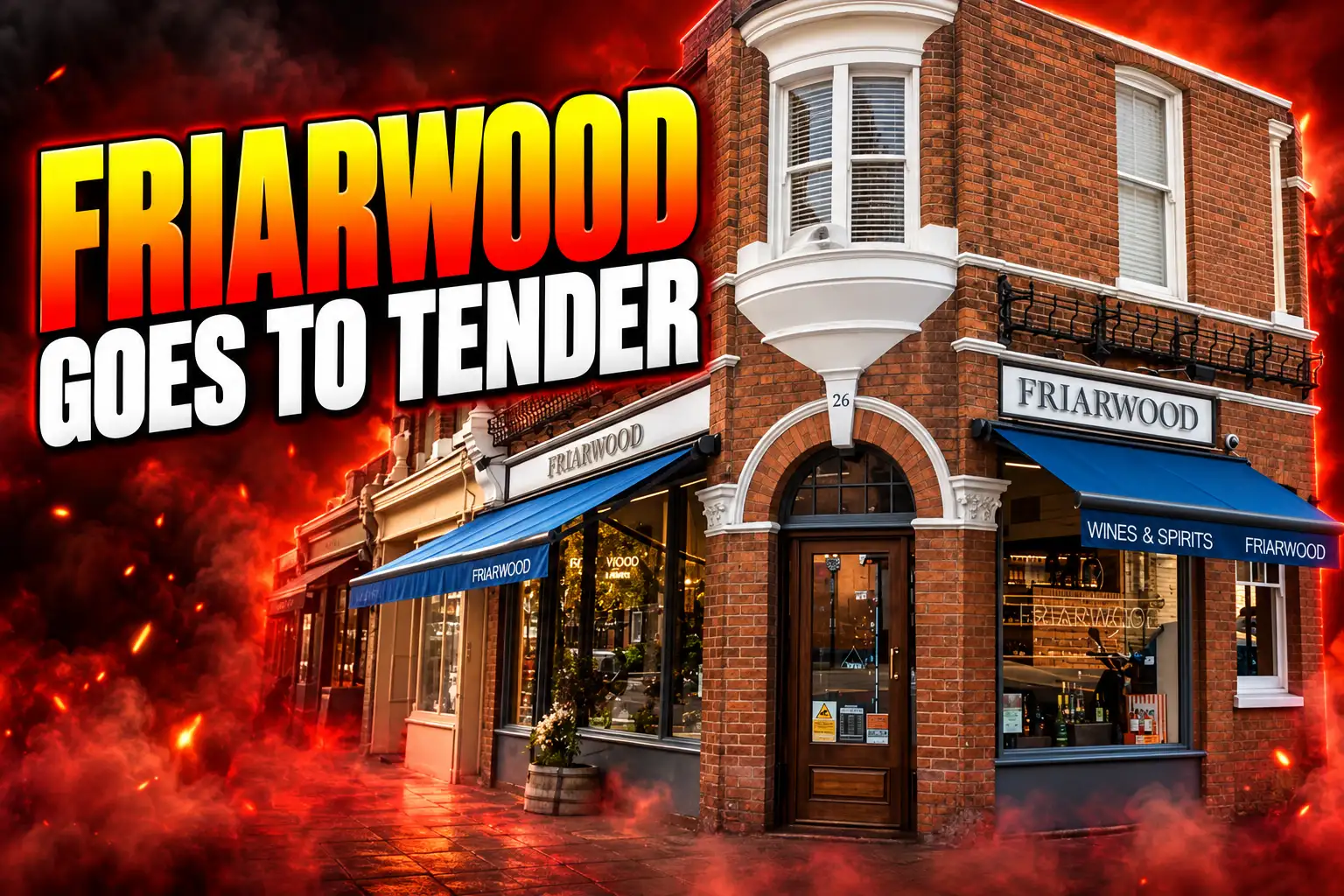
Walk-in trade had already stopped. The site told customers to order online by a Monday cutoff, said deliveries would still go out after the last day of trading, and kept click-and-collect at 26 New Kings Road, Parsons Green, until 7 August 2026, between 9am and 5pm. After that date the storefront was done. Wine-Searcher later marked the merchant closed.
A £234,000 Cellar Sat in a Barking Bond
Shop stock was the visible remainder. The heavier parcel never sat under the blue awning on New Kings Road. In September, Hilco Global, acting for the administrators, put the leftover fine wine and spirits out to tender from London City Bond’s Olympus warehouse at 91-101 River Road, Barking, Essex.
THE BARKING TENDER
- The parcel: Fine and rare Bordeaux and Burgundy, other premium French and Italian wines, plus aged Armagnac, rum, whisky and tequila.
- The ticket: Hilco put the in-bond stock listed at about £234,000 cost, duty unpaid.
- The lock: Bids closed at 12pm BST on Wednesday 25 September 2026, with notice to the winner due in one to three business days and payment due within 48 hours.
- The gate: Only buyers with an AWRS licence and bonded warehouse facilities could bid, on an as-is, where-is basis with no returns.
That gate is the whole point of the sale. A private customer who used to walk into Parsons Green could not bid, and neither could a sommelier who simply wanted the same list. Title passed only on cleared funds, and the buyer had 14 days after payment to pull the cases out of the seller’s bonded account or start paying storage.
Hilco also invited offers for the Friarwood name itself: the trademark, the website, the Shopify account, domain names, customer databases, social accounts and marketing assets. The cellar and the brand could go to different buyers. No public notice has named who, if anyone, won either lot.
Restaurants and Growers Are Left Off the Bid Sheet
Retail was never the centre of the book. When Ben Carfagnini opened the Wimbledon Village shop, the two stores were contributing about a third of turnover; the rest was wholesale into hotels, restaurants and private members’ clubs, sold as wines that could not be found anywhere else in London, most of it bought straight from producers. The company’s own trade pages pitched next-day delivery from a central London cellar of more than 14,000 bottles, with no minimum order for London drops, and stock held in those cellars, in UK bond, or on reserve at châteaux and distilleries.
Head buyer Auriane D’Aramon, who grew up on an estate in Saint-Émilion, told a 2016 trade interview that about 90 percent of the range came direct from producers. Two thirds of some 800 lines still came from France, though the list had been pulled off a strict Bordeaux and Burgundy diet toward the Loire, the Rhône, Bulgaria, Italy, Australia, Argentina, Chile and Canada. On-trade clients got same-day mixed cases and help building wine lists. The company’s later history page put the on-trade book at more than 200 accounts and the payroll at 18 people.
Those accounts do not get a seat in the Barking tender. A restaurant that listed an exclusive Friarwood grower has to find another importer, or drop the wine. A small estate that shipped on invoice sits as an unsecured creditor behind any secured lender and behind wages. The public row about the closure has treated it as another high-street shuttering, which is the easy photograph. The unpaid grower does not have a shopfront.
WHO IS LEFT OUTSIDE THE BOND
- On-trade lists: Michelin-starred dining rooms, hotels, caterers and members’ clubs that used Friarwood for bottles they said were not on the open London market.
- Direct producers: Estates in Bordeaux, Burgundy, Tuscany and the rest of the expanded list, now chasing an insolvent UK importer.
- Shop regulars: Parsons Green and Wimbledon Village customers who lost tastings, including late events such as Cellar Sounds at the Wimbledon shop in November 2025.
- Brand bidders versus creditors: A licensed rival can buy the name and the cases; trade suppliers cannot jump the queue by wanting their own wine back.
Premium spirits, added in 2023, sit in the same sale as the claret. Rare Armagnac and tequila do not change the legal order of who gets paid.
Peter Bowen Built It, Then Handed It On
Peter Bowen founded Friarwood in 1967 in Sands End, using château contacts in Bordeaux and, in the company’s telling, delivering on a horse until he could afford a car. The firm became a large UK importer of Bordeaux and later claimed exclusive lines into top restaurants and hotels. Retail arrived late: the Parsons Green showroom opened from the office in 2001. A second shop followed at 31 High Street, Wimbledon Village, in 2017.
The legal vehicle now in court is younger than the trading name. Friarwood Fine Wines Limited was incorporated on 9 December 2014, days after Bowen’s death that September, first under the shelf name Ingleby (1969) Limited. Carfagnini, a Canadian who had arrived in 2010 as an unpaid intern after leaving landscape architecture, had done an MBA in Bordeaux, come back to run on-trade sales, and then bought the business in February 2015 after Bowen’s widow, Isabelle, offered it to him.
“When Peter passed away, in September 2014, Isabelle came to me and offered me the opportunity to purchase Friarwood so I went from internship to ownership in only a few years,” Carfagnini said in a 2017 interview. He also said the Parsons Green shop had still been running on pen and paper, with no till, no EPOS and no wifi, and that the first website and then e-commerce followed in 2016. On the company’s own LinkedIn, the firm later said it had come in at number 46 on Harpers’ Top 50 Drinks Wholesalers for 2025.
The “family-run London merchant” line always skipped a filing. Companies House still shows that a majority of the voting rights sit with Jay Anthony Carfagnini, a Canadian living in Canada, at more than 50 percent but less than 75 percent. Ben holds more than 25 percent but not more than 50 percent. The intern who became managing director was never the majority owner on the register.
HOW THE BOOK WAS ASSEMBLED
- 1967: Peter Bowen founds Friarwood as a London Bordeaux wholesaler.
- 2001: Retail opens from the Parsons Green office at 26 New Kings Road.
- September 2014: Bowen dies; Isabelle offers the firm to intern-turned-salesman Ben Carfagnini.
- 9 December 2014: Friarwood Fine Wines Limited is incorporated; Carfagnini completes the purchase in February 2015.
- 2016 to 2017: E-commerce launches, then a second shop in Wimbledon Village.
- 2023: The firm adds premium spirits to the wine book.
- 3 July 2026: Administrators are appointed; collect-from-store ends on 7 August 2026.
- 25 September 2026: The bonded tender closes at London City Bond in Barking.
D’Aramon stayed the public face of buying, a winemaker by training with an INSEEC MBA, while Carfagnini ran the commercial side. The heritage the pair kept selling was Bowen’s château network. That network is what the Barking catalogue is now reducing to lots.
Debts Rose to £2.22 Million as Cash Shrank
The company filed small-company accounts and did not publish a profit and loss. The balance sheet that is on file is still enough to show why a rescue as a going concern was unlikely by the time Batty and Jesseman arrived.
LAST ACCOUNTS TO 31 MARCH 2025
| Measure | 31 March 2024 | 31 March 2025 |
|---|---|---|
| Debts | £1.79 million | £2.22 million |
| Net assets | £675,491 | £319,352 |
Net assets more than halved in a year. Debts rose by £430,000 to £2.22 million. The same accounts put total assets at £2.6 million and cash at bank at £3,000. The September bonded parcel, at about £234,000 cost, is a later snapshot of what had not been sold in the 60 percent shop clearance; it is not a second count of the March 2025 stock figure. Even if that parcel sold at cost, it would cover about a tenth of the debts on the last filed sheet.
Companies House now records that Friarwood Fine Wines Limited is in administration, with last accounts made up to 31 March 2025. No administrator’s progress report naming recoveries has been posted in public notices alongside the original appointment. Unsecured suppliers will learn those numbers from the office-holders, not from the shop window.
Novel Wines and MWH Show the Same Squeeze
Friarwood did not fall over in a quiet year for drinks wholesalers. MWH Wine Merchants Limited, a Reading independent, had liquidators Thomas Edward Guthrie and John William Rimmer of BRI Business Recovery appointed on 13 May 2026, after which its site went dark. Novel Wines, an online specialist in lesser-known bottles that had shut its Bath shop in 2024 to lean on wholesale and the web, had Richard Cole and Stephen Kenny of KBL Advisory appointed on 18 September 2026, a week before Friarwood’s bonded bids closed.
The cost stack is the same one other merchants have been naming in public. Alcohol duty moved in February 2025 from a banded rate on still wine to a strength-by-strength charge, which Majestic chief executive John Colley said forced the chain to delist small-vineyard wines because the paperwork and the tax no longer paid. Business-rate Covid relief was also coming off. Taurus Wines’ Rupert Pritchett put the new rates bill at 12,160 bottles of £10 wine if those bottles had to fund it, plus the VAT and import duty the Treasury already takes on the same case. Extended producer responsibility added a glass packaging levy on top, with base fees quoted at £192 a tonne once the rate was set.
That is not unique to Parsons Green. It is the climate in which a specialist importer with £3,000 in the bank and £2.22 million on the other side of the ledger runs out of time. The Insolvency Service counted 151 administrations in January 2026 in England and Wales, 41 percent more than December 2025 and 14 percent more than January 2025, even as overall company insolvencies that month, at 1,744, were still 14 percent lower than a year earlier. Administration is the tool directors reach for when they still think there is a book worth selling. Friarwood used it. The shops still closed.
The Friarwood Name Is on the Block Too
A licensed merchant who won the Barking lots can move the cases into another bond within 14 days of paying and sell them under a different label tomorrow. Winning the name is a separate bet: databases, a Shopify login, and a trademark that still means château allocations to a few hundred on-trade buyers. Whether anyone wanted that second lot, and at what price, has not been published.
Collection at Parsons Green ended on 7 August 2026. The tender closed on 25 September. The company remains in administration, the website remains a closed-store notice, and the growers who used Friarwood as their London pipe are still creditors, not bidders.

The Court Revisits the Climate Nuisance Door It Left Open

ChatGPT Now Compiles Live Interfaces With GPT-6

A Tanker Attack Moves the War Into Qatar’s Waters

Personio Buys Circula to Own the DATEV Channel

Bluesky Files for .bsky and Enters the Registry Queue

Musk’s $914 Billion Lead Is a Public SpaceX Bet

Microsoft’s 96% Cyber Score Sits at 86.3% on the Board

Endgame Encore’s $86 Million Trial for Infinity Vision

Free Live Sports Streaming in 2026: What to Watch Without Cable

Andrew Garfield’s Spider-Man Films Are No Longer Free
-
 BUSINESS4 months ago
Musk’s $914 Billion Lead Is a Public SpaceX Bet
-
 NEWS2 months ago
Microsoft’s 96% Cyber Score Sits at 86.3% on the Board
-
 SPORTS3 months ago
Free Live Sports Streaming in 2026: What to Watch Without Cable
-
 ENTERTAINMENT3 months ago
Endgame Encore’s $86 Million Trial for Infinity Vision
-
 ENTERTAINMENT2 years ago
Andrew Garfield’s Spider-Man Films Are No Longer Free
-

 NEWS4 months ago
Singapore’s 3×3 and Surfing Debuts Miss the Medal Stand
-

 ENTERTAINMENT1 month ago
Sterling Point Holds No. 2 on Prime Video After 32 Days
-

 NEWS6 months ago
White Sands Footprints Put People in Ice Age New Mexico