Volkswagen licensed its name and its car safety technology to a new eBike range, unveiled Tuesday in Wolfsburg, Germany, with prices starting at $4,000. The bikes come from n+, an eBike maker building under license from the automaker, and lean on radar sensors, a handlebar-mounted camera and automotive-style brake lights to make the pitch.
One feature does not travel well. n’s own release admits the eBike’s automotive-style brake and turn-signal lighting is not street legal to use as designed in Germany and France, Volkswagen’s home country and one of Europe’s largest cycling markets.
n+ Builds the Bike, Volkswagen Lends the Playbook
n+ designs and manufactures the range. Volkswagen’s accessories, lifestyle and licensing division signs off on the branding and the safety philosophy behind it. It is a license, not a joint venture, so n+ carries the manufacturing and inventory risk while Volkswagen supplies the badge and the engineering references.
Technologies like these are most commonly known from the automotive world. Seeing them make their way onto an e-bike demonstrates how technologies can evolve and be adapted in meaningful ways.
Peter Jost, chief executive of Volkswagen’s accessories, lifestyle and licensing business, made the comment in the announcement, pointing to how far automotive engineering can now travel from the factory floor.
This is not Volkswagen’s first bicycle deal. The automaker previously struck an e-bike partnership with Dutch cycling group Pon Holdings, and separately let e-bike maker MC E-Bike build a cargo bike modeled on its Bulli van. What changes with n+ is the emphasis: not motor power or battery size, but sensors and lighting borrowed from a modern dashboard.
n+ packages the idea into four pieces of connected hardware:
- Smart View – a radar-linked camera built into the handlebars for a live rear view
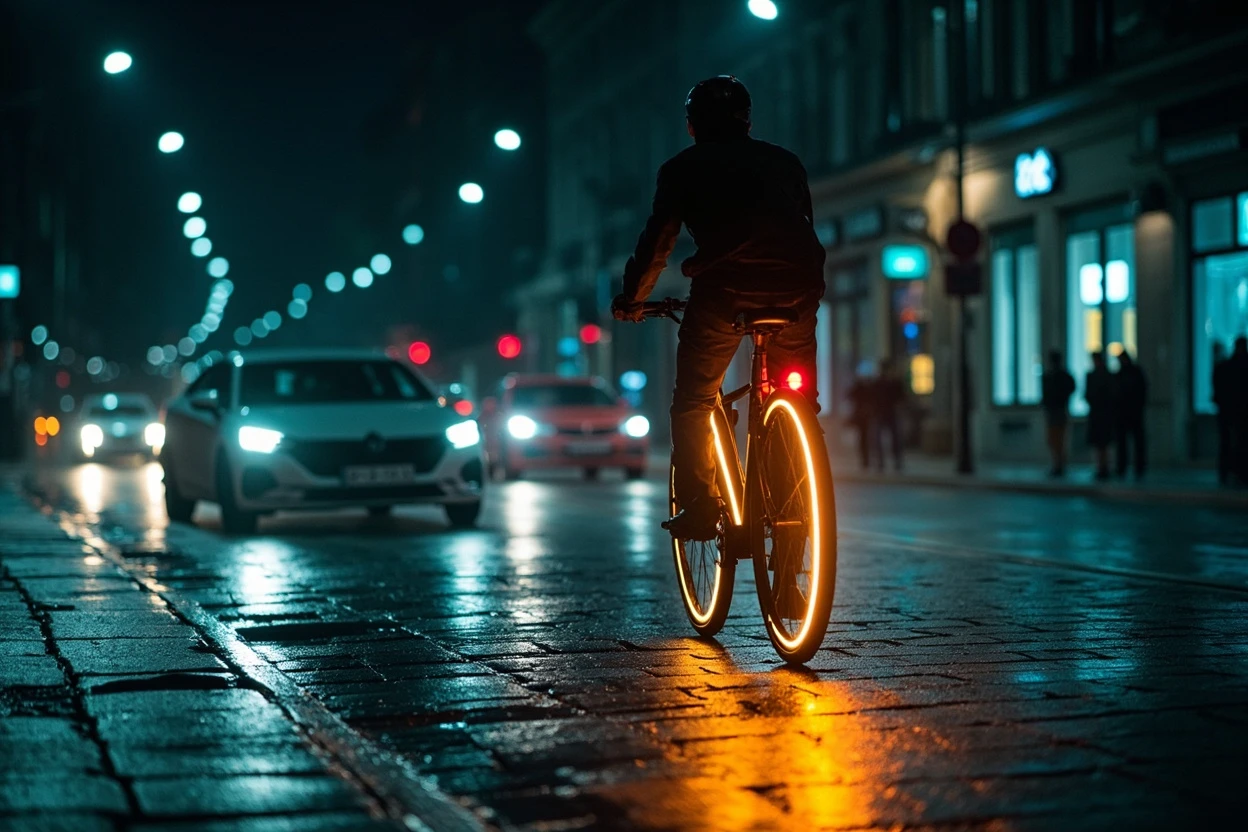
- Smart Lights – a full-length LED strip that brakes and signals like a car
- Smart Helmet – a Bluetooth-linked helmet with repeater lights and crash detection
- Smart Glasses – heads-up display glasses built with input from fighter-jet cockpit engineers
Smart View and Smart Lights come standard on both launch models. The helmet and glasses sell separately, at extra cost.
Eyes in the Back of the Handlebars
Smart View puts a small screen where a cycling computer usually sits, built into a handlebar console designed to resemble a car’s instrument cluster. It streams a live rearward video feed from a camera mounted behind the saddle, so a rider can check traffic without turning around.
Radar sensors handle the rest. They track vehicles approaching from behind and trigger a blind-spot alert before a driver gets close, the same logic that has flagged lane-change hazards in passenger cars for more than a decade.
The Top Tube Learns to Blink
The most visible new part of the bike is not a screen. It is a full-length LED strip built into the top tube, the horizontal bar a rider’s leg swings over on every pedal stroke.
Volkswagen designed the strip to echo its cars’ light signature: a daytime running light when idle, a red glow under braking and an amber flash when a rider signals a turn. Drivers already read those colors instinctively. Putting them on a bicycle is meant to close the gap in how cars and bikes communicate on the same road.
The One Feature Wolfsburg Can’t Switch On
n+’s own release carries a footnote most companies would rather bury. The brake-red and turn-amber lighting behavior at the center of the pitch is not street legal to use as designed in some countries, and the release names two: Germany and France.
Volkswagen has built cars in Wolfsburg since 1938. Its headquarters city sits inside one of the two markets where its new bike cannot legally do the one thing it was designed to do. France, the release’s other named market, is among Europe’s largest cycling nations, with its own strict rules on what lights a pedal cycle may carry.
Neither company says whether the feature ships switched off in those two markets or whether riders there must disable it themselves. The release does not address it.
The Injury Numbers Behind the Timing
The safety pitch lands as e-bike injuries climb sharply in the same markets these bikes target. A 2026 tally of national emergency-room data tracks the toll rising across several measures:
- 59,200 e-bike injuries treated in U.S. emergency rooms in 2024, up from roughly 26,800 two years earlier
- 97 e-bike deaths recorded in 2024, up from zero in 2017
- 44% of injured riders were wearing a helmet at the time of the crash
- 48% lower head-injury risk for riders who do wear one, based on a review of 55 studies
CNN reported in May that the rising toll is already fueling new regulatory and accountability scrutiny in multiple U.S. states. That shift puts pressure on manufacturers to show they are building in safeguards, not just adding battery range and top speed.
Helmets and Glasses Extend the Safety Net
Two more pieces carry the system beyond the bike itself. The Smart Helmet syncs over Bluetooth and repeats the brake and turn signals in its own LED lights, so a driver behind a cyclist sees the same cue twice: once from the bike, once from the rider’s head. A built-in accelerometer detects a crash and sends a text alert to a preset contact.
Smart Glasses go further, projecting Smart View’s navigation prompts and blind-spot alerts directly into the rider’s field of vision, the same heads-up display (HUD, information projected into the wearer’s line of sight) logic used in modern car windshields, developed with engineers who built cockpit displays for fighter jets. A deliberate glance to the top right corner switches the display on or off.
Volkswagen’s record with in-car tech has not always been smooth. A review of the automaker’s Atlas Cross Sport SUV called its infotainment system stylish but frustrating, a data point worth keeping in mind for a bike that now asks riders to trust a heads-up display at speed.
Who Can Afford the Fully Loaded Bike?
A base Sport model costs $4,000 and a Crossover costs $4,350, both with Smart View and Smart Lights included standard. Adding the optional Smart Helmet and Smart Glasses pushes a fully equipped Crossover to $5,250. That price range points the lineup at enthusiasts and early adopters rather than the commuters and delivery riders most exposed to the injury numbers above.
| Item | Price | What It Adds |
|---|---|---|
| VW Sport eBike | $4,000 | Base model with Smart View and Smart Lights standard |
| VW Crossover eBike | $4,350 | Same camera, radar and lighting hardware in a crossover frame |
| Smart Helmet (add-on) | +$400 | Bluetooth sync, repeater LEDs, crash-detection alert |
| Smart Glasses (add-on) | +$500 | Heads-up navigation and blind-spot prompts |
| Fully equipped Crossover | $5,250 | Crossover plus both wearable add-ons |
The same combination on the Sport model runs $4,900. Distribution matches the price: n+ is selling through selected partners and directly at smart-bike.net, with orders open now and shipments expected between October and December 2026.
This launch also lands as Volkswagen’s core car business retrenches at home. The automaker has moved to close or restructure several German plants and cut thousands of jobs as demand cools, a contrast to a licensing deal that puts n+, not Volkswagen, on the hook for manufacturing and inventory. The bikes built to make city streets safer will not reach any street before October.
Frequently Asked Questions
How much does the Volkswagen eBike cost?
The Sport model starts at $4,000 and the Crossover starts at $4,350, both with Smart View and Smart Lights included. Adding the Smart Helmet and Smart Glasses brings a fully equipped Crossover to $5,250. n+ has not said whether Smart View or Smart Lights will ever be sold as standalone kits for other bikes.
When can I actually buy one?
Orders are open now through n+’s website and select partners, but delivery is not immediate. n+ expects the first bikes to ship between October and December 2026, so early buyers will wait several months before riding.
Does the Smart Helmet call for help automatically in a crash?
Not quite. The helmet’s built-in accelerometer detects a crash and sends a text message to a preset contact, closer to a personal alert than the automated emergency-service dispatch built into some connected cars. Riders who want a direct line to first responders still need to arrange that themselves.
Can the Smart Glasses be used without the eBike?
Yes. n+ designed them to double as everyday sunglasses and says they work for motorcycling, driving or action sports beyond cycling, not only alongside the Smart View camera system.
What motor and range does the Volkswagen eBike have?
Both models use a 250-watt Yamaha motor with pedal assistance capped at 15 mph, in line with European pedelec rules, and a claimed range of up to 100 miles under ideal conditions. Real-world range will vary with rider weight, terrain and how much of that assist gets used.
Is the Volkswagen eBike legal to ride in Germany and France?
Yes, the bicycle itself is legal to ride. What is restricted is the automotive-style brake-red and turn-amber flashing behavior of the Smart Lights strip, which n+’s own release lists as not street legal to use as designed in some countries, specifically naming Germany and France.