Vietnam’s central bank has told 25 commercial banks they can lend more for social housing, industrial parks and export processing zones in 2026 without that money counting against their real estate credit ceilings. The carve-out, set out in an official dispatch dated December 31, 2025, runs for the full calendar year and applies to any new lending above each bank’s end-2025 balance in those segments.
Affordable housing gives the policy its public face. But the segment with the most to gain from looser bank financing is industrial property, the factory parks and export zones that house the foreign manufacturers powering Vietnam’s growth, and the whole device is a temporary fix inside a quota system Hanoi has already decided to retire.
What the Central Bank Carved Out of the Ceiling
The mechanism is narrow and specific. Loans extended between January 1 and December 31, 2026 to social housing projects, industrial parks and export processing zones, to the extent they exceed each lender’s balance at the close of 2025, will not be counted toward that bank’s real estate credit growth limit for the year. Everything below the 2025 baseline still counts as normal.
The guidance reached 25 commercial banks, a list that mixes the big state-linked lenders with large private players. The State Bank of Vietnam attached a guardrail to the favour: real estate credit growth at any of these institutions must not outpace its overall credit growth for the year, and banks that breach that ratio risk having their quota trimmed.
The named recipients span much of the system’s lending capacity:
- State-linked majors: VietinBank, Agribank and BIDV
- Large private lenders: Techcombank, ACB, Sacombank and MSB
- Mid-tier banks: Eximbank, Nam A Bank and Saigonbank
You can read the exemption two ways. It is a subsidy of permission rather than price, since it does not lower a single interest rate; it simply removes a regulatory brake. For context on how Hanoi frames its monetary tools, the central bank’s 2026 credit guidance sits within a wider effort to steer capital toward production and away from speculation.
Why the Exemption Lands Now
Credit has been running hot all year, and that is the pressure the carve-out answers. The central bank reported total outstanding loans of more than VND19.4 quadrillion, around 737 billion US dollars, as of April 28, 2026. Banks have been eating through their allocated room quickly, which is exactly when a sector-specific exemption becomes valuable: it lets a lender keep financing priority projects after its general ceiling tightens.
- +18.26% year-on-year growth in total outstanding credit as of late April 2026
- +4.42% credit growth since the end of 2025, in under four months
- VND4.3 quadrillion in agriculture and rural lending, about 22.2 percent of the loan book
This is also the second straight year banks have entered with a binding constraint. Vietnam’s banking sector spent the back half of 2025 squeezed for headroom, a dynamic covered in our look at Vietnam’s banks hitting their 2025 lending limits after a fast start exhausted most institutions’ allocations.
The timing matters for a second reason. Prime Minister Pham Minh Chinh has tasked the central bank with piloting the removal of the credit growth quota itself from 2026, replacing the rigid cap with criteria based on bank governance and safety indicators. By early 2025 the regulator had already lifted the ceiling for foreign banks, joint-venture lenders and non-bank credit institutions, keeping it only for domestic commercial banks. The social housing carve-out, in other words, is a patch on a system Hanoi is actively trying to dismantle, a tension laid out in the government’s plan to phase out credit quotas.
Industrial Parks Are the Quieter Winner
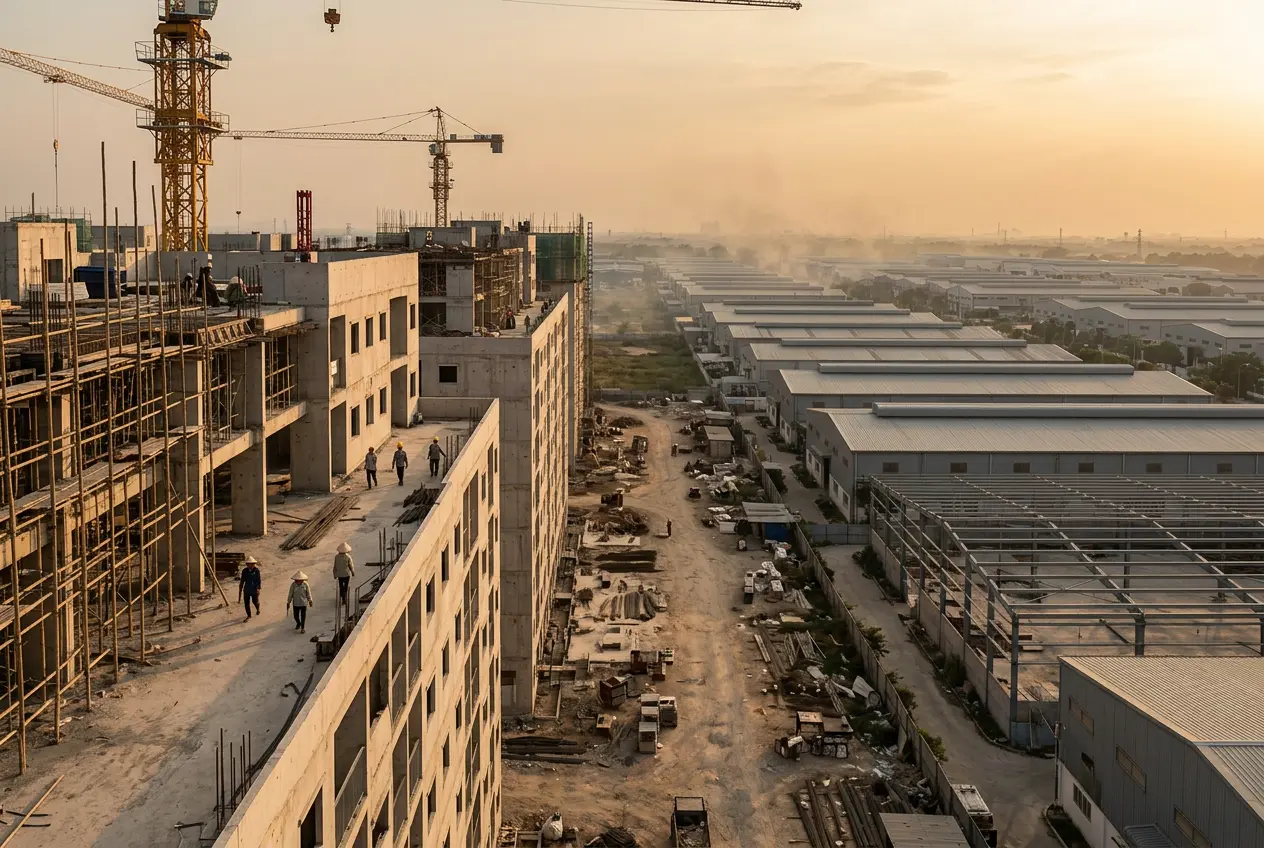
Strip away the housing language and the exemption looks like industrial policy wearing a welfare label. Export processing zones and industrial parks are bundled into the same carve-out, and they sit at the heart of the manufacturing build-out that foreign investors keep funding.
The FDI Engine Behind the Carve-Out
Vietnam now counts 478 operational industrial parks, with average occupancy running between 80 and 85 percent and southern zones near saturation at 89 to 92 percent. Realised foreign direct investment (FDI, money actually deployed rather than pledged) reached an estimated 7.40 billion US dollars in the first four months of 2026, up 9.8 percent year-on-year, while newly registered FDI in the first two months jumped 61.5 percent. Credit to export-oriented firms grew 11.2 percent in the first quarter, and lending to high-tech companies rose 18.81 percent.
That demand needs warehouses, ready-built factories and serviced land, all of which run on bank debt. Vietnam’s pitch to manufacturers leaving China depends on supply keeping pace, the kind of capacity question that runs through the World Bank’s Vietnam growth outlook.
Why Developers Kept Bumping the Ceiling
Industrial property is classified as real estate, so every loan to a park developer competes for room under the same ceiling that captures luxury condos and land banking. By lifting incremental factory-zone lending out of that bucket, the central bank lets banks fund the productive end of property without it crowding out, or being crowded out by, speculative housing exposure.
| Priority channel | Outstanding loans | Main lenders | Status check |
|---|---|---|---|
| Social housing | ~VND41 trillion (mid-March 2026) | Vietnam Bank for Social Policies plus commercial banks | About 62% of the 1 million-unit goal |
| Industrial parks and export zones | Part of the wider real estate book | Commercial banks | 478 parks, 80% to 92% occupancy |
Social Housing’s Numbers Tell a Slower Story
The housing side of the ledger is smaller and stickier than the political attention suggests. Total outstanding loans under social housing programmes had reached roughly VND41 trillion as of mid-March 2026. The state-owned Vietnam Bank for Social Policies’ lending programmes accounted for more than VND25 trillion of that, with commercial banks adding over VND16 trillion at preferential rates that start around 5.6 percent a year.
Output has actually beaten plan recently. Vietnam completed 102,633 social housing units in 2025, about 2 percent above the annual target, lifting the national programme to roughly 62 percent of its goal of one million units between 2021 and 2030. Around 698 projects covering more than 657,000 units are under construction.
The harder part is the back-loaded schedule, which assigns localities a steep climb toward 2030: 116,347 units in 2026, 148,343 in 2027, 172,402 in 2028, 186,917 in 2029 and 271,161 in 2030. Cheaper bank credit helps, but high land costs, scarce sites and slow administrative approval remain the binding constraints, none of which a credit exemption directly touches.
Where the Carve-Out Could Leak
A permission-based subsidy invites gaming, and that is the central risk. The line between a priority project and a speculative one is drawn by classification, which means the value of the exemption depends on how strictly banks and the regulator police what actually qualifies.
Three pressure points stand out:
- Label arbitrage: mixed-use developments can dress up market-rate components as social housing or industrial support to slip lending under the exempt category.
- Disbursement, not approval: the bottleneck for affordable housing is land and permits, so freed-up credit may sit idle if projects cannot break ground.
- A soft guardrail: the rule that real estate credit must not outgrow total credit is a ratio, and ratios bend when overall lending is already expanding near 18 percent year-on-year.
There is a system-wide tail risk too. As Western banks have shown, regulatory nudges that wave capital toward favoured sectors can pull lenders back toward thinner credit standards, a pattern visible in how banks have drifted back toward riskier lending when the incentives lean that way.
A Patch Inside a System Being Dismantled
The exemption only makes sense because the quota still exists. Once the central bank delivers on the 2026 pilot to scrap the credit ceiling for domestic commercial banks, the carve-out loses its purpose, since there would be no cap to carve out of. That makes this a transitional instrument, useful for one budget year while the bigger reform is engineered.
For now, the policy reveals what Hanoi values most when capital is scarce: factory floors and affordable flats over speculative towers. Whether the money follows the permission is the open question, because banks have been handed room to lend, not an obligation to.
If incremental factory-zone and social housing loans visibly climb through the second half of 2026, the exemption will have done its job and the quota’s removal becomes easier to sell. If the new lending stays flat while developers chase classifications, the central bank will have proven that the ceiling was never the real bottleneck, and the 2027 reform arrives with a harder problem to solve.