Transport operators squeezed by volatile diesel prices are hearing a confident pitch from the dashcam industry: let an artificial intelligence (AI) system watch the driver, and the fuel bill falls. Netradyne, the San Diego fleet-safety firm, says its customers report saving as much as 25 percent on fuel after fitting its driver-monitoring camera platform, a number its senior executive repeated in India this week.
On June 2, the company announced a tie-up with National Highways for Electric Vehicles (NHEV), a government-backed corridor project, to push that technology onto India’s long-haul freight routes. That deal, more than the fuel arithmetic, is what shifts the ground under Indian fleets.
The 25 Percent Pitch and Who Is Making It
The claim came from Durgadutt Nedungadi, Senior Vice President for EMEA and APAC business at Netradyne, speaking to news agency ANI on the sidelines of the event. His argument is that fuel scarcity and price swings hit logistics operators hard, and that software is the cheapest lever they have left to pull. He framed rising risk as the very reason to spend on technology rather than cut back.
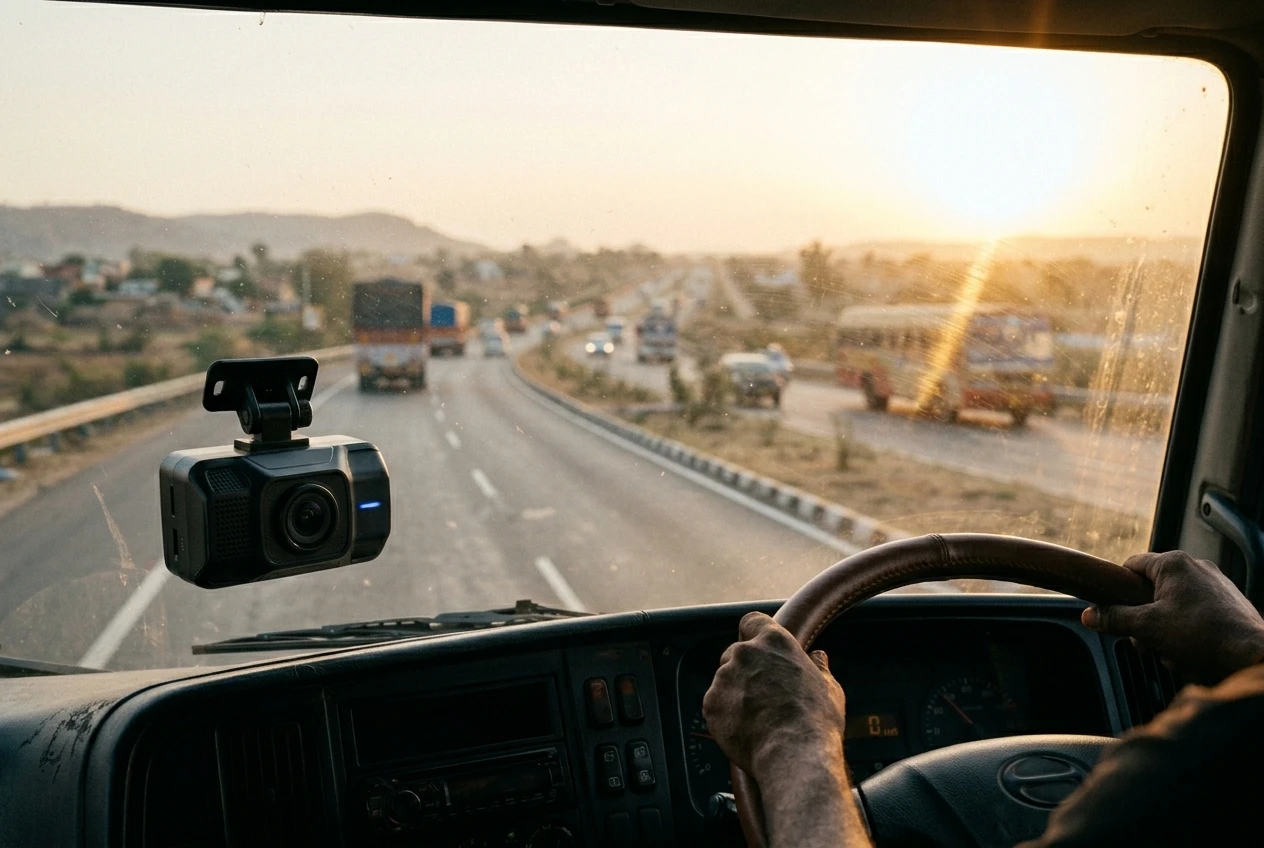
The executive tied the savings directly to how people drive. Hard braking, harsh acceleration, speeding and long idling all burn diesel, and a camera that flags those habits in real time, he said, changes them. His customers see the fuel line move as driving scores climb, and accident rates fall alongside.
Their data shows that they’re saving up to 20 to 25 per cent on fuel because of the use of AI in our tech.
That is a striking figure, and it deserves a caveat the pitch tends to skip. The numbers are customer-reported and cited by the vendor, not independently audited. Nedungadi also said there is a clear link between better driver behaviour and lower fuel cost, which the research broadly supports. How big that link is, and how much of the 25 percent is real, is where a closer look helps.
What the Independent Fuel Numbers Say
Driver behaviour genuinely moves fuel economy. Researchers estimate it accounts for up to 30 percent of a heavy truck’s miles-per-gallon (MPG, a standard fuel-efficiency measure) outcome, so coaching it has real value. The open question is the size of the prize.
Independent studies tend to land below the vendor’s top figure. A 2022 review by the Traffic Injury Research Foundation (TIRF) put eco-driving fuel savings at up to 15 percent, with the most efficient behaviour reaching around 20 percent. A federal trial of in-truck telematics feedback, run for the United States Department of Transportation (DOT), measured gains of 5.4 percent for sleeper-cab drivers and 9.3 percent for day-cab drivers.
| Source | Reported fuel saving | Basis |
|---|---|---|
| Netradyne (vendor, customer-reported) | Up to 20 to 25% | AI driver-monitoring cameras |
| TIRF 2022 review | Up to 15 to 20% | Eco-driving behaviour |
| US DOT telematics trial | 5.4 to 9.3% | In-truck real-time feedback |
| Fleet eco-driving analytics (industry range) | 10 to 25% | Behavioural coaching |
The pattern is consistent. Real savings show up, usually in single or low double digits, with the headline numbers sitting at the optimistic edge of the range. Fleets that already run disciplined operations see less; those starting from poor habits see more.
None of this makes the technology a bad buy. It means the fuel case on its own is thinner than the brochure, and the smarter operators treat the top figure as a ceiling reached by the worst-behaved fleets, not a baseline they can bank.
The NHEV Tie-Up Wires AI Into India’s Highways
The partnership announced this week pairs NHEV’s corridor infrastructure with Netradyne’s analytics across connected commercial electric vehicles (EVs). Rolled out in phases, it promises real-time fleet visibility, predictive risk alerts, driver-behaviour insights and corridor-level operational monitoring for long-distance hauls. The road authority builds the network and charging spine; the camera firm supplies the intelligence layer that rides on top of it.
That split is the real story for India. Once cameras feed a shared corridor system, highways stop being passive asphalt and start generating a continuous stream of driving, routing and risk data. India’s logistics sector is already being reshaped by a wave of startups rebuilding its supply-chain maps, and instrumented corridors push that further by turning every long-haul trip into a measurable, scoreable event for operators, financiers and insurers alike.
Safety and Insurance, Not Only the Fuel Bill
Where the Value Migrates
Fuel is the easy headline, but it is rarely why fleets sign up. Research firm Mordor Intelligence tracks a global video telematics market that is growing steadily, with software and analytics expanding faster than the cameras themselves, a sign buyers are paying for insight more than hardware.
- 10.38 million units in the 2026 video telematics market, on track for 14.28 million by 2031.
- $1.35 billion valuation from Netradyne’s early-2025 funding round.
- Around half the accident rate, the cut Netradyne says its alerts deliver.
Netradyne sits near the front of that shift. The company says it has analysed more than 25 billion miles of driving data and raised a $90 million round in early 2025. Heavy trucks make up roughly a third of the video telematics market, the segment where fuel and safety stakes are both highest.
Why Insurers Are Watching
The insurance angle is where the data earns its keep. Mordor Intelligence reports that 88 percent of fleets now deploy video mainly for safety, and about 30 percent share footage with insurers. Clean footage settles liability disputes fast and can pull premiums down, a saving that often dwarfs the fuel line.
For an operator weighing the spend, that reframes the calculation. A camera that trims premiums and clears one disputed claim can pay for itself before the fuel savings even register, which is why adoption keeps climbing even where diesel prices hold flat.
That logic is spreading across logistics. Big operators are folding it into innovation programmes; GXO Logistics, for one, has launched a UK accelerator scouting startups that slot into live warehouse and transport operations.
The Surveillance Bill Riding Shotgun
The same cameras that score fuel also watch the driver’s face. Inward-facing lenses flag drowsiness, distraction, phone use and missing seatbelts, with detection rates that vendors put between 88 and 99.5 percent. That accuracy is exactly what unsettles the people behind the wheel.
In mature trucking markets, drivers and unions have pushed back hard, arguing the cameras work less as a safety aid than as a disciplinary tool, with managers reviewing footage for reasons unrelated to the road. In most places companies must tell drivers a camera is fitted, but they rarely need consent, leaving the workforce with a blunt choice between the lens and the job.
India offers far thinner privacy protection for workers than Western markets, and a corridor-wide rollout would normalise constant in-cab monitoring across hundreds of thousands of vehicles. For drivers, the productivity gains the industry celebrates arrive bundled with a permanent audience.
India as the Next Growth Frontier
India is where these forces collide. Asia-Pacific is the fastest-growing region for video telematics, expanding at a 7.57 percent compound annual growth rate (CAGR) through 2031, and Netradyne says it expects the broader mobility industry to grow 30 to 40 percent globally. The country’s freight fleets are a prime target for both ambitions.
The safety stakes are stark. India recorded about 4.73 lakh road accidents and 1.70 lakh deaths (roughly 170,000) in 2024, according to provisional Ministry of Road Transport and Highways accident data, with trucks the single largest category of vehicle involved in crashes. On corridors that deadly, even modest gains in driver behaviour translate into lives, not just litres of diesel.
Netradyne’s growth so far has come largely from North America, which still holds the biggest slice of the market. India, with its scale and its accident toll, is the kind of frontier that could either validate the 30 to 40 percent ambition or expose how far real-world savings sit below the sales deck.
If the cameras deliver those safety gains on India’s worst corridors, the fuel savings will end up looking like the minor benefit. If they mostly add a layer of driver surveillance with returns closer to the studies than to the pitch, fleets will have bought the data and drivers will have absorbed the cost.