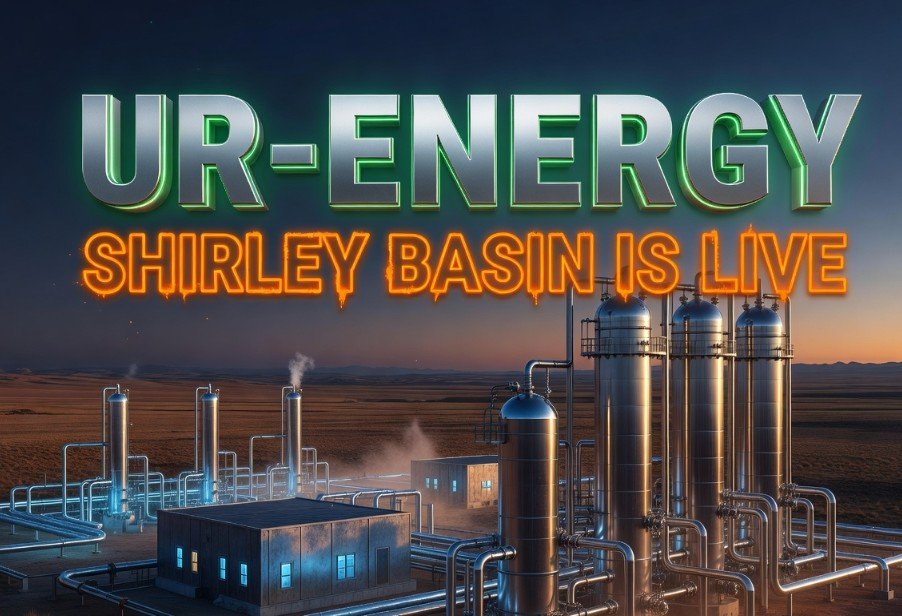
A uranium district that helped write American mining history has just come roaring back to life. In April 2026, Ur-Energy officially commenced mining operations at its Shirley Basin project in Wyoming, activating a smart, low-footprint satellite processing model that is quickly becoming the blueprint for modern uranium recovery in the United States.
This is not just a company milestone. It is a signal to the entire nuclear fuel supply chain that domestic uranium production is moving again, and moving fast.
The Ground That Changed Mining Forever
The Shirley Basin story starts long before any recent press release. In 1963, this very piece of Wyoming ground became the site of the first commercially successful in-situ recovery mining operation in the United States.
That distinction matters enormously. Before ISR, uranium meant blasting and digging, open pits carved into the landscape or dark underground shafts. Shirley Basin proved there was a better way.
The district initially used conventional underground methods starting in 1959. But within four years, operators demonstrated that uranium could be dissolved underground and pumped to the surface, eliminating the need for massive earthworks. Production eventually shifted to open-pit mining in the 1970s to meet surging Cold War demand, and the site ran continuously until 1992.
By the time the last ore was processed, Shirley Basin had become historically the second largest uranium producing district in Wyoming, producing more than 51 million pounds of U₃O₈ from 1960 through 1992. Now, three decades later, it is open again, and the technology driving it is far more precise than anything the Cold War era could have imagined.
How the ISR Satellite Model Actually Works
Most people picture mining as an act of physical removal. ISR flips that idea entirely. Modern ISR involves the circulation of naturally occurring groundwater, fortified with oxygen, through a uranium ore body. This natural water plus oxygen is pumped into injection wells, through the uranium ore body, where the uranium in the host sandstone is oxidized and solubilized, then continues through the sandstone to extraction wells where the uranium-bearing groundwater is pumped to the surface.
Once on the surface, that uranium-rich water runs through a critical piece of equipment: the ion exchange column.
The water proceeds to an ion exchange unit, like a big water softener, for uranium removal, and is then pumped back to the wellfield for re-fortification with oxygen, down into the injection wells, and again recirculated through the ore body. The uranium sticks to the resin beads inside the column. Everything else gets recycled back underground.
Here is where the “satellite” model becomes brilliant from an engineering standpoint. For small orebodies amenable to in-situ leaching where a central process plant may be distant from the mine, a satellite plant is set up. This does no more than provide a facility to load the ion exchange resin so that it can be trucked to the central plant for stripping. Hence very small deposits can become viable, since apart from the wellfield, little capital expenditure is required at the mine site.
That is precisely the setup Ur-Energy has deployed at Shirley Basin. Shirley Basin operates as a satellite operation integrated with Lost Creek, where uranium captured on resin will be transported to Lost Creek for final processing, drying, and drumming. The yellowcake, as packaged uranium concentrate is called, is then ready for the nuclear fuel supply chain.
Today, ISR accounts for about 60% of global uranium production. The satellite variant of that model is what makes smaller, stranded ore bodies economically viable in the modern era.
What Is Actually Happening Inside Shirley Basin Right Now
Ur-Energy Inc. is pleased to announce the start of uranium mining operations at its Shirley Basin Project in Wyoming. The company made that announcement on April 23, 2026.
But the groundwork runs much deeper than a single press release.
Ur-Energy made the decision to build out the fully permitted and licensed project in Carbon County, Wyoming, in March 2024, with the company estimating it would take about 24 months to finalize designs, order materials, and construct the satellite plant and initial wellfield. They hit that target almost exactly.
Here is the operational picture as of early May 2026:
- 540 wells had been pilot drilled as of March 31, 2026, with 312 of those wells cased and eight drill rigs active
- Five header houses had been constructed, with additional units underway
- The first header house (HH 1-1) was brought online in April 2026, with uranium-bearing solution now flowing through the plant
- Current flow rates are running at several hundred gallons per minute, with a full operational target of 6,000 gallons per minute
- First resin shipments to Lost Creek are expected this summer, pending final regulatory approval
Uranium concentrations in recovered solutions are expected to increase over time as the wellfield is further conditioned and all production circuits are brought online. This gradual ramp-up is standard ISR behavior. As leach solution circulates more extensively through the ore body, geochemical equilibrium builds, and uranium concentrations climb.
The numbers behind the project are compelling on their own.
| Metric | Figure |
|---|---|
| Licensed Annual Production Capacity | Up to 2.0 million lbs U₃O₈ |
| Measured and Indicated Resources | ~9.1 million lbs U₃O₈ |
| Average Ore Grade | 0.22% eU₃O₈ |
| Anticipated Mine Life | ~9 years across 3 mining units |
| Combined Capacity with Lost Creek | 4.2 million lbs U₃O₈/year |
Construction will continue through 2026, with additional plant systems planned for 2027. The site is fully staffed, supported by a phased hiring and training program aligned with operational ramp-up.
CEO Matt Gili did not understate what this moment means. “Two years ago, we committed to building out this project. Today, we have successfully brought a historically significant uranium district back to life, demonstrating disciplined execution of our strategy,” Gili said. “It is particularly meaningful as it supports the growing need for secure, domestic uranium supply and underscores our ability to move permitted projects toward production while strengthening our role in the U.S. nuclear fuel cycle.”
Why America Needs This Mine Right Now
Shirley Basin’s restart is not happening in a vacuum. It is arriving at precisely the moment the United States needs it most.
Uranium prices are surging in 2026 as a widening supply deficit collides with soaring demand from nuclear power plants and AI data centers. The market fundamentals are unlike anything seen in years.
Seventy-eight gigawatts of nuclear reactor capacity are now under construction across 15 countries, according to the International Energy Agency’s 2026 Global Energy Review, and global installed nuclear capacity sits at 420 GW. At the Paris Nuclear Energy Summit in March, 38 nations signed on to triple nuclear capacity by 2050, locking in sovereign fuel commitments that tighten the supply picture for years.
The problem is that supply is not keeping up.
The U.S. Energy Information Administration reported that domestic uranium concentrate production fell 44% in Q3 2025, to about 329,623 pounds of U₃O₈, from only six operating facilities, mainly in Wyoming and Texas. That is a sobering number for a country with 94 operating commercial nuclear reactors.
Geopolitics is adding more pressure. New restrictions on Russian uranium imports starting in 2028 further emphasize energy security risks. Meanwhile, interest in nuclear power has risen with the need for more diverse baseload power, enhanced energy security, and the development of new technologies such as small modular reactors, which could provide power for remote areas, industrial applications, and artificial intelligence data centers.
Ur-Energy’s financial positioning reflects a company that is playing a long game here. Ur-Energy holds uranium sales agreements totaling approximately 5.75 million pounds through 2033, providing long-term revenue visibility against spot price volatility. That is not a speculative play. That is a production company with contracts in hand and mines now running.
Lost Creek, Ur-Energy’s primary Wyoming facility, has already demonstrated what disciplined ISR operations look like. Lost Creek drummed 57,479 pounds in April 2026, its highest monthly total since the 2023 ramp-up decision. With Shirley Basin now feeding the same processing infrastructure, the combined output trajectory points sharply upward.
The satellite model Ur-Energy has deployed at Shirley Basin is not just operationally efficient. It is a template. It shows that permitted, resource-rich ISR sites can go from construction decision to active uranium production in roughly two years, at a fraction of the cost and environmental impact of conventional mining. Groundwater is restored using reverse osmosis, and surface areas are fully reclaimed, resulting in a smaller environmental footprint than conventional mining.
Shirley Basin gave the world ISR mining in 1963. Sixty-three years later, it is giving the world something just as important: proof that American uranium production can be rebuilt, responsibly and quickly, at a moment when the stakes for energy security have never been higher. For a country trying to feed a nuclear renaissance with a domestic fuel supply that has been hollowed out over decades, this Wyoming wellfield may end up being far more significant than it first appears. What do you think? Is the ISR satellite model the future of domestic uranium mining? Share your thoughts in the comments below.