Clean energy developer Avaada Group on Monday closed $950 million in debt financing for three utility-scale renewable projects, including what it calls India’s largest fundraise yet for firm and dispatchable renewable energy (FDRE, hybrid plants that pair solar or wind with battery storage to deliver power around the clock). The money, raised through separate bank consortiums for a project in Bikaner and two 300 MW solar plants, lands in a market that is rapidly rewriting how it buys clean electricity.
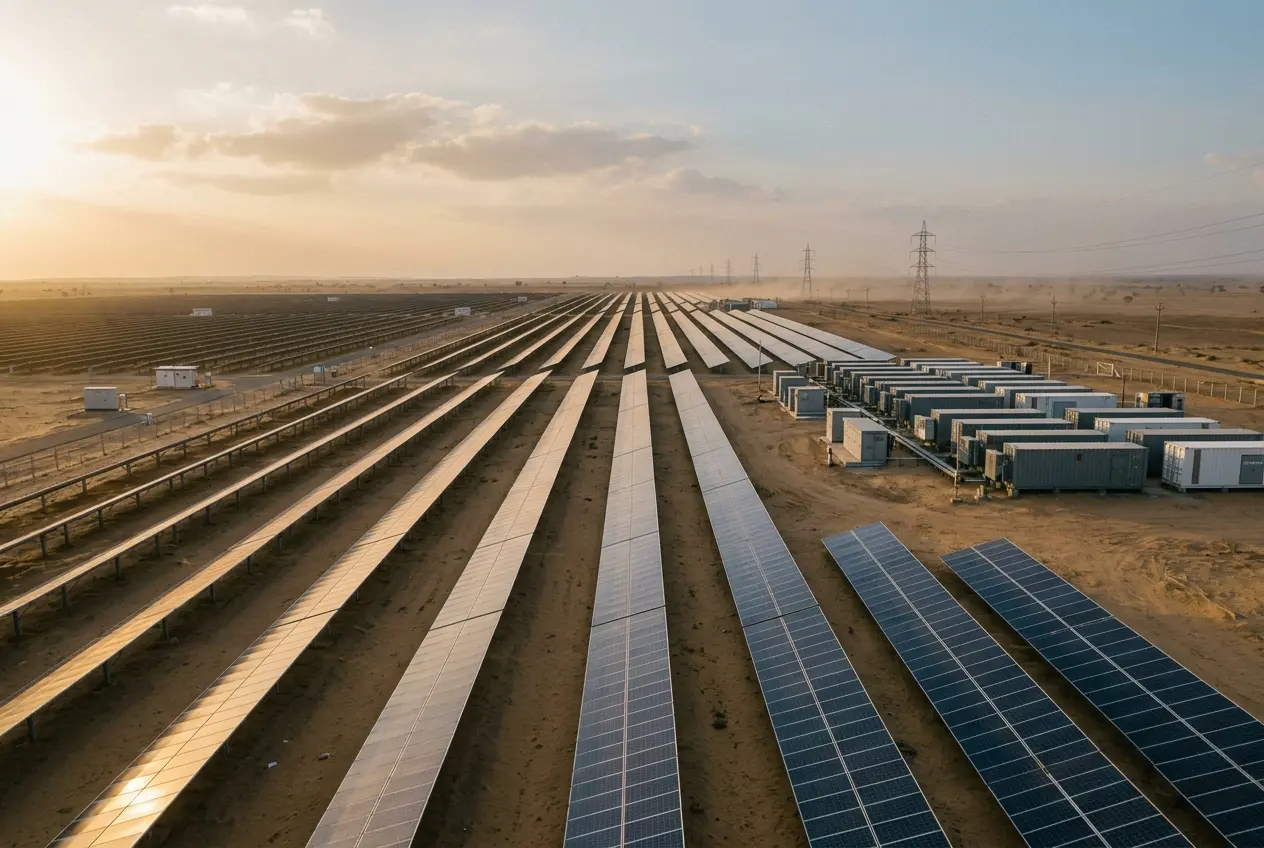
The headline number is the easy story. The quieter signal sits in the structure of the lead asset: seven international and Indian banks just underwrote a battery-anchored project whose value rests on delivering power at night, not at noon. That is a different bet from the cheap-daytime-solar model that built India’s renewable boom, and the lenders behind it are telling you where the country’s power market is heading.
The Deal That Closed in Mumbai
Avaada Group, the Mumbai-based developer led by chairman Vineet Mittal, said the $950 million (about Rs 8,000 crore) covers three assets at different stages of construction. The centrepiece is the FDRE project in Bikaner, Rajasthan, sold under a long-term power purchase agreement (PPA, the contract that fixes price and offtake) with state-run producer SJVN Limited.
The other two are conventional 300 MW solar plants. One sits in Rajasthan with a PPA held by NTPC Limited, India’s largest power generator. The other is in Gujarat, backed by a contract with the Solar Energy Corporation of India (SECI, the central government’s renewable procurement agency). All three are expected to be commissioned during FY2027-28.
| Project | Location | Offtaker | Structure |
|---|---|---|---|
| Bikaner FDRE | Rajasthan | SJVN | Firm, round-the-clock supply with storage |
| Solar plant (300 MW) | Rajasthan | NTPC | Conventional solar PPA |
| Solar plant (300 MW) | Gujarat | SECI | Conventional solar PPA |
The financing was syndicated across consortiums of lenders that included Standard Chartered Bank, State Bank of India, HSBC, DBS, SMBC, MUFG and BNP Paribas. That roster of global and domestic names is the part worth slowing down on, because of what the Bikaner asset asks of them.
What Firm and Dispatchable Renewable Energy Means
A standard solar farm sells power when the sun is up. Its output is cheap, but it is also variable and concentrated in daytime hours, which leaves distribution utilities scrambling for thermal capacity after dark. FDRE flips that problem.
An FDRE plant bundles solar, sometimes wind, and a large battery energy storage system (BESS) under a single contract that commits the developer to supply firm power for set hours, often during non-solar periods, at a guaranteed availability. The metric that matters is the capacity utilisation factor (CUF), the share of theoretical maximum output a plant actually delivers. Plain solar runs at roughly 20 to 25 percent CUF. FDRE tenders ask developers to commit to far higher firm availability across the day.
That is why the model is described as round-the-clock. The buyer is no longer purchasing electrons whenever they happen to flow; it is buying a dependable block of clean power it can schedule against demand. For a grid that has spent two decades balancing intermittent renewables against coal, that reliability is the product.
The catch is cost and complexity. Every megawatt of firm output has to be backstopped by storage, and the developer carries the risk of sizing that solar-to-battery mix correctly over a 20-year-plus contract. Get it wrong, and the economics that looked tidy at financial closure unravel in operation.
Why Global Banks Underwrote a Battery-Heavy Bet
Lenders have historically loved Indian solar for one reason: predictable, low-cost generation against a long government-backed PPA. FDRE breaks part of that comfort. The revenue now depends on battery performance, degradation curves, and a developer’s ability to hit firm-supply targets year after year. Financing it requires lenders to get comfortable with technology risk they could once avoid.
That seven banks did get comfortable, including names like MUFG, SMBC and BNP Paribas that price project risk globally, is the real tell. Mittal framed the closure as a turning point for the sector.
This landmark financing is not just a milestone for Avaada, but a defining moment in India’s renewable energy evolution.
The chairman of Avaada Group made the comment in the company’s announcement, tying the raise to what he called growing confidence in clean energy capable of delivering reliable power at scale. Strip away the framing and the mechanics still hold: capital that used to flow to daytime solar is now willing to fund the storage-heavy assets India’s grid increasingly demands. You can read more about the developer’s portfolio on Avaada’s renewable energy project pages.
India’s FDRE Pipeline Crossed 14 GW
Avaada is not pioneering this shift so much as riding it. Since the Ministry of Power issued FDRE guidelines in 2023, central and state agencies have launched more than 10 tenders for over 14 GW of firm renewable capacity, with roughly 10 GW already under construction. The full slate of live auctions sits on the government’s renewable tender portal.
- 14 GW of FDRE capacity tendered by SJVN, NHPC, SECI and NTPC since the 2023 guidelines.
- 10 GW of that capacity already under construction across the country.
- 69 storage tenders totalling about 102 GWh were floated during 2025, with NTPC and SECI leading volume.
- Battery storage in operation is projected to reach roughly 3 GW by end-2026 before ramping past 12 GW by 2028.
The proof of concept arrived this spring. India’s first FDRE project, developed by Juniper Green Energy under an SJVN tender, brought 259 MWp of solar online in March and its 200 MWh battery system in April. SJVN signed a back-to-back power sale agreement (PSA) with the Haryana Power Purchase Centre, showing a state utility willing to buy firm clean power on a long contract. Avaada’s Bikaner asset follows the same template under the same offtaker.
The Tariff Math Closing on Coal
The economic case for FDRE turns on a single comparison: can firm clean power match new coal? A December report from the International Institute for Sustainable Development (IISD) and the Center for Study of Science, Technology and Policy concludes it is getting close, fast.
Recent FDRE tariffs have been discovered between INR 4.76 and INR 4.77 per kWh, already below the average power procurement cost of INR 5.38 per kWh in 2024-25. The benchmark that matters for the energy transition is new pithead coal, pegged at INR 4.65 per kWh before any environmental cost is counted. The study finds FDRE can reach broad parity with new thermal by 2030 under realistic conditions, and sooner if developers can sell surplus power.
Fold in externalities and the gap vanishes immediately. Counting air pollution and climate damage, the IISD analysis puts the effective cost of new pithead coal at INR 13.19 per kWh, which makes firm renewables cheaper in every scenario the authors model. The full methodology sits in the IISD net-zero budgeting report for India, with related cost modelling in the CSTEP study on FDRE deployment.
That trajectory is why lenders are leaning in. A power source that undercuts coal on a 2030 view, while solving the intermittency problem that haunts plain solar, is a bankable asset even with the added storage risk.
Where the Model Still Strains
For all the momentum, FDRE has hit friction at the point of sale. When SECI’s FDRE-II tender failed to find buyers at INR 5.59 per kWh, the agency cut its monthly demand-fulfilment requirement from 90 percent to 75 percent and relaxed frequency matching from 15-minute to hourly blocks, just to reach a marginally lower INR 4.98 per kWh. The terms had to bend to clear the auction.
- Distribution utility distress. State DISCOMs carried accumulated losses of about INR 6.92 trillion as of March 2024, making them reluctant to sign long-term contracts for premium firm power.
- Tender repricing. Buyers have pushed agencies to soften availability and matching terms, shifting risk back toward developers and offtakers.
- Battery cost dependence. The whole model rests on storage economics staying on their downward curve; a cell-price reversal would reprice every project still under construction.
That is the live tension around Avaada’s raise. The financing proves capital believes in firm clean power; the auction record shows the buyers on the other side are still negotiating how much reliability they will pay for. ACME Solar Holdings winning a 301 MW, 1,204 MWh FDRE project from SECI in February shows the pipeline filling regardless, but the price of firm power is being set deal by deal.
Frequently Asked Questions
What Is Firm and Dispatchable Renewable Energy (FDRE)?
FDRE is a clean power contract that bundles solar, sometimes wind, and battery storage so the plant can supply dependable electricity around the clock, including during non-solar hours. Unlike plain solar, it commits the developer to firm availability targets rather than selling power only when the sun shines.
How Much Did Avaada Raise and Which Banks Lent the Money?
Avaada Group secured nearly $950 million in total debt sanctions across three projects. The financing came through separate consortiums that included Standard Chartered Bank, State Bank of India, HSBC, DBS, SMBC, MUFG and BNP Paribas.
How Is FDRE Different From a Regular Solar Project?
A regular solar plant sells variable power concentrated in daylight hours at a low cost. An FDRE plant adds battery storage and contracts to deliver firm power across set hours at a guaranteed availability, trading some of solar’s low price for the reliability grids need after dark.
When Will Avaada’s Three Projects Start Operating?
All three assets, the Bikaner FDRE project and the two 300 MW solar plants in Rajasthan and Gujarat, are currently under construction and are expected to be commissioned during FY2027-28.
Is FDRE Power More Expensive Than Coal in India?
Recent FDRE tariffs have been discovered between INR 4.76 and INR 4.77 per kWh, already below the 2024-25 average procurement cost of INR 5.38 and close to new pithead coal at INR 4.65. Research by IISD finds FDRE can reach broad cost parity with new thermal power by 2030, and is cheaper today once pollution and climate costs are included.
Disclaimer: This article is for informational purposes only and does not constitute investment advice. Renewable energy projects and the companies behind them carry construction, technology and regulatory risks. Readers should consult a qualified financial professional before making any investment decision. Figures are accurate as of publication.