Tesla began pushing Full Self-Driving (Supervised) V14.3.3 to Australian Model 3 and Model Y owners on June 19, 2026, the first time the V14 stack has reached a right-hand-drive market. The rollout is staggered and limited to vehicles running Hardware 4 cameras, the company’s latest camera-and-sensor suite, and is delivered as software build 2026.16.6.
The update lands almost nine months after Tesla first opened FSD Supervised to eligible Australian cars on September 18, 2025, when Australia and New Zealand became the first right-hand-drive markets anywhere to receive the feature. Tesla Australia and New Zealand confirmed the start of the rollout on X the same day, framing V14 as a step-change rather than an incremental patch.
- Software build: 2026.16.6
- FSD build: V14.3.3
- Rollout start: June 19, 2026
- Markets: Australia and New Zealand
- Eligible hardware: Hardware 4 (HW4)
The Engineering Rewrites Powering the Update
Tesla’s release notes front-load three structural changes that owners will never see but that determine how the system drives. The first is a complete rewrite of the AI compiler and runtime using MLIR, a compiler infrastructure developed at Google and now used across the machine-learning industry. According to the official Tesla release notes for software 2026.16.6, that rewrite produced a 20% faster reaction time across the stack and shortened the loop Tesla uses to iterate on new models.
The second is an upgrade to the Reinforcement Learning stage of training, the part of the pipeline where the neural network learns from simulated and recorded driving scenarios. The release notes describe the change as producing “improvements in a wide variety of driving scenarios” without singling out specific behaviours.
The third is an overhaul of the neural network’s vision encoder, the component that turns raw camera frames into a 3D model of the world. Tesla says the new encoder improves “understanding in rare and low-visibility scenarios,” strengthens 3D geometry understanding, and expands the system’s ability to read traffic signs. Coverage of the rollout in Australia, citing Tesla’s own pre-launch email to customers, notes the same three changes and frames them as the spine of V14 (the rollout confirmation from Tesla Australia and New Zealand).
| Component | Change | Stated effect |
|---|---|---|
| AI compiler and runtime | Rewritten from the ground up with MLIR | 20% faster reaction time |
| Reinforcement Learning stage | Upgraded training stage | Improvements across a wide variety of driving scenarios |
| Neural network vision encoder | Upgraded | Better understanding in rare and low-visibility scenarios; stronger 3D geometry and traffic sign understanding |
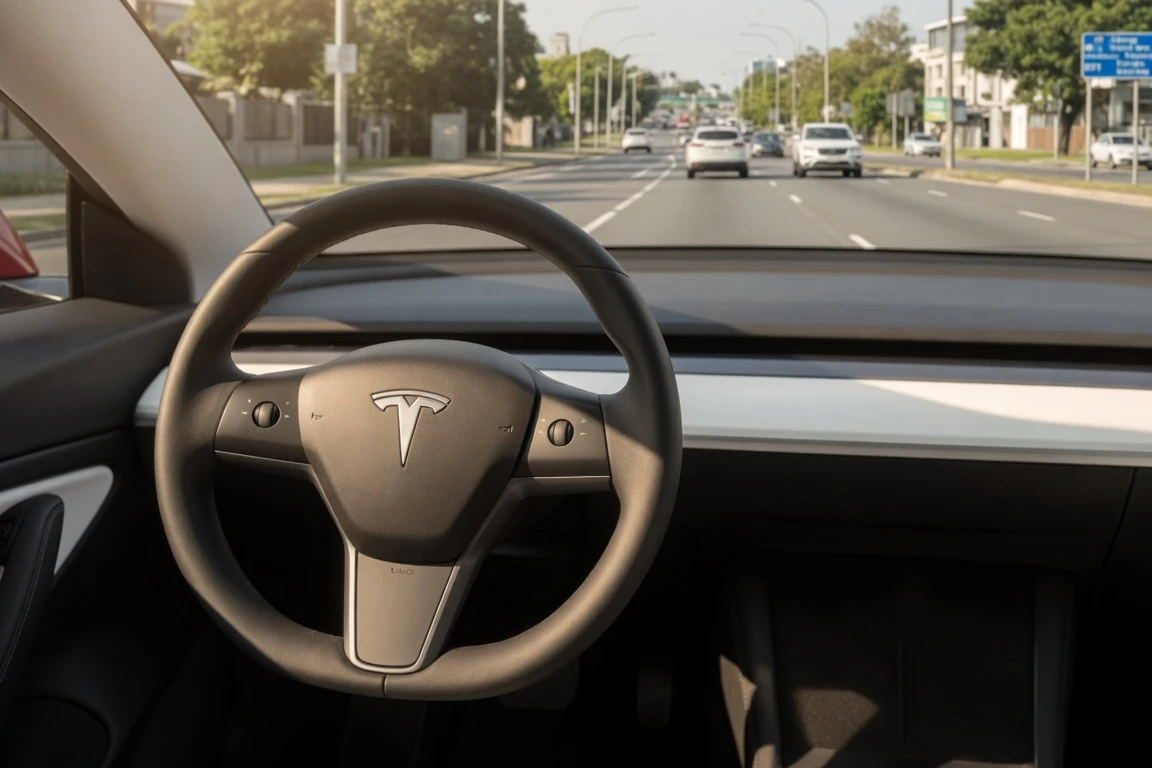
How the System Now Behaves Behind the Wheel
The behaviour-side changes are visible from the driver’s seat the moment the system engages. Tesla has reshaped the Speed Profiles that govern how aggressively FSD chooses speeds and gaps, and the spread between the modes is now wider than before. Sloth is new in this release and Tesla’s release notes describe it as offering “lower speeds and more conservative lane selection than CHILL.” Chill, Standard, and Hurry remain.
Driver profile now carries more weight than it did under V13. The release notes state plainly: “The more assertive the profile, the higher the max speed.” In practice, that means two owners of identical cars running the same V14.3.3 build can hand the car very different personalities by selecting different profiles. The Mad Max profile, the most aggressive of the five modes used in the US, is not in the initial Australian release.
Reporting on what V14 actually claims to deliver behind the wheel describes a system “claimed to react faster, make smarter decisions and perform better in poor weather,” and lists sharper obstacle detection, more decisive lane changes, and improved traffic negotiation as the headline gains (Drive’s coverage of what the V14 update delivers).
Tesla claims new iteration is claimed to be more adept at detecting road obstacles, changing lanes, operating in poor weather, and making decisions in traffic.
That paragraph, written by Drive journalist Alex Misoyannis, summarises the claims Tesla has attached to V14 as it reaches Australia.
Where the Software Reads the Road Better
V14’s world-reading improvements cluster around the rare and the dangerous, the situations where V13 most often handed control back to the driver. The release notes now describe explicit handling for “small animals,” gained by focusing reinforcement-learning training on harder examples and adding rewards for proactive safety, plus improved responses to emergency vehicles, school buses, and right-of-way violators.
Traffic-light handling at complex intersections with compound lights, curved roads, and yellow-light stopping was also rebuilt using “hard RL examples sourced from the Tesla fleet,” according to the release notes. The system can now also push through temporary degradations, such as a briefly blurred camera, by maintaining control and automatically recovering without disengaging FSD.
Inside the cabin, the driver-monitoring camera has been reworked for “better eye gaze tracking, eye wear handling, and higher accuracy in variable lighting conditions,” and a new counter in the Self-Driving App now logs the distance travelled under FSD without an intervention and tracks the driver’s longest intervention-free streak.
- Handling of small animals, via harder RL examples
- Response to emergency vehicles, school buses, and right-of-way violators
- Traffic light handling at complex intersections with compound lights and curved roads
- Automatic recovery from temporary system degradations without disengagement
What’s Still Missing (and Who’s Still Waiting)
Tesla’s release notes close with an “Upcoming Improvements” section that lists two items: expanding reasoning to all behaviours beyond destination handling, and adding pothole avoidance. Neither has shipped in V14.3.3.
The rollout is also gated on hardware. V14.3.3 reaches only Hardware 4 vehicles, which on the Model 3 means cars built since the September 2023 facelift, and on the Model Y means cars produced since late January 2024. Owners of older Hardware 3 cars, a substantial chunk of the Australian Tesla fleet, are not included, and there is no confirmed timeline for them. Pricing has also tightened. The outright purchase option ended on March 31, 2026; since April 1, 2026, FSD Supervised in Australia is available by subscription only, at A$149 per month, with New Zealand paying the equivalent of NZ$159 per month (the FSD V14.3.3 rollout tracker for Australia).
The new Sloth profile is the most concrete behaviour change for owners who want a calmer default. The Mad Max profile, already a notable absence in early reporting, remains absent.
Why This Update Stretches Beyond Australia
Australia and New Zealand were the first right-hand-drive markets to receive any version of FSD Supervised when V13 launched locally on September 18, 2025. V14, however, has been in the US since October 2025, and the V14.3.3 build arriving here was made available in Tesla’s home market two months earlier. Catching up to the US on the same major version is itself a milestone for local owners, who until now were running a software stack several months behind.
V14 is also the foundation of the unsupervised version of Full Self-Driving being trialled on a fleet of autonomous Model Y taxis in select US cities. That trial runs with or without a Tesla test driver behind the wheel, which makes the supervised Australian rollout the de facto right-hand-drive proving ground for the same neural network.
Frequently Asked Questions
Who gets FSD V14.3.3 in Australia?
Only Tesla vehicles running Hardware 4 cameras: Model 3s built since the September 2023 facelift and Model Ys built since late January 2024. The rollout is staggered, so not every eligible car will receive the update on the same day.
How much does FSD Supervised cost in Australia now?
FSD Supervised is subscription-only in Australia since April 1, 2026, at A$149 per month. Tesla ended the outright purchase option, which had been priced at $10,100, on March 31, 2026.
What actually changed from V13 to V14?
Tesla rewrote the AI compiler and runtime using MLIR, delivering a stated 20% faster reaction time. The release also upgraded the Reinforcement Learning stage of neural-network training and overhauled the vision encoder for better understanding in rare and low-visibility scenarios.
Can I take my hands off the wheel with V14?
No. FSD Supervised remains a Level 2 advanced driver-assist system. The driver must stay attentive, keep hands available, and be ready to take over at any time.
When will pothole avoidance arrive?
Tesla’s release notes list pothole avoidance under “Upcoming Improvements” but do not give a date. It is not part of the V14.3.3 build rolling out in Australia.