Tech billionaires have spent hundreds of millions of dollars to shape California’s June 2 primary, and the loudest bet has gone quiet. Outside committees funneled roughly $22 million into ads for the gubernatorial run of San Jose mayor Matt Mahan, a centrist Democrat. On the eve of the vote, he sits at 4% in the polls, and the main super political action committee built to carry him has already closed its books.
That visible misfire has drawn most of the attention. Less noticed is a methodical effort to win about a dozen open seats in the state legislature, the body that will write California’s rules on artificial intelligence (AI, the technology Silicon Valley is racing to build) for the next several years.
The Marquee Bet That Flopped
Mahan was, in many ways, the industry’s dream candidate. He studied at Harvard alongside Facebook co-founder Mark Zuckerberg, co-founded a startup backed by Salesforce chief executive Marc Benioff and Napster co-founder Sean Parker, and built a platform around government efficiency and resistance to new taxes. Tech leaders urged him to run, then opened their wallets.
Since his late-January launch, Mahan has pulled in close to $50 million in contributions, drawing from current and former executives at Google, Amazon, Snap, eBay, PayPal, LinkedIn, DoorDash, Reddit and Palantir. Two outside committees spent nearly $22 million boosting him, more than double the roughly $9 million his own campaign laid out. It was not enough to fix a stubborn problem: almost nobody outside Silicon Valley knew who he was.
The retreat came early. One pro-Mahan committee filed papers to dissolve before the final day of voting, and a related group refunded a $1 million donation from Netflix co-founder Reed Hastings. “I’m not running for tech,” Mahan said, pointing to six years in office without a single favor to the industry at the public’s expense. The polls put him sixth among all candidates and fourth among Democrats.
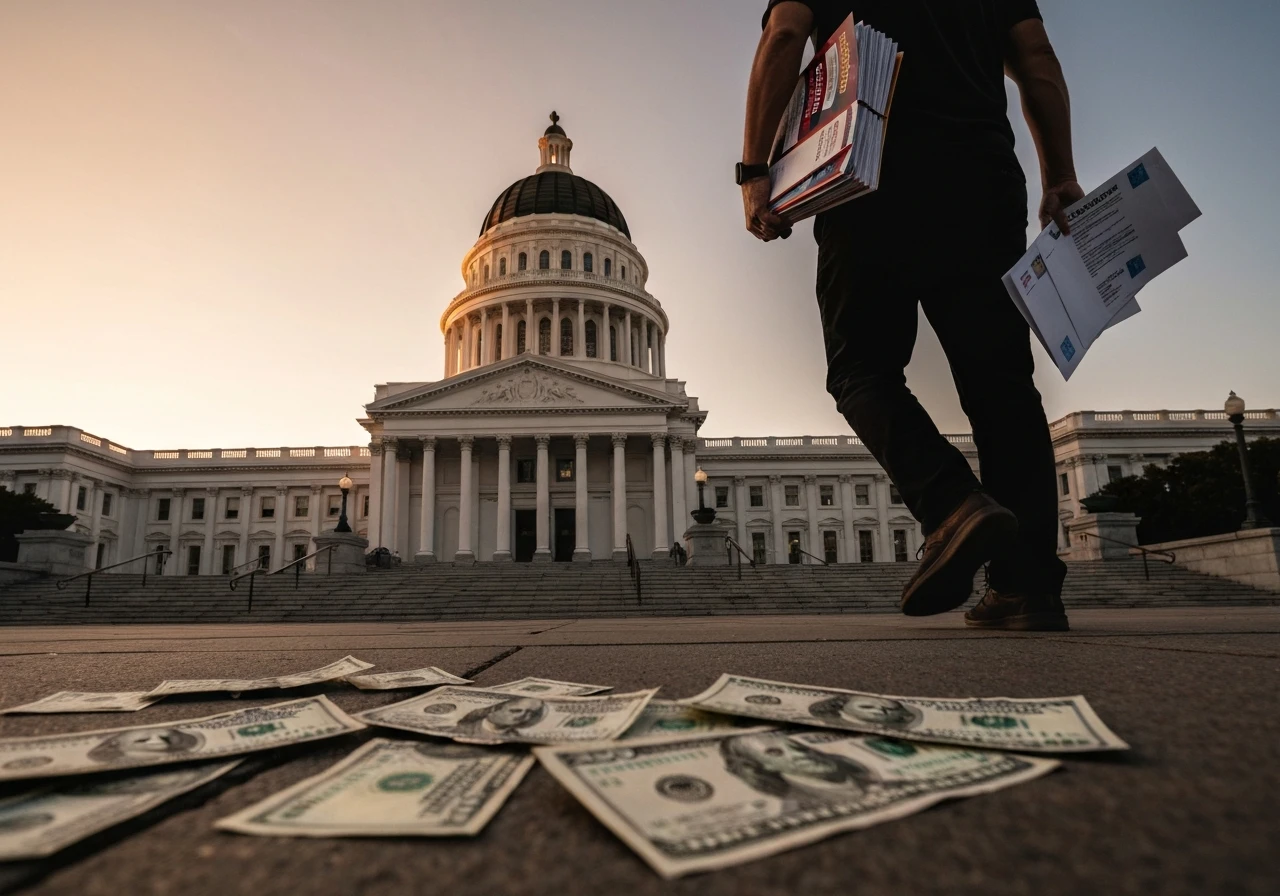
The Quieter Play in the State Legislature
While the governor’s race soaked up the headlines, a second stream of money moved through dozens of assembly and senate primaries with far less notice. The strategy is narrow and deliberate, aimed almost entirely at open seats rather than sitting incumbents.
Grow California’s Open-Seat Map
The most committed local spender is Chris Larsen, co-founder of crypto firm Ripple Labs and worth an estimated $12 billion. His main legislative vehicle, a super PAC called Grow California, has taken in $15 million from Larsen and $5 million from venture capitalist Tim Draper, part of a wider pool the group says runs to $40 million in commitments across multiple cycles.
| Super PAC | Main funders | Reported money | Focus |
|---|---|---|---|
| Grow California | Larsen ($15M), Draper ($5M) | $14M+ deployed | Labor-opposed legislative seats |
| California Leads | Google ($5M), Meta ($5M) | $10M raised | Moderate legislative candidates |
| Deliver for California | Brin ($1M) and others | ~$22M | Governor’s race (now closed) |
| Golden State Promise | Larsen and Ripple ($10M) | Attack ads | Blocking the wealth tax |
The group has poured hundreds of thousands of dollars into individual races. Mark Pulido, an assembly candidate in Orange County, has drawn more than $1.5 million from Grow California, while Scott Sakakihara, a senate hopeful in Alameda County, has received more than $500,000. Larsen has been blunt about the target, telling Politico he wants “to work on taking out those people who are not working for the people of California,” a reference to organized labor’s grip on the legislature.
Google and Meta’s Parallel Fund
Google and Meta have backed a similar committee, California Leads, with $5 million each, steering money toward Central Valley contenders and several of the same candidates as Larsen’s group. Pulido alone has collected close to $750,000 from it. John Bennett, director of the advocacy group California Initiative for Technology and Democracy, has tracked the pattern and says the focus is unmistakable.
They’ve been hyper-focused on those open seats, not going after incumbents this time around. So it seems like they’re doing a long-term strategy to slowly turn the legislature to become more friendly to them.
That is the part of the story the governor’s race tends to bury. A handful of low-profile assembly and senate seats, won quietly over a cycle or two, can shift the committees that decide which bills live and die.
Why AI Rules Sit Behind the Spending
The reason for the patience is sitting in the statute books. Since the current legislative session opened in December 2024, more than 50 bills touching AI have moved through Sacramento, covering everything from companion chatbots to algorithmic pricing and digital replicas.
The flagship is the Transparency in Frontier Artificial Intelligence Act, signed by Governor Gavin Newsom on September 29, 2025, with most provisions live since January 1. Known as SB 53, it applies only to large frontier developers, defined as firms training the most powerful models and clearing $500 million in annual revenue, a group that in practice covers roughly five to eight companies including OpenAI, Anthropic, Google DeepMind, Meta and Microsoft.
For those companies, the law sets concrete duties:
- Publish a documented framework for managing catastrophic risk before deploying major new models.
- Release transparency reports describing each model’s intended uses and risk assessments.
- Report critical safety incidents to the state’s Office of Emergency Services within 15 days.
Industry reaction split sharply. Anthropic backed the bill, while OpenAI, Meta and Google lobbied against it, warning of duplicative paperwork and slower innovation. The same firms have a long record of trying to steer how the state writes technology rules, from earlier efforts against election deepfakes to fights over California’s web age-verification mandate. Whoever fills the open legislative seats gets a vote on what comes after SB 53.
The Scale Hidden in the Filings
The campaign donations are only one layer. On lobbying alone, the bigger picture shows just how much Sacramento now matters to the industry.
- $39 million went to influence state politics in 2025 from AI and crypto firms, a CalMatters analysis found, edging past the roughly $34 million spent by oil and gas.
- $109 million went to federal lobbying by the biggest tech and AI companies that year, per a Bloomberg analysis, meaning their California spending equals about 36% of the federal total.
- Nearly $30 million came from Meta alone in 2025, including $20 million seeded into a committee that backs candidates favoring AI deregulation.
Even those figures understate the reach, says Francesco Trebbi, a public policy professor at the University of California, Berkeley. Sophisticated donors, he notes, route money through dark-money groups that never surface in campaign filings, using “both visible and invisible forms of influence.” What shows up in the public record, he argues, is “just the tip of the iceberg.”
Trebbi frames the spending as a feedback loop. “This money is flowing in the direction of politicians that can be influential in defining the regulatory agenda for the next five years,” he said, describing a cycle in which economic power buys political power that then protects economic power.
Brin’s $66 Million War on the Wealth Tax
One fight has pulled in more money than any other, and it is not on the June ballot at all. Sergey Brin, the Google co-founder worth an estimated $290 billion, has put at least $66 million into blocking a proposed wealth tax headed for the November ballot.
The measure, pushed by the Service Employees International Union-United Healthcare Workers West (SEIU-UHW, a major California healthcare union), would impose a one-time 5% levy on the net worth of state residents holding more than $1 billion in assets, with proceeds aimed at healthcare, education and food assistance. Backers say it could raise tens of billions of dollars.
Brin’s money is the spine of a broader campaign. He contributed $20 million to Building a Better California, a group that has gathered upward of $100 million from donors including former Google chief executive Eric Schmidt, Stripe chief executive Patrick Collison, former Sequoia partner Michael Moritz and Larsen. Two countermeasures have already qualified that could weaken or block the union plan if it passes.
His own stake in the outcome is personal as well as financial. Brin relocated from California to Nevada before a December 31 cutoff, a move that would place him outside the tax’s reach.
The same impulse has reached city contests. Brin spent $500,000 last month fighting a San Francisco measure to expand a tax on highly paid chief executives, and Larsen has routed money toward a heated race for state insurance commissioner. The spread of the spending, from statewide ballot fights to single assembly districts, is the point.
What June 2 Settles, and What It Doesn’t
The primary will close the book on the governor’s race that absorbed the most attention and the least durable strategy. The open legislative seats, the wealth-tax fight in November, and the next round of AI bills will not be settled tomorrow, and that is where the patient money is parked. Larsen alone has said he expects to spend as much as $30 million of his own across several cycles.
If the candidates backed by Grow California and California Leads take those open seats this year, the legislature that drafts California’s next AI rules starts out friendlier to the firms that paid for the campaigns. If labor holds the line, the spending simply resets for the cycle after, which is exactly what the industry’s biggest donors have promised to fund.