South Korea’s five largest won-denominated crypto exchanges processed 163.55 trillion won, or about $125.8 billion, in overseas remittances last year, a 380% jump from 34.02 trillion won in 2022. Over the same stretch, the country’s five biggest commercial banks moved about 1,590 trillion won in foreign-currency remittances, a 20% rise from 1,318 trillion won.
The figures come from a SBS Biz report citing data provided by the office of Congressman Kim Sang-hoon. They land months before a new regulatory framework for cross-border virtual-asset transfers is set to take effect. Amendments to the Foreign Exchange Transactions Act were promulgated on June 2 after cabinet approval; the revised law will apply following a six-month grace period, and every cross-border crypto transfer provider will have to register with the Ministry of Economy and Finance and report through the Bank of Korea’s foreign-exchange network.
The Numbers Behind the Three-Year Crypto Surge
South Korea’s crypto remittance market has become one of the fastest-growing cross-border payment flows in the country. Per the SBS Biz report, the five largest won-denominated exchanges moved 163.55 trillion won overseas last year, up from 34.02 trillion won in 2022. That three-year rise outpaced growth at major commercial banks.
On the banking side, foreign-currency remittances handled by the country’s five major commercial banks reached 1.108 trillion dollars in 2025. In 2022, the same five banks processed 1.009 trillion dollars. The bank side still moves far more in absolute terms than the crypto side, but the SBS Biz data show the crypto side is growing from a small base at a rate the bank side is not matching.
The figures were cited from data provided by the office of Congressman Kim Sang-hoon, who chairs the People’s Power Party’s stock and digital-asset value committee. SBS Biz is the financial-news arm of the Seoul-based broadcaster SBS.
| Channel | 2022 remittances | 2025 remittances | Change |
|---|---|---|---|
| Five largest won-based crypto exchanges | 34.02 trillion won ($26.2 billion) | 163.55 trillion won ($125.8 billion) | 380% |
| Five largest commercial banks (foreign-currency) | $1.009 trillion (roughly 1,318 trillion won) | $1.108 trillion (about 1,590 trillion won) | about 20% |
What the Fee Gap Looks Like for a Real Transfer
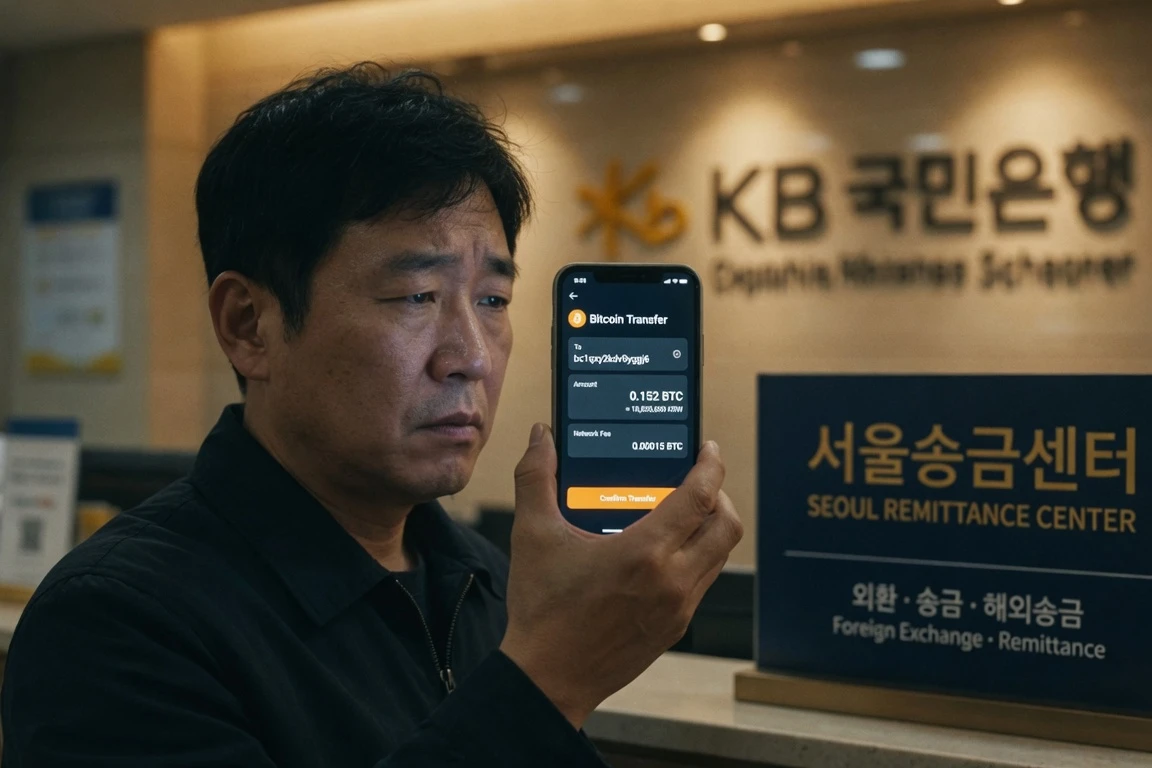
The price gap shows up most clearly on a single transaction. SBS Biz worked the numbers for a $20,000 transfer, about 30 million won, and the comparison is direct: a commercial bank charges about 25,000 won in remittance fees, roughly $16.67, while the same amount moved as Bitcoin through a domestic crypto exchange costs about 19,000 won, or $12.67. The crypto fee is reported as flat regardless of transaction size, which means the gap widens as the transfer grows. The bank fee, by contrast, scales with the size and routing of the wire. For a Korean sending paychecks home to a spouse or parents abroad, those differences compound across the year.
Hwang Seok-jin, a professor at Dongguk University’s Graduate School of International Information Protection, told SBS Biz that lower transaction costs are likely the main reason consumers have moved flows to crypto platforms. He pointed to the fee gap as the clearest differentiator for users sending smaller, more frequent transfers. The data behind the cost comparison were provided by the broadcaster, drawing on the same Kim Sang-hoon dataset.
Toss Bank Taps Solana to Rebuild the Remittance Stack
Toss Bank signed a memorandum of understanding with the Solana Foundation on June 19, becoming the first South Korean internet-only bank to partner with the organization behind the Solana network. The agreement covers a phased proof of concept for blockchain-based international remittances, alongside stablecoin and digital-asset settlement work.
Toss Bank’s international remittance business, launched in January, currently supports seven major currencies across 30 countries. Toss Bank said the partnership is intended to build on that base by adding blockchain-based settlement infrastructure, and that the two sides had been discussing the work before formalizing the MOU. The bank serves about 15 million customers, a footprint that puts it in the country’s top three internet-only lenders. Phase one of the proof of concept will test the technical feasibility of stablecoin transfers on the Solana network; later phases will bring in overseas partners and assess anti-money-laundering and know-your-customer procedures.
Shinhan Financial Group and the Industrial Bank of Korea have also held discussions focused on stablecoins and digital-asset payments, per the SBS Biz report. The bank-side push into blockchain rails is concentrated in those three names for now. Each move is timed to land before the year-end regulatory framework takes effect, with the country’s wider CBDC trial pause and stablecoin pivot underscoring the shift in policy direction.
This partnership marks the first step toward integrating blockchain-based digital infrastructure into our existing financial services.
Park Jin-hyun, head of strategy at Toss Bank, made the comment at a signing ceremony at the bank’s Sinnonhyeon office in Seocho-gu, Seoul, on June 19. Lily Liu, president of the Solana Foundation, said the collaboration could help establish new standards for international remittances by combining the trust of traditional finance with the efficiency of blockchain technology.
The December Framework and Who Gets to Register
South Korea is moving to put its first legal frame around cross-border crypto remittances. Amendments to the Foreign Exchange Transactions Act were promulgated on June 2 after cabinet approval and will take effect in December following a six-month grace period, per the SBS Biz report and a separate MLex summary of the Ministry of Economy and Finance announcement. The law extends supervision to companies that have until now moved money across borders through virtual assets largely outside the foreign-exchange reporting perimeter.
Under the new regime, firms handling cross-border digital-asset transfers must register in advance with the Ministry of Economy and Finance. They will also have to report each transfer through the Bank of Korea’s foreign-exchange reporting network.
The biggest open question is who else gets to play. The framework could leave the field to registered crypto exchanges, the country’s existing Virtual Asset Service Providers, or it could open to fintech firms that have so far been locked out. Many of those fintechs have struggled to offer digital-asset services because of VASP registration rules and difficulty securing real-name banking partnerships. Bank of Korea officials have said there is no need to restrict virtual asset transfer services to traditional VASPs alone if other entities can perform the transfers efficiently. The Digital Asset Basic Act, the broader crypto bill, was postponed at the National Assembly after the June 3 local elections and is not expected to return before late this year.
Per the registration and reporting rules for cross-border crypto transfers, transfer data shared with tax, customs, financial supervision and anti-money-laundering authorities will be used to investigate illegal transactions. Violations of the registration, reporting, or inspection rules will be subject to sanctions comparable to those imposed on existing foreign-exchange institutions. South Korea’s central bank pitch for bank-led stablecoin issuance runs in parallel with the framework, shaping who can issue the rails even after the transfer rules are written.
Per the SBS Biz report, competition among banks for new revenue opportunities could intensify once the framework is complete and broader cryptocurrency legislation advances. Fintech firms and exchanges are now running the same calendar to be ready when enforcement begins.
What’s at Stake for Banks, Exchanges, and Fintechs
The growth at crypto exchanges and the slow growth at banks sit against a backdrop of bank moves into blockchain rails. Toss Bank’s Solana tie-up and the Shinhan and IBK discussions show the incumbent side positioning on multiple tracks. Each of those moves is timed to land before the year-end framework takes effect.
Three bank-side moves have come into public view so far:
- Toss Bank’s June 19 MOU with the Solana Foundation on stablecoin remittance testing for its 15 million customers
- Shinhan Financial Group’s separate discussions on stablecoins and digital-asset payments
- Industrial Bank of Korea’s parallel talks on the same set of products
The Bank of Korea has signalled that authorities are still analyzing which entities can be licensed under the new framework, and implementation rules are expected before enforcement begins. The Digital Asset Basic Act, the broader crypto bill, remains on hold at the National Assembly until later this year. Year-end transfer rules are what banks and exchanges are racing to clear first.
Frequently Asked Questions
What is changing in South Korea’s cross-border crypto remittance rules in December?
Amendments to the Foreign Exchange Transactions Act, promulgated on June 2 and taking effect after a six-month grace period, require every firm handling cross-border digital-asset transfers to register with the Ministry of Economy and Finance in advance. Providers must also report each transfer through the Bank of Korea’s foreign-exchange reporting network, with the data shared with tax, customs, financial supervision and anti-money-laundering authorities. Violations of registration, reporting, or inspection rules are subject to sanctions comparable to those imposed on existing foreign-exchange institutions.
Why are crypto remittances cheaper than bank transfers in South Korea?
Dongguk University professor Hwang Seok-jin told SBS Biz that lower transaction costs are the main reason. The broadcaster’s worked example shows a $20,000 transfer through a commercial bank costs about 25,000 won (around $16.67) in fees, while the same amount moved as Bitcoin through a domestic crypto exchange costs about 19,000 won (around $12.67), a flat fee that does not change with transaction size. For larger transfers, that flat structure widens the gap.
Can fintech firms enter South Korea’s cross-border crypto transfer market?
That is the open question. Per Bank of Korea officials cited in the lead-up to the year-end launch, authorities are reviewing whether to allow non-VASP fintech firms to participate alongside registered crypto exchanges. The implementation rules, expected before the framework takes effect, will set the licensing and compliance bar for any applicant. Many fintechs have previously struggled to offer digital-asset services because of VASP registration rules and difficulty securing real-name banking partnerships.
Are South Korean banks building their own blockchain rails or buying into exchanges?
Toss Bank signed an MOU with the Solana Foundation on June 19 to test stablecoin-powered remittances on the Solana network for its 15 million customers, the first such partnership between a South Korean internet-only bank and the foundation. Shinhan Financial Group and the Industrial Bank of Korea have held separate discussions on stablecoins and digital-asset payments, per the SBS Biz report. The moves put bank-side blockchain projects on the same regulatory calendar as the year-end framework.
Disclaimer: This article is for informational purposes only and does not constitute financial, investment, legal, or tax advice. Cryptocurrency-based remittances carry risks, including price volatility, regulatory change, and the possibility of capital loss. Figures cited here are accurate as of the publication date and may have changed. Readers should consult a qualified financial or legal professional before making decisions about cross-border transfers, digital-asset use, or related investments.