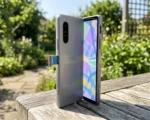
Samsung Display is targeting the first half of 2028 to ship its first commercial rollable smartphone, per reports from South Korean outlets Maeil Business and MoneyToday. The device would expand from a regular phone size to a 10-inch OLED panel without the hinge or visible crease that defines every foldable on the market today.
Samsung has not officially announced the phone. A company executive told Maeil Business that Samsung is “developing a rollable phone with a target launch date in the first half of 2028,” with “a high possibility that Samsung Display panels will be adopted.” Forbes reports Apple’s first foldable, possibly called the iPhone Ultra or iPhone Fold, is on track for a September 2026 unveiling, ahead of Samsung’s reported H1 2028 rollable target.
What the Report Says and Where It Came From
The underlying reporting comes from Maeil Business, a South Korean business daily, with a parallel account carried by MoneyToday and picked up across the English-language tech press. The story has been summarised by SamMobile, Sammy Fans, Gizmochina, and MegaMobileContent in the days since. All four English-language outlets are citing Korean reporting that surfaced within days of each other. The source quoted is a Samsung Electronics executive, not an outside analyst.
The most specific claim is a direct quote attributed to a Samsung Electronics executive. Per the executive quote attributed to a Samsung Electronics source, the unnamed executive said Samsung is “developing a rollable phone with a target launch date in the first half of 2028.” A separate Sammy Fans summary reports the same source as saying there is “a high possibility that Samsung Display panels will be adopted.” That phrasing matters because the Samsung executive is essentially saying the in-house panel arm will supply its own phone business, which is the closest thing to an internal green light.
Samsung has not made a public announcement. The rollout timeline is the company’s internal target; no specific launch date has been set.
Internally, we are developing a rollable phone with a target launch date in the first half of 2028, and there is a high possibility that Samsung Display panels will be adopted.
Unnamed Samsung Electronics executive, quoted by MoneyToday and carried in SamMobile’s write-up of the report.

The Spec Sheet, Sourced to Omdia
The closest thing to a hardware spec sheet comes from Omdia, the display market research firm. Per Omdia’s 10-inch, 440.6ppi spec sheet as reported by Sammy Fans, the rollable phone is expected to use a 10-inch OLED panel with a 16:9 aspect ratio and a pixel density of 440.6ppi. Gizmochina, citing the same Omdia data, rounds that figure to “around 440 pixels per inch.” Sportskeeda adds that the device would measure roughly 6.5 inches in its standard, un-extended form.
A 10-inch, 16:9 panel lands in tablet territory rather than phone territory. That puts the device in direct competition with Samsung’s existing foldable line, where the Galaxy Z TriFold already reaches a 10-inch screen by adding a third fold and a second hinge, per MegaMobileContent. A rollable would, in theory, hit the same screen size without those mechanical compromises. SamMobile notes the launch would coincide with the tenth anniversary year of Samsung’s foldable smartphone lineup.
- 10 inches extended screen size (Omdia via Sammy Fans)
- 6.5 inches standard screen size (Sportskeeda)
- 16:9 aspect ratio (Omdia via Sammy Fans)
- 440.6ppi pixel density (Omdia via Sammy Fans)
- H1 2028 target launch window (SamMobile, Sammy Fans)
Why 2028, and Why the Pivot Now
The reported timing aligns with a specific market shift. Per Gizmochina’s summary of Omdia numbers, Samsung Display’s share of the foldable display panel market dropped from about 41.8% in Q4 2025 to 27% in Q1 2026. Gizmochina attributes the drop to “more competition heating up.”
The pitch inside the company, per SamMobile, is that “companies with technological leadership and a strong supply chain will have an advantage in the emerging rollable smartphone market.” SamMobile adds that Samsung Display has “set a goal of securing leadership in the next generation of smartphone form factors after dominating the foldable smartphone market for years.”
Apple is the other piece of the timing puzzle. Apple’s reported September 2026 foldable unveiling is on track, per Forbes, citing supplier guidance delivered via DigiTimes and the China Securities Journal. A supplier has reportedly begun shipping components “in small batches” for the device. That would put Apple’s first foldable on shelves ahead of Samsung’s reported rollable target.
MegaMobileContent’s framing captures another wrinkle. Some earlier reports pointed to a rollable arriving alongside the Galaxy Z Fold 8 in the second half of 2026, not 2028. The gap between those dates suggests Samsung Display’s panel readiness may be ahead of Samsung’s mobile division’s willingness to commit to a product launch.
The Rollable Concepts Samsung Has Shown Before
Samsung has been publicly demonstrating rollable display technology for years without ever shipping it. The earliest named demo in the current reporting chain came at CES 2023, where Samsung Display introduced Flex Hybrid, a concept that combined folding and sliding motions.
Six months later, at SID Display Week 2023, the company showed Rollable Flex, a panel that physically extended from 49mm to over 254mm, more than five times its starting size. That was still a prototype, not a product. The pattern has held through every demo since. At MWC 2026 in Barcelona, per Samsung’s MWC 2026 slidable demo and timing, Samsung showed a “slidable” concept that expanded from 5.1 inches to 6.7 inches; even Samsung’s own booth staff labelled that one “under development.”
Samsung isn’t the only one that has tried. LG had a working rollable phone prototype with a motorized scroll mechanism before shutting down its mobile division in 2021. Reviewer MKBHD later handled a unit and called the engineering “impressive,” noting the hardware was strong enough to push a laptop across a desk. LG never shipped it. Nobody has yet managed to ship a rollable phone at scale.
| Samsung Display demo | Event | What it did |
|---|---|---|
| Flex Hybrid | CES 2023 | Combined folding and sliding motions |
| Rollable Flex | SID Display Week 2023 | Extended from 49mm to over 254mm, more than 5x starting size |
| Slidable concept | MWC 2026 | Expanded from 5.1 inches to 6.7 inches, labelled “under development” |
How a Rollable Phone Actually Works
A rollable phone replaces the foldable hinge with a motorized internal spool inside the chassis. The flexible OLED panel wraps around that spool in its compact state and extends outward on command, producing one continuous flat surface when fully deployed. There is no visible crease because nothing folds; the display bends in a much gentler arc as it unrolls. Samsung’s Galaxy Z TriFold reaches a similar 10-inch screen size today, but it does so with two hinges and three panels, both of which add thickness and weight.
The engineering is harder than foldable in several specific ways. Per Sammy Fans’ summary of the industry’s view, the display has to “repeatedly roll and extend while maintaining durability, flatness, brightness, and consistent image quality.” Gizmochina adds that the internal mechanism has to stay “thin and light enough for everyday use,” which is the constraint most rollable prototypes have failed to meet.
Every layer inside the panel has to slide against its neighbours without catching or creasing. The rollers themselves have to be precise enough to keep the panel flat across hundreds or thousands of extension cycles. Samsung Display’s panel commitment doesn’t solve any of it on its own.
How rollable OLED laptops extend on demand is the closest existing parallel: rollable laptops already use a similar extending-display mechanism, drawing on the same flexible OLED and motorized spool approach. The form factor is related enough that Samsung Display’s laptop work and its phone work share materials research. Durability standards are higher on a phone, though. Phones get dropped, pocketed, and pulled out thousands of times a year, while laptops sit on desks. That difference is the variable that has kept every prior rollable phone prototype, including LG’s, off the shelves.
What Has to Land Before H1 2028
For the target to hold, four things have to land in order. None of them is a guaranteed yes; each is a step Samsung Display or its mobile division has signalled it is working on.
The technical risk runs alongside the commercial risk. Samsung Display has to ship a panel that meets Omdia’s projected spec, 10-inch, 16:9, 440.6ppi, and survives the company’s own internal durability testing. The phone business has to commit to a price point that doesn’t price the device out of the early-adopter base that buys Z Fold models today.
MegaMobileContent’s framing of the timing gap is the cleanest version of the commercial pressure: Samsung Display may be ready sooner than Samsung’s mobile division is willing to commit to a product launch. That mismatch is the single biggest variable in whether the target slips to late 2028 or even 2029. There is also the second rollable model to consider. Gizmochina reports “talk of a second model coming in 2030,” though the same outlet flags that this is rumour level. A 2030 second model only ships if the first lands cleanly enough to validate the form factor.
- Samsung Display mass-produces a 10-inch, 16:9 rollable OLED panel at 440.6ppi that passes internal durability tests (per Omdia specs).
- Samsung’s mobile division formally approves the panel and commits to a launch window.
- Apple launches its first foldable in September 2026 (per Forbes) without major issues, reshaping consumer expectations of what a “new phone shape” looks like.
- The second rollable model reportedly planned for 2030 (per Gizmochina) stays in the pipeline, signalling Samsung sees the first model as a beachhead rather than a one-off.
Frequently Asked Questions
When will Samsung’s rollable phone launch?
Per reports from South Korean outlets Maeil Business and MoneyToday, Samsung is targeting the first half of 2028. The company has not made a public announcement, and no Samsung executive has confirmed the date on the record. Samsung Display is reportedly in advanced discussions to supply the rollable OLED panels to Samsung’s mobile division.
What size screen will it have?
Per Omdia, the rollable phone is expected to use a 10-inch OLED panel with a 16:9 aspect ratio and 440.6 pixels per inch. In its standard, un-extended form, the device is reportedly around 6.5 inches, per Sportskeeda.
What will it be called?
The name has not been confirmed. Per Gizmochina and Sammy Fans, the device is internally linked to the “Galaxy Z Slide” name. Other reports, including those from MegaMobileContent, refer to a possible “Galaxy Z Roll” name. Either name would put it inside Samsung’s existing Z series of foldables.
How does a rollable phone differ from a foldable?
A foldable phone uses a hinge and bends a flexible OLED panel in half, which produces a visible crease along the fold line. A rollable phone wraps the panel around a motorized internal spool and extends it outward without folding. The expanded display is one continuous flat surface.
Will Samsung’s rollable phone beat Apple’s first foldable?
Per Forbes, Apple’s first foldable (possibly called the iPhone Ultra or iPhone Fold) is on track for a September 2026 unveiling. Samsung’s reported H1 2028 rollable target would come after that. The competitive question is whether Samsung reaches the new form factor first, or whether Apple’s first foldable sets the consumer template that Samsung then has to follow.