
BUSINESS
RBI Fined Five Co-op Banks, Then Froze One
RBI fined five cooperative banks ₹44.80 lakh in July 2026 for KYC and governance lapses, then froze withdrawals at Ashok Sahakari Bank in August.

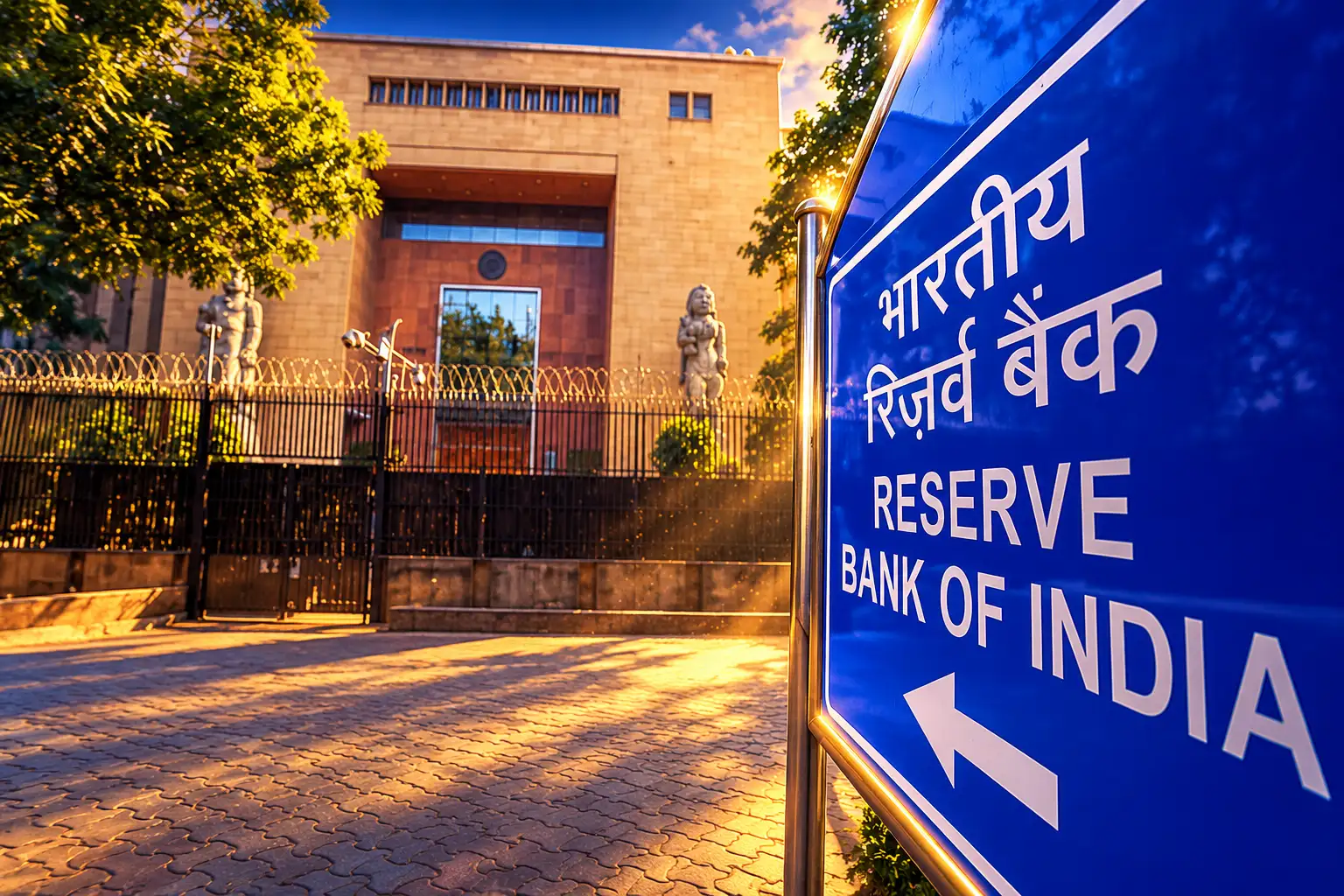
The Reserve Bank of India fined five cooperative banks ₹44.80 lakh in July 2026, then froze withdrawals at one of them in August. The notices, posted on July 13, rest on inspections of the books as on March 31, 2025, and cite board conflicts, loans that the law bars, unclaimed deposits left off a statutory fund, and slow KYC filing.
RBI said each fine is for compliance gaps and does not void deals with customers. That line is the standard closer on these orders. It is also the part that ages worst, because one of the five was already on a tighter leash.
Five Orders Landed on a Single Monday
July 13 was not a special sitting. RBI published four of the orders that day and grouped a fifth with them, after show-cause notices, written replies, and, in most cases, a personal hearing. The five cooperative banks fined in July split across two supervisory tracks. Surat People’s Co-operative Bank Ltd., The Chikhli Urban Co-operative Bank Ltd., and Ashok Sahakari Bank Ltd. are urban cooperative banks inspected by RBI. The Sambalpur District Co-operative Central Bank Ltd. and The Nawada Central Co-operative Bank Ltd. are district central cooperative banks inspected by the National Bank for Agriculture and Rural Development (NABARD).
THE FIVE JULY ORDERS
| Bank | State | Fine | Order date | Finding that stood |
|---|---|---|---|---|
| Surat People’s Co-operative Bank Ltd. | Gujarat | ₹13.30 lakh | July 10, 2026 | Directors sat in on proposals in which they were interested |
| The Chikhli Urban Co-operative Bank Ltd. | Maharashtra | ₹13 lakh | July 8, 2026 | Unclaimed sums not moved to the DEA Fund, builder land loans, weak suspicious-transaction software |
| Ashok Sahakari Bank Ltd. | Maharashtra | ₹10 lakh | June 29, 2026 | Loan sanctioned to a director |
| Sambalpur District Co-operative Central Bank Ltd. | Odisha | ₹8 lakh | July 2, 2026 | Unclaimed sums not moved to the DEA Fund, customer risk not reviewed on time |
| The Nawada Central Co-operative Bank Ltd. | Bihar | ₹50,000 | July 2, 2026 | Customer KYC files not uploaded to CKYCR on time |
The powers cited are the same in every notice: Section 47A(1)(c) read with Sections 46(4)(i) and 56 of the Banking Regulation Act, 1949. Chief General Manager Brij Raj signed the releases. Each order also says the fine is without prejudice to any other action RBI may still take. That clause is boilerplate until a bank tests it.
Ahmednagar Depositors Lost Access in August
Ashok Sahakari Bank Ltd., an urban cooperative bank in Ahmednagar, took a ₹10 lakh fine after the June 29, 2026 order found it had sanctioned a loan to one of its directors, which Section 20(1) of the Banking Regulation Act, 1949 does not allow. RBI posted that order on July 13 with the rest of the batch. The inspection still referred to March 31, 2025.
On August 28, 2026, RBI used a different tool. In August 28 directions on Ashok Sahakari, issued under Section 35A(1) read with Section 56 as Directive Ref. No. S4110 /12-22-377 / 2026-27, the bank was told that from the close of business that day it could not, without RBI’s written approval, do the ordinary work of a deposit-taking lender.
WHAT THE AUGUST DIRECTIONS BLOCK
- New credit: The bank may not grant or renew loans and advances.
- Fresh money: It may not take new deposits or borrow, and it may not make investments.
- Cash out: It may not let a depositor withdraw from a savings, current, or any other account.
- Assets: It may not sell, transfer, or otherwise dispose of property, or enter a compromise, except as the directions allow.
- What still runs: Set-off of loans against deposits is allowed on stated terms, and specified costs such as staff pay, rent, and electricity may still be paid.
RBI tied the freeze to liquidity and to talks with the board that had not produced a fix. It did not present the June director-loan order as the legal trigger, and the two actions sit on different sections of the Act.
These Directions are necessitated due to supervisory concerns emanating from the recent material developments in the bank, and to protect the interests of depositors of the bank. RBI has in the recent past engaged with the Board and Senior Management of the bank for improvement in its functioning. However, lack of concrete efforts taken by the bank to address the supervisory concerns and to protect the interest of depositors of the bank, necessitated issuance of these Directions.
Brij Raj, Chief General Manager, Reserve Bank of India press release, August 28, 2026
The directions run for six months from the close of business on August 28, 2026, and are subject to review. RBI said they should not, as such, be read as cancellation of the banking licence, and that the bank may keep doing banking work inside the limits until its position improves.
What Deposit Insurance Covers at Ashok Sahakari?
Eligible depositors can claim up to ₹5,00,000 from the Deposit Insurance and Credit Guarantee Corporation (DICGC) in the same capacity and the same right, after they submit willingness and the claim is checked. That insurance cover of ₹5 lakh is the statutory ceiling, not a special grant for this bank, and depositors are told to start with bank staff and the DICGC site. A freeze of this type is still read, in Maharashtra, through the PMC Bank years: the licence stays on paper, the cash does not move, and the insured slice is ₹5 lakh.
Penalty Notices Continued Through Late August
The July 13 bundle sat in the middle of a summer of similar notices, not at the end of one. RBI’s own enforcement list kept adding cooperative banks through the rest of July and into August, including urban banks and district central banks in Maharashtra, Karnataka, Gujarat, and Odisha. The charges on those later days run in the same family: KYC, credit-information reporting, exposure caps, and unclaimed deposits.
FROM THE JUNE ORDER TO THE FREEZE
- June 29, 2026: RBI records the Ashok Sahakari order for a director loan under Section 20(1).
- July 2, 2026: Orders go out against Sambalpur (₹8 lakh) and Nawada (₹50,000), both after NABARD inspections of the March 31, 2025 position.
- July 8, 2026: The Chikhli order (₹13 lakh) is signed for the DEA Fund delay, builder land loans, and suspicious-transaction software.
- July 10, 2026: The Surat People’s order (₹13.30 lakh) is signed for directors sitting in on interested board items.
- July 13, 2026: RBI posts the batch that wire copy treated as a single crackdown.
- July 20 to August 31, 2026: Further penalty releases name, among others, Kolhapur, Manmad, Raigad, Sangli, Kedarnath, and Amravati banks, plus several Karnataka lenders.
- August 28, 2026: Section 35A directions hit Ashok Sahakari, the only bank from the July 13 group to lose its cash window.
A ₹50,000 KYC fine and a six-month withdrawal freeze can share a news cycle and still be different instruments. The first is a receipt. The second is a lock on the till. Treating every July 13 notice as if it carried the same weight hides that split.
The Ten-Year Clock on Forgotten Deposits
Two of the five banks were fined for missing the Depositor Education and Awareness Fund, the statutory pool created under Section 26A of the Banking Regulation Act, 1949. The scheme took effect on May 24, 2014. It pulls in credit balances that have sat unoperated or unclaimed for 10 years or more, across savings, term, current, and a long list of other accounts, plus accrued interest.
HOW THE DEA FUND WORKS
- The trigger: Ten years of continuous inoperative or unclaimed status on a covered balance.
- The transfer date: Banks must move the sum on the last working day of the month after that tenth year is completed.
- The claim path: A customer or legal heir still goes to the bank, which pays and then recoups an equal amount from the fund; there is no cut-off in the scheme for that claim.
- If a bank is in liquidation: The liquidator handles the claim, with DICGC cover still capping the insured slice at ₹5 lakh where that cover applied when the money moved to the fund.
Chikhli, the Maharashtra urban bank, failed to transfer eligible unclaimed amounts within the prescribed period. The same order also found it had sanctioned loans to builders for land acquisition, which RBI’s housing-finance directions for urban cooperative banks do not allow, and that it had not put in place software that could identify and report suspicious transactions. Sambalpur, the Odisha district central bank, missed the DEA Fund deadline and had not reviewed customer risk categories on the KYC cycle. In both cases the money that should have left the bank’s books is, on paper, depositor money the law already pulled out of day-to-day use.
Nawada’s July 2, 2026 fine of ₹50,000 was narrower: it had not uploaded customer KYC records to the Central KYC Records Registry (CKYCR) within the allowed time, after a NABARD inspection of the March 31, 2025 position. That was not the bank’s first recent order. On November 14, 2025, RBI had already fined it ₹1.50 lakh for missing a DEA Fund transfer and for not sending credit information to all four credit information companies. The July ticket is a second, smaller bill for a related filing failure.
A Director’s Loan and a Boardroom Conflict
The two largest urban-bank fines in the July 13 group are board problems, not software tickets. Surat People’s Co-operative Bank Ltd. paid ₹13.30 lakh after RBI found that certain directors had taken part in a board meeting where proposals in which they were directly or indirectly interested were discussed and approved, against RBI directions on boards of urban cooperative banks. Ashok Sahakari paid ₹10 lakh because it had sanctioned a loan to one of its directors.
Section 20(1) is not a technicality of urban co-op culture. It is a statutory bar on a bank lending to its own directors, written into the same Act that lets RBI fine and, later, restrict. A director who sits in on a file that touches his own interest, or a board that clears a loan to one of its members, is using a member-owned bank as a private credit line. The July orders price that conduct in lakhs. They do not unwind the underlying vote or the loan, because RBI’s own closing line says the fine is not a ruling on whether any customer deal is valid.
Chikhli’s builder-land loans sit next to that pattern even though no director is named in the release. Housing finance for urban cooperative banks is supposed to fund housing, not land banks for contractors. Pair that with software that cannot flag suspicious transfers, and the July 13 notice is a cheap invoice for three separate control failures. Thirteen lakh rupees does not purchase a new monitoring stack, and it does not put the land loans back.
1,457 Banks, and Most of Them Are Small
These five names sit inside a sector RBI has been shrinking since 2004-05, when it stopped issuing new urban cooperative bank licences and began merging or closing the weak ones. At end-March 2025, India had 1,457 urban cooperative banks, down from 1,926 at end-March 2004, according to RBI’s Report on Trend and Progress of Banking in India. FY25 added seven mergers, six of them in Maharashtra, taking the cumulative merger count since 2004-05 to 163, and eight non-scheduled licences were cancelled, taking cancellations since 2020-21 to 57.
UCB SECTOR AT END-MARCH 2025
- Books: Deposits ₹5.84 lakh crore, advances ₹3.70 lakh crore, assets ₹7.38 lakh crore.
- Shape: 838 Tier 1 banks, 57.5% of the count, held 11.3% of deposits; six Tier 4 banks sat at the other end of the scale.
- Asset quality: Gross NPAs were 6.2% in March 2025, against 12.1% in March 2021; credit rose 6.7% in FY25, the fastest in six years, and deposits rose 5.2%.
- Weak banks: A January 2026 RBI discussion paper on UCB licensing counted 82 weak urban cooperative banks under restrictions, of which 28 were under all-inclusive directions, 32 under prompt corrective action, and 22 under the supervisory action framework.
Credit growth and cleaner NPA ratios describe the sector average. They do not describe a director loan in Ahmednagar or unclaimed balances that never reached the DEA Fund. Most urban cooperative banks are still small. More than half by number are Tier 1, and that tier holds a thin slice of deposits, which is why a filing miss or a board conflict at one of them rarely moves a national total and still traps the people who actually bank there.
RBI has other levers besides a few lakh rupees. All-inclusive directions, prompt corrective action, licence cancellation, and forced merger have been in use for two decades. The July 13 fines put five more names on the public docket. The August 28 order put one of those names under a six-month cash lock, with the licence left in place and DICGC standing behind the first ₹5 lakh. That is the part of the July batch that did not end when the penalty notices went up.
Disclaimer: This article is news reporting on RBI enforcement actions and related statutory schemes, and it is for information only. It is not investment, banking, deposit, or legal advice, and it does not tell any reader to keep, move, or claim money at any bank. Anyone with funds in a cooperative bank, or with a possible DICGC or DEA Fund claim, should speak to the bank, to DICGC where insurance may apply, and to a qualified banker or lawyer before acting. Penalty amounts, restriction terms, and insurance ceilings are those stated in the cited RBI materials and may change if later orders modify them.

The Court Revisits the Climate Nuisance Door It Left Open

ChatGPT Now Compiles Live Interfaces With GPT-6

A Tanker Attack Moves the War Into Qatar’s Waters

Personio Buys Circula to Own the DATEV Channel

Bluesky Files for .bsky and Enters the Registry Queue

Microsoft’s 96% Cyber Score Sits at 86.3% on the Board

Musk’s $914 Billion Lead Is a Public SpaceX Bet

Free Live Sports Streaming in 2026: What to Watch Without Cable

The Odyssey’s IMAX Film Run Hit a 41-Theater Limit

Endgame Encore’s $86 Million Trial for Infinity Vision
-
 NEWS3 months ago
Microsoft’s 96% Cyber Score Sits at 86.3% on the Board
-
 BUSINESS5 months ago
Musk’s $914 Billion Lead Is a Public SpaceX Bet
-
 SPORTS4 months ago
Free Live Sports Streaming in 2026: What to Watch Without Cable
-
 ENTERTAINMENT3 months ago
The Odyssey’s IMAX Film Run Hit a 41-Theater Limit
-
 ENTERTAINMENT4 months ago
Endgame Encore’s $86 Million Trial for Infinity Vision
-

 ENTERTAINMENT2 years ago
Andrew Garfield’s Spider-Man Films Are No Longer Free
-

 NEWS5 months ago
Singapore’s 3×3 and Surfing Debuts Miss the Medal Stand
-

 NEWS7 months ago
White Sands Footprints Put People in Ice Age New Mexico