Kirsty Coventry, the new president of the International Olympic Committee (IOC), told New Zealand’s Sport Nation that she does not believe in paying Olympic athletes. The body she runs collected more than $12 billion in its last four-year cycle. The athletes who fill its stadiums and sell its broadcast rights walk away with a medal and, from the IOC itself, no cheque at all.
One problem with that line: a federation under the IOC’s own umbrella has already crossed it. At the Paris 2024 Games, the global track and field body handed every gold medalist a $50,000 prize, the first time any governing body had paid Olympians directly. Coventry is defending a wall that has started to come down.
Coventry Draws a Line the Federations Already Crossed
The remarks landed this month in an interview with Sport Nation, a New Zealand outlet, and they were not an off-hand slip. Coventry, a seven-time Olympic swimming medalist for Zimbabwe and the country’s former sports minister, framed her position as a matter of principle rooted in her own career.
I come from a small country, I came from a sport that doesn’t necessarily pay athletes very well, and I still don’t think we should be paying athletes at the Olympic Games.
Her case for the status quo rests on what athletes receive in kind. They get the venues, the village and the experience, she argued, all funded by the money the committee raises. She wants the IOC to help athletes in other ways, through scholarships, talent programs and support for life after sport, rather than direct payments for competing or winning.
The president was elected in March 2025 and took office that June as the first woman and first African to lead the committee. She is 41, the youngest president in its history, and she replaced Thomas Bach, whose 12-year tenure drew steady criticism over pay and governance. On the question of athlete money, she has planted herself exactly where her predecessor stood, even as the ground beneath that position has shifted in the last two years.
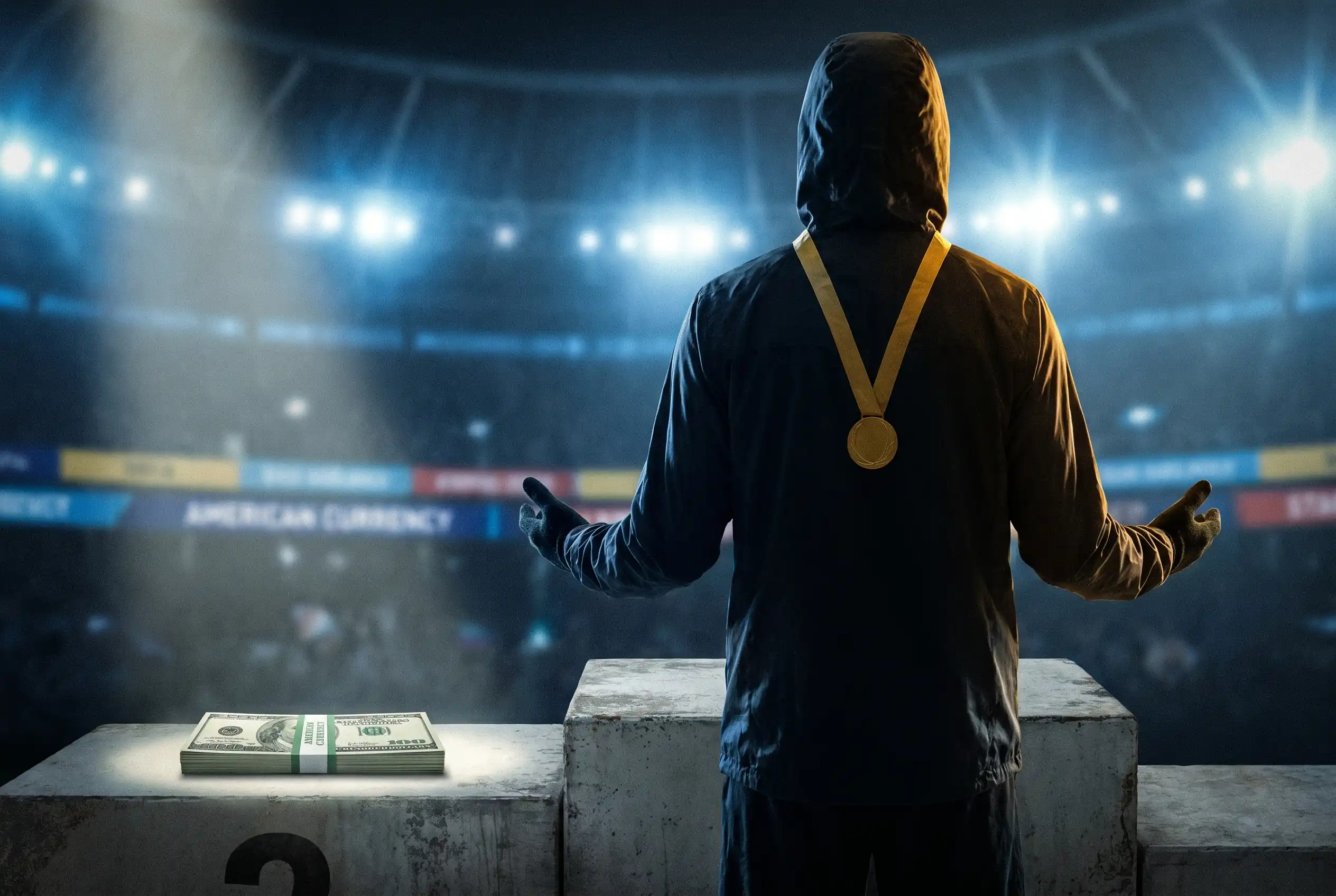
Twelve Billion In, Zero to the Podium
The figures behind the Games are hard to square with that frugality. In the 2021 to 2024 Olympic cycle, the committee took in more than $12 billion, almost all of it from broadcast rights and a handful of global sponsors. The IOC does not build the venues or run the host cities; those costs fall on the hosts. Its job is to sell the show and split the proceeds.
- $12.3 billion in total IOC revenue across the 2021 to 2024 cycle
- $4.9 billion held in the committee’s reserves
- $4.7 million the IOC says it channels into sport every day
- $0 in prize money the IOC itself pays any Olympic medalist
The committee’s own framing is that it is generous. It says it redistributes about 90 percent of its income to athletes and sports organizations worldwide. An independent reading of the committee’s published revenue and redistribution figures and its 2024 accounts put the actual share returned in the cycle nearer 74 percent, around $8.8 billion, with the rest covering operations and reserves.
Either number sounds athlete-friendly until you trace where the cash goes. It flows to national Olympic committees and international federations, the very officials who decide what, if anything, reaches a competitor’s bank account. Most of it never reaches the people on the podium.
The Directors Who Out-Earn the Champions
Follow the money up the organization and the contrast sharpens. The IOC has no salary cap, and under Bach the pay at the top rose sharply. According to the committee’s US tax filings, its director general earned more in a single Olympic cycle than the entire prize pot one federation set aside for every gold medalist in Paris.
| Role or group | Reported earnings, 2021 to 2024 cycle | Olympic prize from the IOC |
|---|---|---|
| IOC director general (Christophe De Kepper) | about $6.3 million | None |
| 16 senior IOC officials, each | more than $500,000 | None |
| IOC president (Coventry, reported) | about $300,000 a year | None |
| Track and field gold medalist, Paris 2024 | $50,000 (paid by the federation) | None |
| Medalist in most other sports | $0 | None |
Christophe De Kepper, the IOC’s director general, took home roughly $6.3 million over the cycle, the filings show; 16 senior managers cleared half a million dollars each, and the president herself reportedly draws over $300,000 a year. Set that beside the prize an Olympic champion collects from the committee, which is nothing, and the priorities are not subtle. The full breakdown sits in the IOC’s US tax filings.
World Athletics Broke the Pay Barrier
The reason Coventry’s stance looks dated is that one of her biggest federations stopped waiting. In April 2024, World Athletics, the global governing body for track and field, became the first international federation to put cash in Olympic medalists’ hands, paying every champion $50,000.
- A cash prize for each gold medalist across all 48 track and field events at Paris 2024
- A total pot of $2.4 million, drawn from the federation’s own share of IOC revenue
- A firm commitment to extend payments to silver and bronze medalists at the Los Angeles 2028 Games
The structure matters. The federation did not invent new money; it redirected a portion of what the committee already pays it every four years to reward the athletes who generate the audience.
Sebastian Coe, the World Athletics president and a double Olympic 1500 meters champion, called it “a pivotal moment” for the sport when he announced the plan. The cash came from the same revenue share Coventry says should not fund direct payments, which is the part that stings. A federation took its slice of the committee’s billions and decided athletes should see some of it.
Other sports have not rushed to follow, and the economics differ wildly between disciplines. Gold medalists in the rest of the program, such as a Paris 2024 freestyle wrestling champion, collected nothing comparable from any federation. But the precedent is set, and the body that set it sits inside the IOC’s own structure.
From Amateur Creed to Billion-Dollar Show
The no-pay tradition is a relic of a Games that no longer exists. The modern Olympics began in 1896 as a strictly amateur event, and professionals were barred from most sports until 1988. Over the following two decades that amateur ideal was quietly abandoned, and the world’s best paid professionals now headline basketball, tennis, golf and football at the Games.
What did not change was the cash flow to ordinary competitors. The committee points to programs such as Olympic scholarships, which supported 1,560 athletes before Paris 2024, of whom 599 reached the Games and won 75 medals. Those grants help athletes prepare; they are not payment for performing on the sport’s biggest stage. The detail is laid out in the IOC’s 2024 annual report.
The committee’s grip on that stage is near-total, from deciding who competes to setting the terms of every broadcast. Its power over eligibility was on display in its handling of Russian and Belarusian athletes competing as neutrals at Paris 2024, a reminder that the body, not the competitor, holds the leverage in nearly every negotiation.
What LA28 Forces the IOC to Answer
The 2028 Los Angeles Games are where the contradiction becomes hard to hide. World Athletics has already promised to widen its prize money to silver and bronze, which means three medalists per event will be paid by their federation while the committee that banks the broadcast money pays them nothing.
That gap invites pressure. Athlete groups have spent years pushing for a share of Games revenue, and the football comparison Coventry’s critics keep raising is blunt: a mid-tier professional footballer earns more in a season than most Olympic champions make in a career, despite drawing a fraction of the global audience an Olympics commands.
The president has room to move without writing checks to every competitor. She has floated more scholarships, better support for athletes leaving sport, and direct programs rather than prize money. Whether that satisfies a generation of competitors who can now watch one federation pay out is another matter.
There is also the optics problem. An organization sitting on billions and paying its directors millions, while telling the people who supply the spectacle that the experience is reward enough, reads very differently now than it did a generation ago. Defenders counter that the committee redistributes most of its income and bankrolls sport in countries that could never afford it, which is true, and that its reserves cushioned the movement when the pandemic nearly forced a cancelled Games.
So the test arrives in Los Angeles. If the federations pay out across all three medal steps and others follow, the line that Olympians should compete for the experience starts to look untenable, and the pressure moves onto Coventry to find real money. If they hold back and the audience shrugs, she will have read the room correctly, and the podium stays a place you win everything except a paycheck.