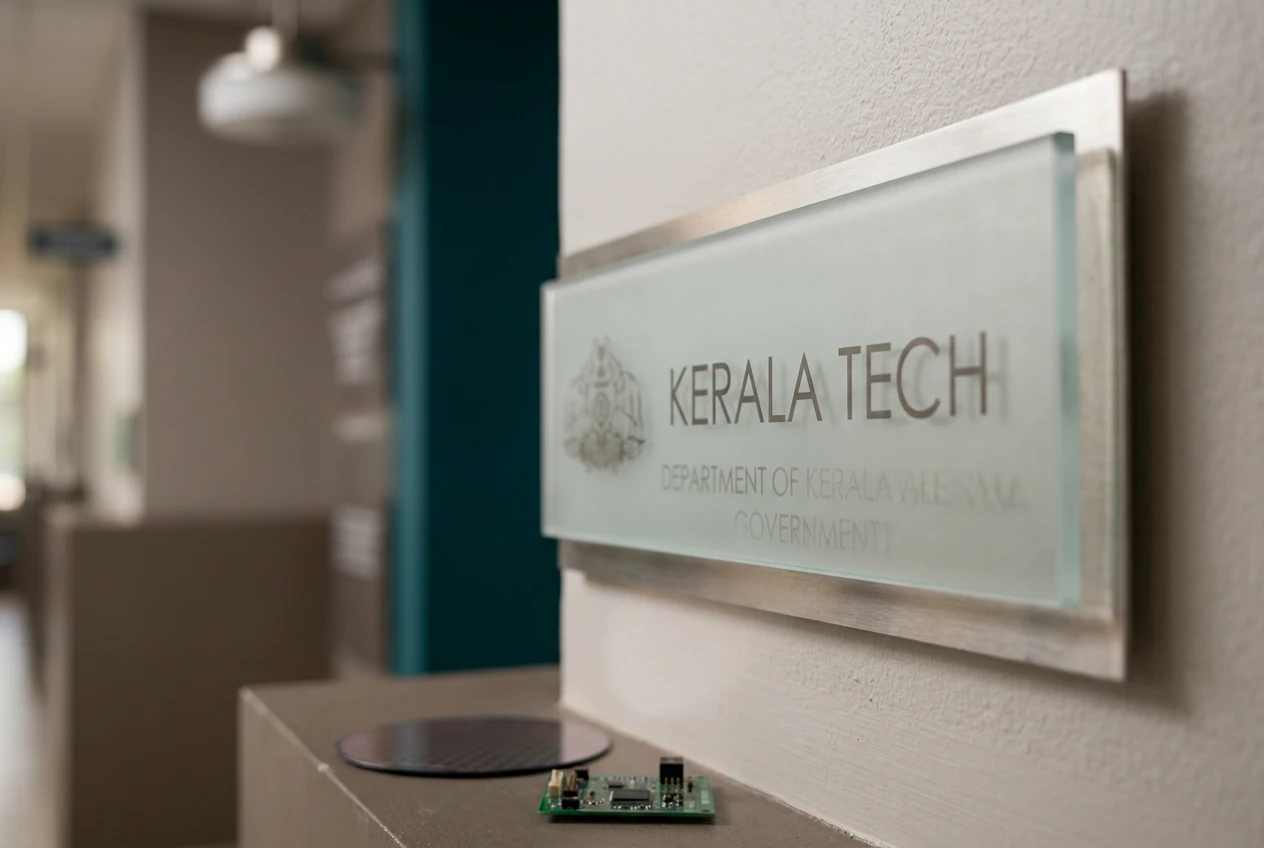
Kerala’s new United Democratic Front (UDF) government has renamed the state’s Electronics and Information Technology department as the IT, Future Technologies and Start-ups department, marketed under a single consumer-style brand called Kerala Tech. Governor Rajendra Vishwanath Arlekar announced the change in his policy address to the 16th Kerala Assembly on May 29, 2026, alongside new missions for artificial intelligence and semiconductors.
Read quickly, it sounds like a clean-slate technology agenda from a government barely two weeks into office. Read against the record, much of the machinery was already drawn up. The outgoing Left Democratic Front (LDF) administration laid out most of these missions in a Vision 2031 document released in October 2025, which means the rebrand inherits a blueprint as much as it writes one.
What the ‘Kerala Tech’ Rebrand Changes
The most visible move is a label. The Electronics and Information Technology department becomes the IT, Future Technologies and Start-ups department, presented to investors and citizens under one brand name. The Governor’s address tied that name to a broader promise of a digital government model built around citizen experience, with AI woven into service delivery.
Underneath the label, the plumbing shifts. Kerala’s state IT implementation agency, the Kerala IT Mission, is being recast as the Digital Transformation Mission, absorbing a Kerala AI Mission and a Kerala Emerging Technologies Mission. A separate Electronics and Semiconductor Mission will be formed to drive the chip agenda.
To separate what is genuinely new from what is merely renamed, the table below maps the structure before the handover to the structure the policy address described.
| Element | Under the LDF (Oct 2025) | Under the UDF (May 2026) |
|---|---|---|
| Department | Electronics and IT department | IT, Future Technologies and Start-ups (brand: Kerala Tech) |
| Nodal agency | Kerala IT Mission | Digital Transformation Mission |
| Artificial intelligence | Kerala AI Mission (K-AIM) | Kerala AI Mission, folded into the Digital Transformation Mission |
| Emerging tech | Kerala Future Tech Mission (KFTM) | Kerala Emerging Technologies Mission, folded into the Digital Transformation Mission |
| Chips | Kerala Semiconductor Mission (planned) | Electronics and Semiconductor Mission (to be formed) |
The Vision 2031 Blueprint the Rebrand Inherits
A Plan Drafted Before the Election
Chief Minister Pinarayi Vijayan released a draft Vision 2031 document for the IT, electronics, semiconductor and emerging-technology sectors at the ReCode Kerala 2025 seminar in Kochi in October 2025. That document set the headline targets now in circulation and established four strategic vehicles: the Kerala Artificial Intelligence Mission, the Kerala Semiconductor Mission, the Kerala Future Tech Mission and a body called The Future Corporation.
Line the two structures up and the overlap is hard to miss. The UDF’s Emerging Technologies Mission maps onto the predecessor’s Future Tech Mission; its AI mission carries the same name; its semiconductor mission was already on the drawing board. The new government’s clearest additions are the consolidation of these strands into one Digital Transformation Mission and the consumer-facing brand on top of it.
None of that makes the rebrand empty. Folding scattered missions into a single agency can reduce turf overlap, and a brand can help in pitching to investors who do not follow Kerala’s administrative wiring. The honest read is that the architecture is largely inherited while the packaging is new, which is a different story from the one a casual headline tells.
How the Handover Unfolded
The sequence matters because it shows how quickly a long-term plan changed political owners. Here is the short timeline.
- October 2025: the LDF government releases the draft Vision 2031 document at ReCode Kerala 2025 in Kochi.
- The 2026 assembly election delivers the UDF 102 seats, its strongest showing in decades and an end to ten years of Left rule.
- May 17, 2026: V D Satheesan is sworn in as Chief Minister and the cabinet is named.
- May 20, 2026: a state gazette order assigns the AI and IT portfolios to P K Kunhalikutty.
- May 29, 2026: the Governor’s policy address unveils the Kerala Tech rebrand and the new mission structure.
India’s First Cabinet-Level AI Ministry
The genuinely original structural move sits in the cabinet, not the department name. With the gazette order of May 20, Kerala became the first Indian state to assign artificial intelligence as a distinct cabinet-level responsibility. Veteran Indian Union Muslim League leader P K Kunhalikutty holds it, bundled with Industries, Commerce, Information Technology, start-ups, mining and geology, and handlooms and textiles.
That single appointment is the part of this package no previous administration matched, and it gives the rebrand a political spine. It also dovetails with national programmes: the national AI mission’s Kerala activity includes two AI centres of excellence, one focused on Bio-AI at the Kerala Startup Mission in Kochi and a general-purpose centre under Digital University Kerala in Thiruvananthapuram. Having a minister whose title literally reads AI is meant to signal that the file has a clear owner. Whether India’s first cabinet-level AI portfolio translates into budgets is the open question.
The Semiconductor Bet Kerala Is Making
Niche Over Mass Fabrication
The new Electronics and Semiconductor Mission is not a pitch to build a giant chip fab. Kerala lacks the land, water and capital that mega-fabs in Gujarat and Assam are chasing, and the Vision 2031 work acknowledged as much. The state’s stated plan leans toward niche, low-volume work rather than mass production, betting on design and specialised manufacturing where small batches still earn good margins.
That focus aligns with where India’s broader incentives sit. The state can plug into the national semiconductor incentive framework without trying to win the capital-heavy fabrication race outright. The concrete focus areas read like this.
- Electronics System Design and Manufacturing (ESDM, the work of designing and assembling electronic systems rather than fabricating raw silicon)
- Specialised research-and-development fabrication, deliberately skipping capital-heavy, high-volume production lines
- High-value design segments where Kerala’s engineering talent, not its factory footprint, is the asset
The Infrastructure Behind It
There is physical scaffolding for this already. The Digital Science Park in Thiruvananthapuram, a project pegged at about Rs 1,515 crore, is meant to anchor research in AI, semiconductors, robotics and smart materials, giving the chip mission a campus to grow into rather than a greenfield to clear.
The mission’s success will hinge on whether design houses and global firms actually set up there, not on the ribbon-cutting. Infrastructure without anchor tenants is a familiar Indian park problem, and Kerala has empty floor space in older corridors to fill before it builds much more.
Who Gains From the New Label
The most direct beneficiaries are the state’s existing technology corridors. The policy address promised to expand current IT parks and court fresh investment, which matters most to Technopark, Infopark and Cyberpark, the campuses that already house Kerala’s software workforce. The Vision 2031 work wants to add roughly 30 million square feet of office space and pull in 120 global capability centres (GCCs, the offshore units multinationals run for their own engineering and back-office work) by the end of the decade.
Start-ups sit in the second tier of beneficiaries. The state’s start-up accelerator network, the Kerala Startup Mission, already backs thousands of young firms, and the rebrand keeps start-ups in the department’s name. Traditional and small-scale sectors get a mention too, with the address pairing AI and biotechnology ambitions with support for coir, handloom, plantations and food processing.
The numbers the new government has effectively adopted are large.
- $50 billion in IT economic value targeted by 2031
- Five lakh high-value jobs, roughly 500,000 positions, over the same horizon
- Rs 20,000 crore (about $2.4 billion) in start-up investment, alongside 20,000 new start-ups
- 120 global capability centres planned across the state by 2031
Where the Plan Could Stall
Land is the first constraint, and the government knows it. The policy address flagged the creation of a land bank using special purpose vehicles (SPVs, separate entities set up to ring-fence a project), funded through market borrowing and private fundraising, precisely because Kerala’s dense settlement leaves little room for sprawling industrial parks. Borrowing to assemble land carries its own fiscal risk in a state already weighing a White Paper on its finances.
Ownership is the second issue. Targets drafted by one government and adopted by its rival can drift, especially when the rival has incentive to claim wins and disown shortfalls. The missions need budgets, staffing and timelines attached before the brand means anything operationally.
Process reform is where the new administration can move fastest. The address promised to formalise an Investment Promotion Board, modernise the K-SWIFT single-window clearance platform and empower the Single Window Clearance Board for time-bound approvals, the kind of plumbing that decides whether a GCC actually lands or files its papers elsewhere.
If the rebrand attaches real money and firm deadlines to the missions it inherited, Kerala Tech becomes a working department rather than a logo. If it does not, the state will have changed the letterhead while the targets keep their 2031 date and lose their momentum.
Frequently Asked Questions
What is Kerala Tech?
Kerala Tech is the new brand name for the state’s renamed technology department, formally the IT, Future Technologies and Start-ups department. The Governor announced it in the policy address to the 16th Kerala Assembly on May 29, 2026.
Which department was renamed and what is the new name?
The Electronics and Information Technology department was renamed the IT, Future Technologies and Start-ups department. Its nodal agency, the Kerala IT Mission, is being recast as the Digital Transformation Mission.
Who is Kerala’s first AI minister?
P K Kunhalikutty, a senior Indian Union Muslim League leader, holds the artificial intelligence portfolio under a gazette order dated May 20, 2026. His charge also covers Industries, Commerce, Information Technology, start-ups, mining and geology, and handlooms and textiles, making Kerala the first Indian state with a cabinet-level AI portfolio.
What are the new technology missions?
The state is creating a Digital Transformation Mission, which absorbs a Kerala AI Mission and a Kerala Emerging Technologies Mission, and a separate Electronics and Semiconductor Mission for the chip sector.
What is Kerala’s IT Vision 2031 target?
The Vision 2031 document, drafted under the previous government in October 2025, targets $50 billion in IT economic value and about five lakh high-value jobs by 2031, along with 20,000 start-ups and 120 global capability centres.
Will Kerala build semiconductor fabrication plants?
No mass-production fabs are planned. The semiconductor mission focuses on Electronics System Design and Manufacturing and specialised research-and-development fabrication, aiming at high-value, niche segments rather than capital-intensive bulk chip making.