The Federal Trade Commission and five state attorneys general secured a court order on July 8, 2026 requiring John Deere to hand over the diagnostic software, repair manuals, and electronic reprogramming tools that have locked farmers and independent mechanics out of their own tractors for more than a decade. The settlement, filed in U.S. District Court for the Northern District of Illinois, marks the first time a federal antitrust agency has applied the legal theory that withholding software to control who can repair a physical product constitutes illegal monopolization under the Sherman Act. Deere did not admit wrongdoing; the company had denied throughout the litigation that its practices were anticompetitive.
For a farmer with a broken John Deere combine sitting idle in a half-harvested soybean field, the practical consequence is immediate: the software that only an authorized Deere dealer could access to complete an electronic repair must now be made available to her, on fair and reasonable terms, for the next ten years. The mechanism Deere used is not unique to tractors. It describes how much of the consumer technology industry already operates, from cars with locked telematics data to iPhones with software-paired parts.
How Deere’s Software Lock Worked
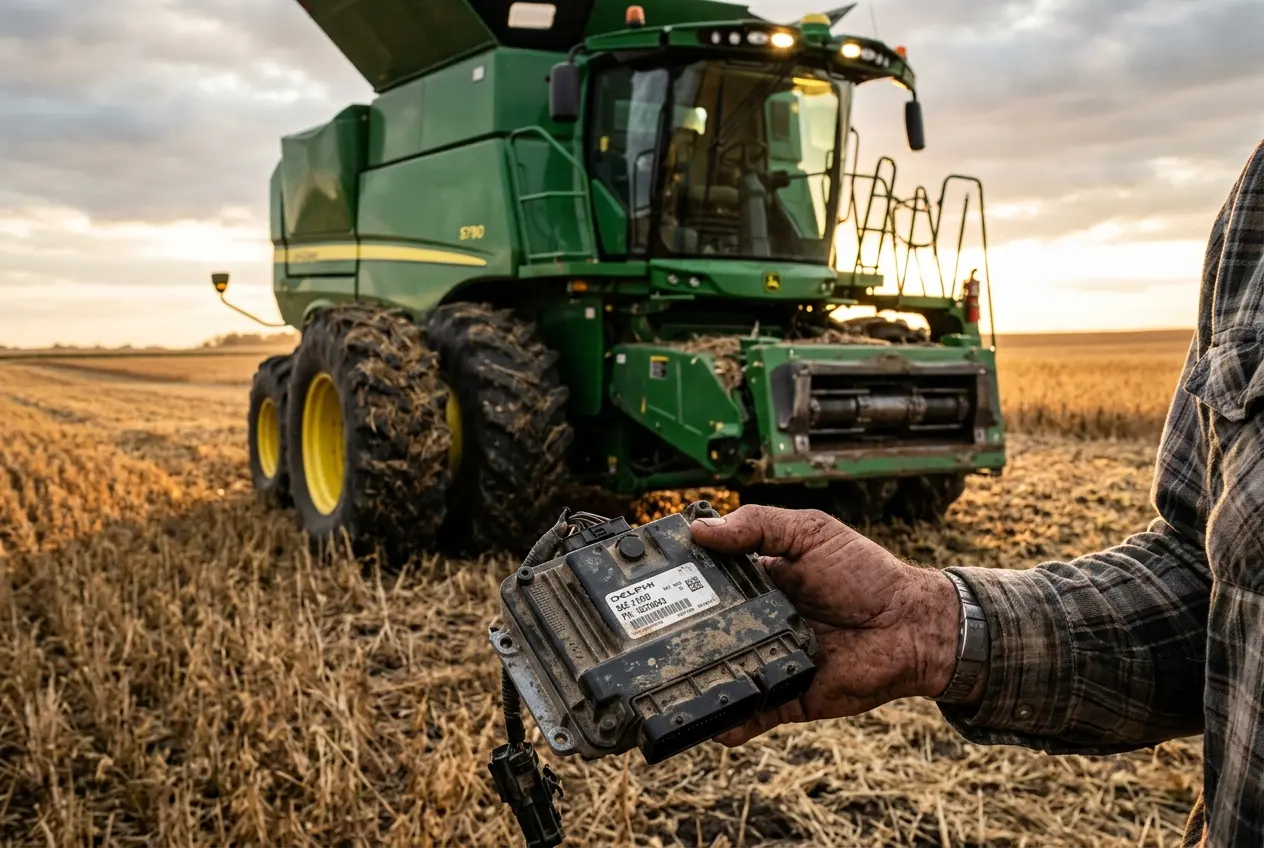
Modern John Deere agricultural machinery contains up to 40 electronic control units (ECUs), onboard computers linked through a Controller Area Network bus that monitors everything from engine performance to emissions systems. A single machine may carry up to 125 software-connected sensors, according to a 2023 U.S. PIRG audit. When any one of them trips a fault code, the ECU can enter what Deere calls “limp mode,” restricting the machine’s speed and function until the fault is resolved.
Resolving that fault required two software steps that only Deere’s dealer-level Service ADVISOR could perform. The first was reading the fault code with full diagnostic context, including the troubleshooting pathways that Deere redacted from the version of the same software it sold to the public. The second, and more consequential, was “pairing”: uploading what Deere calls a “payload file” to a newly installed electronic component, instructing the CAN bus to recognize it. The analogy is a printer driver. The hardware may be physically connected and mechanically sound, but without the driver installed, the machine remains inert.
The public-facing version of Service ADVISOR, which Deere sold to farmers and independent repair shops for $3,000 or more per year, redacted the ECU fault descriptions, withheld troubleshooting guides, and disabled the reprogramming function entirely. The Service Obstructor audit documented the gap in a direct comparison of the two software versions. Without the payload file, a mechanically correct repair left the machine unable to operate. A farmer could own the combine, buy the replacement part, install it correctly, and still be unable to make the machine run without calling a dealer technician, who would then complete the pairing remotely, at dealer rates.
- $3 billion in estimated annual farmer downtime losses (U.S. PIRG)
- $1.2 billion in estimated annual excess repair costs (U.S. PIRG)
- $4.2 billion in estimated annual losses across all farm-equipment manufacturers (U.S. PIRG)
- $99 million Deere agreed to pay in the April 2026 class action settlement
- More than 200,000 farmers are part of the class action, per legal analysis
What the FTC Order Actually Requires
Under the proposed stipulated order, Deere must provide farmers and independent repair providers, on fair and reasonable terms, repair resources equal to what it provides its authorized dealers. The list, drawn directly from the FTC’s July 8 press release, includes reading, clearing, and resetting electronic fault codes; reprogramming electronic components and pairing newly installed parts with the machine’s CAN bus; restarting equipment following emissions-related shutdowns; and full access to technical manuals, troubleshooting solutions, and Deere’s internal product improvement programs and DTAC solutions. The Commission voted 2-0 to issue the proposed order, with FTC Chairman Andrew Ferguson issuing a statement alongside Commissioner Mark Meador endorsing the settlement.
The forward-looking provision may prove equally significant over time. Deere must make any future repair resources available to independent shops and farmers once they are rolled out to over 50 percent of its authorized dealer network in the United States. Deere cannot quietly expand dealer capabilities during the order’s 10-year window while keeping the independent repair market frozen. If Deere violates the order’s terms, the 10-year clock can be extended.
Deere is also barred from instructing its dealers to discriminate or retaliate against customers who choose independent repair, a provision that closes the informal enforcement mechanism that had allowed the monopoly to persist even in cases where software access was not technically denied. The five plaintiff states, Arizona, Illinois, Michigan, Minnesota, and Wisconsin, also received $1 million collectively to cover antitrust enforcement costs. State attorneys general in all five states have standing to enforce the order directly in their own jurisdictions, distributing enforcement responsibility beyond the FTC alone. Deere also faces 60-day compliance reports during the consent decree’s term, and the notification requirement obliges Deere to send letters to farmers and independent repair providers explaining the settlement terms.
Today’s settlement enables farmers to do what they’ve done for generations, fix their own tractors and other farm equipment, without having to pay an authorized John Deere dealer to do it for them.
That statement came from Daniel Guarnera, the FTC’s Bureau of Competition Director. Deere’s Vice President of Aftermarket and Customer Support Denver Caldwell framed the agreement in different terms: “We’ve said from the beginning that our focus is on helping customers keep their machines running when and how they need them. This is good news for our customers and for the future of how Deere equipment is supported.” Both statements now sit in the public record.
The $99 Million Class Settlement That Came First
The FTC order is the second major right-to-repair settlement Deere reached in 2026. In April, the company agreed to pay $99 million, plus interest accruing at 3.95% per year, to resolve a consolidated class-action lawsuit covering farmers who paid authorized dealers for large agricultural equipment repairs between January 10, 2018 and the date of preliminary approval, courts granted preliminary approval in May 2026. The lawsuit, originally filed in 2022 as multidistrict litigation in the same Northern District of Illinois court, alleged Deere monopolized the aftermarket repair landscape by tying machinery sales to its own repair services.
The class action put cash in farmers’ pockets for past harm. U.S. PIRG’s Right to Repair campaign called the cash payout “a relatively minor financial penalty” against the broader repair-restriction problem. The lawsuit had argued Deere wields significant economic power in the market for large tractors and combines, with a market share larger than the next two biggest tractor makers, Case New Holland and Kubota Corp., combined. Nathan Proctor, U.S. PIRG’s senior director, said “the most important thing is for farmers to be able to fix their stuff” and promised continued advocacy against every equipment maker, not just Deere.
The two settlements serve different purposes. The class action compensates for past harm. The FTC order is structural: it changes the underlying rules going forward and places federal regulatory oversight and five state attorneys general behind that change for a decade. Both were filed in the Northern District of Illinois before Judge Iain Johnston. The FTC order still requires Johnston’s signature to carry the full force of law; consent decrees of this type are routinely approved.
What This Means for Cars, Medical Devices, and Phones
The mechanism Deere used, proprietary software required for essential maintenance withheld from anyone outside the manufacturer’s authorized service network, is not unique to tractors. Automotive manufacturers have deployed similar architecture in vehicle telematics and OBD-based diagnostic systems for years. The Alliance for Automotive Innovation spent years litigating against the Massachusetts’ 2020 telematics data-access law, which passed with 75 percent of the vote. A federal trial court dismissed the automakers’ remaining claims in February 2025. The case is now before the U.S. Court of Appeals for the First Circuit, with mediation being explored.
Federal legislation has moved in parallel. The automotive REPAIR Act (H.R. 1566), with a Senate companion (S. 1379) sponsored by Senators Josh Hawley and Ben Ray Luján, advanced from a House Energy and Commerce subcommittee by voice vote on February 10, 2026, per the REPAIR Act bill status and history on Congress. Full REPAIR Act provisions were subsequently dropped from the committee’s May 2026 highway bill markup and replaced by a narrower substitute. Negotiations over right-to-repair language continue ahead of the surface transportation reauthorization deadline of September 30.
Medical device manufacturers have long restricted independent repair of hospital equipment using software-lock mechanisms structurally identical to Deere’s payload-file pairing. Consumer electronics makers, including Apple, have defended parts-pairing restrictions under intellectual property arguments that closely mirror Deere’s prior legal positions. The antitrust theory the FTC applied here does not automatically bind other industries, but it signals the FTC treats software-lock repair monopolies as actionable antitrust conduct wherever the factual predicate is similar.
Six states enacted consumer electronics right-to-repair laws effective January 1, 2026, covering California, Colorado, Minnesota, New York, Oregon, and Washington. Connecticut and Texas repair laws take effect later this year, per Arnold & Porter analysis. More than 33 right-to-repair bills were introduced in state legislatures in early January 2026, alongside the federal FARM Act introduced in October 2025. Several of those bills include anti-parts-pairing provisions that would prohibit manufacturers from using software to restrict component-level repair.
The EU’s Right to Repair Directive (2024/1799), which requires manufacturers to offer repair services that are efficient and affordable, required member state transposition by July 31, 2026, a deadline that arrived this week. State legislatures in the U.S. continue to expand the scope of who must open their repair systems. The cumulative effect across the U.S., EU, and individual states is a rapidly shrinking set of industries that can claim a permanent monopoly on repairing their own products.
| Sector | Software lock mechanism | Active legal action | Status as of July 2026 |
|---|---|---|---|
| Farm equipment (Deere) | Payload-file pairing via Service ADVISOR | FTC stipulated order filed July 8, 2026 | 10-year consent decree pending Judge Johnston’s signature |
| Automotive | Telematics data access; OBD diagnostics | Massachusetts law upheld Feb 2025; REPAIR Act in subcommittee | First Circuit mediation; highway bill negotiations through September 30 |
| Medical devices | Software locks on hospital equipment | Pending industry-specific rules and advocacy pressure | Structural parallels to Deere theory cited by advocates |
| Consumer electronics | Parts-pairing in devices including iPhones | Six state laws in effect Jan 1, 2026 | Apple and others defend parts-pairing under intellectual property law |
Why the Order Is Ten Years, Not Forever
The Deere settlement covers John Deere specifically, not the industry. Other major agricultural equipment manufacturers, CNH Industrial (Case IH, New Holland), AGCO (Fendt, Massey Ferguson), and Kubota, face no parallel obligations under this order. The antitrust theory the FTC has now successfully deployed applies equally to their practices if the factual record supports it. Whether the FTC or a state attorney general files a parallel action is the open question.
The 10-year window is also worth considering plainly. Right-to-repair advocates spent more than a decade reaching this settlement, and the order expires in 2036. Without broader federal legislation or parallel enforcement actions against other manufacturers, the structural problem can reassert itself once the clock runs out, or migrate to a competitor’s product line where no order applies. Voluntary commitments have not reliably delivered access in the past. Deere’s 2023 memorandum of understanding with the American Farm Bureau Federation had promised expanded repair access, but a U.S. PIRG audit one month after the MOU took effect found the customer version of Service ADVISOR still redacted ECU fault descriptions and disabled reprogramming. The consent decree’s 60-day compliance reports and federal oversight are the mechanisms that replace that voluntary framework.
What Changes for Farmers This Week
A farmer who owns a John Deere 8R tractor and has been waiting two weeks for a dealer appointment to clear a fault code on a sensor she already replaced herself will see the practical change once Judge Johnston signs the order. She will be entitled to access the software to clear that code herself, or take it to the independent mechanic down the road who charges half what the dealer does. Within 30 days of the court order, Deere must send notification letters to farmers and independent repair providers explaining the settlement terms and how to access the newly available resources.
Independent repair technicians like Montana-based Brad Sage, who told NBC News he had resorted to purchasing bootlegged dealer-level Service ADVISOR software from third-party online marketplaces, will be able to operate above board with legitimate access to the same tools the manufacturer provides its own dealer network, after years of buying bootlegged Service ADVISOR copies. Missouri farmer Jared Wilson’s 2022 experience illustrates what the lock cost in practice: after a combine ECU failed during his soybean harvest, a new part arrived in three days. The machine still could not function until a dealer technician uploaded the payload file. His soybeans continued falling to the ground while he waited.
Implementation will require ongoing attention. The “fair and reasonable terms” standard leaves room for dispute over pricing; if Deere’s pricing tiers for access tools effectively recreate the old access barrier through high fees instead of denial, that would violate the order’s intent and its terms. A farmer who can now take a broken machine to any competent mechanic instead of waiting for an authorized dealer with a monopoly on the necessary software can compare prices between competing repair providers for the first time.
Willie Cade of the repair advocacy organization Repair.org welcomed the FTC deal but urged vigilance: “After years of fighting for the right to repair, this order gives farmers real hope. But promises on paper must become tools in farmers’ hands, and we will be watching implementation every step of the way.” That scrutiny will determine whether the Deere consent decree becomes a template or a one-off.
Frequently Asked Questions
What does the John Deere FTC settlement require, and when does it take effect?
The proposed consent decree requires Deere to provide farmers and independent repair providers the same diagnostic and repair software it gives its authorized dealer network, including electronic fault-code reading and clearing, ECU component reprogramming and parts-pairing (the payload file process), limp-mode release after emissions shutdowns, and full access to technical manuals, troubleshooting guides, and internal product improvement programs. The order takes the force of law once signed by U.S. District Judge Iain Johnston in the Northern District of Illinois; signature is pending but consent decrees of this type are routinely approved. Within 30 days of the court order, Deere must send notification letters to farmers and independent repair providers explaining the settlement terms and how to access the newly available resources.
Will this FTC settlement affect my ability to get my car or phone repaired independently?
Not directly. The Deere order is specific to John Deere agricultural equipment. The legal principle it establishes, however, is significant for every other sector using a similar software-lock architecture. This is the first time a federal antitrust agency has successfully applied the theory that withholding software to control an aftermarket repair market constitutes Sherman Act Section 2 monopolization. The automotive REPAIR Act (H.R. 1566) advanced from a House subcommittee on February 10, 2026, though full REPAIR Act provisions were dropped from the May 2026 highway bill markup and replaced by a narrower substitute. Six states enacted consumer electronics right-to-repair laws effective January 1, 2026, covering California, Colorado, Minnesota, New York, Oregon, and Washington. The Deere precedent does not automatically bind other industries, but it signals that federal enforcement is viable.
Why couldn’t independent mechanics fix John Deere equipment before this settlement, even with the right parts?
Because Deere’s repair monopoly was built into the machine’s software architecture, not just its policies. Modern Deere tractors run on a network of up to 40 electronic control units connected through a Controller Area Network bus. When a faulty component is replaced, the new part must receive a payload file, a software driver that instructs the CAN bus to recognize it, before it will function. Uploading that payload file required Deere’s dealer-level Service ADVISOR software, which the company withheld from farmers and independent mechanics. The customer version of Service ADVISOR, sold for $3,000 or more per year, redacted the fault descriptions and disabled the reprogramming function entirely. A competent mechanic with the right part and the right tools still had to call a dealer to complete the job.
Does the Deere settlement cover CNH, AGCO, Kubota, or other farm equipment brands?
No. The FTC order applies only to Deere & Company and its authorized dealer network. CNH Industrial (which makes Case IH and New Holland equipment), AGCO (Fendt, Massey Ferguson), and Kubota face no parallel legal obligations under this order. All three have signed memoranda of understanding with the American Farm Bureau Federation promising expanded repair access, but as Deere’s MOU history demonstrates, voluntary commitments without enforcement mechanisms have not reliably delivered access in practice. U.S. PIRG and Repair.org have said their next priorities include pressing for enforcement actions and legislation that cover the full agricultural equipment market, not just John Deere.
How much will farmers receive from the related $99 million class-action settlement?
The $99 million fund, plus interest at 3.95% per year, resolves a consolidated class-action lawsuit covering farmers who paid authorized dealers for large agricultural equipment repairs between January 10, 2018 and the date of preliminary approval, which courts granted in May 2026. U.S. PIRG estimated the cash payout represents a recovery rate of 26% to 53% of estimated past overcharges. After attorneys’ fees, lead-plaintiff awards, and litigation expenses are paid, the remainder will be divided among eligible farmers who submit claims. The class action was filed in 2022 as multidistrict litigation in the Northern District of Illinois, alleging Deere monopolized the aftermarket repair landscape by tying machinery sales to its own repair services.