The Tata Sierra EV arrives at a starting price of Rs 18.79 lakh (ex-showroom), and CarDekho’s first drive of the SUV walks back from the launch with a familiar split verdict: a cabin, feature list, and battery warranty that push the segment forward, paired with the same build-quality niggles that have dogged Tata’s recent launches. The car is a calculated wager, a bet that buyers will trade panel gaps and a missing spare tyre for a 15-year battery warranty, a 665 km claimed range, and a triple-screen dashboard in a family SUV that does not look like every other aerodynamic bar of soap on Indian roads.
The Sierra EV’s positioning matters because it shares its name with an ICE Tata that has already sold on nostalgia and design. Adding an electric variant on top of that name is a different kind of bet from launching a clean-sheet EV. Tata has to keep existing Sierra buyers curious without cannibalising them, and it has to convince a new EV buyer that the brand’s quality story has caught up with its feature story. The first-drive verdict from CarDekho, cross-read against Autocar India’s drive and Tata’s own specs page, suggests one side of that bet has clearly landed and the other is still being paid off.
Where the Sierra EV Sits in the Lineup
Tata launched the Sierra EV in five personas and two battery packs, with prices stretching from Rs 18.79 lakh for the Pure 63 kWh rear-wheel-drive version to Rs 25.99 lakh for the Empowered A 75 kWh Quad Wheel Drive variant, according to a variant-by-variant breakdown published on 1 July 2026. The price ladder is wide on purpose. The entry Pure trim is not positioned as a stripped-down EV: it ships with bi-LED projector headlamps, connected LED DRLs and tail-lamps, 18-inch alloys, a 12.3-inch touchscreen, a 10.25-inch digital instrument cluster, wireless Android Auto and Apple CarPlay, six airbags, ESP, hill hold and descent control, and a tyre-pressure monitoring system.
The climb up the ladder changes the car’s character more than it changes its name. Adventure is the first point where the larger 75 kWh battery becomes available, and Empowered A is the only trim that can be ordered with Tata’s new Quad Wheel Drive (QWD) dual-motor setup. That top variant adds a head-up display, Level 2+ ADAS with 22 functions, e-Valet parking assistance with automatic parking, remote park, summon and reverse assist, plus a 540-degree camera with transparent mode. The QWD version further adds Boost Mode, six terrain modes, Off-Road Assist, and 205 mm of ground clearance.
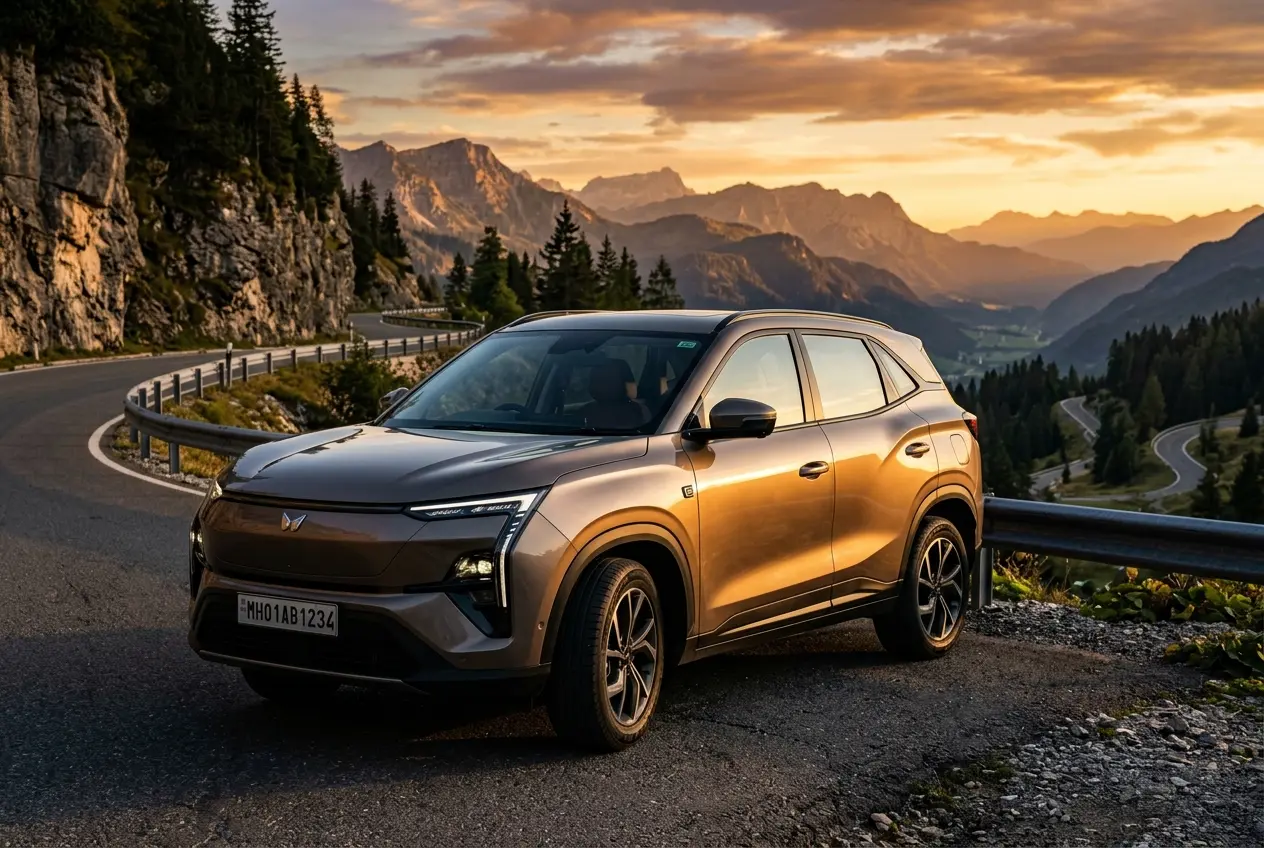
What the Drive Team Liked: Design and Cabin
CarDekho’s review opens by treating the exterior as a quiet win. The Sierra EV does not try to reinvent the silhouette of its ICE sibling. The Alpine-inspired rear quarter windows and the connected lighting elements at both ends give it a distinct identity, and the single body-coloured blanked-off nose replacing a traditional grille makes it look more futuristic for that one change alone. Autocar India notes that this is a welcome departure from the notion that all EVs need to be shaped like bars of soap for better aero efficiency, and credits Tata for keeping the Sierra’s upright, boxy stance intact.
The boxy shape pays off inside. The dual-tone colour scheme brightens up the interior, while the dashboard layout has a simple, modern look that doesn’t overwhelm you with buttons, CarDekho writes. The cabin’s generous proportions make it feel more like a lounge than a conventional car, and the cream-coloured leatherette-bound dashboard on higher trims adds to that effect. Autocar adds that the front seats are very comfortable and offer a good amount of shoulder support, and that the floor height has gone up by less than an inch compared to the ICE Sierra, with no perceptible difference once you sit in the back.
Boot space is unchanged at 622 litres, measured floor to roof. A 55-litre frunk in the single-motor models and a 35-litre frunk in the dual-motor version give buyers a lockable space for charging cables or valuables. The Sierra’s awkward L-shaped B-pillar returns from the ICE car, and a small amount of backrest recline is available in the rear. The panoramic sunroof on top trims is, in Tata’s own words, gigantic.
The Feature List Is the Headline
Where the Sierra EV clearly tries to break from the segment is on equipment. CarDekho lists a triple screen setup with crisp displays, built-in games and OTT apps for the co-passenger, a panoramic sunroof, ventilated front seats, and a JBL audio system with Dolby Atmos as the standouts. Autocar’s tally goes further: a 12-speaker JBL Black sound system with Dolby Atmos, dual-zone climate control, an onboard air purifier, connected car tech, drive modes, regen modes, terrain modes, and a Google Maps integration that predicts the state of charge at your destination.
The safety stack is also generous. CarDekho credits the Level 2 ADAS suite for not constantly nagging or surprising the driver with abrupt interventions, and Autocar rates the features-and-safety package 9 out of 10, calling the Sierra EV one of if not the best equipped in its segment with every conceivable gizmo on the top Empowered A trim. The EV gets a small edge over the ICE version in the form of a powered front passenger seat, a head-up display that runs alongside (not instead of) the three-screen layout, and a driver seat memory function.
Tata has used the additional screen real estate to add features that look clever on paper. The passenger display supports multiplayer gaming that lets all passengers connect their phones to the car and play from their own devices. The HUD gives a cleaner read of speed and ADAS prompts than the slightly cluttered 10.25-inch driver’s display. Whether any of this survives daily use is a question a longer test will have to answer, but on first acquaintance the equipment load is the strongest argument the Sierra EV makes.
Range, Charging, and the 15-Year Battery Warranty
Range is the second-strongest argument. CarDekho’s claimed-range table, which Tata’s official page attributes to ARAI testing under the MIDC Part 1 plus Part 2 cycle, breaks down as follows.
| Battery Pack | Layout | Claimed Range (MIDC Part 1 + 2) |
|---|---|---|
| 63 kWh | Single-Motor (RWD) | 565 km |
| 75 kWh | Single-Motor (RWD) | 665 km |
| 75 kWh | Dual-Motor (QWD) | 624 km |
Autocar India’s review adds the caveat: Tata itself says the MIDC rating won’t be achieved in real-world use, but the larger battery can deliver upwards of 500 km realistically. CarDekho’s drive notes that on longer journeys, you won’t be hunting for a charger every couple of hours. The 63 kWh and 75 kWh packs are among the bigger batteries offered in this segment, with only the Mahindra BE 6 offering a larger 78 kWh unit.
Charging is competitive without being class-leading. On a 7.2 kW AC charger, the 63 kWh pack takes 8.9 hours to go from 10 to 100 percent, while the 75 kWh pack takes 10.5 hours, according to Autocar. On a 120 kW DC charger, both packs do a 20 to 80 percent top-up in about 26 minutes. The headline, though, is the warranty: Tata is offering a 15-year, unlimited-kilometre warranty on the high-voltage battery, and Tata’s own terms page defines that lifetime as fifteen years from the first date of registration under the Motor Vehicles Act, 1988, for the first registered private owner, with the warranty voided if the car is sold on to a third party. For anyone still hesitant about switching to an electric vehicle because of long-term battery health, this goes a long way in easing those concerns, CarDekho writes.
The Powertrain and How It Actually Drives
The Sierra EV is offered in three powertrain configurations: a 63 kWh battery with a single rear motor, a 75 kWh battery with a single rear motor, and the 75 kWh battery with dual motors that Autocar drove. The dual-motor QWD version is the first AWD in this segment, and it is the most potent variant, with a class-leading output of 306 hp and 504 Nm. Despite a kerb weight of around 2.1 tonnes, the SUV can sprint to 100 kph from a standstill in a claimed 5.8 seconds.
None of those numbers come across in the cabin. The power delivery is smooth, the throttle is progressive, and the car moves off with a gentle, predictable response, CarDekho’s drive notes say. Even if you’re new to the Sierra EV, you’ll be comfortable driving it in no time. The instant burst of acceleration is waiting just beneath your right foot when you do need to overtake. Autocar’s verdict is that the powertrain is smooth and refined, as expected from Tata’s EVs over the years, but feels a bit too similar to older Tata EVs for a new-generation model, with a small dead zone at the start of the pedal travel before power comes in abruptly.
The off-road course Tata set up for the media drive was not a walk in the park, and the QWD version handled it with surprising ease. Short overhangs improve approach and departure angles, and the responsiveness of the e-motors does most of the work without needing to dip into the terrain modes for most obstacles. On tarmac, the 19-inch wheels and frequency-dependent dampers absorb broken roads with equal composure. Wind noise around the A-pillars at high speed is more apparent because the powertrain is so quiet, but it is not an irritant.
There is a hidden drift mode that deactivates the ESC. Whether that belongs in a family SUV is a question Tata did not answer.
The Niggles: Where Tata’s Compromise Shows
The downsides cluster around build quality and ergonomics, and they are the same complaints that have surfaced on recent Tata launches. CarDekho’s standout negatives are these.
- Misaligned badges and inconsistent panel gaps inside the cabin. Small things, but the kind you notice once and can’t completely unsee.
- Piano black trim everywhere. Classy on day one, but dust, scratches and fingerprints become part of daily life very quickly.
- No spare tyre as standard. You pay extra to get one, and many buyers still value the reassurance of having one, making the optional extra feel unnecessary.
- Driving position awkward for taller drivers. The seat and steering adjustments may not offer enough flexibility for everyone.
Autocar’s review, which has its own first drive of the car, adds more weight to this list. For every soft surface and attractive trim piece, there is visible hard plastic, rough edges, crooked stitching and misaligned panel fit, which is an eyesore at this price. The pedestal-mounted drive selector wastes the space below it. The umbrella holders in the door cards have no drain plug, so surplus water collects in the door pockets. The replacement for the spare wheel, which was mounted under the body on the ICE Sierra, is a puncture repair kit tucked inside the 622-litre boot.
Tata has also not retuned the throttle for stop-and-go traffic the way newer EVs have. There is a small dead zone at the start of pedal travel, after which power comes in abruptly, requiring care in dense traffic. The regen modes, easily accessible via the steering-mounted paddles, do not feel all that different from one another. None of these are deal breakers on their own. Taken together, they read like a car that was signed off at the spec level rather than at the touch-and-feel level.
Safety and the Bharat NCAP Question
The Sierra EV has not been crash-tested by Bharat NCAP yet. The ICE Sierra scored a 5-star Bharat NCAP rating, which should feasibly carry forward to the EV, Autocar writes, while flagging that this is an inference and not a tested result. Until the EV gets its own star rating, the safety case rests on the equipment list: six airbags as standard, all-wheel disc brakes, electronic parking brake with auto hold, ABS with EBD, ESP, traction control, hill hold, hill descent control, a 540-degree camera with transparent mode on the top trim, and the Level 2+ ADAS suite that, in CarDekho’s experience, intervenes naturally rather than abruptly.
For a buyer cross-shopping the segment, this is competitive but not unique. The Mahindra BE 6, Mahindra XEV 9e, Hyundai Creta Electric, MG ZS EV and Maruti Suzuki e Vitara all sit in the Sierra EV’s competitive orbit, and most of them offer overlapping ADAS and airbag kits. What the Sierra EV has that the segment mostly does not is the lifetime battery warranty and the most loaded feature list in the price band, which is exactly the wager Tata is making.
No car is perfect. The Tata Sierra EV also has a few shortcomings that deserve attention, but they don’t overshadow the overall experience. It has more strengths than compromises. Moreover, it’s modern, feature-packed, and drives really well whether on well-paved tarmac or off it.
That is CarDekho’s closing verdict, and it captures the bet in one sentence. For the buyer willing to live with panel gaps and piano-black fingerprints in exchange for a 665 km claimed range, a 15-year battery warranty, and a lounge-style cabin with three screens and a JBL Black audio system, the Sierra EV is the most convincing Tata EV you can buy right now.
Frequently Asked Questions
What is the starting price of the Tata Sierra EV?
The Tata Sierra EV starts at Rs 18.79 lakh (ex-showroom) for the Pure 63 kWh rear-wheel-drive variant and goes up to Rs 25.99 lakh for the Empowered A 75 kWh Quad Wheel Drive variant. Prices were confirmed at launch in early July 2026.
What is the claimed range of the Tata Sierra EV?
Claimed range under the MIDC Part 1 plus Part 2 cycle is 565 km for the 63 kWh single-motor, 665 km for the 75 kWh single-motor, and 624 km for the 75 kWh dual-motor QWD. Tata has said real-world range from the larger battery can exceed 500 km, with the MIDC figure itself not achievable in everyday driving.
Does the Tata Sierra EV come with a spare tyre?
No. The Sierra EV ships with a puncture repair kit in place of the spare wheel that was mounted under the body on the ICE Sierra. A spare tyre is available as a paid extra.
How long is the Tata Sierra EV’s battery warranty?
Tata is offering a 15-year warranty on the high-voltage battery, defined as fifteen years from the first date of registration under the Motor Vehicles Act, 1988, for the first registered private owner. The warranty is voided if the car is transferred or sold to a third party, after which the cover drops to 10 years or 2,00,000 km from the date of first registration.
How many variants and battery packs does the Tata Sierra EV come in?
Five personas (Pure, Pure S, Adventure, Empowered, Empowered A) and two battery packs (63 kWh and 75 kWh). The dual-motor QWD setup is exclusive to the top Empowered A 75 kWh variant.
The Tata Sierra EV’s broader verification is in our first-drive review of what worked and what didn’t, the Autocar India review that covered the QWD off-road course, the official Tata.ev spec and warranty page, and the full variant-by-variant price breakdown.