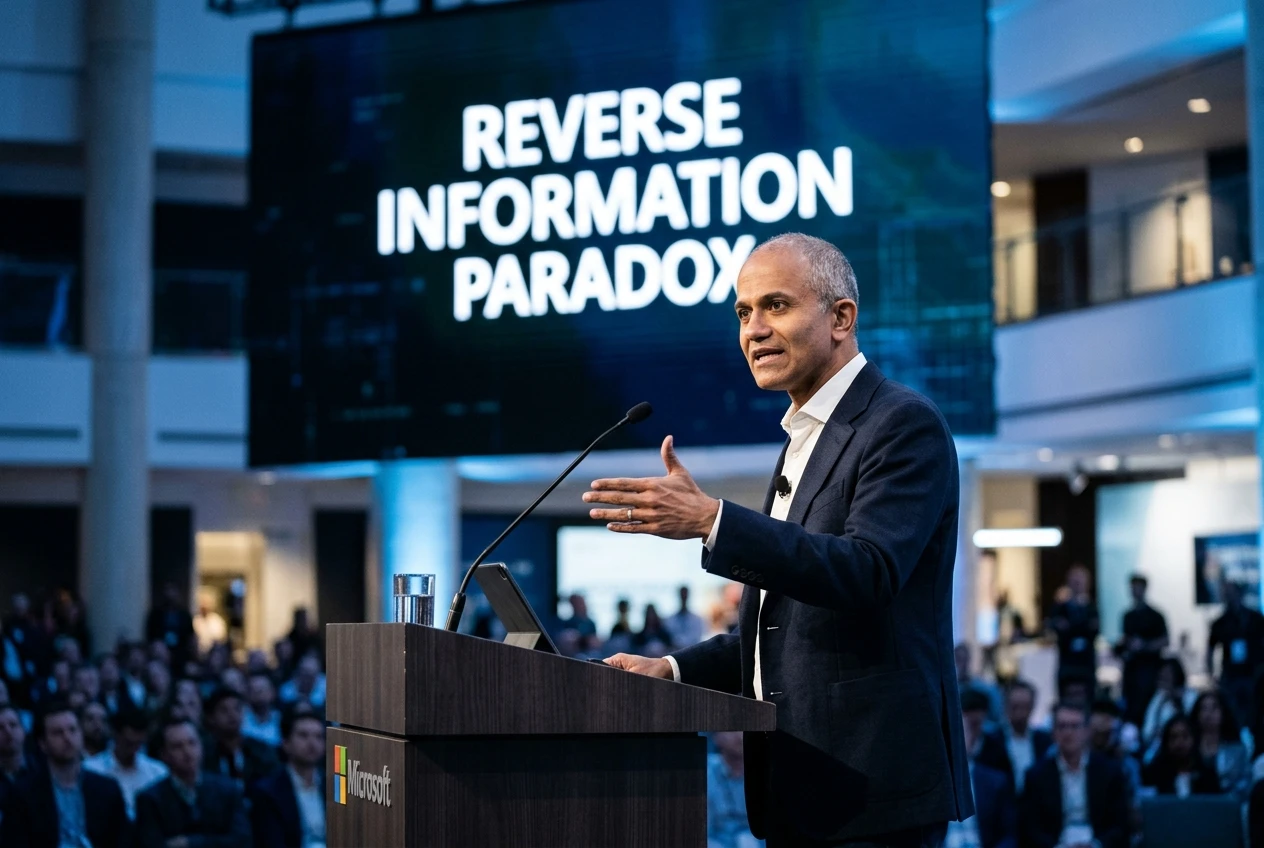
Microsoft chairman and CEO Satya Nadella posted a long essay on X this week called “The Reverse Information Paradox,” and named it the central challenge businesses must confront in the age of intelligence. He argued that whenever firms ask a model to do real work, they pay twice: once with money and once in proprietary knowledge. His post drew immediate endorsements from former White House AI adviser Sriram Krishnan and Palantir CEO Alex Karp.
The framing adapts Nobel-winning economist Kenneth Arrow’s old idea about markets for information and flips it. Arrow said a seller of information cannot reveal its worth without losing the sale. In AI, Nadella wrote, the buyer is the one giving away knowledge, “just in order to use what they bought.” “You essentially pay for intelligence twice,” he added, “once with money, and again with something even more valuable: the proprietary knowledge you must reveal to make that intelligence useful.”
The Post And The Claim It Makes
Nadella published the full Reverse Information Paradox essay on July 12 and titled it “The Reverse Information Paradox.” It is built around Arrow’s “Information Paradox,” a description of why information is hard to buy and sell: the buyer cannot value what they have not seen, yet once they have seen it, the buyer has it without paying.
In the AI version, “the buyer risks giving away knowledge, just in order to use what they bought.” “Over time, the information asymmetry becomes increasingly skewed,” Nadella wrote. “The seller learns more and more about you as you use what you purchased, while you learn very little about what the seller is learning in return.” Patents protect an inventor who discloses an idea without simply giving it away, Nadella noted, and the new paradox “needs its own equivalent.”
What ‘Exhaust’ Means And Why It Adds Up
Nadella names the leak path exhaust. Models learn continuously from the prompts employees write, the tools agents use, the corrections made when models are wrong, evaluation frameworks, workflows and feedback. Each correction captures how a firm thinks about a problem, the decision rules that distinguish a good answer from a bad one, and the organisational priorities that shaped the prompt in the first place. Three streams matter most.
- Prompts and queries that route real work through the model.
- Agent tools and the traces they leave behind.
- Corrections and evaluations that capture institutional decisions.
“Every correction is distilled into institutional know-how,” Nadella wrote. “It’s the kind of knowledge a competitor could never buy, and the kind that leaks almost imperceptibly: trace by trace, correction by correction, eval by eval.”
The asymmetry compounds over time. The provider sees what every employee types, what tasks fail and how they are fixed, and accumulates a steady stream of decision patterns from a wide cross-section of its enterprise customers. The customer, by contrast, typically gets no view into what the provider has learned or how the insight is being used. “In consuming intelligence, you are creating intelligence,” Nadella wrote. “And what you create should belong to you.”
Other Tech Leaders Are Echoing The Warning
Nadella’s post did not land alone. The same week, Palantir CEO Alex Karp told CNBC that frontier AI labs were using enterprise customers as raw material, with David Sacks posting clips from the interview and calling Karp’s argument the real “AI safety” discussion for businesses. Snowflake CEO Sridhar Ramaswamy used a February podcast to warn that major model makers “want to create a world in which all of the data for all of the enterprises is easily available to them,” turning every other firm into “a dumb data pipe that feeds into that big brain.”
What the technical customers want is control over their compute, their models, their data stack, and their alpha. They want to know they own the means of production, and it’s not being transferred to someone else.
Alex Karp, the chief executive of Palantir, said this in a CNBC interview that aired in early July, with Karp’s full quote on enterprise AI and sovereignty documented shortly after. Within hours of Nadella’s post, Sriram Krishnan, until recently the White House’s senior AI adviser, reposted it on X with a question aimed at every private and public leader: how do you “preserve and grow what is yours when working with models and have sovereignty”? Box CEO Aaron Levie raised the same dilemma in a January LinkedIn post: in a world where everyone has access to the same expert intelligence, he asked, “how does a company differentiate?”
The Five Principles Nadella Says Firms Need
Nadella did not stop at the warning. The bulk of his post lays out a five-part framework he wants every enterprise to adopt. He calls the layers Control, Capability, Choice, Cost, and Compound. Each one comes with concrete instructions about what a firm should own, build, or keep clear of. Together, they sketch an architecture for an AI-era enterprise that does not depend on a single vendor for its most valuable work.
- Control: create private evaluations, retain ownership of organisational memory, traces, feedback, decisions and institutional context, and keep the right to use model outputs for your own fine-tuning.
- Capability: build proprietary learning environments inside your tenant boundary so models improve against real workflows without exposing company knowledge.
- Choice: keep the orchestration layer decoupled from any single model, so losing one model does not cost you the “veteran” capability your company has built up.
- Cost: decouple orchestration from model selection, and pull context, models and tasks into the cheapest reliable combination.
- Compound: combine the first four into a continuous learning loop, a “hill climbing machine,” that lets AI investments compound rather than reset.
The deeper argument is about who owns the learning. “It’s imperative that we distribute the learning infrastructure to every firm so that they can control their own learning loop,” Nadella wrote. He argued that if learning flows in only one direction, “economic value converges toward the owners of the learning infrastructure rather than the creators of the knowledge itself.” That framing borrows from the older cloud pattern: AWS, Azure and Google Cloud built their businesses by being the substrate underneath every startup’s data, and Nadella is now proposing that the substrate for AI is the loop in which a firm’s private evaluations, traces and adapted weights accumulate and improve.
In Nadella’s framing, the cloud era was about accumulating data. The AI era is about accumulating learning. The trust boundary has to evolve in the same direction, moving from protecting information to protecting the mechanisms through which an organisation learns, adapts, and compounds intelligence. He spelled out the demand that firms should expect from their AI providers: “Enterprises will demand the rights to use model outputs to fine tune and/or train their own models,” he wrote. “I think of this as every firm’s right to align models to their enterprise accountability obligations.”
Microsoft Already Sits Inside The Argument
The framework doubles as a strategy, and Microsoft sits inside it. Nadella’s prescription puts every firm’s private evals, tenant boundary and learning loop on top of infrastructure someone has to sell. That someone is, conveniently, Microsoft. The numbers inside the company hint at why the warning is arriving now: Microsoft reported $37.5 billion in capital spending in its second quarter, up nearly 66% from a year earlier, and above the $34.3 billion analysts had projected.
The pressure is visible inside the firm as well. Its Experiences and Devices division is canceling the majority of its internal Claude Code licenses, effective June 30, after monthly usage rates reached 84% to 95% and per-engineer API costs ran from $500 to $2,000 a month. Microsoft’s AI budget squeeze and Claude Code cuts reflect the same dynamic Nadella describes at the macro level playing out at the micro level inside his own company. The cancellation came after Microsoft exhausted portions of its annual AI budget due to token-based billing.
Nadella’s essay is also a critique of how the rest of the AI industry is set up. He called it “ironic” that model providers retain fair use rights to train on public data while imposing restrictive terms on distillation and reserving the right to learn from customer usage. Distributing learning infrastructure to every firm, he wrote, is “imperative.” A world in which every enterprise builds its own loop on top of frontier models is a world in which Microsoft sells the picks and shovels to all of them. He has made the broader case in societal terms too, arguing in a separate essay that there is no societal permission for an AI future that hollows out entire industries, and drawing a parallel to the first phase of globalisation.
Frequently Asked Questions
What is the Reverse Information Paradox?
It is a term Microsoft CEO Satya Nadella introduced on X on July 12, 2026 to describe how firms using AI risk handing over their most valuable proprietary knowledge every time they ask a model to do real work. He framed it as the buyer-side mirror of Nobel economist Kenneth Arrow’s Information Paradox, in which the seller of information cannot reveal its worth without giving it away.
How does a company’s knowledge leak through AI?
By what Nadella calls exhaust: the prompts employees type, the tools agents invoke, the corrections made when models are wrong, the evaluations, and the workflows. Each correction captures how a firm thinks about a problem, and providers learn from all of it across their entire customer base, while customers typically cannot see what providers have learned.
What did Nadella say firms should do?
He outlined five principles: build private evaluations and own organisational memory (Control); create proprietary learning environments inside the tenant boundary (Capability); keep the orchestration layer decoupled from any single model (Choice); route context, models and tasks into the cheapest reliable combination (Cost); and combine all four into a continuous learning loop that compounds (Compound).
Which other tech leaders have backed the warning?
Within hours of the post, former White House AI adviser Sriram Krishnan endorsed it on X. Earlier in July, Palantir CEO Alex Karp told CNBC that technical customers want control over their compute, models, data stack, and “alpha.” Snowflake CEO Sridhar Ramaswamy and Box CEO Aaron Levie have made similar warnings about the risk of enterprises becoming “data pipes” for frontier model makers.