
Attorneys for three-time Olympic canoeist David “Davey” Hearn filed Tuesday to dismiss the Reflecting Pool felony with prejudice, locking the door on any fresh charges after prosecutors admitted the damage stemmed from a rushed contractor job, not vandalism.
The move lands days after U.S. Attorney Jeanine Pirro’s office abandoned the case without prejudice and President Donald Trump publicly said she “choked” and “folded like an umbrella.”
How a Bike Ride Became a Felony Charge
Hearn, then 67, was on a June 19 bike ride near the Lincoln Memorial when he stopped at the recently recoated Reflecting Pool. Park Police and National Guard detained him after witnesses said he reached into the water and tugged at a flapping section of blue liner.
He told officers he was checking the water temperature and that he stopped when told. Body-camera and witness accounts differed on how forcefully he pulled. Pirro announced a felony destruction-of-property indictment on July 2, telling reporters her office could prove beyond a reasonable doubt that Hearn caused at least $1,000 in damage.
- Charge: one count under D.C. Code 22-303, potential 10-year sentence
- Threshold: $1,000 damage for felony treatment
- Grand jury: returned indictment July 2 after a key witness was recalled on cost estimates
- Parallel cases: three misdemeanor Reflecting Pool matters also later dropped
Hearn pleaded not guilty. His lawyers later noted the grand-jury presentation contained irregularities and that a National Park Service engineer had already cut loose peeling sections with a knife to stop further flapping.
The felony threshold turned on a single dollar figure. Once prosecutors framed the flapping liner as intentional damage worth at least $1,000, the case left misdemeanor territory and entered a charging track that carried a decade of exposure. That framing rested on cost estimates presented to the grand jury after a witness was recalled, a sequence the defense later flagged as irregular.
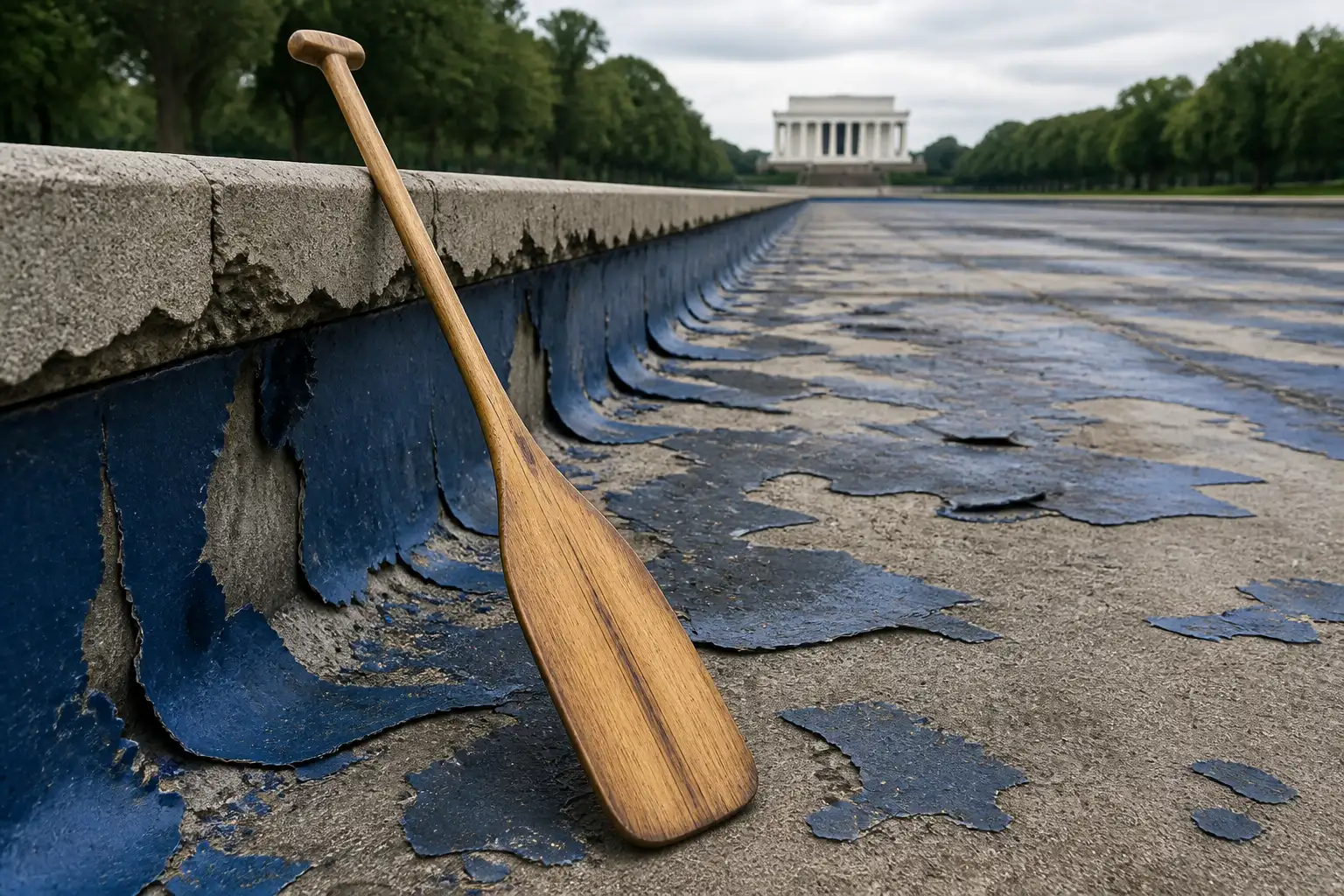
Interior Documents Undercut the Vandalism Story
On July 17, after a defense expert inspected the drained pool, Pirro and senior prosecutors saw extensive peeling across the basin, including in the middle. They demanded full installation records. The Interior Department then produced 695 megabytes of files.
Those records showed Atlantic Industrial Coatings, selected sole-source, began spraying Rhino 406 and Pipeliner 5000 coatings in early May under tight deadlines tied to America 250 events around Independence Day. Rain delays, product shortages, failed expansion-joint tests and blistering appeared in contemporaneous emails. Quality-control notes flagged problems weeks before the pool reopened.
| Date | Event |
|---|---|
| May 5-7, 2026 | Installation starts; first coats of Rhino 406 on 68,000 sq ft |
| May 10-11 | Rain halts work; contractor noted “significantly behind schedule” |
| May 16-21 | Expansion-joint sealant fails twice; blistering reported; more rain |
| June 19 | Hearn arrested after touching flapping liner |
| July 2 | Felony indictment returned |
| July 17-31 | Drained-pool inspection; 695 MB docs reviewed; motion to dismiss filed |
In the government’s motion admitting botched installation, prosecutors wrote that the rush produced “hasty and botched work that was not remediated” and that widespread peeling made it “difficult to attribute the damage” to vandals beyond a reasonable doubt. They moved to dismiss without prejudice under D.C. Superior Court Rule 48 on dismissals.
The volume of the production itself told part of the story. Nearly 700 megabytes of installation files documented rain stoppages, failed sealant tests and blistering weeks before the pool reopened to the public. Once those records reached prosecutors, the vandalism theory lost the factual foundation required to carry a felony past a reasonable-doubt standard.
Why Hearn’s Team Wants the Case Buried Permanently
Without-prejudice dismissal leaves the door open for refiling. Hearn’s lawyers, including Steve Levin, Norm Eisen and Mary Dohrmann, filed for dismissal with prejudice. They called the original case “motivated by political considerations and devoid of adequate factual support” and said the Justice Department has shown willingness to reinstate charges “to satisfy the President, irrespective of the law or facts.”
The sprint to charge, they wrote, mirrored the expedited renovation timeline that caused the peeling. They also accused Pirro of an “unprofessional and unethical press conference” that discussed purported evidence, bolstered witnesses and opined on guilt in violation of D.C. Bar and DOJ rules.
- Demand permanent bar so the incident cannot be revived
- Flag NPS engineer’s own knife cuts of loose liner as government knowledge of pre-existing failure
- Seek full grand-jury record review for alleged misleading presentation
- Preserve path to civil suits, bar referrals, sanctions and fee reimbursement
“By moving to dismiss, the U.S. Attorney’s Office did the right thing,” Levin said. “But as our response makes clear, it did so the wrong way.” A hearing set for Thursday was cancelled; the judge has not yet ruled.
For the defense, the form of the dismissal matters as much as the dismissal itself. A without-prejudice order keeps the charging authority intact. A with-prejudice order would extinguish it. That distinction drives the pending motion and the ancillary steps the team has listed once the court rules.
The Same Haste That Ruined the Liner Drove the Charges
Trump publicly floated a $1.8 million fix to turn the pool “American flag blue.” Interior records and contemporary reporting put the no-bid award to Atlantic Industrial Coatings far higher, in the $13.1 million to $14.7 million range, with a reported 20 percent profit margin well above the 6-12 percent typical for such work. The company had no prior federal contracts of this scale; its specialty was highway culverts, pipes and tanks. Work began before final price agreement under an urgency exemption.
| Cost Measure | Figure |
|---|---|
| Publicly floated fix | $1.8 million |
| No-bid award range | $13.1 million to $14.7 million |
| Reported profit margin | 20 percent |
| Typical margin for such work | 6-12 percent |
That compressed calendar, rain interruptions and product shortfalls produced the blistering and peeling that later became the “vandalism” narrative. Once the pool was drained, the pattern was obvious to anyone standing on the floor. The same pressure that put an unfinished coating into service put an under-documented felony before a grand jury.
Similar pressure appears in other Olympic-scale water venues. Another Olympic venue facing costly repairs recently required a $52 million rescue for failing pipes, while disputed Olympic pool projects abroad have drawn criticism over tender processes and timelines.
How Sole-Source Urgency Shaped the Coating Failure
The installation path left little margin for error. Atlantic Industrial Coatings won the work sole-source, began spraying before a final price was set, and operated under an urgency exemption tied to America 250 deadlines around Independence Day. Its prior specialty was highway culverts, pipes and tanks, not a 68,000-square-foot ceremonial basin in constant public view.
Contemporaneous emails captured the squeeze. Rain halted work within days of the first coats. Expansion-joint sealant failed twice. Blistering appeared. Quality-control notes recorded problems weeks before reopening. Product shortages compounded the calendar pressure. None of those conditions originated with a passerby on a bicycle.
When the pool was later drained, peeling extended across the basin, including in the middle, far from the spot where Hearn stopped. Prosecutors reviewing the 695 megabytes of Interior files concluded the rush had produced hasty and botched work that was never remediated. That concession undercut any claim that a single tug explained the damage.
The charging timeline tracked the same urgency. Indictment came on July 2, still inside the Independence Day window that had driven the coating schedule. Defense lawyers later argued the sprint to charge mirrored the expedited renovation that caused the peeling in the first place.
Trump’s Reaction and Pirro’s White House Visit
Trump told reporters he disagreed “100 percent,” insisted the pool had been vandalized, and said Pirro faced a hostile judge even though no substantive judicial ruling had issued. He released video he described as showing cutting with a knife or box cutter. Hours after the criticism, Pirro appeared at the White House carrying an evidence box.
Public reaction on X mixed sharp skepticism with defense of the drop. One widely shared post from Bill Kristol noted the gap between Pirro’s July claim of “tremendous evidence” and the later admission:
One month ago today: U.S. Attorney Jeanine Pirro claims she has “tremendous evidence” against David Hearn for vandalizing the Reflecting Pool. She lied. Secretary Burgum lied. White House staff lied. Trump lied. There will be no consequences.
The post drew more than 26,000 likes. Other users asked how a grand jury could return an indictment if Interior already held installation failure records, while some argued Pirro deserved credit for walking the case back. The crowd read the without-prejudice language as retained leverage rather than full retreat.
The sequence left a narrow public record: a presidential rebuke, a White House visit with an evidence box, and a dismissal that preserved the option to refile. That combination is what the defense now seeks to close off permanently.
What the Grand Jury Did Not Hear in Full
The July 2 indictment followed a recalled witness on cost estimates and a presentation the defense later called irregular. At that stage, Interior already held installation records documenting rain delays, failed expansion-joint tests and blistering. Those files had not yet been demanded by prosecutors or produced in the 695-megabyte dump that arrived after the drained-pool inspection.
Defense lawyers want the full grand-jury record reviewed for a misleading presentation. They also point to the National Park Service engineer who had already cut loose peeling sections with a knife. That act, they argue, shows government knowledge of pre-existing failure before any visitor touched the liner.
Three parallel misdemeanor Reflecting Pool matters were later dropped as well. Their dismissal, alongside the felony, suggests the attribution problem was not limited to a single defendant or a single dollar threshold. Once widespread peeling became documented fact, the vandalism narrative lost force across the related dockets.
- Grand jury returned the felony after a recalled cost-estimate witness
- Interior installation records already existed at indictment
- NPS engineer had knife-cut loose liner before the arrest
- Three related misdemeanors were dropped with the felony
What Hearn Can Still Pursue
Hearn competed in the 1992, 1996 and 2000 Games, collected multiple world championship golds in C1 and team events, and entered the International Whitewater Hall of Fame. His three Olympic canoe appearances and decades around water made the vandalism framing jarring to many who know the sport.
His team has said “all options are on the table,” including civil suits for malicious prosecution, bar complaints, requests for sanctions, attorney-fee recovery, and congressional or inspector-general inquiries. Those steps largely wait on the with-prejudice ruling. Michael Bromwich, a former DOJ inspector general, entered an appearance for the defense shortly before the government’s dismissal motion, signaling readiness for a longer fight.
The athlete’s record supplies context for why the charge landed so hard among people familiar with paddlesports. A canoeist with three Olympic appearances and world-championship golds is an unlikely candidate for intentional destruction of a water venue. That biographical mismatch does not decide the legal questions, but it shaped public reception of the indictment and of the later concession that installation failure, not vandalism, explained the peeling.
What We Know
- Government concedes installation failures and rush caused widespread peeling
- Felony and three misdemeanors dismissed without prejudice
- Defense motion for with-prejudice dismissal pending; no ruling yet
What’s Unconfirmed
- Whether the court will grant permanent dismissal
- Any internal DOJ or White House personnel consequences for Pirro
- Scope or timing of civil or disciplinary actions Hearn may file
The case remains active on the D.C. Superior Court docket. Hearn has said the pool looked the same after he stepped away as before he touched the water. His lawyers now want that chapter closed so thoroughly that it cannot be reopened to satisfy anyone.