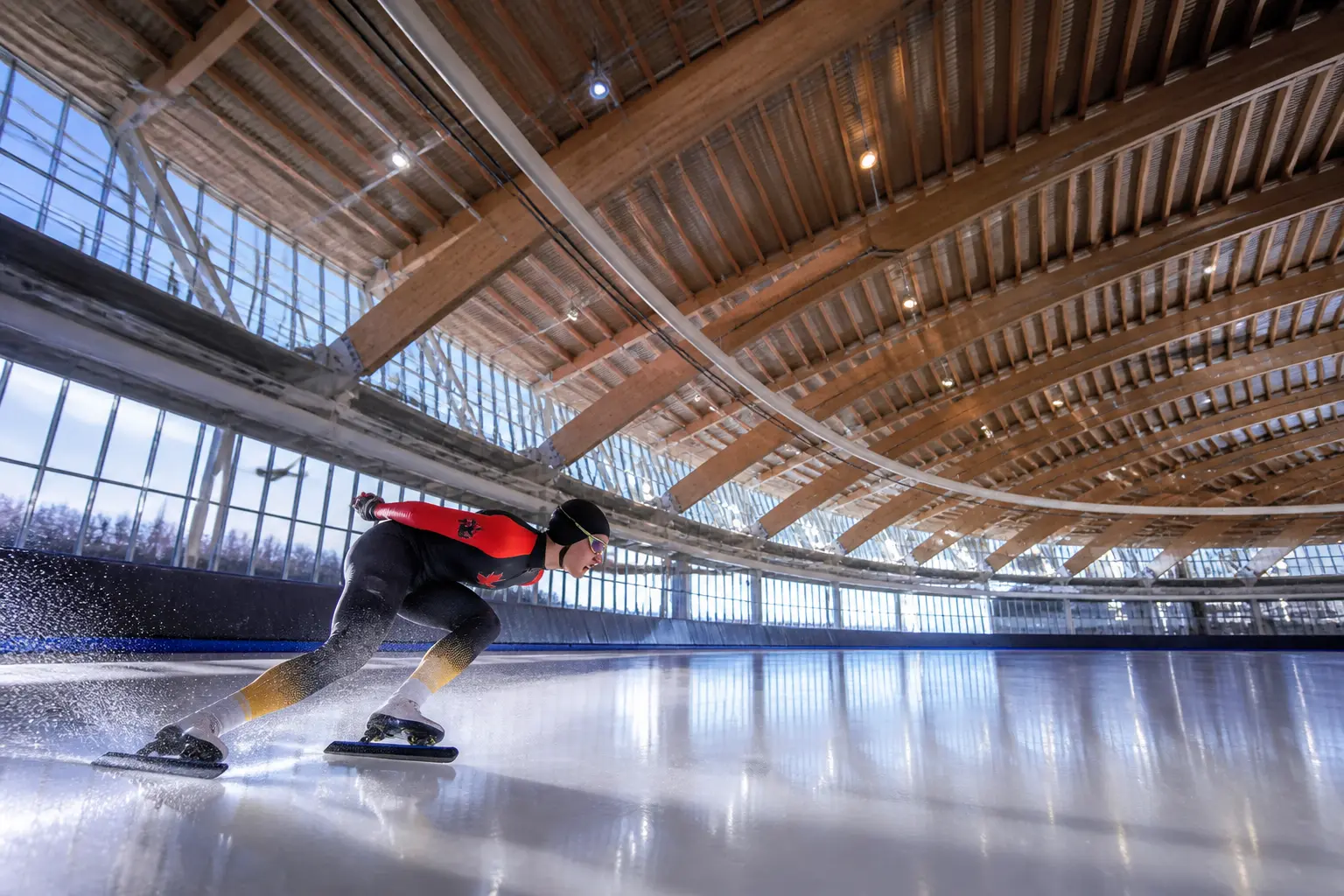
Canada’s federal government and Alberta will each pay $26 million to replace the failing brine pipes and ice floor inside Calgary’s Olympic Oval, built for the 1988 Winter Olympics. The announcement Monday means crews can finally tear up the aging floor in January 2028, before its roughly 400 pipe connections fail outright.
The rescue comes five months after Calgary trained skaters won gold at the Milan Cortina Games, and after Salt Lake City’s newer oval quietly took over Calgary’s old claim to the fastest ice on Earth. Another $13 million is still needed to finish the job.
The Pipes Were Already Failing
The Oval opened in 1987 for $40 million on the University of Calgary campus, hosted Olympic speed skating the following year, and has run almost continuously since as a training base for the national team. Underneath its 400 meter sheet sit roughly 400 brine pipe connections that keep the ice frozen, and coaches and officials spent 2025 watching more of them leak.
Oval director Mark Messer, who has worked there since it opened, said the deterioration was accelerating.
This $52 million, that’ll save us. We know now we can do the project.
Messer said. He added that the floor itself cannot be touched until the ice season ends in January 2028, when crews begin what is expected to be a nine month replacement.
Aging Olympic infrastructure is a fight playing out well beyond Calgary. In Estonia, officials are pushing through a contested tender for a new Olympic standard pool, and in Mississippi, young competitors are still chasing Junior Olympic qualifying times inside a facility that is falling apart around them.
How Ottawa and Alberta Split the Bill
The Oval’s location on university land had complicated its funding case for years, since the property counted as an educational institution rather than a straightforward sport facility. That barrier finally broke this year, when the Oval qualified for $26 million from the federal government’s $51 billion Build Communities Strong Fund, matched by an equal provincial contribution.
Alberta’s sport minister, Andrew Boitchenko, called it money well spent.
“This facility is truly a multi-sport facility. We have judo, volleyball, other competitions here,” Boitchenko said. “It’s definitely worth investing in and keeping it going.”
The Oval was one piece of a larger Monday announcement from Secretary of State for Sport Adam van Koeverden, who framed it as part of a broader push into Canadian sport funding.
- $52 million – split evenly between Ottawa and Alberta to replace the Olympic Oval’s brine pipes and ice floor
- $7.67 million – for snowboard and ski racing facilities across Quebec, Yukon, Alberta and British Columbia
- $3 million – annual top-up to the Athlete Assistance Program, lifting it to $43 million a year
Of the snowboard and ski money, $4 million goes to snowboard facilities in Quebec, Yukon and Alberta, while $3.65 million funds ski racing venues in Alberta and B.C. “We’re making the largest investments our country has ever seen in sport from the playground to the podium,” van Koeverden said in Calgary, describing months of talks with Boitchenko that put the Oval “top among” federal priorities.
Who Uses the Olympic Oval?
The Olympic Oval is not just a national team training site. It doubles as a University of Calgary athletic facility, a public rink where children learn to skate, and the training ground where hockey great Hayley Wickenheiser and nearly a dozen future Canadian Olympic teammates once played club hockey. Judo and volleyball programs share its floor too, since the building holds space for more than a dozen volleyball courts at once.
That campus setting puts the Oval alongside the university’s own varsity program, whose Dinos athletics awards night wrapped its own season earlier this year. Double Olympic gold medalist Isabelle Weidemann, who trains at the Oval, said the funding felt personal after word spread that the ice plant might not survive.
“People came together to save this facility, and it would not have survived, and speed skating would have had to move out of Calgary,” Weidemann said. “I have chills. I’m really overwhelmed by the community that’s come together to save it.”
Forty Olympic Medals, One Sheet of Ice
Canadian speed skaters who trained at the Oval have produced 40 Olympic medals since 1988, a list that includes Catriona Le May Doan, Cindy Klassen, Clara Hughes, Denny Morrison, Jeremy Wotherspoon, Weidemann and Ivanie Blondin. Weidemann and Blondin were both on the team pursuit squad that won gold at the Milan Cortina Games in February, training out of the same building whose pipes were already leaking underneath them.
- 1987: The Oval is completed on the University of Calgary campus for $40 million.
- 1988: It hosts speed skating at the Calgary Winter Olympics and earns the nickname the fastest ice in the world.
- 2025: Coaches and officials flag worsening brine leaks among the 400 pipe connections beneath the ice.
- February 2026: Weidemann, Blondin and teammates win team pursuit gold at the Milan Cortina Olympics.
- July 27, 2026: Ottawa and Alberta announce the $52 million rescue package.
- January 2028: Crews begin a nine month floor replacement and the Oval goes dark.
Salt Lake City Already Has Faster Ice
More than 300 world records have been broken at Calgary’s Oval since it opened, a tally built on the city’s altitude and dry air. But the record book has moved on. Only seven current world records still stand at Calgary, against fifteen at Utah’s Olympic Oval, which counts more standing marks than any other track in the sport, with one more in Inzell, Germany.
Utah’s oval sits 4,675 feet above sea level, and the thinner air there produced ten Olympic records and nine world records at the 2002 Salt Lake Games alone, the most ever set at a single meet. A World Cup stop there in November 2025 added another, when the American men’s team pursuit squad broke three minutes, 32.49 seconds. Utah’s advantage will only grow: the IOC elected Salt Lake City-Utah by an 83-6 vote to host the 2034 Winter Games, its second turn hosting since 2002.
Calgary remains the oldest of Canada’s three indoor ovals, and the only one now facing a floor replacement.
| Facility | Location | Opened | Defining Stat |
|---|---|---|---|
| Calgary Olympic Oval | Calgary, Alberta | 1987 | 7 current world records; needs $52 million-plus in repairs |
| Pomeroy Sport Centre | Fort St. John, B.C. | 2010 | Built for $44 million |
| Centre de glaces Intact Assurance | Quebec City, Quebec | 2021 | Built for $68.7 million; hosts international meets |
| Utah Olympic Oval | Salt Lake City, Utah | 2002 | 15 current world records, most of any track |
The Countdown to January 2028
Once construction starts, the floor swap is expected to take about nine months, a window Messer said is dictated by when deterioration risk peaks and the ice season allows the building to go offline. He said the $52 million covers the pipes and floor, but not everything the Oval needs.
A running track and improved accessibility for people using mobility aids are still on the list, and Messer said fundraising for the remaining $13 million is ongoing. Boitchenko said he hopes the building outlasts the current fix by decades.
“We’ve had it here since ’88, and hopefully we’ll have it here another 40, 50 years, because having such a beautiful big building where people can come and do all these events and competitions is so important for Calgary, the province and for Canada,” Boitchenko said.
The renewal itself, engineers estimate, should extend the Oval’s technical lifespan by about 30 years once the floor and pipes are done. Calgary’s fix lands in 2028, six years before Salt Lake City’s oval hosts the Winter Games it already holds on paper.
Frequently Asked Questions
Why Is Salt Lake City’s Ice Faster Than Calgary’s Now?
Utah’s Olympic Oval sits 4,675 feet above sea level, and the thinner air there cuts resistance for skaters, a factor that helped produce a record nine world marks at the 2002 Games alone. Calgary’s altitude and dry climate built its own reputation decades ago, but Utah’s oval and its refrigeration upgrades have since taken over the record book, holding fifteen current world records to Calgary’s seven.
How Much Money Has Been Spent on the Olympic Oval in Total?
Counting construction, renewal and pending fundraising, the Oval represents roughly $105 million in commitments since 1987: $40 million to build it, $52 million to save its ice plant, and another $13 million still being raised for a new running track and better accessibility.
How Much Do Carded Athletes Get Paid Each Month?
Under the newly announced top-up, a senior national team athlete’s monthly living and training allowance rises 5.5 percent to about $2,300, up from roughly $2,175, part of a package that also adds 30 new senior cards to the Athlete Assistance Program, largely for athletes in new Olympic and Paralympic sports and for guides who assist visually impaired competitors. About 1,900 athletes across more than 90 disciplines receive AAP funding annually.