Qualcomm’s Snapdragon 8 Elite Gen 5 outscores Google’s Tensor G5 chip by 86% in multi-core benchmark tests, according to comparison data from NanoReview and CPU Monkey. Google switched the chip’s manufacturing from Samsung to TSMC for this exact reason, and the gap barely moved. Pixel phones are selling better than ever anyway.
That contradiction sits at the center of the Pixel lineup right now. A phone built around software, cameras, and seven years of guaranteed updates keeps outselling a market that is otherwise shrinking, even while its processor loses badly on paper, several of its headline features vary by zip code, and its battery finished last in a recent flagship rundown. Google is about to find out how long that trade can hold, with a much bigger, much riskier chip bet due within weeks.
The Samsung Foundry Bet Google Had to Abandon
Google’s phone business did not always look like this. The Nexus lineup that preceded Pixel was built by outside partners including HTC, Samsung, LG, and Huawei, and every model shipped with different hardware and a different feel. Pixel, launched in 2016, was Google’s attempt to control that experience end to end.
The chip was the last piece. Tensor debuted inside the Pixel 6 in 2021, developed with help from Samsung’s semiconductor arm and built in Samsung’s own foundry. It was pitched as independence from Qualcomm. Instead, it became a bottleneck.
Samsung’s 3-nanometer production reportedly ran at yields near 50%, well below what a flagship chip supplier needs to hit volume and cost targets. Google’s answer arrived with the Pixel 10 line in 2025: Tensor G5 became the first Google chip built by TSMC instead of Samsung, using TSMC’s N3P process, after TSMC’s yields on comparable nodes were reported near 90%. One report on the move described it as a shock to Samsung and a wake-up call for its foundry business.
- 2016: Google launches the first Pixel, ending the multi-vendor Nexus era.
- 2021: Tensor debuts inside the Pixel 6, designed and fabricated with Samsung’s help.
- 2025: The Pixel 10 ships with Tensor G5, Google’s first chip built by TSMC after four generations with Samsung.
- 2026: Tensor G6 is set to become the first mass-produced smartphone chip on TSMC’s 2-nanometer process, arriving in the Pixel 11.
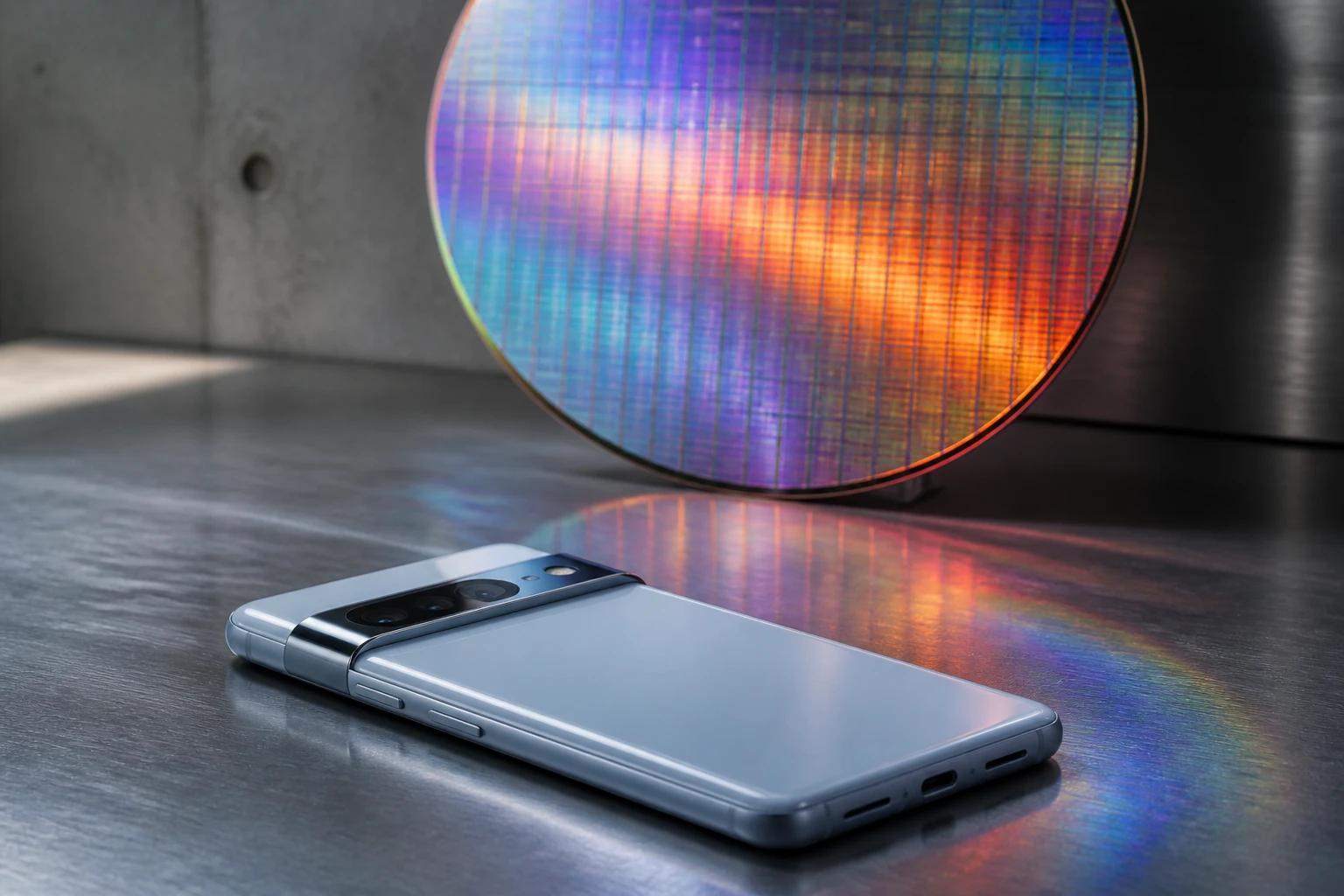
Why Does Tensor G5 Still Lose to Snapdragon?
Tensor G5 trails Qualcomm’s newest flagship chip because Google fixed where the chip gets built, not how it is designed. Snapdragon 8 Elite Gen 5 runs on Qualcomm’s own custom cores, while Tensor G5 still leans on off-the-shelf Arm designs, and that architecture gap shows up directly in every major benchmark.
| Metric | Snapdragon 8 Elite Gen 5 | Tensor G5 |
|---|---|---|
| AnTuTu total score | 4,033,382 | 1,565,089 |
| Geekbench single core | 3,831 | 2,285 |
| Geekbench multi core | 11,525 | 6,191 |
| CPU cores | Qualcomm Oryon v3 (custom) | Arm Cortex (off the shelf) |
| Foundry and process | TSMC, 3-nanometer class | TSMC N3P (Samsung through Tensor G4) |
That works out to roughly 2.6 times higher in raw AnTuTu scoring and a chip that scores two and a half times higher in AnTuTu testing, with the multi-core Geekbench comparison showing Snapdragon’s chip outperforms it by 86 percent in multi-core scores. Google says Tensor G5 still delivers a 34% CPU speed gain and a 60% jump in AI processing over the outgoing Tensor G4, both real improvements that simply started from a much lower baseline than Qualcomm’s.
None of this showed up as a problem in daily use during SlashGear’s own review of the Pixel 10 Pro XL, which reported no real-world performance issues. The gap matters most to a narrower group: people who play graphically demanding games and expect flagship-tier frame rates to match a flagship price.
Marquee AI Features Don’t Travel With the Phone
Google sells Pixel primarily as a software phone, which makes it stranger that several of its most talked-about software features do not work the same way for every buyer. Availability splits by country, language, and even which Pixel model is in your hand.
- Enhanced call screening – works in Germany, France, Australia, and India, but fully automatic screening requires a U.S. location.
- Call Notes – transcribes and summarizes calls, but does not run on Google’s budget A-series phones at all, and its country and language list stays limited elsewhere.
- Hold for Me and Take a Message – both restricted to select regions rather than available globally.
- Scam Detection – marketed as a core safety feature, yet far less widely available than the marketing suggests.
Google is not alone in this. Apple and Samsung both gate features by region too. The difference is that Pixel’s entire pitch rests on software doing the heavy lifting that its hardware does not, which makes a geography-locked feature list a sharper letdown here than it would be on a phone people bought for the screen or the chip.
Pixel Plays It Safe While Rivals Take Risks
Set a Pixel next to the rest of the Android field and the caution becomes obvious. Modern Pixels are well made, a glass sandwich with an aluminum frame, a bright uniform-bezel display, and a genuinely strong camera. They are also, by design, the least adventurous phones in the room.
Oppo’s Find X9 Ultra reaches 10x optical zoom through a periscope lens without needing a clip-on attachment. OnePlus keeps shipping high-spec phones priced below where Google and Samsung sit. Chinese manufacturers have largely moved to silicon-carbon batteries, which pack more capacity into the same physical space. Gaming-focused phones from Red Magic add active cooling and capacitive shoulder triggers that mimic a real controller.
Pixel’s own software adds to the sense of restraint. Next to feature-dense Android skins like Samsung’s One UI or OnePlus’s OxygenOS, Pixel’s interface reads as minimal by comparison, which some users read as clean and others read as bare. SlashGear’s review of the Pixel 10a put it plainly: it is essentially last year’s phone again, a formula that works but does not try very hard to surprise anyone.
Battery Life Still Lands Pixel Near Last Place
Battery life depends on screen brightness, workload, and whether a phone leans on 5G or Wi-Fi, but the broader trend across Android is bigger cells and smarter charging. Pixel has mostly sat out that race.
- 9 hours, 53 minutes: how long the Pixel 10 Pro XL lasted in a head-to-head flagship battery rundown from YouTuber MrWhoseTheBoss, finishing last among the phones tested.
- 10 hours, 43 minutes: the Samsung Galaxy S25 Ultra’s result in the same test, one place ahead of the Pixel.
- 5,000mAh: Samsung’s flagship battery capacity, unchanged since the Galaxy S20 Ultra launched in 2020, offset by display and chipset efficiency gains rather than a bigger cell.
- 7,000mAh or higher: the capacity now common on Chinese rivals running silicon-carbon batteries, several of which also support charging speeds up to 120W in certain markets.
The Pixel 10 Pro XL’s result came from a test that finished dead last in a flagship battery rundown against several rival phones. Neither the chip’s power draw nor a conservative battery capacity is doing Pixel any favors here, and Google has not signaled a silicon-carbon switch of its own.
Growing Sales, Shrinking Market
Here is the part that does not fit the rest of this story neatly: Pixel is one of the only phone lines actually growing right now. Global smartphone shipments are on pace for their lowest year since 2013, based on market tracking reported in mid-2026. Pixel shipments climbed 16% year over year in the second quarter of 2026, extending a 14% gain from the first quarter, according to Counterpoint Research.
Analysts at Counterpoint tie that growth to Pixel’s AI capabilities, its computational photography, and its comparatively clean software, plus expansion into markets beyond the traditional Pixel strongholds of the United States and Japan. That last point cuts both ways, since several of the features driving the AI pitch are the same ones locked to a narrower set of countries.
Price is doing real work here too. Google has leaned hard into discounting to keep volume moving across the lineup: the Pixel 9a dropped to $349 in a Prime Day sale, and Google has separately been cutting prices on refurbished Pixel 7 phones to keep older hardware appealing. A flagship Pixel still costs more than Samsung’s similarly specced Galaxy S26, which matches it on screen size and camera quality while starting with more storage, but Google is clearly working the rest of the lineup harder to compensate.
The Real Test Arrives With Tensor G6
The bigger swing is still ahead. Tensor G6 is expected to be the first mass-produced smartphone chip built on TSMC’s 2-nanometer process, arriving inside the Pixel 11 series around August 2026, roughly a month before Apple’s next iPhone is expected to reach the same milestone. It would mark the first time Google beats Apple to a new manufacturing node rather than following it.
Google has already proven it can walk away from a chip partner that was not delivering. Whether a new process node can close a design gap this wide is a separate question, and the Pixel 11 is about to answer it in public.
Frequently Asked Questions
Why Did Google Switch Tensor Production From Samsung to TSMC?
Samsung’s 3-nanometer manufacturing reportedly produced yields near 50%, compared with roughly 90% at TSMC on similar nodes. After four generations of Tensor chips built with Samsung, Google moved Tensor G5 to TSMC’s N3P process for the Pixel 10 line to get more usable chips per production run.
Will the Pixel 11’s Tensor G6 Close the Gap With Snapdragon?
It might narrow it, but supply could limit how many buyers benefit right away. Tensor G6 is expected to be the first mass-produced chip on TSMC’s 2-nanometer process, yet large blocks of that capacity are reportedly close to sold out for the next two years, with TSMC pushing customers to lock in orders stretching into mid-2027.
Are Pixel Sales Falling in the U.S.?
In the U.S. specifically, yes. Google shipped roughly 800,000 Pixel phones in the country during the first quarter of 2026, down 7% year over year, even as Pixel’s global shipments climbed over the same stretch.
Where Is Pixel Growing the Fastest?
Growth is increasingly coming from markets outside the U.S. and Japan, Pixel’s traditional strongholds, according to Counterpoint Research. That expansion sits awkwardly next to the fact that several of Pixel’s flagship AI features still work best, or only, inside the United States.
Does Every Pixel Model Match Rivals on Camera Zoom?
No. Pixel phones rely on computational, software-driven zoom rather than the periscope hardware now common on rivals like Oppo’s Find X9 Ultra, which reaches 10x optical zoom without an attachment lens. Pixel’s camera reputation rests more on image processing than on optical reach.