UK space technology companies have raised £4.2bn ($5.6bn) across 85 funding rounds, according to new data from Tracxn, a global market intelligence platform. Roughly seven of every eight pounds trace back to one company. OneWeb, the London-founded satellite communications operator, has pulled in £3.7bn of that total on its own, and Britain no longer controls it outright.
Tracxn published the tally in a new report called The State of UK SpaceTech, mapping the country’s satellite, Earth observation, launch and manufacturing startups against their funding and exit histories. Strip OneWeb out of the total, and the other 84 rounds combined raised roughly £500m between them.
Inside Tracxn’s Map of UK Space Tech
UKTN, a UK outlet that tracks the country’s tech funding data, published Tracxn’s findings on Tuesday. The report sets out to map the country’s homegrown space industry from end to end: satellite communications, Earth observation, launch, mission services and in-space manufacturing.
Below OneWeb, Tracxn points to a second tier of companies still raising serious growth capital. SatVu, Open Cosmos and Space Forge have each raised somewhere between £26.3m and £91.7m, and Tracxn says all three continue to attract investors.
| Company | Segment | Capital Raised | Ownership Today |
|---|---|---|---|
| OneWeb | Satellite communications | £3.7bn | Part of Eutelsat Group; UK government holds 10.89% |
| SatVu | Earth observation | £26.3m to £91.7m | Independent, UK-based |
| Open Cosmos | Mission services | £26.3m to £91.7m | Independent, UK-based |
| Space Forge | In-space manufacturing | £26.3m to £91.7m | Independent, UK-based |
The gap in that table is the story. Nobody sitting below OneWeb has come close to its scale, and Tracxn’s own figures show why the sector’s growth tier and its headline number barely resemble each other.
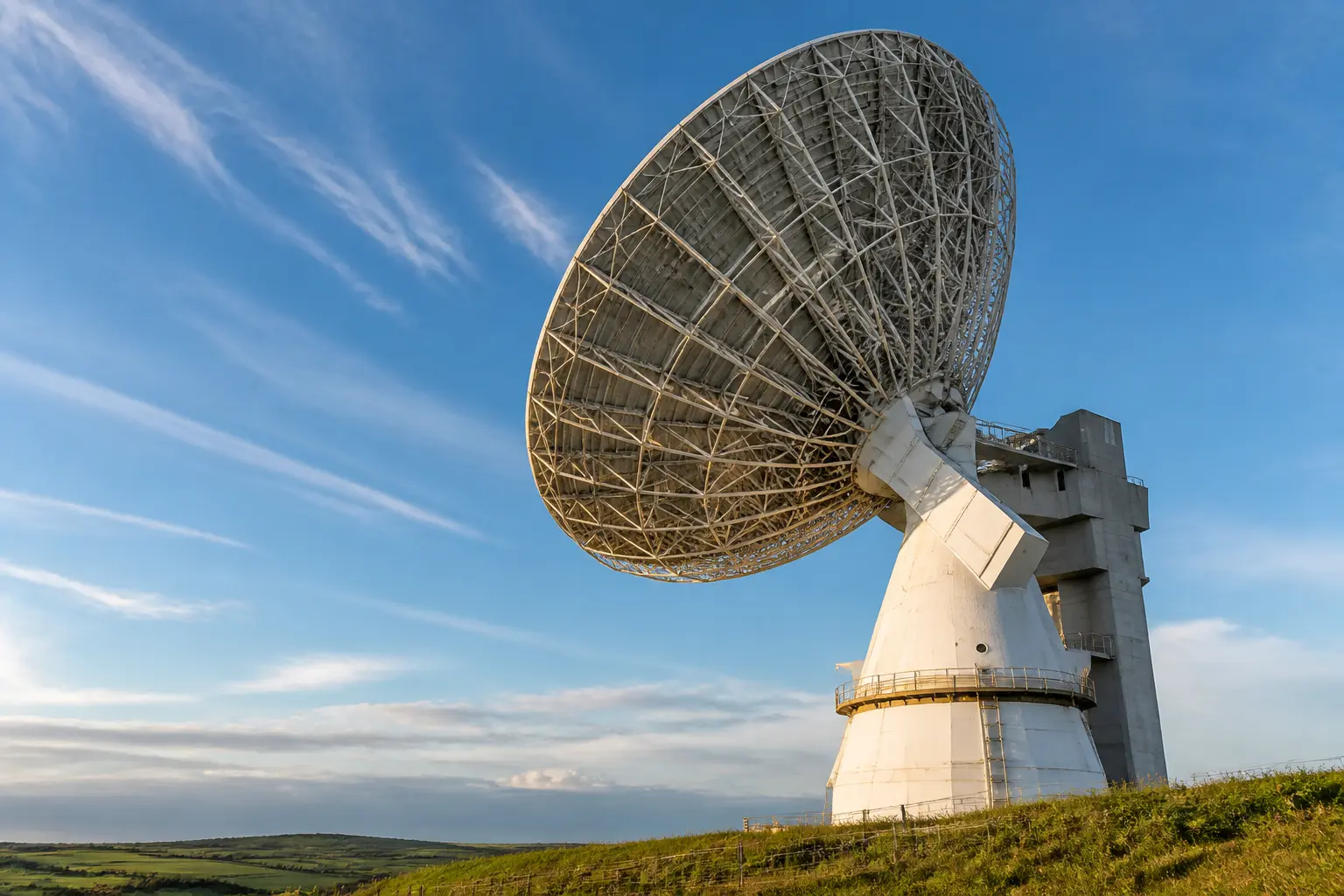
Where Seven of Every Eight Pounds Went
Run the subtraction Tracxn’s report invites and the concentration is stark. OneWeb’s £3.7bn against a sector total of £4.2bn works out to about 88% of every pound the UK space industry has ever raised sitting inside one balance sheet. The remaining 84 funding rounds, spanning launch startups, Earth observation satellites and in-space manufacturing ventures, split roughly £500m between them.
That is not a criticism of the smaller companies. Open Cosmos, SatVu and Space Forge are each raising real money at a stage most European deep-tech startups never reach. But a sector described as spanning the full value chain, from satellite communications through launch to mission services, is still overwhelmingly a story about one satellite operator’s finances.
How London’s Satellite Champion Ended Up in Paris
OneWeb now operates as part of Eutelsat Group, the Paris-headquartered satellite operator it merged with. That merger has reshaped who actually owns the company behind Britain’s biggest space tech number.
France led a €1.5bn recapitalisation of Eutelsat in 2025, with the French state committing €750m for a stake described in its own shareholder registration document as approximately 29.65% of the capital and voting rights, making Paris the group’s largest shareholder. Bharti Space Limited holds 17.88%, the UK government holds 10.89%, and shipping group CMA CGM holds 7.46%.
The UK government’s stake did not come free. It came from a written statement confirming a £140m top-up to the 2025 recapitalisation, money committed just to hold onto 10.89% rather than watch that number fall further. Trade publication Space Intel Report has tracked the UK’s Eutelsat stake shrinking for roughly five years, even as successive governments keep adding cash to defend what is left of it.
A Fresh 62 Million Pound Bet on the Rest of the Sector
The new government money Tracxn’s report references was announced at the Farnborough International Airshow on July 20, eight days before the report’s publication. It splits into two pots described on a fresh £62m package for homegrown space technology: £42m for the third funding round of the Connectivity in Low Earth Orbit programme, part of a four-year, £160m effort, and £20m for the National Space Innovation Programme, with projects due to start in April 2027.
The C-LEO money targets five specific technology areas:
- On-board satellite processing
- Active antennas
- Optical communication links
- Networking and routing systems
- User terminals
The UK Space Agency also signed a memorandum of understanding with Space Florida to set up a £300,000 joint commercial innovation fund. Two thirds of the £62m package targets satellite communications specifically, which lines up with where the sector’s money and its concentration problem already sit.
Who Is Buying Britain’s Space Startups?
Money going in is only half of Tracxn’s report. The other half covers exits, and the pattern there is just as lopsided. Tracxn counts 16 acquisitions across deep-space communications, space sustainability and geospatial data, and the three most recent named deals all ended with UK-built companies inside American balance sheets.
- June 2024: Space domain awareness startup 3S Northumbria became a subsidiary of ExoAnalytic Solutions, a California-based space-tracking firm, boosting commercial space situational awareness capacity for the UK government and its allies.
- May 2025: Woolpert, an Ohio-headquartered geospatial and engineering firm, acquired Bluesky International, described in Woolpert’s own announcement as the UK’s largest commercial aerial survey firm.
- May 2026: Intuitive Machines, the Nasdaq-listed lunar lander company, agreed to buy Goonhilly Earth Station and its COMSAT subsidiary for £37m, split evenly between cash and stock, adding 44 antennas to its deep-space ground network.
Intuitive Machines described its £37m deal for Goonhilly’s ground stations as a way to expand communications and navigation support for lunar and cislunar missions, the same crowded push toward the Moon that has SpaceX racing toward its own 2028 landing target. Goonhilly’s dishes, built to talk to spacecraft on the far side of the Moon, now report to a Houston boardroom instead of a British one.
The consolidation does not stop with the buyer. ExoAnalytic Solutions itself agreed in March 2026 to be acquired by Anduril Industries, the US defense technology company, meaning 3S Northumbria has now passed through two ownership changes in under two years without a single UK acquirer in the chain.
Tracxn frames the acquisition count as proof of demand, noting that international space and data companies keep buying UK capabilities. That reading holds up. It also means the sector’s most concrete evidence of success is measured in exits, not in companies that stayed independent long enough to list or scale on their own.
What Comes Next for SatVu, Open Cosmos and Space Forge
The £62m package is explicitly aimed at the layer below OneWeb, the earlier-stage antenna, processing and optical-link technology that companies like SatVu, Open Cosmos and Space Forge will need if they want to grow past their current £26.3m to £91.7m range. Whether that money produces companies that scale independently or simply produces better acquisition targets is the open question Tracxn’s report does not answer.
Sixteen acquisitions in, the UK has proven it can build space technology other countries want to buy. What it has not yet proven, on Tracxn’s own numbers, is that it can keep what it builds.