Anduril Industries expects to reach about 250 employees by the end of this year at Arsenal-1, its new billion-dollar drone factory outside Columbus, Ohio. The company wants that number near 4,000 within a decade. Every headline about defense tech’s soaring valuations skips it.
Kela hit unicorn status in May at a $1.2 billion valuation. Anduril’s own valuation reached $61 billion the same month, and by mid-June secondary trades implied a figure closer to $100 billion. Behind those numbers sits a plainer one: the industry’s scarcest hire this year is not a machine learning researcher. It is a manufacturing engineer, and the United States does not have nearly enough of them.
A Billion-Dollar Factory with Room to Spare
Arsenal-1 sits near Rickenbacker International Airport south of Columbus. Anduril is spending roughly $1 billion to build it, and the first production line, dedicated to the YFQ-44A Fury combat drone, started building hardware in March, about four months ahead of the company’s own schedule.
Running three eight-hour shifts, that single line can turn out up to 150 Fury airframes a year. It is one line in a factory built for far more: at full scale the plant is designed to sprawl across 5 million square feet and grow its headcount toward 4,000 within a decade, according to Ohio’s state development agency. By the end of this year, Anduril plans to add production lines for its Roadrunner interceptor drone and Barracuda cruise missile, plus a classified platform nobody outside the company has named.
None of that runs itself. Every one of those lines needs technicians who can read a torque spec, engineers who can requalify a supplier in a week instead of a quarter, and enough hands to keep the jigs moving through three shifts. That is a very different hiring problem than the one Silicon Valley has been solving for twenty years.
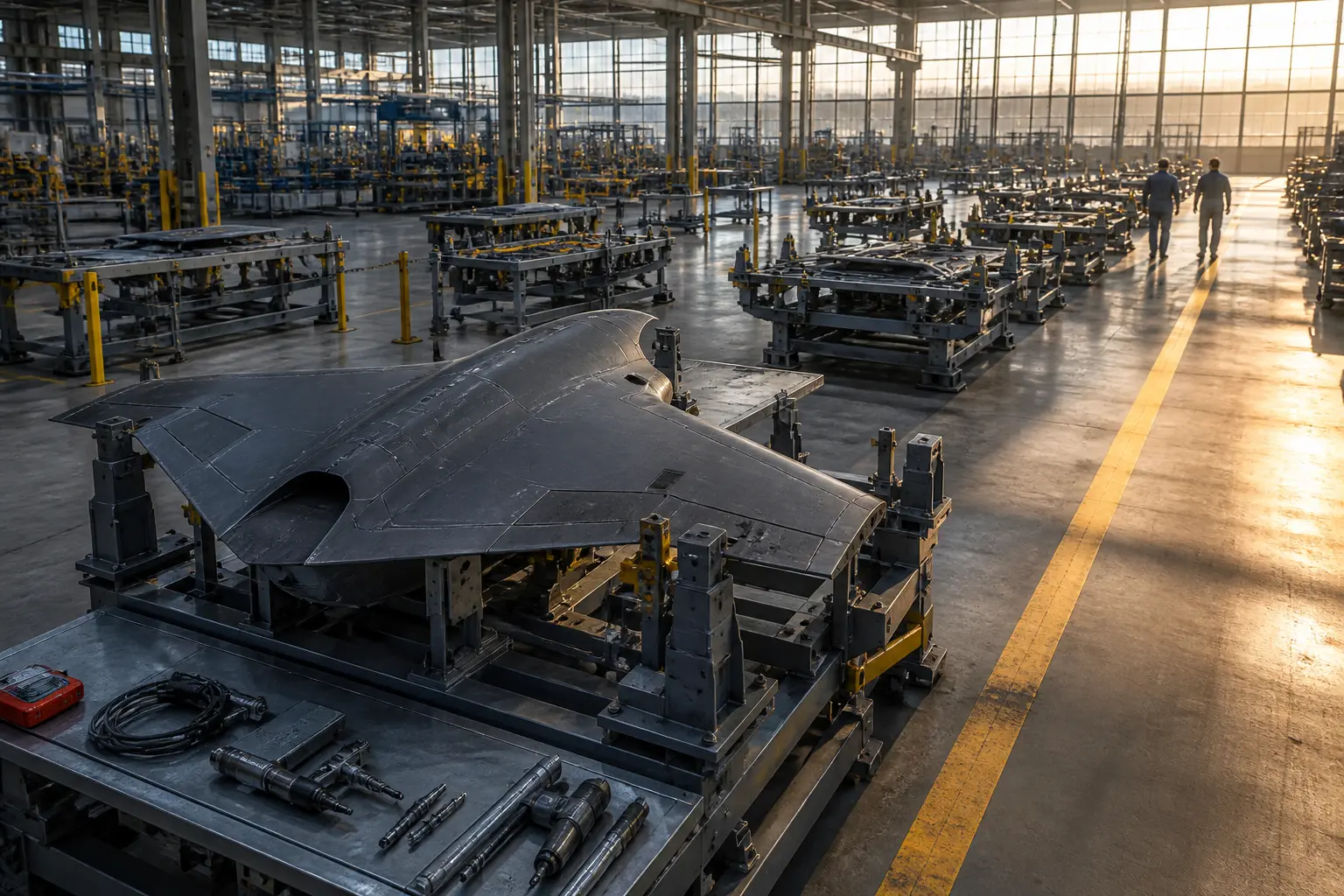
The Stack Has a Basement Nobody Photographs
Tal Pinkasovich, a defense-technology analyst and major in the Israeli navy reserves, mapped this industry for The Jerusalem Post as a stack of distinct layers rather than a single sector: software platforms on top, then compute, then navigation and sensing, then firmware, then hardware, and finally the factory floor underneath all of it. His point was that consolidation is real only on the top floor, the “penthouse” occupied by Palantir, Anduril and Kela, while every layer below it is fragmenting and hiring at once.
The labor data bears that out layer by layer. The defense semiconductor market was worth $13.4 billion in 2025 and is projected to nearly triple within a decade, and the Pentagon backed that growth in December with a contracting vehicle carrying a $25 billion ceiling for American-made military chips. One rung down, SandboxAQ’s AQNav system navigates by reading the Earth’s magnetic field instead of relying on satellites, logging more than 450 flight hours across four aircraft types on its way into a Pentagon quantum-sensing program. Below that sits firmware: Ukraine’s The Fourth Law built a machine-vision guidance module, the TFL-1, for under $100, and it now flies with roughly 20 Ukrainian brigades.
At street level sits hardware itself, where SpektreWorks, a 14-person company in Arizona, designed the $35,000 LUCAS loitering munition that made its combat debut over Iran in January. The Pentagon’s first drone “gauntlet” this year bought 30,000 drones at roughly $5,000 apiece from 12 different vendors, not two prime contractors. Smaller public names are riding the same current. Maris-Tech, a micro-cap sensor and video systems maker, has booked repeat defense orders for its observation systems without disclosing their value, a pattern common among the smaller vendors filling the stack’s lower floors.
| Floor of the Stack | Example | What Is Actually Scarce |
|---|---|---|
| Software platforms | Anduril ($61B), Palantir ($1.63B Q1 revenue), Kela ($1.2B) | Nothing; it is consolidating around a few winners |
| Compute and chips | $13.4B defense semiconductor market; Pentagon’s $25B chip contract vehicle | Fabrication capacity |
| Navigation and sensing | SandboxAQ’s AQNav, 450+ flight hours logged | Quantum and sensing engineers |
| Firmware and edge autonomy | The Fourth Law’s TFL-1, under $100, fielded with 20 brigades | Almost nothing; that is the point |
| Hardware and airframes | SpektreWorks’ LUCAS, $35,000, 12 vendors in one Pentagon buy | Nothing; competition is wide open |
| Factory floor | Anduril’s Arsenal-1, roughly 250 workers now, 4,000 planned | Manufacturing engineers and technicians |
Read down that table and the pattern reverses itself. Every floor above the basement solved its scarcity problem with a small team and a clever idea. The basement cannot.
America Is Short Millions of Workers
The gap at Arsenal-1 is not a company problem. It is a national one. A joint study by Deloitte and the Manufacturing Institute found that American manufacturers could need 3.8 million new employees by 2033, and as many as half of those seats could go unfilled if the skills gap is not closed. An earlier version of the same research had already projected 2.1 million unfilled manufacturing jobs by 2030, at a cost the report put near $1 trillion in lost output for that year alone.
The Pentagon has treated this as a security problem for years, not just an economic one. It has funded workforce partnerships like the SecureAmerica Institute specifically to shore up the industrial base beneath its weapons programs. That funding predates the current boom by years; what has changed is the size of the order book sitting on top of a workforce that was already short.
None of the layers above the factory floor face this problem the same way. A vision-module startup like The Fourth Law needs a dozen sharp engineers. A drone factory chasing 10,000 airframes a year needs thousands of people who can weld, wire and inspect, and those people take years to train, not months to hire.
Why Is the Money Moving Faster than the Workforce?
Demand is not waiting for the workforce to catch up. At the NATO summit’s Defence Industry Forum in Ankara on July 7, allies led by Secretary General Mark Rutte launched the Drone Edge Initiative, committing more than $40 billion over five years to counter-drone defense, procurement and training. The initiative includes:
- Training: five times as many certified drone operators across the alliance by the end of 2027
- A marketplace: a NATO-tested, NATO-compatible counter-drone marketplace so allies can buy proven systems off a common list
- Procurement: up to five Northrop Grumman MQ-4C Triton surveillance drones, with Norway, Finland, Germany and Denmark signing on, the alliance’s first collective Triton purchase
That is a five-year commitment layered on top of an industrial base that already cannot fill its current openings. The mismatch shows up in how long procurement actually takes. The Pentagon’s flagship fast-track acquisition unit still averages about 19 months from solicitation to first delivered article, and defense-tech founders have watched companies die in exactly that gap, after a successful demo but before a funded budget line arrives. A request for 300,000 drones is a question, not a signed contract, and the workforce needed to answer it does not appear just because a budget line does.
Israel Is Running the Same Experiment at Higher Speed
Israel offers a smaller, faster version of the same story. The country’s defense exports reached a record $19.2 billion in 2025, roughly 30% above 2024’s $14.8 billion and the fifth consecutive annual record, according to figures released by the country’s Ministry of Defense. Government-to-government deals made up about $10 billion of that total, and missile, rocket and air-defense systems led product categories with 29% of deals, followed by surveillance and optronics systems at 22%, up sharply from just 6% the year before.
Since October 2023, more than 130 Israeli start-ups have been folded directly into the war effort, about half of them in autonomy and AI and a quarter in sensors, almost none of them needing a fab or a nine-figure round to get in the door. Start-ups working with the Defense Ministry’s own R&D directorate raised more than $1 billion in 2025, against roughly $150 million the year before. A separate industry ranking named 60 firms powering Israel’s defense-tech surge, evidence that the hiring boom Pinkasovich described is already spread across a wide, not a narrow, base of employers.
Israel’s advantage is speed of conversion, not size. A reservist system that moves engineers between start-ups and uniformed service in weeks, not years, turns a funding round into deployed capability faster than a larger, more bureaucratic industrial base can manage. The United States has the deeper bench. It does not yet have the same speed.
2026, Six Moves In
Laid end to end, this year’s events read less like scattered headlines and more like one continuous signal.
- January 2026: SpektreWorks’ LUCAS loitering munition makes its combat debut over Iran at $35,000 a unit.
- March 2026: Anduril starts Fury drone production at Arsenal-1 in Ohio, about four months ahead of schedule.
- May 2026: Kela raises $200 million at a $1.2 billion valuation the same month global tech layoffs cross 185,000.
- June 2026: Israel’s Ministry of Defense reports record defense exports of $19.2 billion for 2025.
- July 7, 2026: NATO’s Ankara summit commits more than $40 billion to counter-drone defense over five years.
Six events, five months, one direction. Capital and combat orders are moving faster than any factory can hire.
Where the Assembly Line Could Choke
This is where the froth argument about defense tech actually lands, and it is not on the balance sheets everyone worries about. Anduril’s billion-dollar bet on Arsenal-1 depends on turning out 10,000 airframes a year without a single sub-tier supplier of motors or thermal batteries choking the line. That supplier base is thin precisely because it draws from the same shrunken pool of manufacturing talent the Deloitte numbers describe.
The cheap, clever layers of the stack, the $100 firmware modules and the $35,000 loitering munitions, already work. They do not need a bigger workforce to prove the concept works; The Fourth Law and SpektreWorks did that with a few dozen people between them. Scaling those ideas from a few hundred units to tens of thousands is a manufacturing problem, and manufacturing problems get solved by people who can run a production line, not by people who can train a model.
In 2018, about 4,000 Google employees signed a petition against a Pentagon AI contract, and the company walked away from it. Seven years on, that same industry has cut hundreds of thousands of jobs, and the fastest-growing employer of technical talent in the West is the one those employees once refused to work for. The open door is on the factory floor. Whether enough workers walk through it is still an open question.
Frequently Asked Questions
How Many People Will Anduril Employ at Arsenal-1?
Anduril expects an initial workforce of about 250 people by the end of 2026 at Arsenal-1, its Ohio drone factory near Rickenbacker International Airport, with plans to grow toward 4,000 employees over the following decade as additional production lines for the Roadrunner interceptor, Barracuda cruise missile and a classified platform come online.
Is Defense Tech a Bubble?
Some valuations look stretched, particularly Kela’s $1.2 billion price tag against roughly $20 million in revenue, a multiple near 60 times sales that only makes sense if growth keeps compounding. But the buyer here is governments rearming on a fear-driven schedule, not consumers who can simply change their minds, which is why analysts expect any shakeout to hit top-floor software valuations rather than the hardware and manufacturing layers below.
Why Can’t AI Replace Manufacturing Jobs in Defense?
Demand for digital and simulation skills in manufacturing has actually risen 75% over the past five years according to Manufacturing Institute research, but that demand sits on top of physical work, torque checks, wiring, supplier inspection, that still requires trained people on a factory floor. Software can design a part in seconds; only a trained technician can build and qualify 10,000 of them.
What Is the Defense Industrial Base?
The defense industrial base is the network of manufacturers, from prime contractors down to small parts suppliers, that builds American weapons systems. The Pentagon funds workforce programs like the SecureAmerica Institute through its Industrial Base Analysis and Sustainment program specifically because a shortage of welders or machinists, not a shortage of software, is treated as a national security risk.