Dun & Bradstreet has ranked Israel’s defense-tech industry for the first time, naming 60 companies at the center of a sector whose funding just tripled in six months. The Duns 100 index, Israel’s longtime business-ranking franchise, built the list this month as exports and venture capital both hit record highs. Roughly 800 startups are currently chasing Defense Ministry contracts, and only 60 of them just got Duns 100’s stamp of approval.
The list reads as a scoreboard for a boom already under way. It is also something more concrete: a credibility marker that Duns 100 says helps ranked firms unlock financing and deals abroad, arriving just as capital pours into a market most of the industry still cannot reach.
A Credit-Data Giant Enters the Arms Business
Duns 100 has ranked Israel’s top companies across law, construction, real estate and finance for two decades. Defense never got its own edition, until this month.
Dun & Bradstreet frames inclusion as more than a badge. Per the company’s own description of its rankings, belonging to Duns 100 is a mark of quality for a company and its managers, and a strategic tool for expanding business opportunities with customers, suppliers and investors in Israel and abroad. That description comes from the same Dun & Bradstreet whose global business runs on credit-risk scoring. Founded 160 years ago, the firm built tools that companies still use to reduce credit risk and vet trading partners, the same lineage behind the business PAYDEX score built from payment history that lenders check before extending credit. Its move into ranking defense-tech extends that same business into a sector usually defined by secrecy and government contracts.
Sheila Zavaro Weiss, senior director at Duns 100, said the new index captures a shift already under way in how outsiders should read Israel’s defense sector.
The ranking reflects a profound shift in how the industry should be viewed: not merely as an industry that manufactures systems and components but as a broad defense-tech ecosystem in which value is created through the integration of industrial capabilities, software, data, AI, autonomy, sensors, and operational relevance.
Weiss added that the ranking does more than show who operates in the field. It signals where Israel’s defense industry is heading, according to Duns 100, whose description of its ranking methodology says companies are judged on business strength, technological innovation, global activity and their place in the defense value chain.
What Sixty Companies Actually Cover
The ranking splits Israel’s defense-tech world into six categories.
- Defense integrators – firms that combine platforms, software and systems into complete operational solutions
- Defense manufacturing – the single largest category, with 23 of the 60 ranked firms
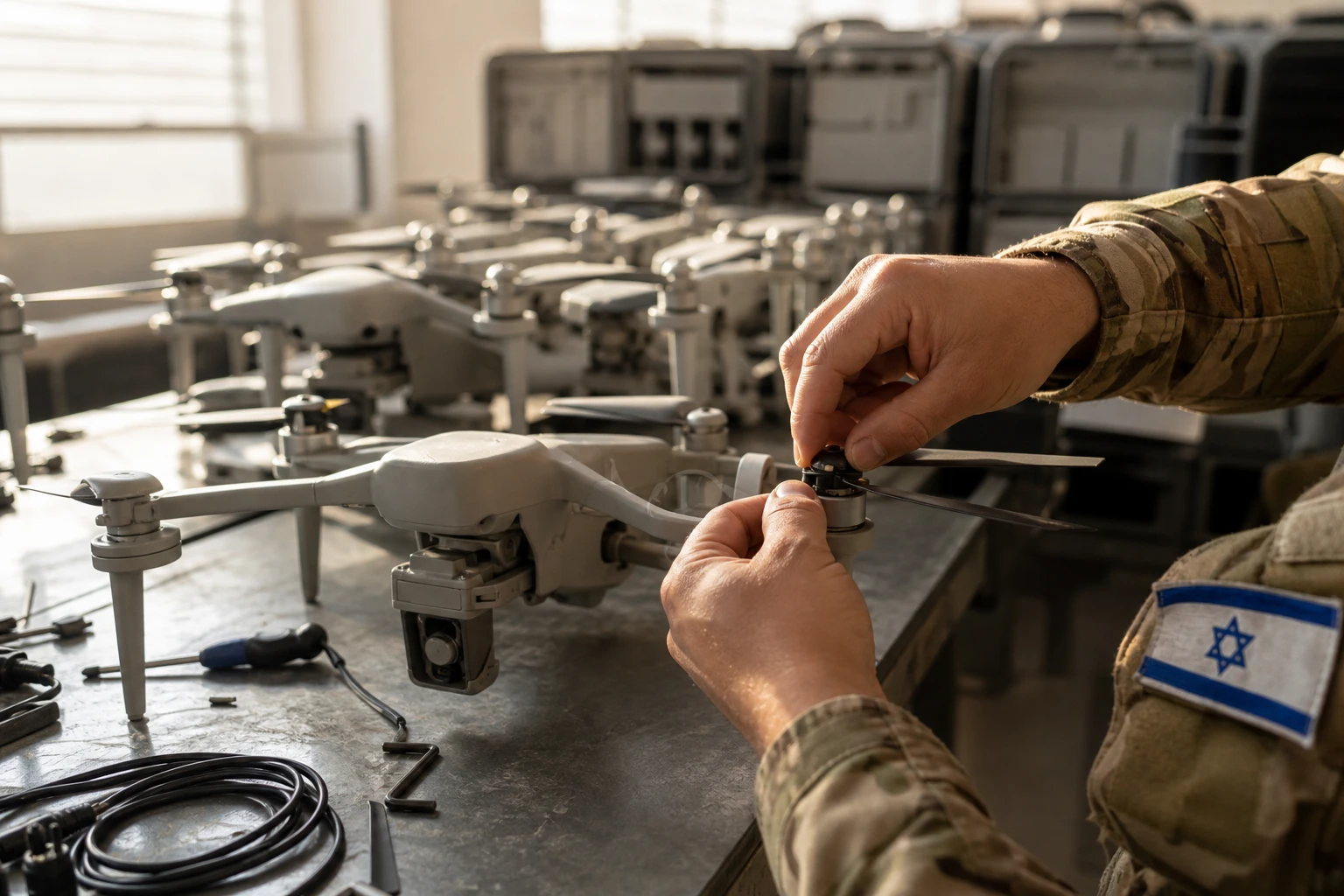
- Unmanned and autonomous systems – the second largest category, with 19 firms building drones and robotics
- Homeland security – firms building perimeter, surveillance and physical protection systems
- Intelligence and cyber – digital forensics, data extraction and cyber-operations firms
- Tactical and ground equipment – firearms, armor and field logistics gear
Elbit Systems, Plasan Sasa, Aeronautics, Magal, Cellebrite and Israel Weapon Industries, known as IWI, were named as leaders across those categories, Duns 100 said. Manufacturing and unmanned systems alone account for 42 of the 60 companies, about 70% of the entire list. That leaves just 18 companies spread across the other four categories combined. Beyond the category leaders, the list includes names like ThirdEye Systems, Parazero Technologies, High Lander Aviation, Controp Precision Technologies, Bagira, Smart Shooter and MeproLight, companies working across autonomy, robotics, advanced sensing, data processing and tactical logistics.
Duns 100 also introduced a separate Emerging Industry Leaders Award for five companies it says are positioned to shape the sector’s future: Aero Sentinel, AIR VEV, Axon Vision, Kela AI and XTEND. Three of them are not waiting for the ranking to prove their relevance.
The Capital Curve Behind the List
Duns 100’s ranking arrived days after new numbers showed how fast the money behind it is moving.
Israeli defense-tech startups working with the Defense Ministry raised nearly $3 billion in the first six months of 2026, three times what the same group raised in all of 2025, according to figures presented at the Haifa DefenseTech Startups and Investors Forum. Defense-tech and dual-use companies made up almost 30% of the $8.4 billion invested across Israeli high-tech in that same stretch.
“Israel is rapidly transforming from a ‘Cyber Nation’ to a ‘Defense-Tech Nation,’” Ilana Averkin, head of Defense-Tech at HiCenter Ventures, said at the forum.
| Period | Capital Raised by Defense-Tech Startups Working With the Ministry |
|---|---|
| 2024 (full year) | About $150 million |
| 2025 (full year) | About $1 billion |
| First half of 2026 | Nearly $3 billion |
About 800 startups are currently fulfilling direct procurement orders for the Defense Ministry. Duns 100 ranked 60 of them. A narrower slice of that universe, the roughly 302 companies working with the ministry’s research and development arm, MAFAT, shows a similar pattern: only 221 have a direct relationship with the directorate itself. Most of the ecosystem still operates without the kind of formal recognition Duns 100 just handed to a select group.
The Emerging Leaders Already Cashing In
XTEND, Kela and Axon Vision have already turned battlefield use into a business case.
XTEND’s Road to Nasdaq
XTEND, founded in 2018 by Aviv Shapira, Matteo Shapira, Rubi Liani and Adir Tubi, builds remote-operated drone swarms for defense, public safety and private security work. The company is heading toward a Nasdaq listing at a $1.5 billion valuation through a merger, months after closing a $70 million funding round led by Protego Ventures and Aliya Capital Partners. It also holds a US Department of Defense contract to build AI-enabled attack drones from a manufacturing site in Tampa, Florida, part of the same push toward permanent defense-industrial ties that Section 224 of the NDAA now writes into US law. Foreign media outlets have reported that an XTEND drone helped locate Hamas leader Yahya Sinwar before Israeli forces killed him.
Kela’s Post-October 7 Rise
Kela was founded after the October 7 attack by Hamutal Meridor and Alon Dror. The company recently raised $200 million and was picked, alongside a firm called eyesAtop, to build what the Defense Ministry describes as the national platform for commanding the IDF’s autonomous attack drone fleet. Kela also won a cash award in a Pentagon-run Lethality Challenge for low-cost, mass-producible drone payloads.
Axon Vision’s First Contract
Axon Vision secured its first major contract for a licensed version of its EdgeUAV system in October 2025. The software lets unmanned platforms detect, track and engage targets with less operator input, cutting response time in contested airspace.
Exports Turn Combat Into Currency
Duns 100’s ranking landed a few weeks after Israel’s Defense Ministry reported its own record. Defense exports hit $19.2 billion in 2025, a fifth consecutive annual high and an increase of nearly 30% from $14.8 billion the year before, more than double the total from five years earlier.
- $19.2 billion – Israel’s record 2025 defense exports, up nearly 30% from $14.8 billion in 2024
- $10 billion – government-to-government deals, more than half of the year’s total and a record on their own
- 53% – share of 2025 export deals worth more than $100 million each
- 22% – observation and optronics systems’ share of exports, up from just 6% in 2024
Missile, rocket and air defense systems led 2025 exports at 29% of total deal volume. Amir Baram, director general of Israel’s Defense Ministry, pointed to several forces behind the surge. “The sharp surge in defense exports reflects the quality of Israel’s defense industry, global demand, the IDF’s operational successes, and our unique ecosystem,” he said.
One of the 60 ranked firms, D-Fend Solutions, shows how far that reach extends beyond any battlefield. Its counter-drone technology was deployed near Pope Francis during a Mass prayer event in Slovakia in September, guarding one of the world’s most recognizable public figures against aerial threats. The same ecosystem that supplies attack drones to the IDF also protects civilian gatherings thousands of miles from Gaza.
The pitch behind the export numbers rests on a war that has not stopped. Israeli forces have kept expanding their footprint under a Gaza ceasefire that has pushed territorial control toward 70%, the kind of sustained operational activity that exporters point to when marketing systems as combat-tested.
Why Does Haifa Miss Out on the Boom?
About 80% of Israel’s defense-tech companies sit in the center of the country, near Tel Aviv, according to data presented at the Haifa DefenseTech Startups and Investors Forum. That leaves the north and south chasing a much smaller share of a funding wave regional leaders say is reshaping national security capacity unevenly.
Hanan Markovitz, CEO of the Haifa Economic Corporation, made that point at the same forum where the funding figures were first presented. “Israel cannot continue concentrating the best human and technological capital of the security establishment in the center of the country,” he said. “Investment in Beersheba is welcome, but national resilience also requires a strong hub in Haifa and the North.”
HiCenter Ventures, the fund Markovitz’s organization built with the city of Haifa, has backed 104 startups since 2021 and helped them raise more than $300 million combined. That is roughly a tenth of what defense-tech startups nationwide raised in the first six months of 2026 alone.
The Boom’s Bet on a Longer War
Danny Gold, the retired brigadier general who heads MAFAT, has already flagged a softer patch ahead. He said 2026 would be challenging for security but was unlikely to match the operational tempo, and the order volume, of the previous two years. Gold also directed at least 10% of the ministry’s 2026 research and development budget to startups instead of Israel’s three largest defense companies, IAI, Elbit and Rafael, which he said were already flourishing on overseas demand.
Duns 100’s list captures 60 of the companies riding this wave. The other roughly 740 are still waiting for their own scoreboard.