Cash held outside Nigeria’s banks fell to ₦4.92 trillion in June 2026, the lowest level in seven months, as more naira notes made their way back through bank teller windows than at any point since November. The Central Bank of Nigeria’s (CBN) latest Money and Credit Statistics, analysed by Lagos financial news outlet Nairametrics, show the stockpile shrank by ₦485.80 billion, or 8.98%, over the six months since December 2025.
That is genuine progress toward a less cash-hungry economy. But stretch the same six-month pace out to 2028, the deadline CBN Governor Olayemi Cardoso has attached to pushing cash outside the banking system below 40% of the total, and the arithmetic comes up far short.
The Slide From ₦5.41 Trillion to ₦4.92 Trillion
The path down was not a straight line. Currency outside banks fell from ₦5.41 trillion in December to ₦5.25 trillion in January, then ₦5.19 trillion in February. The CBN’s dataset skips March entirely, jumping to ₦5.08 trillion in April. May broke the pattern: cash outside banks rose to ₦5.19 trillion, a gain of ₦109.34 billion, or 2.15%, in a single month.
June reversed that bounce hard. Cash outside banks dropped by ₦270.97 billion, or 5.22%, the largest single monthly decline in the available dataset, to land at ₦4.92 trillion, just above November 2025’s ₦4.91 trillion.
| Month | Cash Outside Banks (₦ trillion) | Month-on-Month Change |
|---|---|---|
| December 2025 | 5.41 | Baseline |
| January 2026 | 5.25 | Down |
| February 2026 | 5.19 | Down |
| April 2026 | 5.08 | Down |
| May 2026 | 5.19 | Up ₦109.34 billion (+2.15%) |
| June 2026 | 4.92 | Down ₦270.97 billion (-5.22%) |
CBN has not published a March 2026 figure, so the April number is the only bridge between February and May in the public dataset.
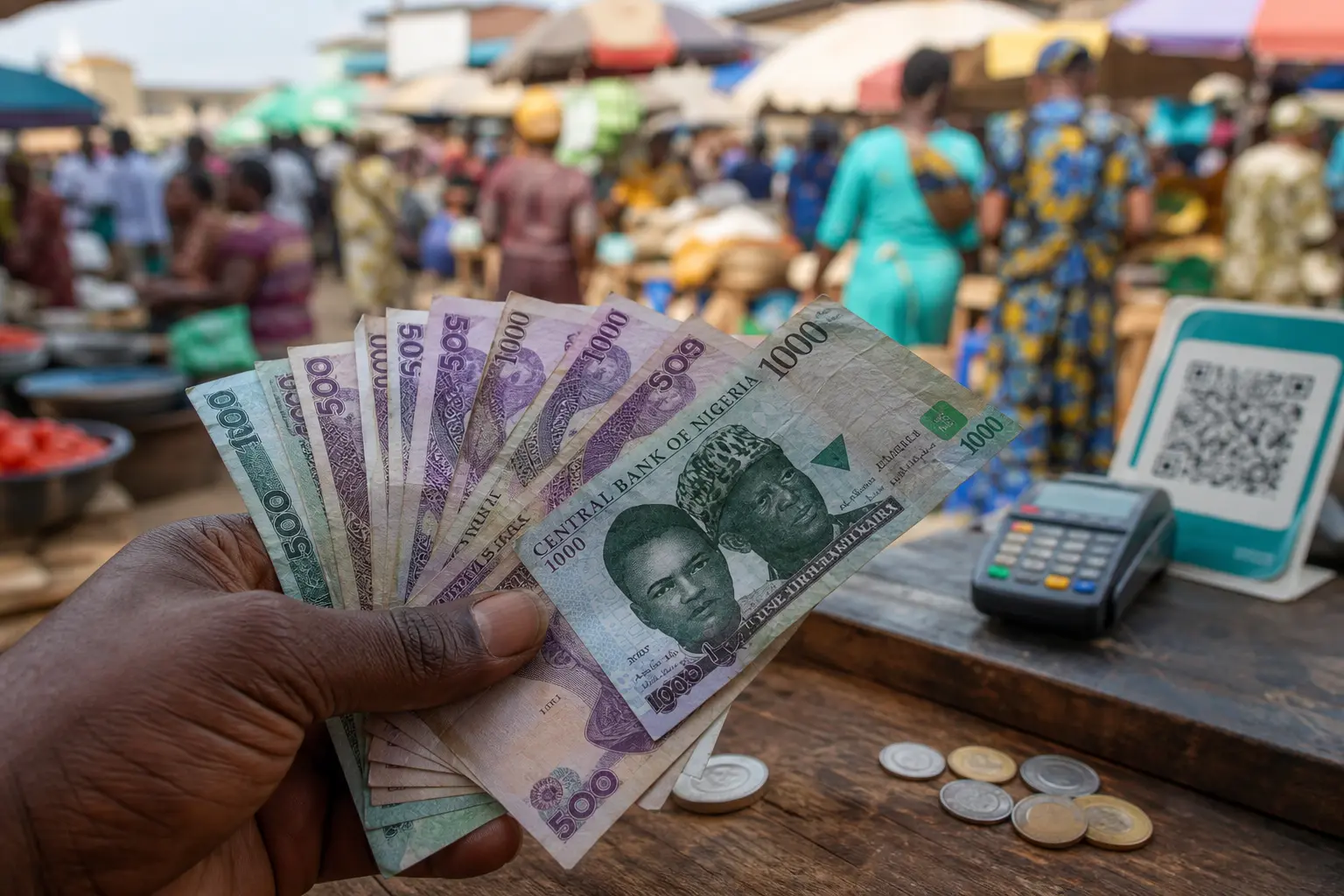
Why More Naira Are Landing Back in Bank Vaults
Total currency in circulation, which includes notes sitting in bank vaults and tills, fell much less over the same window: from ₦5.73 trillion in December to ₦5.52 trillion in June, a drop of ₦209.56 billion, or 3.66%. That gap between the two numbers matters. Cash outside banks fell nearly two and a half times faster than total currency in circulation, which means most of the missing notes were deposited, not destroyed or withdrawn for good.
The ratio tells the same story in percentage terms. At the end of 2025, 94.33% of all currency in circulation sat outside the banking system. By May 2026 that had eased to 91.27%. In June it dropped again, to 89.11%, a 2.16 percentage point move in a single month. Measured against June 2025’s 89.74%, the year-on-year improvement is a modest 0.63 points, meaning most of the past year’s gain arrived in this one month alone.
Nearly nine of every ten naira in circulation is still outside a bank. That is the backdrop the CBN’s digital payments push is working against.
Nigeria Has Tried the Fast Way Before
Nigeria has forced this kind of shift before, and it went badly. In October 2022, then CBN Governor Godwin Emefiele ordered a redesign of the ₦200, ₦500 and ₦1,000 notes and gave the public a matter of weeks to swap old bills for new ones.
- October 26, 2022: Emefiele announces the redesigned ₦200, ₦500 and ₦1,000 notes, setting a January deadline for old notes to lose legal tender status.
- January 31, 2023: The original swap deadline arrives with new notes still scarce in banks and ATMs nationwide.
- February 10, 2023: The CBN extends the deadline after cash shortages trigger street protests in multiple cities, weeks before a general election.
- April 2023: Currency in circulation rebounds to roughly ₦2.4 trillion once old notes regain legal tender status and the panic subsides.
Total currency in circulation had collapsed from ₦3.29 trillion in October 2022 to ₦1.38 trillion by January 2023, a ₦1.91 trillion drop in three months. A policy assessment from the Carnegie Endowment for International Peace, a Washington research institute, later concluded the redesign never achieved the anti-corruption and inflation goals it was sold on. Researchers at the University of Oxford’s Blavatnik School of Government traced how the cash crunch deepened voter hardship just before the 2023 election.
Set beside that, today’s ₦209.56 billion six-month move in total currency in circulation is small, roughly a ninth of what the 2023 shock erased in a single quarter. The CBN appears to be choosing patience this time.
Cardoso’s Blueprint for a Cashless Nigeria
The current strategy has a name and a deadline. At the recent launch of the Nigeria Payment System Vision in Abuja, Cardoso described a plan built around infrastructure rather than deadlines for old banknotes.
- PSV 2028 – the Central Bank of Nigeria’s Payment System Vision 2028, a framework meant to push cash outside the banking system below 40% of total currency in circulation and lift formal financial inclusion to 95% by the end of 2028.
The plan calls for more than 10 million QR-code and tap-to-pay acceptance points across markets, transport hubs, rural communities and commercial centres. It also targets 50 million additional Nigerians, including market women, farmers and young people, brought into the formal financial system, alongside a push to cut fraud losses to under 0.001% of transaction value using artificial intelligence and identity verification tools. Cardoso told the Abuja launch he wants every Nigerian, from Maiduguri to Brass, able to move money “faster than they can blink” by 2028.
Similar bets on cheap acceptance infrastructure are playing out elsewhere. In the Philippines, mobile wallet GCash for Business recently rolled out its SoundPay Plus and EasyPOS tools aimed at getting small merchants off cash without the cost of a card machine, part of the same regional shift toward tap-and-scan acceptance.
The CBN frames its own effort as more than a technology upgrade. Its financial inclusion strategy for underserved groups including market women and rural farmers sits underneath the PSV 2028 numbers Cardoso announced in Abuja.
Can Nigeria Hit 40% by 2028?
Not at the current pace. The ratio of cash outside banks fell 5.22 percentage points between December 2025 and June 2026, or roughly 0.87 points a month. Closing the remaining gap from June’s 89.11% down to the 40% target requires another 49 percentage points of decline, which the current pace would need almost five years to deliver.
Run the clock forward to the end of 2028, roughly thirty months from June 2026, and the same 0.87-point monthly pace would leave the ratio near 63%, well above the sub-40% goal Cardoso has staked his 2028 vision on. To land on target by then, the CBN would need cash outside banks to fall at close to double its current monthly rate, sustained without another May-style reversal.
That does not mean the target is unreachable. The 10 million-terminal rollout has barely begun, and infrastructure pushes often accelerate once acceptance points cross a critical mass rather than growing at a steady clip. But the June data, on its own, describes a country moving in the right direction at roughly half the speed its central bank has publicly promised.
The Traders, Banks and Agents Splitting the Cash
The shift is not evenly felt. A handful of groups sit on different sides of every naira that moves from a pocket to a ledger.
- Informal traders and market vendors: the largest group still paid and paying in cash, from transport fares to farm-gate produce, where a QR scan only works if both buyer and seller trust it.
- Commercial banks: gain cheap deposit liquidity every time a customer walks a stash of notes to the counter instead of keeping it at home.
- Agent banking and POS networks: stand to gain the most ground if the 10 million-terminal rollout lands, since they are the actual point of contact between cash and a bank ledger in rural areas.
- The CBN itself: has staked Cardoso’s Payment System Vision 2028 on the pace picking up enough that the sub-40% target is not remembered as another missed deadline.
For now, the CBN’s next Money and Credit Statistics release, due in late August, will show whether June’s ₦270.97 billion swing back into the vaults marked a faster run or another one-month blip like May’s.
Frequently Asked Questions
What Counts as Currency Outside Banks?
Currency outside banks is the CBN’s term for banknotes and coins sitting in public hands rather than in bank vaults, ATMs or teller tills. It is calculated by subtracting cash held by deposit money banks from total currency in circulation, which is why the two figures moved at such different speeds in June 2026.
How Big Is Nigeria’s Informal Cash Economy?
Estimates put Nigeria’s informal sector, where most transactions still run on physical notes, at more than half of the country’s GDP. That scale is a big part of why market women, transport operators and rural traders will decide whether the CBN’s cashless targets succeed or stall.
What Happens if Nigeria Misses the 2028 Target?
There is no legal penalty tied to the Payment System Vision 2028 deadline. It works as a policy benchmark built around specific tools, including the 10 million new QR and tap-to-pay acceptance points, so missing it would likely show up as slower financial inclusion gains rather than any formal sanction.
How Often Does the CBN Publish This Data?
The CBN releases Money and Credit Statistics on a monthly basis, typically with about a one-month lag. The next update, covering July 2026 cash levels, is due in late August 2026.