Thirty three million people in the United States tuned in to watch their men’s national team get eliminated from its own World Cup. That is more people than have ever watched a soccer match on American television, and it happened twelve days ago, in a 4-1 round of 16 loss to Belgium that ended the tournament for the co-host nation in Seattle.
That number matters because it undercuts the question hanging over this month’s postmortems: whether America’s soccer moment fades now that the home team is gone. The ratings already answered it before the round of 16 was even over. Now Washington DC is putting real money behind the same bet, with a $620 million plan to rebuild Audi Field into a year round arena for D.C. United, the Washington Spirit and the UFL’s DC Defenders.
The Ratings Already Answered the Fade Question
Fox’s broadcast of the United States’ 4-1 loss to Belgium drew a final Nielsen average of 33.09 million viewers, making it the most watched soccer telecast in American history, with a peak of 41 million between 9:15 and 9:30 p.m. as the result slipped away, according to Nielsen’s final same day numbers.
Mauricio Pochettino, the United States manager, did not soften the result afterward. “Today we didn’t show our real quality,” he said. “It just hurts to be eliminated.” Midfielder Tyler Adams was blunter still: “It stinks. Tonight was not a good performance overall.”
Belgium’s players did not let the moment pass quietly either, marking the win with a postgame dance routine aimed at President Trump, who had personally asked FIFA to review a red card suspension for American striker Folarin Balogun days earlier. The United States became the third and final host nation eliminated in that same round, joining Mexico and Canada, whose own run included a climb from 122nd in the world rankings to a knockout stage berth.
What happened next is the part getting less attention. Fox averaged 15.6 million viewers across the quarterfinals, a 150 percent jump from 2022’s 6.25 million, even with the United States and Mexico both gone. Reporting on those numbers concluded plainly that fears of viewers abandoning the tournament were unfounded. Attendance told the same story all tournament long, with FIFA’s own count showing matches filling 99.7 percent of available seats during the group stage, breaking a record that had stood since the United States last hosted in 1994.
- 33.09 million viewers watched Fox’s broadcast of the United States’ elimination, a record for any soccer telecast in the country.
- 15.6 million average viewers tuned into the quarterfinals, up 150 percent from 2022, despite no American team left to root for.
- 99.7 percent of group stage seats were filled, breaking an attendance mark set at the 1994 World Cup.
“Soccer has won,” Bret Myers, who teaches sports analytics at Villanova University, said of the numbers. Whatever the U.S. men accomplished or failed to accomplish on the field, the audience stuck around for everyone else’s tournament.
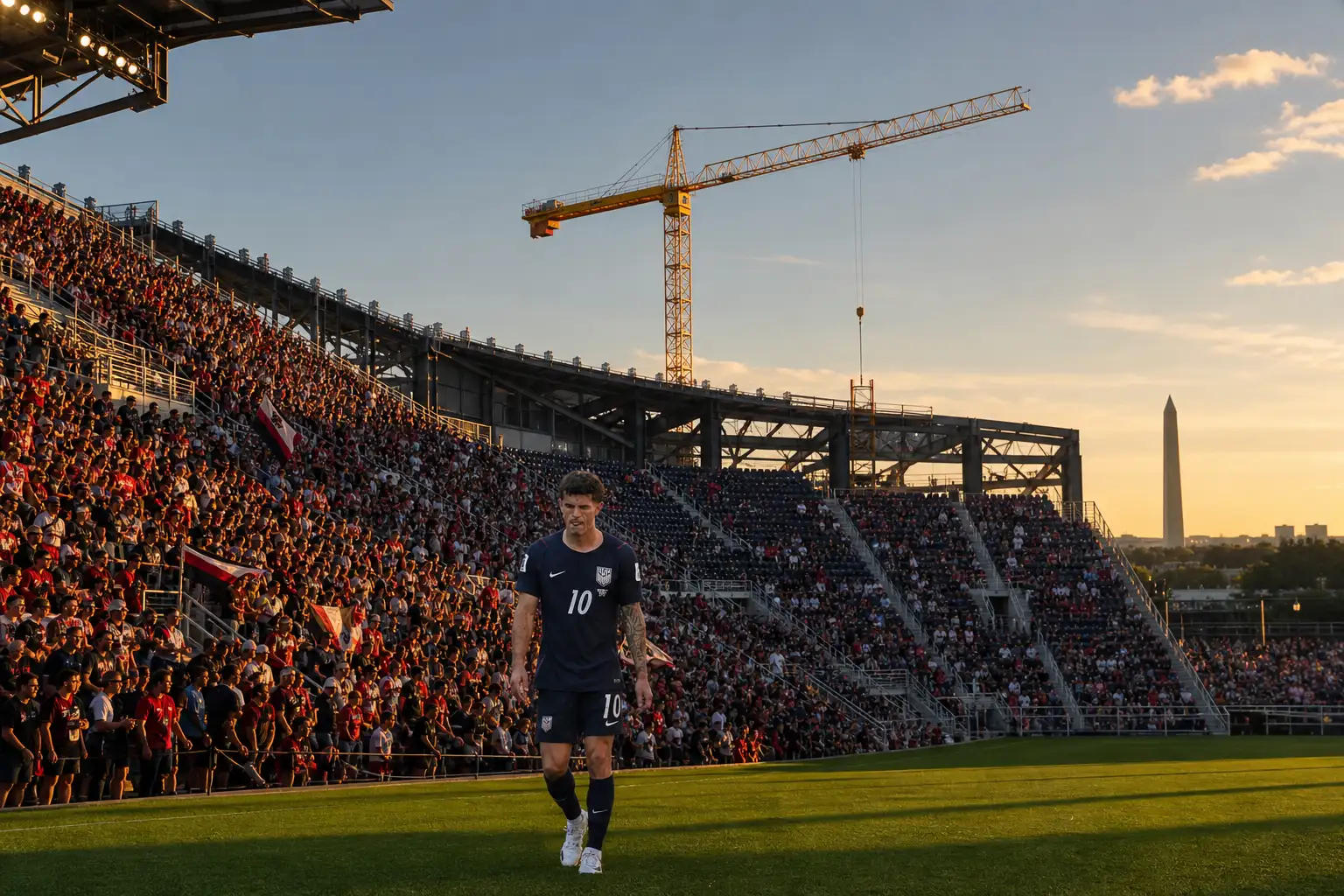
Mendelson’s $620 Million Bet on Buzzard Point
Against that backdrop, DC Council Chairman Phil Mendelson introduced legislation this month called the Soccer Stadium Redevelopment and Maintenance Act of 2026. It would add a climate controlled roof and roughly 8,000 seats to Audi Field, the eight year old, 20,000 seat home of D.C. United in the Buzzard Point neighborhood, pushing capacity toward 28,000.
The project carries a total price tag of $620 million: about $300 million from the District, paid out in $60 million installments over five years, and roughly $320 million from D.C. United itself. Part of the rationale is timing. Major League Soccer is shifting to a February through May calendar starting in 2027, and a covered stadium suddenly matters more when winter games are on the schedule.
Audi Field opened in 2018 with 31 luxury suites and 500,000 square feet of mixed use space built into a compact 13-acre urban footprint, the tightest in Major League Soccer. The bill attaches several conditions beyond the roof itself.
- A climate controlled roof intended to enable at least 100 new events at the stadium each year.
- 467 new residential units on team-owned land next to the stadium, including 148 designated affordable and 122 reserved for senior housing.
- At least one acre of publicly accessible open space.
- A requirement that the majority of professional sporting events hosted at the stadium annually be women’s sports events.
- A dedicated maintenance fund fed by future lease payments, naming rights and sponsorship revenue.
Mendelson has framed the deal as one the city can grow into rather than pay for outright. “I can say that the city is much more supportive of soccer today than it was 10-15 years ago,” he said. “The stadium for D.C. United is frequently sold out and they believe that they have the fan base sufficient to support an expansion of the stadium.”
DC’s Stadium Spending Spree by the Numbers
Audi Field is not an isolated bet. It is the third major sports venue project the District has taken on in recent years, following a wave of spending that now totals well over $2 billion in public and private commitments.
| Venue | Total Investment | District’s Role | Current Status |
|---|---|---|---|
| Commanders Stadium (RFK site) | $1.1 billion | Council-approved public commitment | In development |
| Capital One Arena | $515 million | Council-approved renovation funding | Underway |
| Audi Field expansion | $620 million | About $300 million proposed | Early-stage legislation |
Council Chairman Mendelson calls Audi Field proof of concept rather than a gamble. “Audi Field has proven to be a success,” he said. “It is part of a growing industry in our city of sports, major league sports and using the revenues generated by the stadium to pay for improvements or expansions for the stadium makes a lot of sense.”
Can DC Actually Afford Its Own Wish List?
Not yet decided. Mendelson argues stadium-generated tax revenue, from tickets, concessions and merchandise, would repay the District’s $300 million over time and, per the legislation itself, could ultimately triple that initial investment. But the bill is barely two weeks old, and several council members are not ready to sign on.
Ward 6 Councilmember Charles Allen, whose district includes the stadium, welcomed the concept of a year-round venue while withholding judgment on the price. “Like anything you have to assess what those costs would be and is the District in a position to afford that now,” he said. Mayor Muriel Bowser’s office has so far declined to comment on the proposal.
What’s Locked In, What Still Isn’t
- What we know: The bill sets a $620 million project value, split roughly between $300 million in city funds and $320 million from D.C. United, financed through five years of $60 million annual installments.
- What we know: A public hearing on the legislation is scheduled for this fall, and Mendelson has called the introduction only a “first step.”
- What’s unconfirmed: No construction start date, design or completion timeline exists yet. The proposal remains legislative language, not a funded project.
- What’s unconfirmed: Whether the full Council will approve the deal, and in what revised form, since Mendelson says the financial terms and community benefits could still change after public comment.
Alex Ovechkin Signs On for a 22nd Season in DC
While the stadium bill works through committee, Washington’s other long-running bet on itself just placed its own renewal. Capitals captain Alex Ovechkin, the NHL’s all time leading goal scorer, signed a one-year, $4.25 million deal to return for a 22nd season with the only franchise he has ever played for.
The contract carries a $1 million base salary, a $3.25 million signing bonus, and a $4.75 million bonus if he plays at least ten games, a structure that can pay him up to $9 million while counting just $4.25 million against the salary cap. Ovechkin turns 41 in September. He enters next season with 929 career goals after scoring 32 last season, more than a year after passing Wayne Gretzky’s once-untouchable mark of 894.
By taking the ice again, Ovechkin surpasses pitcher Walter Johnson’s 21 seasons with the old Washington Senators to become the longest-tenured professional athlete in DC sports history. It will also be his 18th season wearing the captain’s “C,” trailing only Sidney Crosby and Steve Yzerman league-wide.
Having the greatest goalscorer in NHL history and the most important player in Capitals history return for another season means so much to our organization, our fans, and our city.
That line came from Ted Leonsis, the Capitals’ owner, after the signing. The Capitals missed the playoffs by two points last spring, the fifth time that has happened since Ovechkin arrived as the top pick in 2004, and the only Stanley Cup the franchise has ever won came in 2018, with Ovechkin as playoff MVP.
Washington’s sports calendar has a way of testing its own bets regardless of how the last one went. The U.S. men fell in the round of 16 and the audience stayed anyway. The Capitals missed the playoffs and their captain came back anyway. Come fall, the Council holds its Audi Field hearing the same season Ovechkin steps back onto the ice, two bets on the same city placed at once.