Canada’s men’s soccer team meets Morocco in Houston on Saturday with a World Cup quarterfinal spot on the line. Twelve years ago the same program sat 122nd in FIFA’s world rankings and was being routed 8-1 on the road in Honduras. The arc from that low to this round of 16 has been one of the quieter turnarounds in international soccer.
The squad that walks out at Houston Stadium was assembled from a multiculturalism policy introduced in 1971, an MLS expansion that crossed the border in 2007, and a dual-national recruitment pipeline that started with one Premier League convert in 2015. They sealed their place with Stephen Eustáquio’s stoppage-time strike against South Africa on June 28. The Canadians had never won a men’s knockout match at a World Cup before, and they now face a Morocco side ranked sixth in the world.
The 8-1 in San Pedro Sula
On October 16, 2012, Stephen Hart woke up in his San Pedro Sula hotel with a sinking feeling. Canada’s charter had landed late after mechanical trouble, half his squad had spent the previous night with food poisoning, and three players had been ruled out by injury. The noise outside the team hotel was unnerving. He needed a draw that night to reach the final round of 2014 World Cup qualifying.
‘We had to use players that weren’t quite ready yet,’ Hart told The Athletic, ahead of a do-or-die game that decided whether Canada reached the final round of qualifying for the 2014 World Cup. ‘We didn’t only lose players of quality. We lost leadership.’ Canada conceded inside the opening minutes and never recovered. Honduras, in front of a sold-out Estadio Olímpico Metropolitano, put eight goals past goalkeeper Lars Hirschfeld, with Jerry Bengtson and Carlo Costly each finishing with hat tricks. Hart stepped down the next day; two years later, FIFA had Canada at 122nd in the world, the lowest mark in program history. The match stood as the second-worst defeat in men’s team history, behind only an 8-0 road loss to Mexico in 1993.
Multiculturalism Opens the Door
The pipeline that feeds Canada’s current squad starts with a federal speech. On October 8, 1971, Prime Minister Pierre Trudeau told Parliament that no official culture and no ethnic group took precedence over any other in Canada, and declared multiculturalism an official state policy. It was the first such policy of any government in the world.
By the 2021 national census, 23 percent of Canada’s population was foreign-born. Soccer, a fringe sport at the time the policy passed, took root as newcomers from Europe, Africa and Asia brought the game’s institutional knowledge with them. ‘As early as 2007, there was a certain demographic of players coming through,’ Hart told The Athletic. The breakthrough onto the men’s national team followed over the next two decades.
The recruitment of dual-nationals became a Canadian specialty. Former Canada Soccer president Victor Montagliani flew to the UK in 2015 to convince Junior Hoilett, then a Queens Park Rangers winger, to play for Canada instead of Jamaica. Canada was ranked 102nd at the time, and landing a Premier League player was, in Montagliani’s framing, a quiet coup. Hoilett was 25 at the time, and his switch opened the door the program kept pushing at.
Hoilett’s switch set the template that followed him. John Herdman, the men’s head coach from 2018 to 2023, used it to bring Stephen Eustáquio across from Portugal’s youth system. By 2026, 15 of head coach Jesse Marsch’s 26-man squad were born in Canada but eligible to play for another country, and another seven were born outside the country, including starters Jonathan David, Ismael Koné and Luc de Fougerolles.
- 1971: Prime Minister Pierre Trudeau announces multiculturalism as federal policy in Parliament.
- 1986: Canada makes its first men’s World Cup appearance, in Mexico.
- November 2005: Major League Soccer announces a Toronto franchise.
- 2007: Toronto FC joins MLS.
- 2011: Vancouver Whitecaps join MLS.
- 2012: Canada falls 8-1 to Honduras in San Pedro Sula; Montreal Impact joins MLS.
- 2015: Junior Hoilett switches from Jamaica to Canada.
- 2018: John Herdman takes over as Canada men’s head coach.
- 2022: Canada qualifies for its first men’s World Cup since 1986.
- 2026: Canada co-hosts and reaches the round of 16.
When MLS Crossed the Border
Major League Soccer’s Canadian expansion reshaped the men’s national team pipeline more than any other infrastructure change. MLS announced in November 2005 that it would put a team in Toronto; Toronto FC joined the league in 2007, with Vancouver Whitecaps and Montreal Impact following in 2011 and 2012. Before that, attempts at a full-time top-flight Canadian league had come and gone. Without that expansion, the kind of talent that has reached the round of 16 would be hard to assemble.
Talented young players in Toronto had two paths in the early 2000s: a semi-pro team that might not develop them into elite athletes, or a move abroad as teenagers that asked a lot of them and their families. Toronto FC and its academy changed the math. ‘It was just the best of the best being at the same place,’ midfielder Nathan Saliba said of his years in the Montreal academy. The numbers quantify what the academies have delivered: 11 players on Canada’s 2026 World Cup squad spent time at a Canadian MLS academy, and another ten played for an MLS club.
The homegrown pipeline has started feeding the senior team. ‘Having MLS teams and MLS academies come and then developing a CPL (Canadian Premier League)’ is what Jesse Marsch credits for the changes on the Canadian side, in The Athletic. ‘Now all of a sudden, kids who play the game can have an outlet that is a little bit higher level and then have the right to dream, right?’ Canadian talent can now also stay home longer before the move abroad to a top European league.
A Bang of Generational Talent
By 2015, Hart was no longer with Canada Soccer but kept ties to its coaches. He had been invited to a training camp for Canada’s under-15s because there were players involved, he was told, that he had to see. These teenagers were about to play in the Torneo International tournament, and they were different, Hart was promised. Hart had done earlier work to raise the level of creativity on the senior side, but the talent he watched that week was different. He watched a couple of training sessions and said to himself, ‘These are genuine footballers that have a chance.’
The ball and themselves just seemed comfortable.
That was Hart in Stephen Hart’s account of Canada’s soccer rise, looking back at a U-15s training session in 2015. The teenagers Hart was invited to observe were Alphonso Davies and Jonathan David, who both represented a sea change in what Canadian men’s soccer could produce.
Both players had been developed in Canada despite being born outside it, and both have played in the UEFA Champions League. David scored a hat-trick in Canada’s 6-0 group stage win over Qatar, the widest margin by a Concacaf team in a World Cup match. Davies moved to Bayern Munich at 18, the kind of transfer Canadian men’s soccer had never seen. Tajon Buchanan, Liam Millar and Alistair Johnston, born within a year of one another, fit the same talent window. The wave of dual-nationals and homegrown talent Hart had worked toward arrived in the same window.
Soccer Becomes a Canadian Sport
The investment in the game off the field has caught up with the changes on it. Canada now has a viable domestic league: the Canadian Premier League, in its eighth season this year, with at least one men’s national team player, defender Joel Waterman, having spent time in the CPL. OneSoccer, Canada’s soccer-focused subscription streaming service, was built around the CPL and invested in broadcasting the men’s national team games. For years before that, Canada Soccer had to pay domestic television stations to get matches on air. Soccer culture was visibly building before the men’s run, with FIFA’s Vancouver exhibition at Science World drawing visitors earlier this year.
For the first time the men’s team is playing on home soil for a tournament the country helped co-build, and the host broadcasters Bell Media and TSN have put visible production weight on the games. A haze of red and white smoke from flares blanketed Trinity Bellwoods Park in Toronto before Canada’s first match against Bosnia and Herzegovina, and a pre-match Voyageurs march on BMO Field drew hundreds down Strachan Avenue. Forge FC of the Canadian Premier League hosted nearly 2,500 people at Hamilton Stadium for the South Africa game. The Voyageurs organised watch parties at bars across Ontario, with their numbers expanding into double digits by the round of 16. Niagara Parks turned Queen Victoria Park into a fan zone across from the Falls. In Lake Country, British Columbia, a children’s ‘Kit Kat Cup’ had Canada winning on the eve of the Morocco match.
The women’s team has set the stage quietly, with multiple Olympic medals and Concacaf championships to its name. The men’s run has caught up to the tradition the women’s side built first.
- Olympic gold: 2021 (Tokyo).
- Olympic bronze: 2012, 2016.
- Women’s World Cup semi-finalist: 2003.
- Concacaf champions: twice.
- Concacaf runners-up: six times.
That pipeline runs from youth setups across the country too: Sudbury’s Cloe Lacasse Olympic roster spot shows the path from amateur play to the senior team.
Eustáquio, Morocco, and the Next Test
Canada finished second in Group B with a 1-1 draw against Bosnia and Herzegovina at BMO Field in Toronto, a 6-0 win over Qatar in Vancouver, and a 2-1 loss to Switzerland in Vancouver. The 6-0 match produced Jonathan David’s three-goal display, the first World Cup hat-trick by a host nation since Geoff Hurst in 1966, and Cyle Larin scored the equalizer against Bosnia on a 78th-minute strike. The Round of 32, the round that sits between the group stage and the proper knockout round in the 32-team format, came down to South Africa at Los Angeles Stadium on June 28, as detailed in Canada Soccer’s account of the South Africa win.
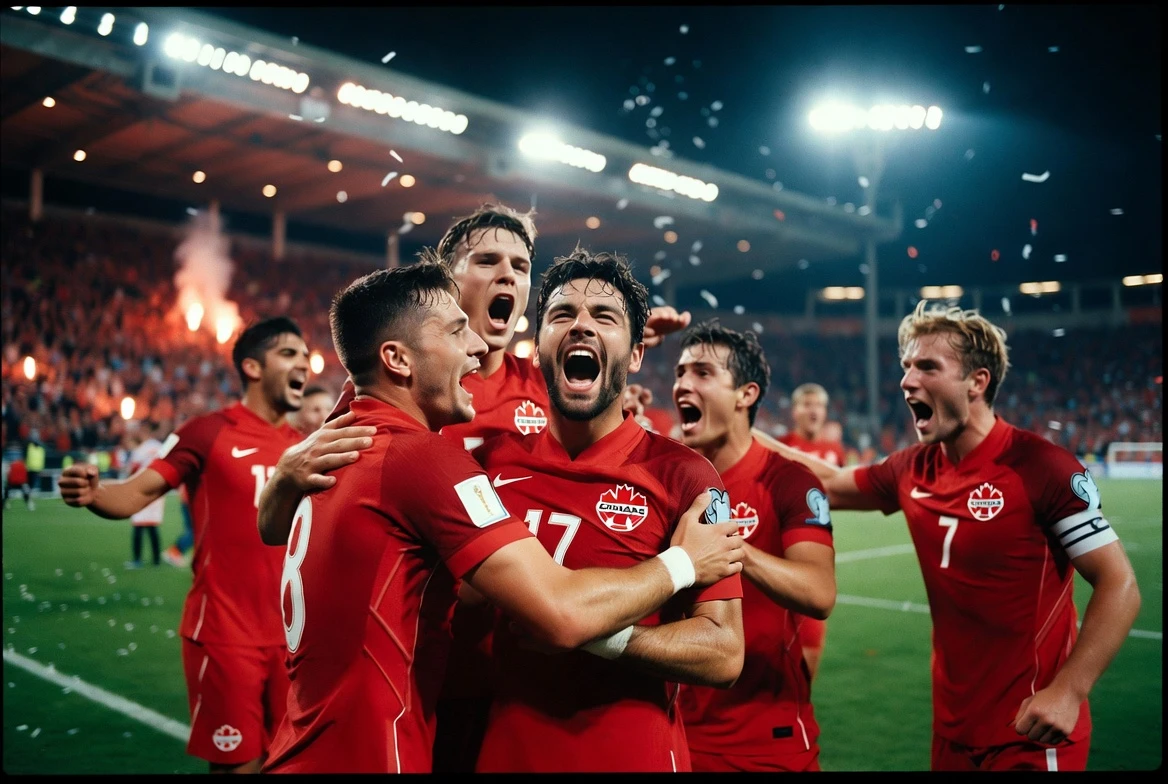
Canada needed a goal. The game went to stoppage time scoreless, with captain Alphonso Davies having entered as a substitute in the 75th minute. Jacob Shaffelburg whipped in a cross from the right side, headed away by a defender, and the rebound fell to Stephen Eustáquio at the edge of the penalty area. His low shot beat South African goalkeeper Ronwen Williams at the corner, and the Canadians had their first men’s World Cup knockout-stage result. Williams had been the only thing keeping South Africa level through 90 minutes plus added time, with about 70,000 fans watching.
‘I felt joy, I felt relief,’ Davies told TSN after the match. His team had won their first men’s knockout match and would now turn full attention to Morocco. In Marsch’s pre-match view of Moroccan confidence, the head coach described Saturday’s opponent as ‘a really talented team that is playing with a ton of confidence’ that ‘winds up being a very difficult team for anyone to play against in international football.’ Morocco sits sixth in FIFA’s world ranking and is the team that beat Belgium and Croatia in 2022 to reach the semi-finals.
- 9 goals for Canada at the 2026 World Cup.
- June 28, 2026: Canada’s first men’s knockout-stage result.
- 6th: Morocco’s position in FIFA’s world ranking going into Saturday.
Frequently Asked Questions
When did Canada first reach a men’s World Cup, and how did they get back?
Canada first reached a men’s World Cup in 1986, in Mexico, and exited in the group stage without a point. The program then went 36 years without qualifying again. Canada returned to the tournament in 2022 in Qatar, lost all three group games, and earned its first men’s knockout-stage result on June 28, 2026. That result came courtesy of Stephen Eustáquio’s stoppage-time goal against South Africa in the round of 32.
Why does Canada’s men’s team have so many dual-nationals?
Canada’s multiculturalism policy dates from October 8, 1971, when Prime Minister Pierre Trudeau told Parliament that no ethnic group should take precedence over any other. That framework, alongside a foreign-born population that reached 23 percent in the 2021 census, has made immigration from Europe, Africa and Asia a defining feature of Canadian life. The dual-national pipeline dates to 2015, when former Canada Soccer president Victor Montagliani convinced Junior Hoilett, then at Queens Park Rangers, to switch from Jamaica. By 2026, 15 of Jesse Marsch’s 26-man squad were born in Canada but eligible for another country.
What was Canada’s lowest FIFA ranking?
Canada fell to 122nd in FIFA’s world rankings in 2014, the lowest mark in men’s program history, two years after the 8-1 loss to Honduras that ended 2014 World Cup qualifying. The ranking was still only 120th in 2017. Three coaches later, the same program finished second in Group B at the 2026 World Cup. Saturday brings the round of 16 against Morocco, the kind of fixture that 122nd-ranked programs do not normally have on the schedule.
When did MLS expand into Canada?
Major League Soccer announced in November 2005 that it would put a team in Toronto; Toronto FC joined the league in 2007 as the first Canadian expansion team. Vancouver Whitecaps and Montreal Impact followed in 2011 and 2012, completing the league’s Canadian footprint. Eleven players on the 2026 World Cup squad spent time at a Canadian MLS academy, and another ten played for an MLS club somewhere in North America.
Who is Stephen Eustáquio, and why does his goal matter?
Stephen Eustáquio is a Canadian midfielder who represented Portugal at youth level before agreeing to switch his international allegiance to Canada. His stoppage-time goal against South Africa on June 28, 2026, gave Canada a 1-0 win in the round of 32. The result was the first men’s knockout-stage victory in Canadian World Cup history, played at Los Angeles Stadium in front of nearly 70,000 fans.