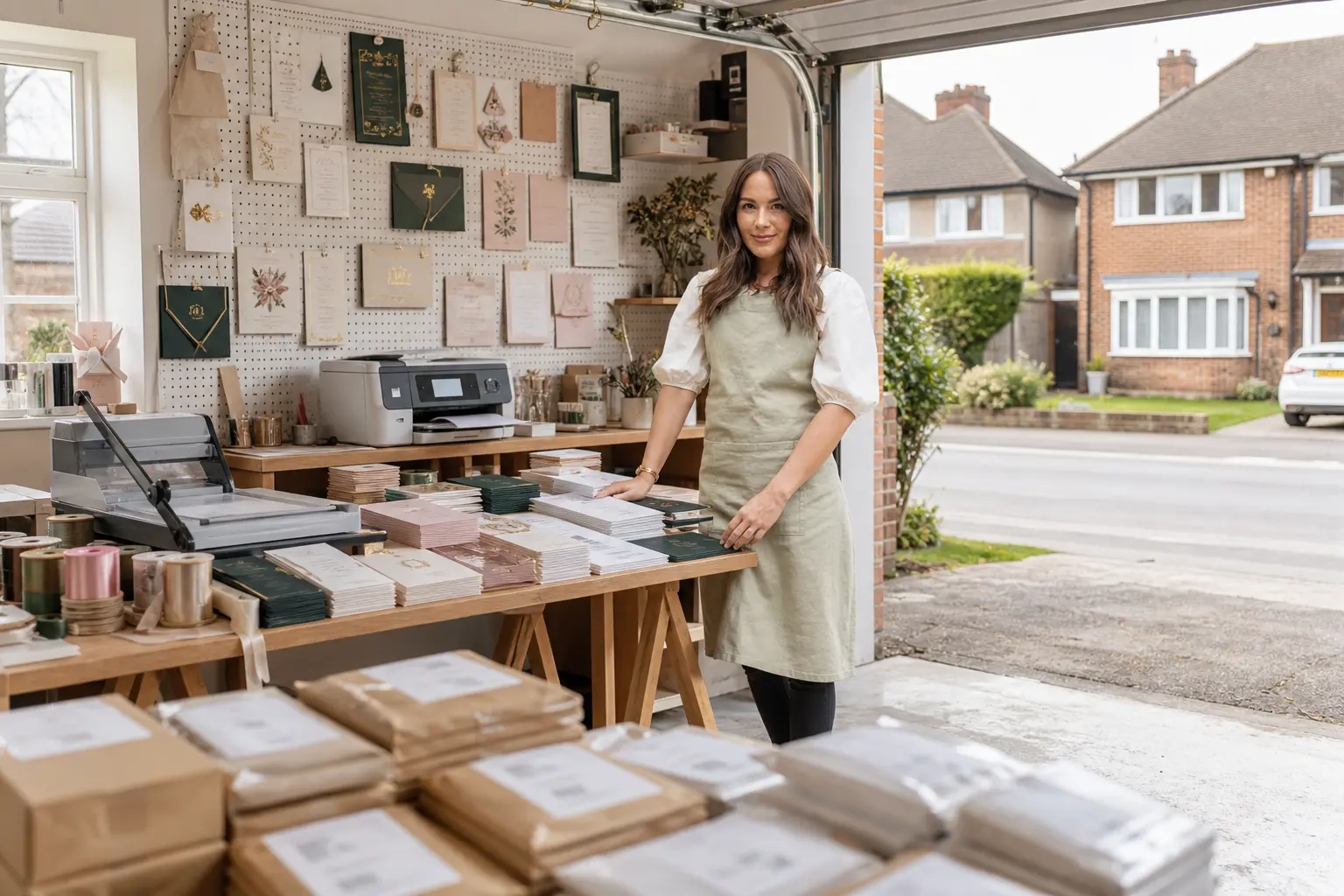
Paige Calland spent four months on furlough from an interior design job in 2020 and came out the other side running a wedding stationery business that hit £100,000 (roughly $134,000) in sales by its second year. Six years later, that garage-based company in Leigh, Greater Manchester, ships to ten countries and employs two part-time staff.
Her decision landed inside a much bigger, largely unremarked-upon moment. The same year Calland was printing wedding invitation samples on a spare-room table, Companies House logged the highest number of business incorporations on record. Most of those companies never made headlines. Neither, until now, has the currency mechanic that has quietly kept orders flowing to home operations like hers ever since.
A Garage in Leigh Joins Britain’s Startup Boom
Calland, 35, told the Manchester Evening News she had been collecting pens, diaries and notebooks since childhood, too precious to write in, just to own them. “All my family have known me to always be just obsessed with paper and drawing,” she said.
She left school with GCSEs in art and graphic design, studied textiles and graphics at college, then moved to London for a textiles degree. A placement at a Yorkshire design company followed, building card and stationery ranges for clients including Marks & Spencer. “I built a huge collection for Marks & Spencer, and it had my name on it on all the back,” she said. “It was all like ‘Designed by Paige.’”
She freelanced, then took a job as a senior designer at an interior design firm, running an Etsy shop called Paige & Co on the side the entire time: cards, prints, the occasional market stall. “Even while I’ve been employed, I’ve still continued to do my own thing on the side,” she said.
A Job-Protection Scheme Ended Up Seeding Companies
The Coronavirus Job Retention Scheme was built to keep people on payroll while businesses were shut or scaled back, not to launch new ones. It ended up doing both. Calland was furloughed from her interior design job for about four months in 2020, and rather than sit still, she spent the time building out the wedding invitation line she had always enjoyed making for family and friends.
She was not unusual in that. A peer-reviewed study in the journal Economic Policy examined business formation across the pandemic and correlated furlough intensity with new business creation, finding solo entrepreneurs played an outsized role, concentrated specifically in online retail, exactly the ground Calland was already standing on with her Etsy shop.
The scale of it is easy to miss inside one mum’s story. Here is what the same period looked like nationally.
- 1.4 million new businesses were registered with Companies House in the sixteen months after the UK’s first lockdown began on 23 March 2020.
- 21.8% jump in company incorporations in the 2020 to 2021 year compared with the year before, a record.
- 1.3 million businesses and 11.6 million jobs were kept afloat by the furlough scheme before it closed on 30 September 2021.
- £100,000 is what Calland’s one-woman operation made in sales by its second year, a rounding error against the national numbers and, for her, life-changing.
Nationally, the furlough scheme supported 1.3 million businesses before ending in 2021, according to the Office for National Statistics. Most of those firms simply reopened. A smaller slice of furloughed workers used the downtime to start something that outlasted the scheme itself.
How Much Does a Weak Pound Help Small Sellers
A weaker pound makes British-made goods cheaper for overseas buyers paying in dollars, which is one reason a home-based wedding stationery shop in Greater Manchester can compete on price with sellers based in the United States. It does not automatically translate into extra profit once import costs and currency risk are factored in.
Calland noticed the American orders almost as soon as she launched, and found it strange given weddings were cancelled or postponed across the board. “Which was strange,” she said. “Because weddings were still cancelled and up in the air, and I didn’t really understand that, but I started getting a lot from America.”
That transatlantic pull has not faded. Sterling has been sliding against the dollar through much of 2026, hovering close to 1.34 against the dollar this month, with the monthly average running nearer 1.32. For a UK-based Etsy seller pricing in pounds, that keeps her invitations looking cheap to a bride in Chicago or Sydney browsing in dollars.
Etsy itself leans on that dynamic. By some seller-analytics estimates, roughly 28% of Etsy sellers now ship internationally, and the platform has increasingly positioned the UK as a cross-border hub since Brexit, both for domestic sales and as a base for shipping into Europe and the US. Wedding stationery and craft goods remain among its steadiest export categories.
The benefit is not one-sided. A survey of 1,000 UK small and medium-sized firms found roughly a quarter had been paid in foreign currency in the past month, and 42% said currency swings had already cost them money this year, mostly through pricier imported materials, ink, paper stock and equipment bought from overseas suppliers. A weak pound that cheapens what Calland sells abroad also raises what she pays for printers and supplies.
Paige & Co, by the Numbers
Calland said the whole process of setting up the dedicated wedding stationery side of the business took a couple of months: pulling designs together, buying printers, building samples, photographing them for the Etsy listing. Orders started arriving almost immediately once the shop went live.
| Period | Milestone | Detail |
|---|---|---|
| 2020, during furlough | Wedding stationery line launched | Built inside roughly four months off work, using an existing Etsy shop, Paige & Co, as the storefront |
| Second year of trading | £100,000 in annual sales | Business crossed six figures while still run from a spare room at home |
| Since launch | 3,500-plus orders, 10 countries | Most orders still arrive through Etsy, with a large share from the US |
| Now | Garage studio, two part-time staff | Business relocated from spare room to a converted garage as volume grew |
Just months after the shop launched, Calland returned from furlough to her old job, pregnant with her first daughter, Pia, now five. She took maternity leave and never went back. “I didn’t really expect that I’ve not had to run around like a headless chicken around the kids to grow this,” she said. “I’ve managed to do it whilst still being able to spend a lot of time with them, which has been amazing.”
Nap Times Are Her Office Hours
Calland now has two daughters, Pia, five, and Dora, one, with her husband Scott. She still works part-time while Dora is young, fitting the business around childcare rather than the other way around. “As soon as she goes down for a nap, the laptop’s out,” she said. “A lot of it’s done during nap times and sleep times.”
Three channels carry the business today:
- Etsy, where most customers, particularly in the US and other overseas markets, still find her.
- Her own Shopify website, run directly rather than through a marketplace.
- Wedding planners, who refer clients straight to Paige & Co outside either platform.
Building a six-figure business on part-time hours is, in her own telling, the part she is proudest of. “It’s been great that I’ve managed to build it to where it’s got with only really working part-time on it myself, so I feel like that’s quite an achievement,” she said.
Self-Employment Fell Even as Startups Surged
The record incorporation numbers sit oddly next to a separate trend. Between January to March 2020 and January to March 2022, the number of people working for themselves in the UK actually fell 14.6% between early 2020 and early 2022, from 3.5 million to 2.9 million, according to the ONS. Traditional sole traders, tradespeople, consultants, contractors, left self-employment in large numbers even as company registrations hit records.
Read together, the two data sets suggest something narrower than a universal entrepreneurship boom: a specific cohort of new, often solo, online-retail founders launched and stuck around, while broader self-employment shrank. Calland’s business fits the narrow group that grew, not the wider group that contracted. Plenty of furlough-era shops never made it past their first Christmas rush; hers kept placing orders long after the scheme that gave her the time to start it had ended.
What Paige Tells the Next Would-Be Founder
Calland is now trying to talk other creative people into taking the same risk she did. “I feel like a lot of creative people still kind of feel like what they do is more of a hobby and a bit on the side,” she said. “But you really can create it into whatever you want. You’ve just got to get out there.”
I didn’t have any investment, I didn’t have a business plan, I didn’t have anything like this, it was just my pencils, my paints, an idea, a few hundred pounds to buy a couple of printers to just have a play around with and buy a bit of stock. That was it.
That was Calland describing how Paige & Co actually started, before it was a garage business with two employees and customers on three continents. Six years after a furlough afternoon gave her the time to try, the pencils and the idea are still doing the work.