Chinese technology and manufacturing firms dominated a four-day industrial exhibition in Phnom Penh that closed Sunday, filling halls with automation lines, robotics and sewing equipment aimed at Cambodia’s factories. More than 200 exhibitors took part, the bulk of them Chinese companies in machinery, textiles, plastics and printing.
The event arrives as official data show 3,357 operational factories employing over 1.35 million workers, more than 70 percent of them women, with total investment near $28 billion.
What Filled the Halls at Koh Pich
Organized by Yorkers Trade & Marketing Service Co. with the Ministry of Industry, Science, Technology and Innovation, the show combined the 10th Cambodia International Machinery Industry Fair, the Cambodia International Textile & Garment Industry Fair and a plastics, rubber, printing and packaging fair. Running August 13 to 16 at the Koh Pich Exhibition and Convention Centre, it gave plant managers direct access to the machines.
three concurrent industrial fairs at Koh Pich drew Chinese suppliers heavily into the core sectors of machinery and automation, textiles and garments, plastics and rubber, and printing and packaging.
| Sector | Main offerings | Origin emphasis |
|---|---|---|
| Machinery & automation | Robotics, production-line systems, smart controls | Heavy Chinese presence |
| Textiles & garments | Sewing, embroidery, button and backstitching machines | Local and Chinese firms |
| Plastics, rubber, printing & packaging | Processing and packaging lines | International with Chinese weight |
Chim Vinly of the organizing staff told Xinhua that most exhibitors came from textile and garment lines and that the annual gathering speeds technology transfer for that sector.
Plant managers could walk from a robotics bay into a sewing demo and then into packaging lines without leaving the centre. That layout matched how Cambodian factories actually buy: one decision on automation often triggers another on finishing and packing. The concentration of Chinese suppliers in every hall made side by side comparison straightforward for buyers short on travel budgets.
The Factory Numbers Driving the Urgency
Ministry figures released with the opening put Cambodia’s industrial base in clear focus. As of the end of July 2026 the kingdom counted 3,357 registered operating factories. They employ more than 1.35 million people. Women fill over 70 percent of those roles.
- $28.08 billion total factory investment, up more than 29 percent from the same point in 2025
- $9.8 billion industrial production value in the first half of 2026
- $7.3 billion of that production destined for export
The jump in capital and output sits behind the minister’s call for faster adoption. Investment has also begun spreading into automotive parts, food processing, electronics, chemicals and furniture, yet garments still dominate employment and export value.
| Metric | Figure | Change / note |
|---|---|---|
| Operational factories | 3,357 | As of end-July 2026 |
| Workers | Over 1.35 million | More than 70% women |
| Factory investment | ~$28 billion | +29% year-on-year |
| H1 2026 industrial production | Over $9.8 billion | ~$7.3 billion for export |
These numbers explain why buyers walked the aisles looking for machines that cut labor time and waste.
Export share of first half output already tops three quarters. Any gain in pieces per hour or drop in scrap therefore feeds foreign orders first. That is why the capital jump of more than 29 percent and the search for automation arrived in the same season.
Why Chinese Equipment Arrives Ready to Sell
Chinese firms showcased cutting-edge machinery at a moment when Cambodian plants need higher output per hour and fewer defects. Bilateral trade has already shifted. Cooperation once centered on fabrics and finished goods now includes capital equipment and know-how.
Thong Mengdavid, deputy director at the China-ASEAN Studies Centre of the Cambodia University of Technology and Science, described the change as technological cross-pollination. Integrating Chinese machinery, he said, addresses output per hour, material waste from human error, and workforce skill development.
- Higher pieces completed each hour on automated lines
- Lower scrap rates when sensors replace pure manual judgment
- On-site exposure that trains Cambodian mechanics and operators
- Direct evaluation of machines before purchase orders
Bo Seyma, a mechanic with Kosin Sewing Machine Co., which supplies equipment from Shanghai-based Shang Gong Group, reported strong local demand for embroidery and automated sewing units. Factories are already placing orders. The machines, he said, accelerate efficiency while meeting buyer specifications for quality and speed.
Ready stock and familiar service networks lower the risk for a mid sized plant writing its first large equipment cheque. Buyers could test stitch quality and line speed on the spot rather than rely on brochures alone. That hands on path shortens the gap between interest and a signed order.
A Workforce That Is Mostly Women Faces the Machines
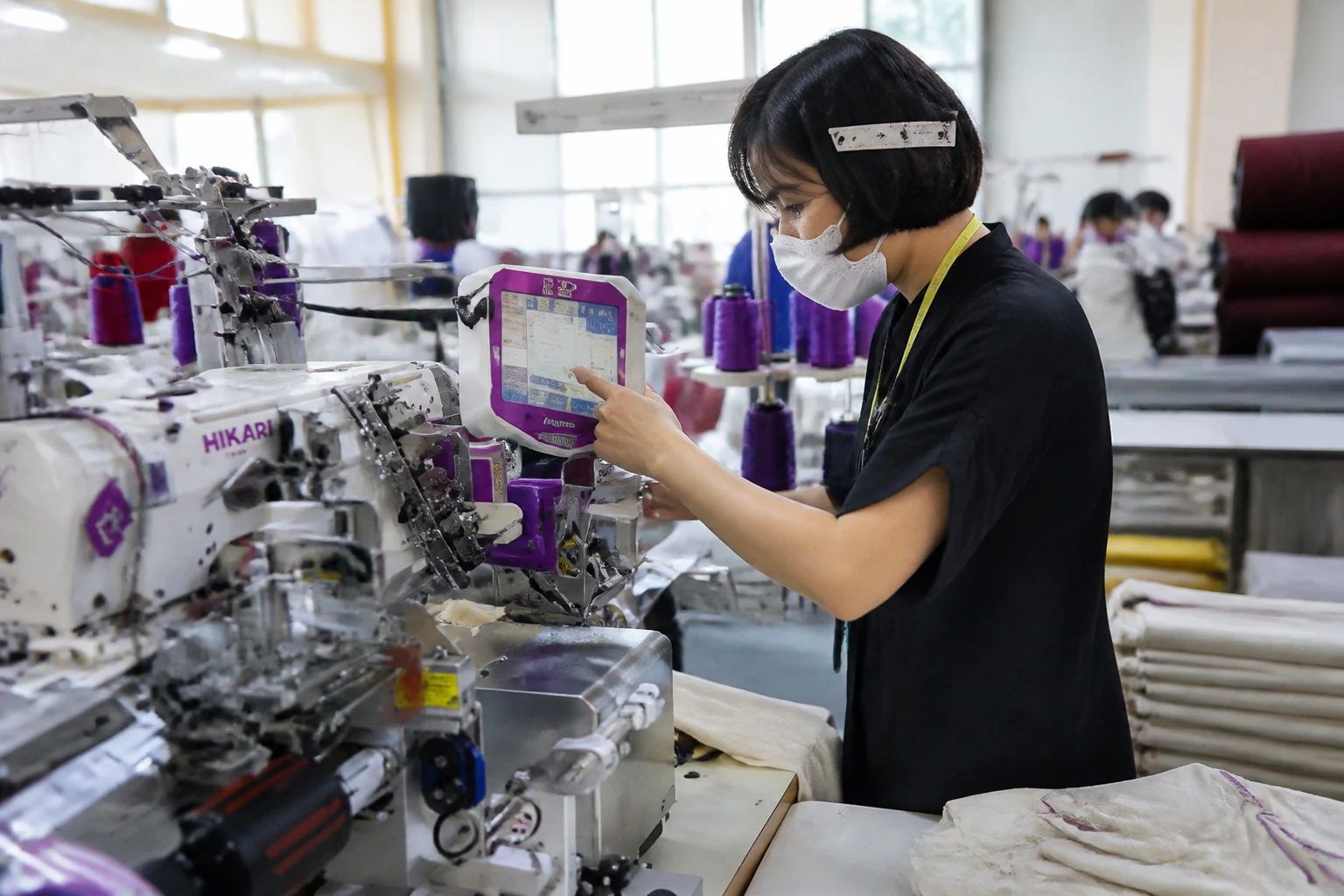
More than 70 percent of the 1.35 million factory workers are women, concentrated in garments. Automation promises to protect competitiveness against rising wages and regional rivals, yet it also rewrites daily tasks. Sewing stations that once required teams of operators can run with fewer people monitoring screens and feeds.
Crowd observations on X and factory floor reports already note that Chinese-owned or Chinese-managed plants are common enough that translators for Chinese often matter more than Khmer fluency for technical work. The thinner development ladder facing garment exporters in Cambodia, Bangladesh and Vietnam means assembly jobs arrived without the full upstream industries earlier Asian industrializers built. Adding Chinese capital goods deepens that pattern: productivity rises, but the core technology and spare-parts supply stay external.
Skill development is the stated upside. Operators who master the new lines gain higher value roles. Those who do not face fewer openings on the floor. The expo itself offered little direct training programming for the existing workforce; the focus stayed on hardware sales and partnership matches.
For a workforce this heavily female and this concentrated in garments, the shift is immediate and personal. Monitoring a feed or clearing a sensor fault is a different day from continuous manual sewing. Plants that pair new machines with clear internal training will keep more of their experienced staff. Plants that treat the purchase as hardware only will see the gap widen between those who adapt and those who do not.
How the Relationship Moves Past Raw Materials
Mengdavid framed the evolution clearly: Cambodia once supplied materials and simple finished goods; now it absorbs Chinese tools and standards. Chinese investment already accounts for a large share of factory capital. Trade volumes keep climbing, with two-way figures in recent periods measured in the low double-digit billions of dollars and Chinese machinery forming a rising slice of imports.
That flow sits alongside China’s domestic push for tech self-reliance. Beijing wants its own firms less dependent on foreign chips and tools at home while those same firms export mature automation and sewing systems to Southeast Asia. Cambodia becomes both a production base and a customer for the next tier of Chinese industrial goods.
Local financing channels matter for the purchases. Broader support for Cambodia’s banking growth can ease credit for mid-sized factories that want to buy the equipment without full foreign ownership. Yet the machines themselves, software updates and specialized parts will keep flowing from Chinese makers for years after the first invoice.
Diversification Grows While Garments Still Lead
Ministry data already list automotive parts, food processing, electronics, chemicals and furniture among sectors drawing fresh capital. Those lines matter for the long map of industrial depth. They do not yet rewrite the employment or export arithmetic that garments still control.
The expo’s exhibitor mix reflected that balance. Textile and garment machinery drew the bulk of stands, according to organizing staff, while automation and plastics filled supporting halls. Buyers from newer sectors could still find robotics and packaging systems, but the order books Bo Seyma described centered on embroidery and automated sewing.
- Garments: still the core of jobs and export value across the 3,357 factories
- Newer sectors: automotive parts, food processing, electronics, chemicals, furniture
- Expo weight: most exhibitors in textile and garment lines, with heavy Chinese machinery presence overall
Capital can spread faster than payroll. Investment near $28 billion and rising does not automatically move the majority female workforce out of sewing halls. Until electronics or food plants hire at garment scale, the machines that matter most for social impact remain the ones that stitch, embroider and finish cloth.
What Changes Once the Machines Leave the Hall
Industry, Science, Technology and Innovation Minister Hem Vanndy opened the show with a direct warning.
Artificial intelligence, production-line automation, robotics, digital technologies and smart manufacturing are increasingly determining the competitiveness of nations. Cambodia cannot remain outside this transformation. We must embrace new technologies to increase productivity, reduce costs, improve product quality and strengthen the competitiveness of our enterprises.
Vanndy spoke on Thursday at the ceremony. He also stressed that government alone cannot build the next industrial base; private firms, investors, research bodies and partners must share the load. Diversification into auto parts, electronics and food processing is already under way, but garments still set the employment rhythm.
On the floor the immediate shift is practical. Shang Gong Group industrial sewing brands and similar lines replace older mechanical units. Output per shift rises. Defect rates fall. Export orders that demand consistent quality become easier to fill. The second-order effects arrive later: spare-parts contracts, software licenses, technician training packages and the quiet standardization of Chinese interfaces across Cambodian plants.
- August 13, 2026, Three industrial fairs open at Koh Pich with minister’s call for AI, robotics and smart manufacturing.
- August 13-16, 2026, More than 200 exhibitors, heavy Chinese presence in automation and garments, order books open for sewing and embroidery lines.
- End-July 2026 baseline, 3,357 factories, $28 billion investment, 1.35 million workers already in place as the upgrade cycle begins.
- First half 2026, $9.8 billion industrial output, $7.3 billion exported, the numbers the new machines must protect and grow.
Factories that buy now will show faster lines within months. Those that wait face competitors with lower unit costs and cleaner quality records. The women who form the majority of the workforce will either move up into monitoring and maintenance roles or watch the headcount on traditional stations shrink. Chinese equipment makers leave Phnom Penh with fresh orders and a larger installed base that will need their support for the next decade.
Why After Sales Ties Outlast the Four Day Fair
Once a line is installed, the relationship shifts from sales pitch to parts, software and technician visits. Shang Gong and similar suppliers already have local channels such as Kosin Sewing Machine Co. Those channels become the daily face of machines bought in a hurry at Koh Pich.
Chinese interfaces and spare parts standards then spread plant by plant. A mechanic trained on one brand can move more easily to another factory running the same systems. That convenience also locks in future orders for the original makers. Trade that once moved fabrics and finished goods now moves service contracts and updates for years after the invoice.
| Stage | What moves | Who holds the link |
|---|---|---|
| At the fair | Demos, price talks, first orders | Exhibitors and factory buyers |
| Install and ramp | Line setup, operator exposure | Local agents and plant mechanics |
| Years after | Parts, software, training packages | Chinese makers via regional supply |
Banking support can help mid sized firms fund the first purchase without surrendering ownership. It does not replace the external flow of specialized components. Cambodia gains speed and cleaner quality records; it also lengthens the tether Vanndy’s competitiveness agenda must manage.
The expo closed with machines sold and contacts exchanged. Cambodia’s factories now carry both higher potential output and a longer tether to the suppliers who built the lines.