
BUSINESS
Ming Foods Administration Leaves Kitchens Without Their Pancake Supplier
Ming Foods, the Kent crispy duck pancake maker, has been in administration since 24 June 2026. Creditors deemed the proposals approved on 9 September.

Ming Foods Limited, the Kent Chinese pancake maker, has been in administration since 24 June 2026. Creditors then let the administrator’s proposals stand on 9 September 2026, with no public buyer named.
The limited company is 22 years old. The pancake recipe is older. The people waiting on the next box are not in Glasgow, where the court file points; they are in Chinese wholesale depots and ready-meal plants that already treated those pancakes as a standard line.
Creditors Have Now Signed Off the Proposals
Steven Wright of Dains, IP number 24534, was appointed administrator on 24 June 2026. The High Court of Justice, Business and Property Courts in Leeds, listed the case as 2026-LDS-000673. The appointment notice dated 2 July 2026 put the trading address at Upper Hockenden Farm, Maidstone Road, Swanley, Kent, BR8 7QH, and named Chris Shades on 0141 535 3133 as the contact.
THE COURT FILE
- Appointment: Wright of Dains, 169 West George Street, Glasgow G2 2LB, took office on 24 June 2026.
- Office move: The registered office moved on 6 July 2026 to 2 Chamberlain Square, Birmingham B3 3AX.
- Affairs paper: A 13-page statement of affairs was filed on 23 August 2026.
- Creditor vote: Notice of deemed approval of the proposals was filed on 9 September 2026.
Deemed approval means creditors did not force a different plan. It does not say whether the Swanley line is still packing pancakes, whether jobs transferred, or whether a buyer has the brand. Those answers sit inside filings that have not been published as a sale notice.
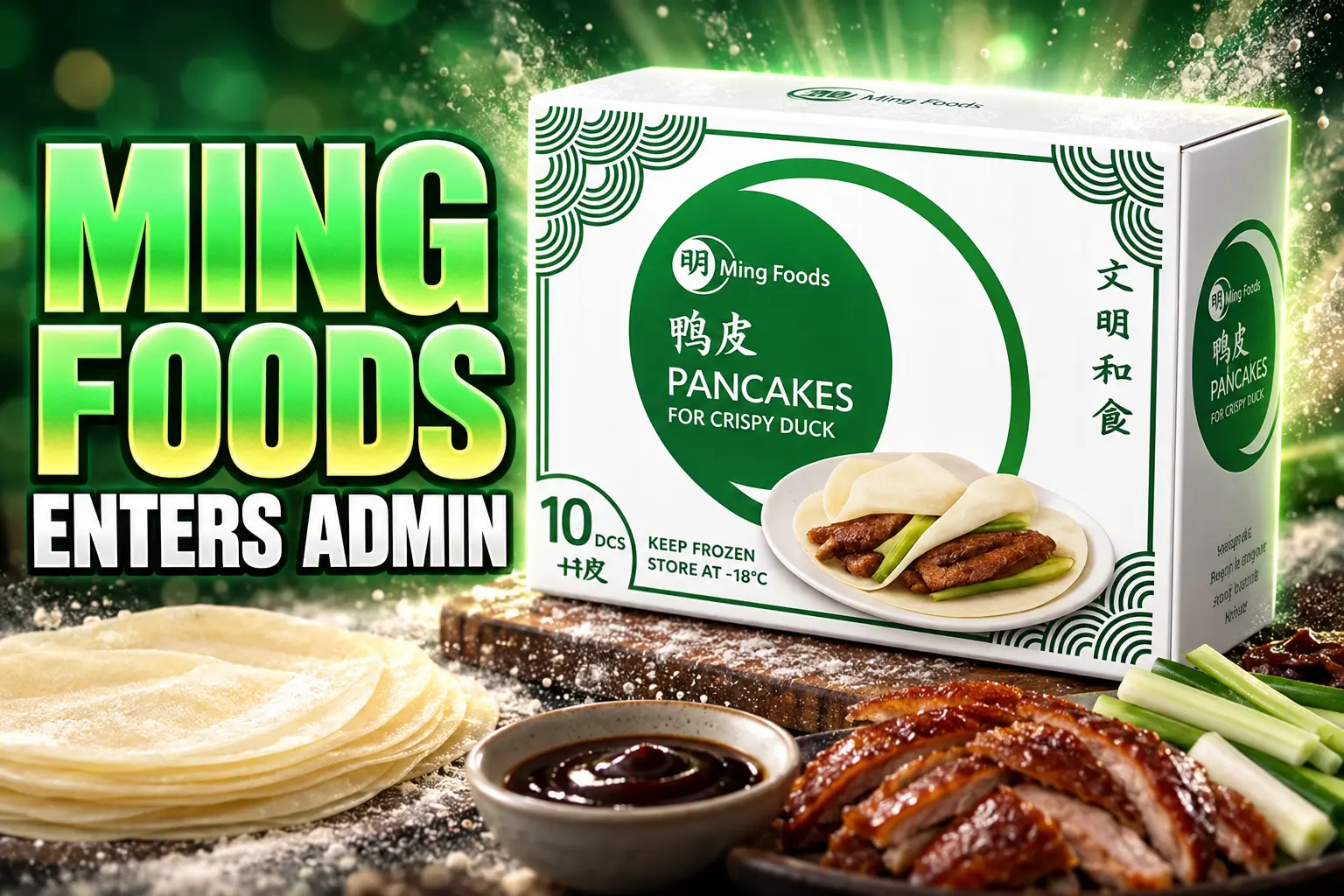
The Kitchens That Relied on Ming Pancakes
Ming Foods sold itself as Britain’s leading Chinese pastry specialist. It made crispy duck pancakes and other thin pastry in Kent, and it had a partner in Asia for spring roll wrappers. The company’s own distribution page says it supplies wholesalers and supermarket ready-meal makers across the UK and the EU, plus oriental wholesalers who then feed restaurants.
That channel is the part a Gazette notice never names. Wai Yee Hong, the Chinese supermarket group, said it had sold Ming products for over six years to both shoppers and caterers. Chi Yip Food Group said it used the pancakes with its Medal Crispy Aromatic Duck. Jeremy Pang, who runs the School of Wok cookery school, put the pastry on his dim sum bench.
The products from Ming Foods are absolutely first class. The spring roll pastry and duck pancakes are by far the best quality on the market as they really hold well. We have also been using their new double action self raising flour for all types of dim sum and steamed buns.
Jeremy Pang, School of Wok, Ming Foods distribution page
Pang’s line about pancakes that “hold well” is the practical stake. A wrapping that splits in a busy fryer is not a branding problem. It is a wasted portion and a queue. Chi Yip’s Medal duck line and Wai Yee Hong’s retail packs sit in the same place: they bought a specialist SKU, not a generic flour tortilla.
WHO BOUGHT THE PANCAKES
| Buyer | What they used | How they described it |
|---|---|---|
| Wai Yee Hong | Retail and catering packs | Sold Ming lines for over 6 years with no quality complaints |
| Chi Yip Food Group | Pancakes with Medal Crispy Aromatic Duck | Called the pancakes delicious and a regular pairing |
| School of Wok | Spring roll pastry, duck pancakes, flour for bao | Pang said the pastry holds and the flour helps Char Siu Bao rise |
| Gary Cheung | Product range | Praised service, range and taste |
Wing Yip, another oriental grocer, put Ming pancakes on a Croydon tasting table as far back as 2015. The pancakes were already a shop-floor item, not a niche mail-order brand. Private-label pastry for other factories sat on the same list, which means a silent supermarket ready-meal spec could be looking for a new sheet as well.
WHAT LEFT THE SWANLEY LINE
- Duck pancakes: Peking and crispy duck pancakes made in the UK, sold in 6-packs and 10-packs into wholesale boxes of about 1,000 pancakes.
- Spring roll wrappers: Made in Asia by a partner selected by Ming, then sold on with the Kent pancakes.
- Flour and bao: Double-strength self-raising flour for dim sum and steamed buns, plus later apple rolls and bao buns.
- Own-label pastry: Bespoke thin pastry for other manufacturers and restaurant owners.
The factory’s own staff note said many workers spoke English, Cantonese, Vietnamese and Mandarin. A company-data listing put headcount at 14 on 31 July 2026, a month after the appointment. LinkedIn still banded the firm at 11 to 50 people. In 2016 the same site had been described as a 28-strong workforce. The floor had already thinned before Wright’s name went on the court file.
A Year After the Founder Left the Register
Van Minh Duong, a director from the 9 March 2004 incorporation, ceased to be a person with significant control on 25 June 2025 and left the board on 14 July 2025. Sam Duong, director and company secretary since incorporation, remained. The public record then got noisier in a hurry.
THE YEAR ON THE COURT AND COMPANY FILE
- 11 June 2025: Charge 050673430019 is registered.
- 25 June 2025: Van Minh Duong ceases as a person with significant control.
- 14 July 2025: Van Minh Duong is removed as a director.
- 21 May 2026: Charge 050673430020 is created, then registered on 28 May 2026.
- 2 June 2026: Charge 050673430015 is satisfied in full.
- 10 June 2026: Anthony John Baker is appointed a director.
- 16 June 2026: Baker’s appointment is terminated, six days after it began.
- 24 June 2026: Steven Wright is appointed administrator.
- 6 July 2026: The registered office moves to Dains’ Birmingham address.
- 9 September 2026: Creditors are treated as having approved the proposals.
Baker’s six-day seat sits between a new charge, a satisfied charge, and the administration order. The filing history does not explain why he was appointed. It only shows he was gone before Wright took control. A petition to wind the company up was also advertised in early July 2026, after the administration had already begun, which is the usual collision when a creditor has already gone to court and an administrator then steps in.
How a Home Pasta Sheeter Became a Kent Factory
The company’s origin story is still on its site. In 1984 Mr and Mrs Minh started making crispy duck pancakes in their home kitchen with a pasta sheeter and a rolling pin. Mrs Minh, the same account says, completed deliveries into London’s Chinatown on the day her son was born in 1985. By 1988 they had opened Viet Hing, a Vietnamese and Chinese restaurant, and put seven pancake-makers upstairs.
In 2002 they met Sam Duong. Ming Foods Limited was incorporated on 9 March 2004, company number 05067343, and in 2005 the Minhs and Duong opened a plant in Erith, Kent. The registered office later moved, on 10 June 2014, from Unit 4 Manor Park, Turpin Lane, Erith, DA8 2AT, to the Swanley farm. A 2023 finance note put that Swanley building at 30,000 sq ft, after an earlier 4,000 sq ft site.
The pitch was tradition plus kit. A pasta roller adapted for pancakes stayed in the lore. The site claimed BRC Global Standards certification. Products were sold as clean-label British ingredients with no artificial flavours or preservatives, and as usable in vegetarian recipes. Exports were described as reaching the United States and Australia, with customers from Las Vegas to Cyprus named in a 2016 funding interview.
That is a long way from a home kitchen. It is also why a quiet administration in Swanley is not only a local jobs file. Thin pastry for crispy duck is a small category. When one specialist stops, the next box has to come from another mill, another importer, or a kitchen rolling dough at 5pm.
Invoice Finance, New Charges, Then the Court
Cash has been the constraint before. In 2012 a funding facility was pulled, and Duong later said the business spent years thinking about survival rather than growth. In 2015 Ming Foods took invoice finance from Bibby Financial Services. By December 2016 Duong was describing a line that turned out 3 million pancakes a week, about 1,500 tonnes of product a year, on turnover of £2.2 million, up from £1 million in 2008.
In the past, it was tough to raise the capital we needed to grow the business and realise the potential that we believe it has. However, both funding and expertise from BFS have relieved the cashflow pressure we faced and has allowed us to think about growth and innovation rather than survival.
Sam Duong, chief executive, Ming Foods, 2016 funding interview
The same year he talked about almost £4 million of investment in the Swanley plant, with £1.4 million already in and a further £2 million earmarked for flour silos and other kit. Capacity, he said, would rise from 3 million pancakes a week to 6 million, with dumplings and spring rolls on the same floor, and talks with large retailers. Those 2015 targets were his plan, not a later audited result.
In October 2023 the company took a £350,000 invoice finance facility from Optimum Finance. The announcement that came with that facility said Ming had made something in the order of two billion pancakes in the previous ten years, and that it also made apple rolls and bao buns. Invoice finance pays a firm against unpaid customer bills. It keeps a packing line moving when supermarket and wholesale terms stretch. It also means a lender is sitting on the receivables when the court file opens.
The last public accounts on the Companies House overview are accounts made up to 31 August 2024, filed on 27 August 2025. The next set, for the year to 31 August 2025, was due by 31 May 2026 and was not on the file when Wright was appointed. The 35-page administrator’s proposal from 28 August is the first long document after that gap. Its text is not in the public HTML extract, so the dividend estimate, the trading decision and any proposed sale remain inside that PDF.
What the 35-Page Proposal Still Leaves Open
Other UK bakeries hit the same cost wall in 2026. Coughlans, a south-London and Surrey shop group founded in 1937, ceased trading on 1 July 2026, made more than 170 staff redundant, then sold most shops out of liquidation in August. State Fayre, a Manchester kosher bakery, went into creditors’ voluntary liquidation the same summer after energy bills and wage costs rose, then sold to a director-backed buyer who kept 25 jobs. Ming is not a high-street bun shop. It is a specialist pastry plant. The same input prices still sit on its invoices.
WHAT WE KNOW
- The order: Wright has been in office since 24 June 2026 and the proposals were deemed approved on 9 September 2026.
- The site: Trading was listed at Upper Hockenden Farm, Swanley; the legal office is now in Birmingham.
- The customers: Named wholesale and cookery-school users already treated Ming pancakes as a regular SKU.
- The board: Van Minh Duong left in 2025; Baker lasted from 10 to 16 June 2026; Sam Duong was the continuing director on the older officer list.
WHAT IS UNCONFIRMED
- A going-concern sale: No public notice of a buyer, a pre-pack, or a shutdown of the Swanley line has been filed as a Gazette sale notice.
- Jobs: Headcount was listed at 14 on 31 July 2026; TUPE transfers, if any, have not been announced.
- Creditor returns: The 13-page statement of affairs is on the register, but its asset and liability totals are not in the HTML extract.
- Who supplies the next pancake: Wai Yee Hong, Chi Yip and private-label meal factories have not said which mill they will use instead.
The pasta sheeter that started in a home kitchen in 1984 is now a court asset in a 35-page plan that creditors have already let through. Until Wright files a sale or a move to liquidation, the kitchens that called those pancakes first class are working off remaining stock and whoever else can roll a sheet that holds.

Saquon Barkley’s Hamstring Leaves the Eagles Thin in London

The Online US Passport Still Needs a Witnessed Oath

Ken Urker Died on His Birthday With No Cause Named

FOX Ices Portnoy After Ohio State’s Access Fight

Micron’s Record Memory Profits Lock RAM Tight Through 2028

Musk’s $914 Billion Lead Is a Public SpaceX Bet

Microsoft’s 96% Cyber Score Sits at 86.3% on the Board

Free Live Sports Streaming in 2026: What to Watch Without Cable

Endgame Encore’s $86 Million Trial for Infinity Vision

The Odyssey’s IMAX Film Run Hit a 41-Theater Limit
-
 BUSINESS4 months ago
Musk’s $914 Billion Lead Is a Public SpaceX Bet
-
 NEWS2 months ago
Microsoft’s 96% Cyber Score Sits at 86.3% on the Board
-
 SPORTS3 months ago
Free Live Sports Streaming in 2026: What to Watch Without Cable
-

 ENTERTAINMENT4 weeks ago
Sterling Point Holds No. 2 on Prime Video After 32 Days
-
 ENTERTAINMENT3 months ago
The Odyssey’s IMAX Film Run Hit a 41-Theater Limit
-
 ENTERTAINMENT3 months ago
Endgame Encore’s $86 Million Trial for Infinity Vision
-

 ENTERTAINMENT2 years ago
Andrew Garfield’s Spider-Man Films Are No Longer Free
-

 NEWS4 weeks ago
G20 Cheers AI Investment After Bailey’s Frontier Cyber Warning