The Bridge on the River Kwai still scores 96% on Rotten Tomatoes nearly seven decades after release, and it remains one of the most decorated war films ever made, with seven Academy Awards and a permanent place on the British Film Institute’s roll of great British cinema. It is also, by the testimony of the men who lived the events behind it, one of the most beautiful distortions Hollywood ever put on screen.
David Lean built a near-flawless picture out of a labour camp on Thailand’s Death Railway. The real prisoners who built the real bridge spent the rest of their lives explaining that almost none of it happened the way cinema audiences cheered.
A 1957 War Drama That Still Scores 96%
Few films from the black-and-white era grip a modern audience the way this one does. David Lean, the British director later celebrated for Lawrence of Arabia and Brief Encounter, turned French novelist Pierre Boulle’s book into a sweeping study of pride, duty and obsession inside a Japanese prison camp. Critics agreed on its quality then, and the verdict has barely moved since.
The headline numbers explain why it keeps getting recommended:
- 96% critic score on Rotten Tomatoes, a rare consensus for a film this old.
- Seven Academy Awards from eight nominations, including Best Picture, Best Director and Best Actor.
- $18 million in estimated box office, the highest-grossing release of its year in the United States and Columbia’s biggest earner at the time.
- 11th place on the British Film Institute’s list of the 100 best British films of the 20th century.
At the centre sits Alec Guinness as Lieutenant Colonel Nicholson, the captured British officer who decides his men will build their captors a bridge worthy of the British Army. The role won Guinness the Best Actor Oscar and made him an international name, and you can still pull up the film’s full box-office tally to see how far ahead of the field it finished. It belongs to a small club of war pictures critics keep re-ranking, even as the genre’s modern benchmark shifts and newer titles join the conversation about the war films that have reshaped the canon.
The Last Twenty Minutes That Critics Keep Quoting
Ask a fan why the film endures and the answer almost always lands on the ending. For most of the running time the camp doctor, played by James Donald, watches Nicholson pour everything into a perfect timber span. The colonel wants a structure that will outlast the war and prove that captured British soldiers never lost their discipline. He stops his own men from sabotaging it.
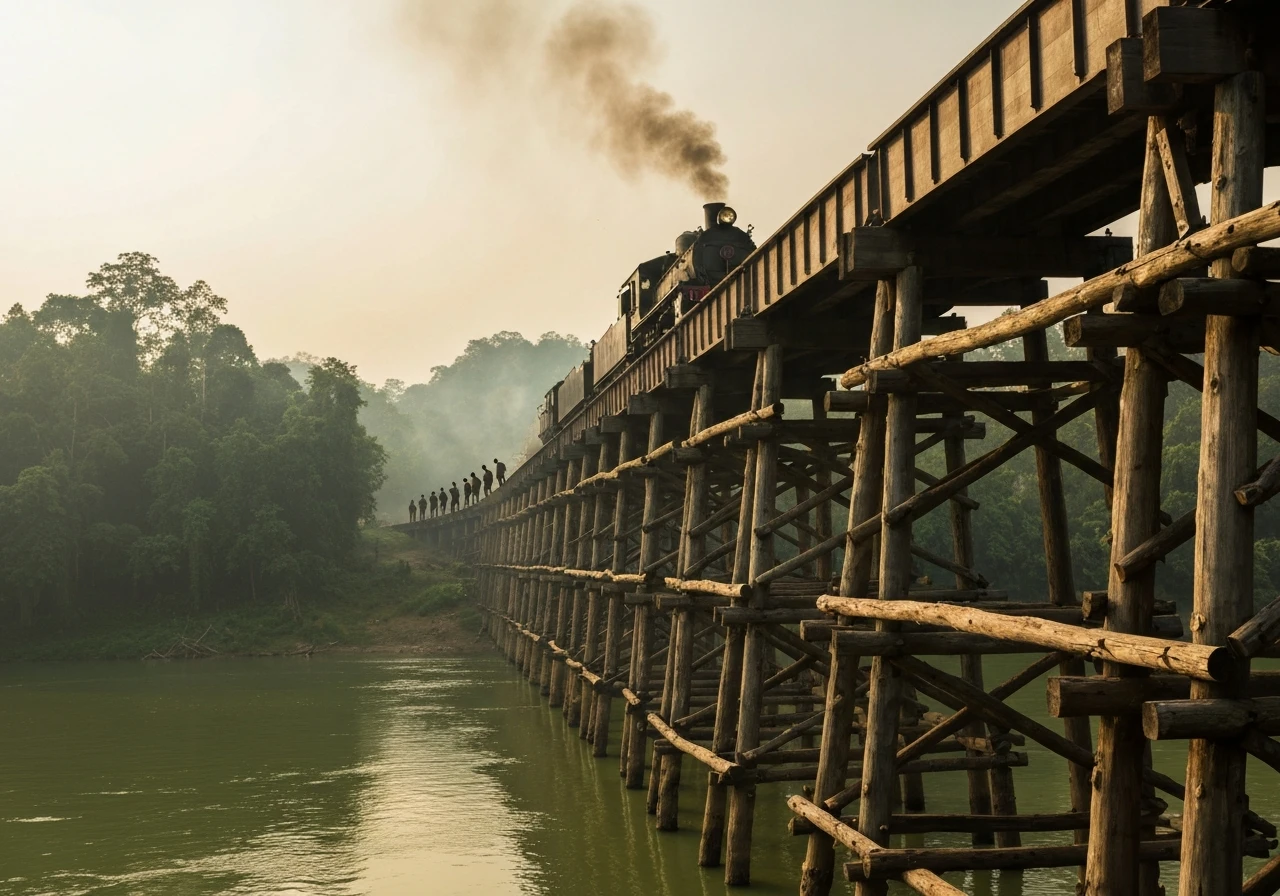
Then the commando team arrives to blow the bridge up, and Nicholson, in a final confused instant, nearly saves the very thing he should want destroyed. He falls onto the detonator as he dies. The bridge goes down. The train plunges into the river.
Donald’s character surveys the wreckage and the corpses and says the word the whole film has been building toward: “Madness. Madness.” One reviewer on Rotten Tomatoes called it “one of the greatest and most satisfying endings in all film history,” and the sentiment is everywhere in the modern fan reaction.
That closing irony, a brave man undone by his own pride, is what lifts the picture above standard wartime adventure. It is also where the film quietly parts company with the history it borrowed.
The Death Railway the Film Left off Screen
The bridge in the title was one small piece of the Burma to Siam railway, a 415-kilometre line the Japanese drove through jungle in 1942 and 1943 to supply their forces in Burma. Allied prisoners and conscripted Asian labourers built it under conditions the film only gestures at. Historians later named it the Death Railway for good reason.
- Around 13,000 prisoners of war died during construction and were buried along the track.
- An estimated 80,000 to 100,000 Asian civilian labourers also died on the project.
- The real bridge stood at Tamarkan, near Kanchanaburi, and crossed the Mae Klong river, not a river called the Kwai.
- So many tourists arrived looking for “the bridge on the river Kwai” that authorities renamed that stretch of water Khwae Yai in the 1960s to match the film.
Lean shot in Sri Lanka, then Ceylon, with a built bridge and a real locomotive, and the result is gorgeous. What it is not is a record of what a prisoner on that railway actually endured. The starvation, cholera and beatings that filled the work camps are softened into a backdrop for a battle of wills between two officers.
Philip Toosey Was No Collaborator
The senior British officer at the Tamarkan camp was Lieutenant Colonel Philip Toosey, and he is widely accepted as the closest real-world model for Nicholson. The two men have almost nothing in common beyond a uniform and a bridge.
Toosey did not chase a monument to British discipline. He negotiated relentlessly to protect his men, and behind his captors’ backs he did everything he could to wreck the work without getting prisoners killed. His men gathered termites by the thousand to eat the timber, and they mixed the concrete badly so it would crumble. Where the fictional colonel forbids sabotage, the real one organised it.
The contrast between the script and the record is stark enough to lay out plainly.
| Detail | Colonel Nicholson (film) | Lt Col Philip Toosey (real) |
|---|---|---|
| The bridge | Builds it to perfection to display British pride | Worked to delay and weaken it |
| Sabotage | Forbids it and protects the structure | Organised termites in the timber and deliberately poor concrete |
| Captors | Cooperates to the point of collaboration | Negotiated hard to shield his men, never collaborated |
| Fate | Dies falling onto the detonator | Survived the war, was honoured, and became a respected banker |
Toosey’s surviving men were blunt about it. The character who hands a working bridge to the enemy, they said, was the opposite of the commander they followed. That gap is the heart of the whole argument over the film.
The War Office Tried to Stop It
Letters held at the British government’s records office show that officials saw the problem coming. The correspondence about the script, preserved in the War Office file on the film at The National Archives, records a department that wanted no part of it.
Major A G Close of the War Office public relations branch, who had spent three and a half years on the railway himself, wrote that the story “is quite untrue and only very occasionally resembles the facts as they were at the time,” and warned it “would not go down well with the British public.” Former prisoners were angrier still. Lieutenant General Arthur Percival, the British commander who surrendered Singapore in 1942 and later chaired the Far East Prisoners of War (FEPOW) federation, put the objection in writing.
Our members are as a body justifiably proud of their conduct as prisoners-of-war. They suffered a great deal for it and they would now deeply resent the presentation of any film which tended to misrepresent and cast aspersions on their conduct.
The veterans and the War Office pushed for a clear disclaimer stating the film was fiction. Producer Sam Spiegel resisted a long version, and because he had moved the shoot abroad he no longer needed any official help, which left the objectors with no leverage. A short notice about the film’s invented nature ran at London screenings, but not everywhere the picture played.
The Oscar Went to a Man Who Could Not Read the Script
The film’s credits hid a second distortion, this one about who actually wrote it. Pierre Boulle was named as the screenwriter and collected the Best Adapted Screenplay Oscar, even though he did not speak English well enough to have written the dialogue.
The real work was done by Carl Foreman and Michael Wilson, two American writers driven into exile in Britain by the Hollywood blacklist. Neither could be credited at the time without sinking the film, so Boulle, who wrote the source novel, took the public bow. The Academy only set the record straight in 1984, restoring the award to Foreman and Wilson, both by then dead, and later prints carry their names.
So a story about honour and credit was itself built on borrowed credit. For a picture whose theme is the cost of pretending, the irony is hard to miss.
Where to Watch and Why It Endures
The film is easy to find. It is available to rent on Amazon Prime Video and Apple TV, and through the Sky Store, so a first viewing or a rewatch is a couple of clicks away. None of the controversy has dimmed its reputation as a piece of filmmaking, and its standing among British classics sits alongside the affection fans hold for another title often called “the best film ever,” the kind of love documented in coverage of the village where The Railway Children was shot.
Watched as drama, it deserves the praise: the performances, Malcolm Arnold’s score with its whistled march, the bridge climbing over the river in a single sweep. Watched as history, it asks for a footnote that took the survivors, the War Office and four decades to attach.
Put it on for Guinness, for the whistle, for the explosion that ends it. Then read what the men who built the real bridge spent their lives trying to say.
Frequently Asked Questions
Is The Bridge on the River Kwai based on a true story?
Loosely. It is adapted from Pierre Boulle’s novel and uses the real construction of the Burma to Siam railway in 1942 and 1943 as its setting, but the central plot and the character of Colonel Nicholson are invented. The War Office and former prisoners objected at the time that it misrepresented how British officers actually behaved in the camps.
Did Colonel Nicholson exist in real life?
No. The closest real figure was Lieutenant Colonel Philip Toosey, the senior British officer at the Tamarkan camp, but he was nothing like Nicholson. Toosey worked to sabotage and delay the bridge rather than build a perfect one, and his men rejected the idea that their commander collaborated with their captors.
How many people died building the Burma Railway?
Around 13,000 prisoners of war died during construction, and an estimated 80,000 to 100,000 conscripted Asian civilian labourers also died. The scale of suffering earned the line its nickname, the Death Railway, which the film only lightly touches on.
Who really wrote the screenplay?
Carl Foreman and Michael Wilson, two blacklisted American writers living in exile, wrote it. Pierre Boulle was credited and accepted the Oscar because the pair could not be named at the time. The Academy restored the award to Foreman and Wilson in 1984, after both had died.
Is the River Kwai a real river?
Not originally under that name. The real bridge crossed the Mae Klong river near Kanchanaburi in Thailand. So many visitors arrived searching for the river from the film that authorities renamed that section Khwae Yai in the 1960s to fit the title.
Where can I watch The Bridge on the River Kwai?
It is available to rent on Amazon Prime Video and Apple TV, and through the Sky Store. It runs a little over two and a half hours and is best watched in one sitting to feel the build toward its famous finale.