In 2002, Providence filmmaker Michael Corrente released “A Shot at Glory,” a movie about a fictional Scottish football club’s run to the Scottish Cup Final. The picture paired Robert Duvall, Michael Keaton, and Rangers legend Ally McCoist in a story American audiences had no reason to care about.
It flopped. One critic called it “Hoosiers with a rowdier crowd,” and Scottish soccer stayed a niche subject in American theaters. The Tartan Army’s 2026 World Cup run changed that, filling bars from Boston to Providence on the way to Scotland’s first men’s World Cup since 1998. “A Shot at Glory” is finding the audience it never had.
The 2002 Film That Read Scotland’s Future
“A Shot at Glory” was the pitch Corrente brought to Duvall. The plot centers on Kilnockie FC, a fictional Second Division Scottish Football League club trying to reach its first Scottish Cup Final. The opponent in the final is Rangers.
The cast pairs Duvall as the manager Gordon McLeod with Keaton as Peter Cameron, an American businessman who wants to move the club to Dublin. McCoist plays Jackie McQuillan, an aging ex-Celtic striker recently signed from Arsenal. Brian Cox plays the Rangers manager Martin Smith, and Cole Hauser plays Kelsey O’Brian. Filming took place across Scotland at Boghead Park, Palmerston Park, Rugby Park, and Hampden Park, with the town of Kilnockie shot in Crail, Fife. Mark Knopfler wrote the score, and the picture was released in 2002 at 114 minutes.
The picture had limited commercial and critical success. One critic called it “‘Hoosiers’ with a rowdier crowd,” Corrente said, and Scottish soccer remained a niche subject in the United States.
- Robert Duvall as Gordon McLeod, the club manager
- Michael Keaton as Peter Cameron, the American owner
- Ally McCoist as Jackie McQuillan, the aging striker
- Brian Cox as Martin Smith, the Rangers manager
- Cole Hauser as Kelsey O’Brian
Capturing the Old Firm in Two Hours
The Old Firm sits at the center of any story about Scottish football. Celtic and Rangers are often compared to the Red Sox and Yankees, but the comparison understates the depth, per the Globe’s Dan McGowan. Generations of religious and cultural identity are wrapped into the Glasgow rivalry in ways that go beyond any baseball parallel. McGowan’s own father grew up in Glasgow as a Celtic supporter, and the family tie is the spine of his column. The film takes the Old Firm as its starting point.
The film tries to bottle that in its opening minutes. The movie introduces the Old Firm before declaring that soccer in Scotland “isn’t a matter of life or death. It’s more important.” The line lands because it lands in Glasgow.
The casting of McCoist added another layer. The Scottish FA’s own tally puts his status beyond argument: 355 goals in 15 years at Ibrox, the club’s all-time record, per the Scottish FA’s McCoist profile. The film cast him as a former Celtic player, a small betrayal that defines the Old Firm. During filming, McCoist wore a Rangers jersey underneath his green Celtic uniform, a secret visible only to the costume department.
The film could not fully translate the Old Firm to a non-Scottish audience, but the producers tried anyway. The working title was “The Cup.”
- The “isn’t a matter of life or death” line that opened the film
- McCoist cast against type as a former Celtic star
- The hidden Rangers jersey worn under his Celtic kit
How a Glasgow Accent Took Over the Set
The bigger barrier was the language. McCoist’s thick Glasgow accent was a wall the cast and crew could not get past. “We didn’t understand a word he said,” Corrente said of his lead. Rhode Islanders have their own thick accents, and the filmmaker declined to throw stones.
What the production did understand was the weight. The pride in the jersey, the tribal loyalties, the place where club allegiance meets family identity. “The people of Glasgow and Rhode Island are not far apart on so many levels. They’re kindred spirits,” Corrente said.
The 2026 Moment the Film Was Waiting For
In 2026, Scotland is back at a men’s World Cup. Under the previous 32-team format, the Scots hadn’t qualified since 1998. Steve Clarke’s side landed in Group C of the expanded 48-team tournament, with Haiti, Morocco, and Brazil as group opponents. Scotland has never made it out of the men’s World Cup group stage.
The opener was a 1-0 win over Haiti at Boston Stadium. John McGinn’s deflected first-half goal gave Scotland its first World Cup win since 1990, per the Guardian’s match report of Scotland’s first 2026 win. The result came “more than 10,000 days” in the making.
The Tartan Army turned Boston into a rolling street party. Fans in kilts marched through central Boston playing bagpipes. They followed the win with a stop at Fenway Park, where they turned a Boston Red Sox home game into a piece of the World Cup, complete with knee-length red socks. The Scots were comfortably in the majority at Boston Stadium, “just as they had been while swarming streets in central Boston.” A few days later, that crowd landed in Providence.
Last Thursday, thousands of Scottish fans marched through downtown Providence before gathering at I-195 District Park for an all-day party. “They didn’t drink us dry, but they were close,” Jeremy Duffy, owner of The Guild brewery in Pawtucket, said afterward.
Scotland’s second group game was against Morocco at Boston Stadium, and the team now sits in third place in Group C with one fixture left. The final group fixture is Wednesday against Brazil at Hard Rock Stadium in Miami, and a Scotland win would put them through to the round of 32. The Scotsman reported that the path back to Boston in the later rounds depends on Wednesday’s result.
- Group C opener: Scotland 1-0 Haiti, Boston Stadium, June 14, 2026
- John McGinn’s deflected first-half goal: Scotland’s first World Cup win since 1990
- Scotland’s first men’s World Cup appearance since 1998
- 48-team format, 12 groups of 4; top two plus 8 best third-placed teams reach the round of 32
- Group C standing: Scotland third after two group games
Glasgow’s Cousin in Providence
The Globe column’s author, Dan McGowan, has his own Glasgow tie, and his father grew up in Glasgow as a Celtic supporter. Some of his cousins still live in the city, running an Italian restaurant called Leonardo’s.
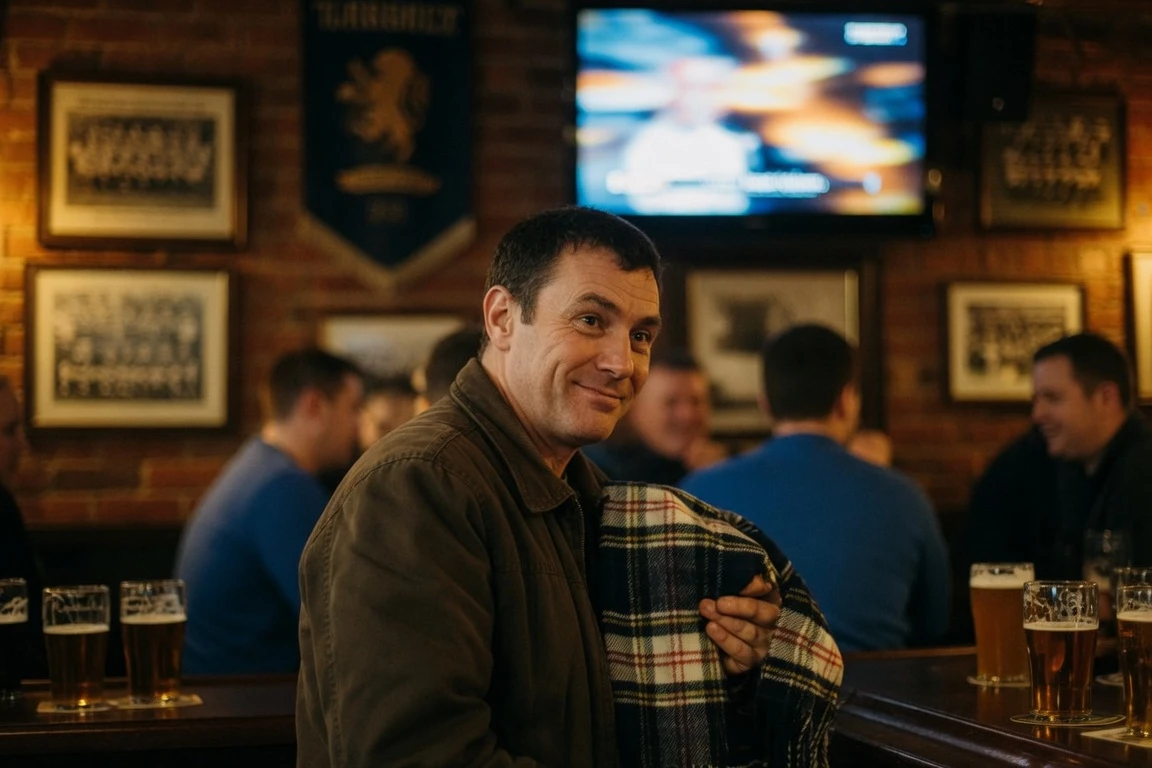
The personal link explains why the film’s premise lands so hard in New England. Rhode Island and Glasgow share a working-class grit, a stubborn pride, and a bar culture that puts the local team at the center of the week. The connection is one Corrente felt too, having spent months on set in Scottish football. The kindred spirits framing came from the filmmaker, not the writer. The family tie shows up in the column from the second paragraph.
What makes the 2026 moment special is the truce. For a few weeks, Celtic supporters and Rangers supporters put all of that aside. They become Scotland supporters. That suspension of club loyalty for a national cause is the beat the film tried to capture, per the Globe’s Dan McGowan.
The Scottish, like the Americans, we all have our differences. But don’t tell us something we don’t want to hear on foreign soil.
They’re very proud people.
Michael Corrente, the Providence filmmaker who directed “A Shot at Glory,” said it in the column on Corrente and the Tartan Army. The filmmaker spent months on set in Scottish football, and the Scots-on-foreign-soil line came from that experience. Boston and Providence bars are full of fans the film tried to put on screen.
A 24-Year-Old Movie Finds Its Audience
Released in 2002, the picture had limited commercial reach. Scottish soccer in America had no way to support a film about the Old Firm at the time. The Tartan Army in Providence bars, the bagpipes on Boylston Street, and the Fenway Park crossover are 2026 scenes. None of it was here in 2002.
The film told a story about a club, a manager, a town, and a stubborn kind of pride. That pride is on display in every Scotland jersey on New England sidewalks in 2026. The casting of McCoist as a former Celtic player wearing a Rangers jersey under his kit sits at the center of that story. Boston and Providence bars now host the kind of fan the film tried to put on screen. The movie’s working title was “The Cup.”
The film is finding the audience it never had. Wednesday’s group finale against Brazil at Hard Rock Stadium in Miami is the next piece. McGowan’s Tuesday column closed with a one-line instruction to the Scots: “Now beat Brazil.”