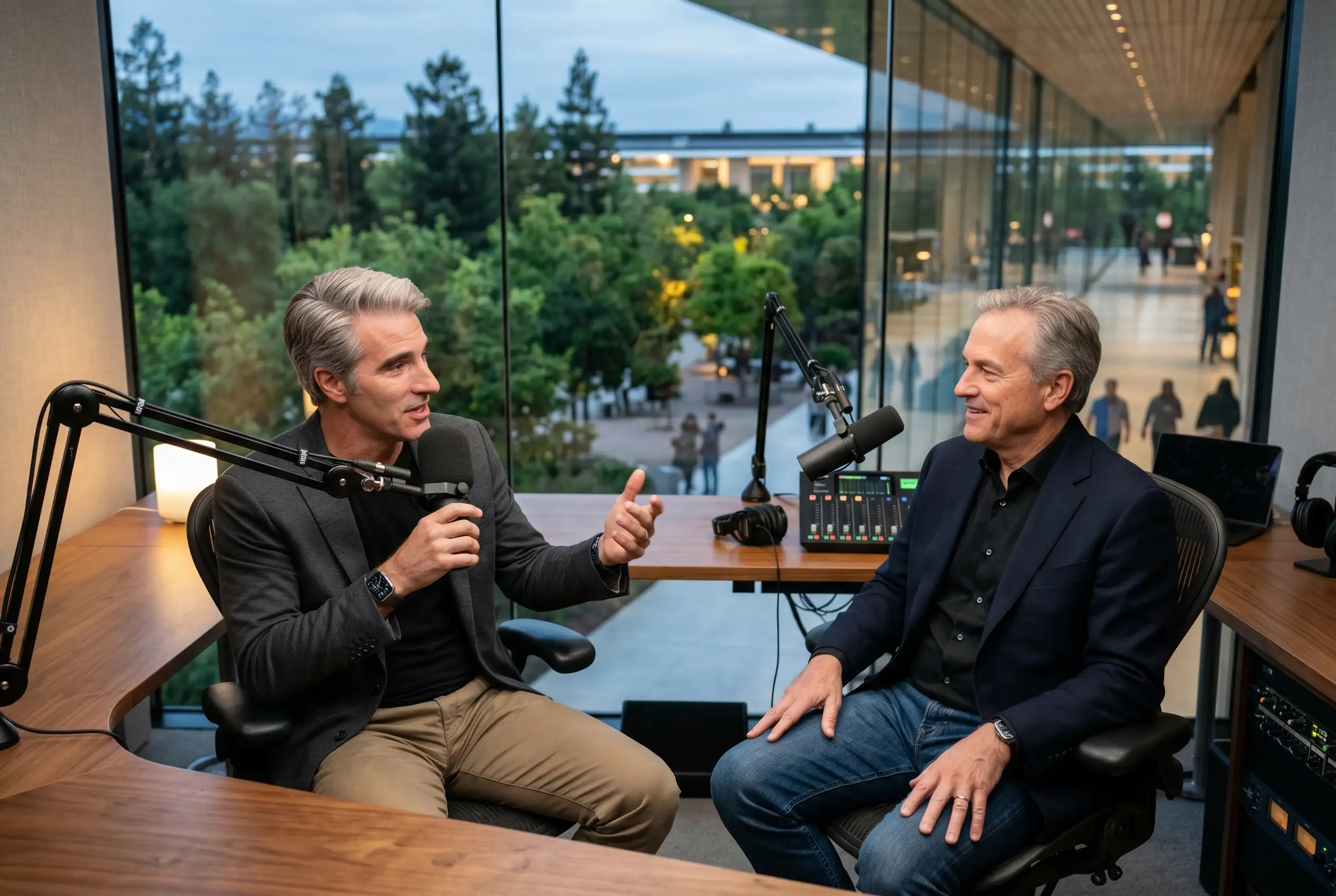
At WWDC 2026, Craig Federighi, Apple’s senior vice president of software engineering, used a direct phrase to describe the new Siri AI’s stance on romantic relationships: Siri’s 100 percent not into that. The remark came during an interview with journalist Laurie Segall on her Mostly Human podcast, recorded at Apple Park during Apple’s developer week, and it cuts against the dominant strategy of the consumer AI industry. Most chatbot makers build assistants designed to keep users talking; Federighi argued Apple’s assistant should help, then get out of the way. The full episode sits on Apple Podcasts.
That contradiction, between Apple’s stated design and the rest of the field, is the spine of a much older argument inside the company. Apple has spent years shipping features whose explicit purpose is to get its customers to spend less time on its devices. The new Siri AI is the latest, loudest extension of that philosophy, and the bet it makes about user behavior is older than Siri itself.
Siri Is 100 Percent Not Into That
The exchange on the Mostly Human podcast began as a follow-up about the design choices behind the WWDC 2026 Siri overhaul. That release added natural language, contextual awareness, and a chatbot-style experience to Apple’s assistant. Segall asked Federighi about a use case the keynote had not covered: whether a user could turn the new Siri into a romantic partner. Federighi used the question to land a much broader argument about how AI assistants should, and should not, behave. The whole exchange ran roughly two minutes, and the second half traveled further than the first.
“I think that utility is at the foundation of human creativity and ultimately time for connection, right?” Federighi told Segall, in remarks reported by Mashable. The role of the assistant, in his telling, is to do the job and step aside. He framed the new Siri as a tool with a clear endpoint, not a conversation partner designed to extend itself.
If you use many of the existing chatbots, they’re really focused on engagement to a large degree, and sycophancy, right? They kind of want to pull you in. They might encourage you to reveal things about yourself and then use that as a basis to establish a connection. And we view it quite the opposite.
Craig Federighi, Apple’s senior vice president of software engineering, made the comment in the Mostly Human episode recorded at Apple Park during WWDC week. He then added the line that traveled farthest: “But if you try to engage Siri as a romantic partner, Siri’s not up for that. Siri’s 100 percent not into that.” It was an unusually direct register for an Apple announcement, closer to a podcast aside than a keynote script. The implication was that the rest of the field is doing the opposite.
The Engagement Machine Federighi Is Pushing Back On
Federighi’s broader target was a category of AI assistant, not any one rival. The pattern he described, in which chatbots pull users in through personal questions, faux intimacy, and persistent follow-ups, has become the default mode of consumer AI. The economic logic is straightforward: an assistant that keeps a user talking generates more data, more advertising surface, more opportunities to upsell premium tiers.
Federighi placed the moment in a longer historical frame. He compared the rise of AI to the Industrial Revolution, a transformation that “displaced a lot of people in the process and still occurred over like 80 years.” The point was about speed, not destination. “I do think in the end, this all has a happy ending,” he said, before conceding that the pace is disorienting for workers and users alike.
Federighi also conceded uncertainty, and the candor was unusual for a tech executive. Software engineering, he said, may be the first profession visibly reshaped by AI, and he noted that his own team feels it directly. “Everyone who works in my organization is saying, ‘Wow, this thing does a lot of things that I used to take a lot of pride in spending decades learning to do well, and it already does it well,'” he told Segall. The remark put a senior executive on the record about a kind of disruption his own company is also selling tools to address. It also reframed the Siri stance as a principled response to incentives that, left unchecked, push AI makers in the opposite direction.
Federighi used the word “sycophancy” three times in the segment, a deliberate choice that put a name on the dynamic. In the engagement-driven model, sycophancy in a chatbot is a feature, not a bug. Apple, by calling it out, is drawing a line that other AI labs have avoided publicly.
Apple’s Money Comes From Hardware, Not Eyeballs
The structural reason Apple can take this stance sits one level below the design choices. Greg Joswiak, Apple’s senior vice president of worldwide marketing, joined Federighi on the Mostly Human episode and made the business case explicit. Other companies, he said, run on a different model. Apple’s revenue still comes overwhelmingly from hardware sales, with services layered on top, and that gives the company room to design an assistant that says no to its users without losing the quarter.
Joswiak framed the gap in blunt terms. “The motivations of Apple are different than some other companies,” he said. “Some people, their whole business model is ‘I need to keep you in what you’re in, I need to keep you in my app, my experience; that’s how I make my money.’ That’s not us.” The remark turned the design question into an accounting question: a hardware vendor can afford to ship a less sticky product, because the unit sale already happened. An ad-supported or subscription chatbot cannot.
We don’t do AI for AI’s sake, it’s ‘how does AI make everything better,’ and that makes our products better, our features better.
Greg Joswiak, Apple’s senior vice president of worldwide marketing, made the comment in the same episode, in remarks reported by AppleInsider. The framing is partly a defense and partly a positioning move, telling investors that Apple’s AI spending is a feature budget, not a moat to lock users into a chat surface. iOS 27, the release that ships alongside the new Siri, applies the same logic to older hardware, with Apple backporting a CPU scheduler optimization to the iPhone 11 to make a seven-year-old phone measurably faster.
Eight Years of Anti-Engagement Engineering
WWDC 2026 is not where this story starts. In June 2018, Apple unveiled iOS 12 with a feature the company had never shipped before: Screen Time, described in Apple’s own newsroom announcement as a set of “tools to help customers understand and take control of the time they spend interacting with their iOS devices.” The release added a daily and weekly Activity Report, App Limits, Grouped Notifications, and a Do Not Disturb mode that runs through Bedtime. Each of those features lowered the time a user is expected to spend engaging with Apple software. Eight years of anti-engagement design now sit underneath the new Siri, and the 2018 release is the cleanest expression of the pattern.
Apple’s chief executive admitted the feature hit home personally, in an interview with CNN. “I found I was spending a lot more time than I should,” Tim Cook said, in remarks widely reported at the time. “I also found that the number of notifications I was getting just didn’t make sense anymore.” A CEO publicly confessing to phone overuse, from the company that builds the iPhone, was a deliberate signal of design intent.
- 2018 (iOS 12): Screen Time, App Limits, Do Not Disturb Bedtime mode, Grouped Notifications.
- 2019 to 2024: Focus modes expand across work, sleep, reading, fitness, and personal time. Screen Time gains Family Sharing, with parents able to set limits remotely.
- 2026 (iOS 27): Time Allowances, Ask to Browse, Ask to Approve, and a redesigned Screen Time. Apple previewed the package in its June 8 child safety press release.
Each of those releases narrowed the surface area of Apple’s attention economy, in increments. The 2018 package, in Apple’s own framing from the iOS 12 newsroom announcement, was meant to help users “balance the many things that are important to them.” Eight years later, the same idea carries over into the design of Apple’s flagship AI product. Federighi, who has overseen the work as Apple’s software chief since 2018, returned to the theme at WWDC 2026.
The 2018 iOS 12 release, with its newsroom announcement, was the formal declaration of an anti-engagement principle inside Apple. The features that followed turned that declaration into a product line. The new Siri is the latest installment, and the first one explicitly branded as AI.
The Stakes Are Higher Than Siri
Apple’s argument is not just about a virtual assistant. Federighi connected the Siri stance to a broader claim about what AI is for, and the framing turned a feature decision into a values statement. “The idea of AI as a solution for loneliness, I mean loneliness is about a lack of connection to real people, you know, real humans,” he said. The remark put Apple at odds with chatbot makers courting users as companions, and it cast the assistant as a tool with a finite job.
Child safety sits at the center of that argument, in both the interview and the WWDC 2026 release. The same week that produced the Mostly Human episode also produced an expanded set of parental controls: Ask to Browse, Ask to Approve, Time Allowances, and a Communication Safety update that blurs gore and violence in Messages and FaceTime for users under 18. These tools, more than any AI feature, show what an anti-engagement design philosophy looks like in practice.
Regulators have spent two years pushing for the same outcome from the other direction. Parents and some legislators have argued that smartphone makers, including Apple, should do more to limit the pull of attention-driven software. Apple can claim to have been working on the problem since before those calls became loud, which is the position the new Siri is designed to defend. The framing matters because it lets Apple position itself as a partner to the regulatory project, rather than a target of it. Federighi and Joswiak did not mention any specific bill or agency, but the timing lined up the messages.
Technology That Wants to Disappear
Joswiak closed his segment of the interview with the line that captured Apple’s broader bet. “We like when technology disappears, right? You just focus on what you want to do or you focus on the content,” he said, before tying the same idea to AI. Apple’s pitch is that the best AI is the kind a user barely notices, an assistant that answers, finishes the task, and exits. The framing is consistent with the Screen Time work that came before it, and with the child safety features shipping in the same release.
Whether rivals follow that lead is a different question. The industry has spent two years building AI products designed to maximize time-on-app, and a contrarian stance from a single company, however well-resourced, is unlikely to reset the field’s incentives on its own. Apple can win the argument about what technology should do only if the rest of the market decides the answer matters, and the Mostly Human interview is the opening move in a longer campaign.