The Fitbit Ace LTE is back to a record-low $99.95 at Amazon, Best Buy, and Target, with Prime Day 2026 now eight days away. The discount returns Google’s kids smartwatch to its lowest-ever price, and the timing is deliberate. It is the same floor the device hit during Amazon’s Big Spring Sale in March and again in late May, and it is sitting there now as Amazon primes the market for a four-day deal event that runs from June 23 to 26, 2026.
The headline number is genuinely steep. $99.95 is 44% off the $179.99 list price on the Fitbit Ace LTE product page on the Google Store and a step down from the $229.95 the watch carried at launch in 2024. For a parent comparing it against Prime Day 2026’s confirmed June 23 to 26 window, the math on the device alone looks like a steal. The math gets messier the moment the activation screen appears.
The Deal: $99.95 Across Amazon, Best Buy, and Target
Google’s kids smartwatch is on sale at $99.95 at Amazon, Best Buy, and Target, with Mashable reporting the Amazon price as of June 3 and The Verge flagging the same figure across all three retailers during the March Big Spring Sale. The $80 cut brings the watch to 44% off the $179.99 Google Store list and to a fresh record low against the $229.95 launch price from 2024.
What makes the timing worth noting is that this same floor has now appeared at three separate sale events in 2026: the March Big Spring Sale, an April discount run, and the early-June lead-in to Prime Day 2026. The Verge’s $99.95 deal write-up from March 23 and Mashable’s June 3 coverage both describe it as the best price seen at Amazon. The $99.95 number is the floor, and it tends to show up whenever Amazon runs a sitewide event.
- Deal price: $99.95 at Amazon, Best Buy, and Target
- List price: $179.99 on the Google Store
- Launch price (2024): $229.95
- Discount: 44% off, $80 below list
The Subscription That Comes With the Discount
Below the $99.95 headline, the Fitbit Ace LTE needs an Ace Pass data plan to function the way the marketing describes. The Google Store lists two options, at $9.99 per month or $119.00 for the year, and both are paid in the Fitbit Ace app during watch setup.
Per Google’s Ace Pass subscription terms, an Ace Pass is required to complete activation. Without it, calling, messaging, location sharing, and the Fitbit Arcade games do not work, so the subscription is not a feature add-on but the activation key. The annual plan is also the one Google is steering families toward, because it ships a free themed Ace Band on activation.
The watch itself is also not the only physical thing a parent can buy. Themed bands like Minecraft, Space Bacon, and Spooky Pugs each cost extra on the Google Store, and the annual Ace Pass is currently the cleanest way to bring a second one home for free.
- 4G LTE connectivity for calling and messaging
- GPS location sharing through Google Maps
- Access to the full Fitbit Arcade game catalog
- All software and Bit Valley updates
- No additional LTE activation fees or carrier contracts
What Kids Actually Get on Their Wrist
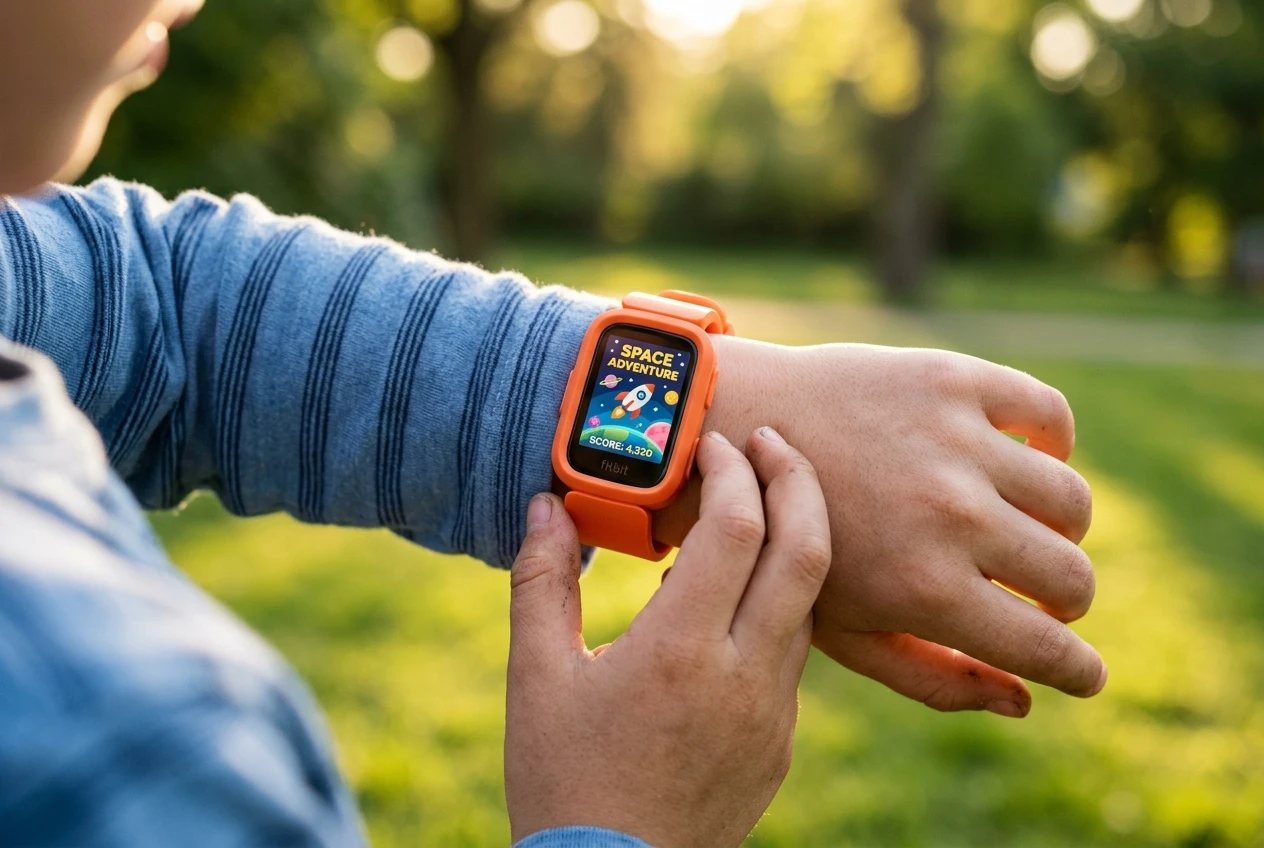
The Ace LTE is built around movement, not notifications. The Google Store describes the design as centered on an animated companion called the eejie, a Tamagotchi-style virtual pet in a place called Bit Valley that gets happier as the wearer racks up activity points. There are no in-app purchases and no shortcuts, so the only way to make progress in a game is to move.
The hardware borrows from the Google Pixel Watch 2 line, with a Gorilla Glass 3 face, a protective bumper case in the box, and water resistance rated to 50 meters. Battery life is rated at 16+ hours per charge, which lands the watch in the “charge it on the counter overnight” category rather than the multi-day category Garmin’s Bounce is known for.
The watch ships in two colorways, Mild (a soft green) and Spicy (a bright orange-red), and Google sells a rotating roster of themed Ace Bands for $34.99 that unlock new eejie outfits and rooms in Bit Valley. Each new band also swaps the animated “Noodle” activity ring on the watch face, so swapping bands is half fashion, half gameplay.
The game catalog itself is short and gamey, not fitnessy. The Verge’s write-up lists a fishing game where kids cast and reel with their arm and a Mario Kart-styled racing game where kids steer by tilting the watch. Sessions are designed to last five minutes or less, then the watch asks for more movement before the next round. That ratio is the central design choice, and the central complaint from parents who want longer play.
What Parents Can Lock Down
School Time is the headline parental control, and the Google Store walks through how to schedule it. The setting mutes notifications and restricts access to games during the hours a parent sets, while still letting the kid call a designated contact in an emergency. School Time can be set to turn on and off automatically by time of day.
Trusted contacts are managed from the Fitbit Ace app, and the watch can stay in touch with up to 20 adults in the family circle, with the rule that contacts have to be 13 or older. Anyone outside the approved list cannot call or text the watch, and kids under 13 cannot use the watch to message each other.
Tap to Pay through Google Wallet is a newer addition, and it requires a supported kids debit card from Greenlight or Acorns Early. Once a parent loads money onto one of those cards, the watch itself becomes the payment device, and the same parental controls that govern contacts also govern the wallet. Location sharing through Google Maps is the other safety feature Google leans on, and the parent app shows where the watch has been, not just where it is right now.
How the Ace LTE Compares to Garmin Bounce and Gizmo Watch 3
The $99.95 price is competitive, but the kids’ smartwatch market is not short on alternatives, and the subscription math lands differently on each one.
The Garmin Bounce is the most direct competitor for active kids, and Garmin’s product page is explicit that voice messages and texts require a subscription managed through the Garmin Jr. app. The Bounce is the model Wirecutter points to for battery life, lasting up to 40 hours on a charge with average GPS use, which is a long way from the Ace LTE’s 16+ hours. The Ace LTE wins on games and on the eejie design; the Bounce wins on time between charges.
Verizon’s Gizmo Watch 3 – Adventure is the third option, and Wirecutter’s guide to kids smartwatches lists a $10 per month service fee and a target age range of 8 to 12. The GizmoHub app is the parent app, the School Mode blocks games, calls, and messages during set hours, and the watch itself is bulkier than either Garmin’s or Google’s offering. None of the three devices escape the monthly fee, and the only way to avoid it is to drop out of the LTE category entirely.
| Device | Monthly fee | Designed for ages |
|---|---|---|
| Fitbit Ace LTE (at $99.95) | $9.99/month via Ace Pass | 7-11 |
| Garmin Bounce | Subscription required (Garmin Jr. app) | Not stated in source |
| Verizon Gizmo Watch 3 – Adventure | $10/month | 8-12 |
Why the Price Keeps Landing at $100
The $99.95 figure is not a one-time flash. It has been the headline price in every major Amazon sale event of 2026, and the early-June run is the third appearance. Mashable’s June 3 coverage is the most recent, and the pricing there is unchanged from the March Big Spring Sale. The pattern looks like a deliberate floor Google is holding through the spring and into the summer shopping calendar.
Prime Day 2026 is the obvious next beat, and the Amazon’s Prime Day 2026 dates of June 23 to 26 page has the event listed exclusively for Prime members. With eight days between today’s date and the start of Prime Day, the $99.95 price is doing two jobs at once: capturing the back-to-school browsing crowd, and setting the comparison anchor for whatever Prime Day itself does. If Prime Day matches $99.95, the deal becomes the new normal. If it dips lower, the early-June price becomes the proof that someone waited too long.
Who Should Buy and Who Should Wait
The sleeper in this deal is the subscription. The $99.95 hardware price is the most visible number, and the $9.99 per month and $119.00 per year Ace Pass prices are the second, and the device does not work without the second. For a family that already plans to keep the subscription active, the $100 price is a real discount on the watch itself, and the annual plan’s free Ace Band is a genuine bonus. For a family that was attracted by the $100 headline and only wants step tracking, the math is the other way around.
Lifehacker’s April 7 write-up of the same deal makes the alternative explicit, pointing to the non-LTE Fitbit Ace 3 at $75.99 for parents who can live with basic movement and step tracking and no calling, messaging, or GPS. The Ace 3 is not the same product, but it is the source-stated fallback for anyone who would rather pay $75.99 once than $99.95 plus a subscription. Google’s $99 Fitbit Air and $349 Pixel Watch 4 cover the adult side of the same family-account story, and they pair with the Ace LTE through the same Google Health app since May 2026.
- Already plan to pay the Ace Pass for LTE calling and location sharing
- Want their kid to use the watch for more than step tracking
- Are buying the second or third Ace LTE for a sibling
Frequently Asked Questions
Is the Fitbit Ace LTE worth buying at $99.95?
For a family that plans to keep the Ace Pass subscription active, $99.95 is a real discount on a device whose Google Store list is $179.99 and whose 2024 launch price was $229.95. The free Ace Band that comes with the annual plan adds modest value, and the same $99.95 price is now sitting at Amazon, Best Buy, and Target.
Does the Fitbit Ace LTE work without the Ace Pass subscription?
No. The Google Store product page is explicit that an Ace Pass is required to activate the device, and the Fitbit Ace support documentation repeats the same rule. Calling, messaging, location sharing, and the Fitbit Arcade games all sit behind the $9.99 per month or $119.00 per year plan.
What ages is the Fitbit Ace LTE designed for?
The Verge’s deal coverage describes the watch as built for kids ages 7 to 11, and the Wirecutter comparison ranges the kids’ smartwatch category more broadly from about 8 to 12. Younger kids tend to use the games and eejie features; older kids lean on the calling and location sharing.
How does the Fitbit Ace LTE compare to the Garmin Bounce?
Both watches require a subscription to unlock voice, text, and location features, and both run through a parent app on the adult’s phone. The Garmin Bounce wins on battery life at up to 40 hours per charge, while the Fitbit Ace LTE wins on game design, eejie customization, and the option to load money through Greenlight or Acorns Early for Tap to Pay.
When does Prime Day 2026 start?
Amazon’s Prime Day page lists the 2026 event as running from June 23 to 26, exclusively for Prime members, in a four-day format that mirrors 2025. With eight days between today’s date and the start, the current $99.95 Fitbit Ace LTE price is the lead-in, and Prime Day itself will set the next reference point.