Nvidia launched its first purpose-built Windows laptop chip on Monday, the RTX Spark Superchip, pairing a 20-core Grace processor with a Blackwell graphics engine and 128GB of shared memory. Chief executive Jensen Huang unveiled it at Computex 2026 in Taipei, positioning the platform as a direct challenge to Intel, AMD, Apple and Qualcomm in the next generation of AI PCs.
Look past the spec sheet, though, and the motive shifts. Nvidia wants the developers a consumer device can recruit, and through them the data-center orders that have made it the world’s most valuable company.
Grace CPU, Blackwell GPU, One Memory Pool
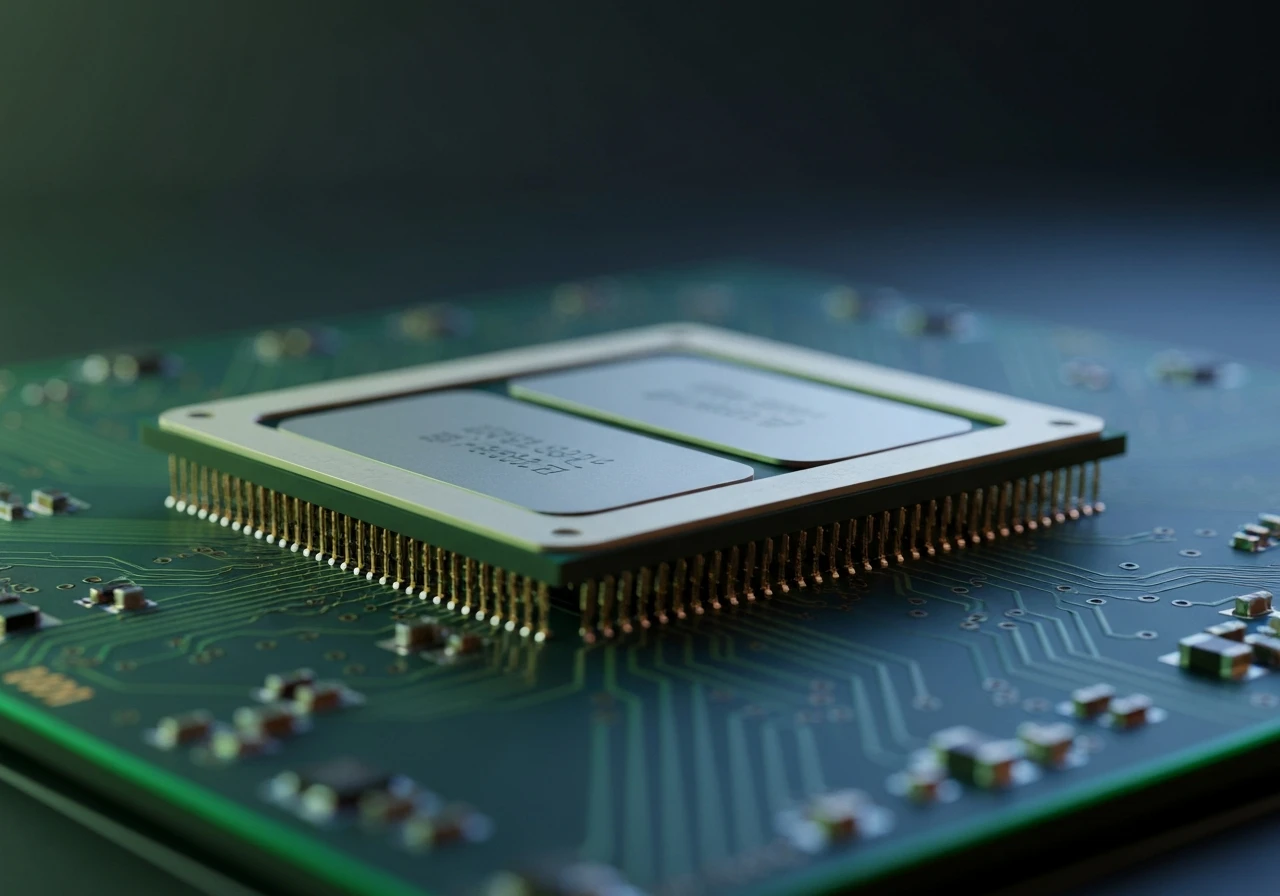
The RTX Spark Superchip welds a 20-core Grace central processing unit (CPU, the brain of a PC) to a Blackwell graphics processing unit (GPU, the chip that renders images and now runs AI) carrying 6,144 CUDA cores, roughly the count found in a desktop RTX 5070. Nvidia links the two over a 600 GB/s NVLink connection and rates the package at one petaflop of FP4 (4-bit floating point, a math format tuned for AI inference). The CPU side was co-engineered with MediaTek, and the whole thing is built on TSMC’s 3nm process as a Windows on Arm platform developed alongside Microsoft.
The design borrows from Apple’s chips and from game consoles: instead of separate memory banks, the CPU and GPU draw from a single pool. Here that pool runs to 128GB of unified memory moving at 300 GB/s, which Nvidia calls the largest GPU-addressable memory ever put on an RTX device. For anyone trying to run a sizeable AI model on a laptop, memory capacity, not raw clock speed, is usually the wall they hit first.
Hardware from Dell, HP, ASUS, Lenovo, MSI and Microsoft’s own Surface line is scheduled to arrive in the fall. That gives buyers a fourth lane in a category that until now split between x86 incumbents, Apple Silicon and Qualcomm’s Arm-based chips.
| Platform | Architecture | Memory model | Native AI software stack |
|---|---|---|---|
| Nvidia RTX Spark | Arm (Grace + Blackwell) | Up to 128GB unified | Full CUDA |
| Apple Silicon | Arm | Unified | Metal / Core ML |
| Qualcomm Snapdragon X | Arm | Unified | ONNX / NPU runtime |
| Intel and AMD | x86 | Discrete or shared | OpenVINO / ROCm |
The Laptop Is a Funnel to the Data Center
The widely reported story is that Nvidia has built a faster, AI-ready notebook. The more consequential one is about software. The chip ships with the full CUDA toolkit, the Compute Unified Device Architecture that has been Nvidia’s deepest moat for two decades because almost every serious AI model is written to run on it.
Put that toolkit on a relatively affordable consumer machine and a developer can prototype an AI agent on a laptop, then push the same code, unchanged, to a rack of Nvidia GPUs in a data center. The laptop becomes the on-ramp. Stephen Wu, a former AI software engineer and founder of the Carthage Capital investment fund, framed the launch in blunt terms.
Nvidia is bypassing the traditional PC supply chain to build an end-to-end hardware monopoly.
Wu told AFP the move is a strategic attempt to get programmers building products on Nvidia’s hardware, which in turn lifts demand for its data-center GPUs. That is where the real money sits. Nvidia’s value has topped $5 trillion, more than the gross domestic product of Japan or India, almost entirely on the back of data-center sales, not consumer parts. Its climb into the trillion-dollar club back in 2023 was built on the same GPU-plus-software flywheel.
Seen that way, the margin Nvidia earns on each RTX Spark laptop matters less than the habit it creates. Every student or startup engineer who learns to build on CUDA at home is a future buyer, or specifier, of the chips that run in the cloud.
Why Intel and AMD Are the Named Casualties
Wu did not hedge on who loses first, calling Intel and AMD “the immediate casualties.” A single vendor now proposes to supply the processor, the graphics, the memory architecture and the software layer that competitors have historically divided among themselves.
- x86 laptop processors, the core franchise both incumbents have defended for decades, now face an Arm rival with AI credibility rather than just battery-life claims.
- Qualcomm’s Snapdragon X, the existing Windows on Arm option, loses its lane as the lone alternative and is outgunned on gaming and creator workloads.
- Apple’s unified-memory advantage, long a selling point of its laptops, is matched in capacity and exposed on the Windows side of the market.
The competitive pressure is broad enough that even firms outside the PC business are racing to cut their reliance on Nvidia. Apple, for one, is developing its own AI silicon to reduce its dependence on Nvidia, a sign of how far the gravitational pull now reaches.
The Memory Crunch That Could Price It Out
There is a catch sitting directly under the launch, and it is made of the same memory the chip leans on so heavily. Consumer electronics are entering one of their most expensive stretches in years because the chips that store data have become scarce and costly.
- 90% jump in PC DRAM (dynamic random-access memory) contract prices in the first quarter of 2026 versus the prior quarter, per TrendForce.
- 63% further rise expected for conventional DRAM in the second quarter as supply stays tight.
- 10% to 20% projected increase in PC, tablet and smartphone prices by the end of the year.
The cause is the very boom Nvidia rode to the top. Samsung, SK Hynix and Micron have shifted the bulk of their output toward high-bandwidth memory (HBM, the specialized memory stacked next to AI accelerators), which now eats 23% of total DRAM wafer capacity. What is left for ordinary laptops is both scarcer and dearer, and you can read the supply math in TrendForce’s latest memory contract-price outlook.
The demand side is buckling too. Research firm IDC projects an 11.3% contraction in the PC market this year as memory and CPU costs push average prices past what many buyers will pay, a slump it details in its analysis of the global memory shortage.
That collides with a chip whose headline feature is 128GB of premium unified memory. Writing last week, PC World senior editor Alaina Yee captured the bind: the biggest question, she argued, may not be how powerful the next wave of PC hardware is, but whether buyers can still afford it.
The irony is hard to miss. Nvidia’s AI franchise is part of what drained the memory supply, and now that drought threatens to put a steep price on the consumer device meant to widen its reach.
Huang’s 40-Year Claim Meets the China Gap
Huang, never short of scale, called the RTX Spark “the first completely re-engineered, reinvented line of PCs that has happened in 40 years” and likened the moment to the phone becoming the smartphone. On stage he also showcased Nvidia’s coming Vera Rubin chip platform and waved off fears that AI will gut employment as “complete nonsense,” arguing the number of software engineers is rising, not falling.
One subject he sidestepped was China. Washington eased national-security export curbs in December to allow sales of Nvidia’s cutting-edge H200 chip, yet there have been no visible orders from Chinese tech firms as Beijing pushes its own domestic silicon. A consumer push into Windows does nothing to close that gap.
So the bet now splits in two. If the memory crunch eases and developers flock to a laptop that runs their data-center code, Nvidia turns a hardware launch into a self-reinforcing pipeline that tightens its grip on AI computing. If prices spike and the consumer market keeps shrinking, the RTX Spark arrives as a brilliant chip very few people can afford to buy.
Frequently Asked Questions
When Will Nvidia RTX Spark Laptops Be Available?
RTX Spark systems are scheduled to arrive in the fall of 2026. Nvidia named Dell, HP, ASUS, Lenovo, MSI and Microsoft’s Surface line as launch partners building laptops and compact desktops on the platform.
What Is Inside the RTX Spark Superchip?
The chip combines a 20-core Grace CPU with a Blackwell GPU carrying 6,144 CUDA cores (roughly RTX 5070-class), linked by a 600 GB/s connection and rated at one petaflop of FP4 compute. It offers up to 128GB of unified LPDDR5X memory at 300 GB/s and is built on TSMC’s 3nm process.
Does the RTX Spark Run Regular Windows Software?
It runs Windows on Arm rather than the x86 version most older PCs use. A growing list of applications now supports Arm natively, including engineering tools such as MATLAB, while the platform’s standout feature is full CUDA support for AI development. Some legacy x86 apps still rely on compatibility layers.
How Does It Compare to Apple Silicon and Snapdragon X?
All three use Arm architecture and a unified memory pool, but the RTX Spark is the only one shipping with Nvidia’s full CUDA stack, the software almost all AI models are written for. It also targets gaming and creator workloads more aggressively than Qualcomm’s Snapdragon X.
Will RTX Spark Laptops Be Expensive?
Likely yes. Nvidia signaled a hefty price tag, and the timing is rough: a memory shortage pushed PC DRAM contract prices up about 90% in early 2026, with analysts expecting consumer-device prices to rise 10% to 20% by year-end.