
When Egypt’s National Authority for Tunnels (NAT, the government body that oversees rail and metro construction) signed a €8.1 billion contract with a Siemens Mobility-led consortium in May 2022, it was the single largest order in the company’s 175-year history. The deal covers 2,000 kilometres of fully electrified track, 41 high-speed passenger trains, 94 regional sets and 41 freight locomotives, all designed to run at up to 230 km/h across three corridors linking the Red Sea, the Mediterranean and Upper Egypt.
What has changed since the signing is the macro frame around the build. The Egyptian pound has been devalued multiple times, Suez Canal revenue has collapsed under Red Sea shipping disruption, and the government’s external debt now sits near $169 billion. Egypt is still building. The financial story around what it is building has shifted enough that every kilometre also reads as a sovereign-risk question.
The €8.1 Billion Order That Predated the Devaluation
The contract arrived in layers. Siemens Mobility signed an initial €2.7 billion turnkey deal in September 2021 covering the first line. By the spring of 2022, that figure had grown to €4.5 billion. Two weeks later, on May 28, 2022, Cairo and the consortium expanded it again to cover the full three-line network, bringing the rolling-stock-and-systems share to €8.1 billion within a combined project that, with civil works included, totals roughly US$23 billion.
- €8.1 billion: lead vendor’s share of the contract, the largest single order in the manufacturer’s 175-year history
- US$23 billion: total project cost including civil works and electrification
- 2,000 kilometres: track length, fully electrified, three corridors
- 15 years: maintenance commitment running alongside the build contract
Three companies handle the construction work: the lead vendor delivers technology and rolling stock; Orascom Construction and The Arab Contractors run civil works. Deutsche Bahn won a separate operations and maintenance contract in November 2022 in partnership with Egypt’s Elsewedy Electric, covering day-to-day running once the network opens. The original consortium press release details the procurement scope.
The 2022 financial assumptions baked into the deal pricing assumed an Egyptian pound trading at roughly 18.6 to the US dollar. Those assumptions did not survive the next 24 months.
Egypt’s Balance Sheet in 2026
The country that signed the order and the country running the order in 2026 are not the same economy. Three pressure lines explain the shift.
External Debt and the 2026 Service Bill
Egypt’s total external debt stands at roughly $169 billion, around 40% of GDP, according to data published by the central bank’s external-position report. External debt service due in 2026 alone reaches about $27 billion. In the FY2024/25 federal budget, 62% of all government expenditures went to debt servicing, a ratio that has squeezed out new infrastructure financing and forced Cairo to lean harder on its existing project pipeline.
That pressure has reshaped how megaprojects get paid. The high-speed rail relies heavily on supplier credit and German export-credit cover, which insulates the construction phase from immediate FX (foreign-exchange) strain. The operating phase, when Egypt begins paying for electricity, maintenance and the long-term service contract in foreign currency, is where the harder squeeze will land.
The IMF Backstop
In February 2026, the IMF Executive Board completed the fifth and sixth reviews of Egypt’s Extended Fund Facility (EFF, a multi-year balance-of-payments support program) and the first review under the Resilience and Sustainability Facility (RSF, a climate-linked lending window), releasing about US$2.3 billion. The fund lifted FY2024/25 real GDP growth to 4.4% and noted headline inflation falling to 11.9% in January 2026 from above 30% during the worst of the 2024 crisis. The Egypt country page on imf.org tracks subsequent reviews.
Gross reserves climbed to roughly US$59.2 billion by December 2025, up from US$54.9 billion a year earlier. The improvement is real. The fund’s staff also flagged “high public debt and elevated gross financing needs” as constraints on medium-term growth, language that lands squarely on the capital-intensive infrastructure portfolio Cairo has built since 2014.
Canal Revenue and the Red Sea Drag
Suez Canal revenue, the dollar-denominated income stream Cairo has relied on to service foreign debt, sank from a record $10.25 billion in 2023 to about $4 billion in 2024 as Houthi attacks on Red Sea shipping diverted container traffic around the Cape of Good Hope. Recovery has been gradual: the waterway earned $449 million in the opening weeks of 2026, up from $368 million in the same period a year earlier. The Suez Canal Authority is projecting growth through 2026, conditional on Red Sea security holding.
For the rail project, the canal recovery matters indirectly: it shapes how much hard currency Cairo has on hand to meet the operating-phase obligations the deal will start generating from the launch onward.
Three Corridors, Two Coasts, One Network
The 2,000-kilometre network is built around three colour-coded lines, each with a different transport job.
| Line | Length | Endpoints | Primary Role |
|---|---|---|---|
| Green Line | 660 km | Ain Sokhna to Marsa Matrouh via Cairo and Alexandria | Tourism plus cargo, north-coast spine |
| Blue Line | 1,100 km | Cairo to Abu Simbel via Aswan | Upper Egypt integration |
| Red Line | 225 km | Luxor to Safaga on the Red Sea | Tourism plus industrial port link |
The Green Line is the first corridor under construction and the one slated to open earliest. It links Egypt’s most heavily populated coastal strip with the Red Sea port-and-resort cluster around Ain Sokhna, then runs west to the Mediterranean tourism belt at Marsa Matrouh.
The Blue Line is by far the longest segment. It is the corridor that finally connects Cairo to the southern tourism anchors at Aswan and Abu Simbel by fast rail, replacing what is today a 12-hour-plus overnight journey on the conventional Egyptian National Railways line.
The Red Line is the shortest but commercially dense. Luxor’s archaeological sites generate steady inbound tourism, and Safaga is one of Egypt’s busier Red Sea cargo ports for phosphate and general bulk.
The Rolling Stock and What “Velaro for the Desert” Means
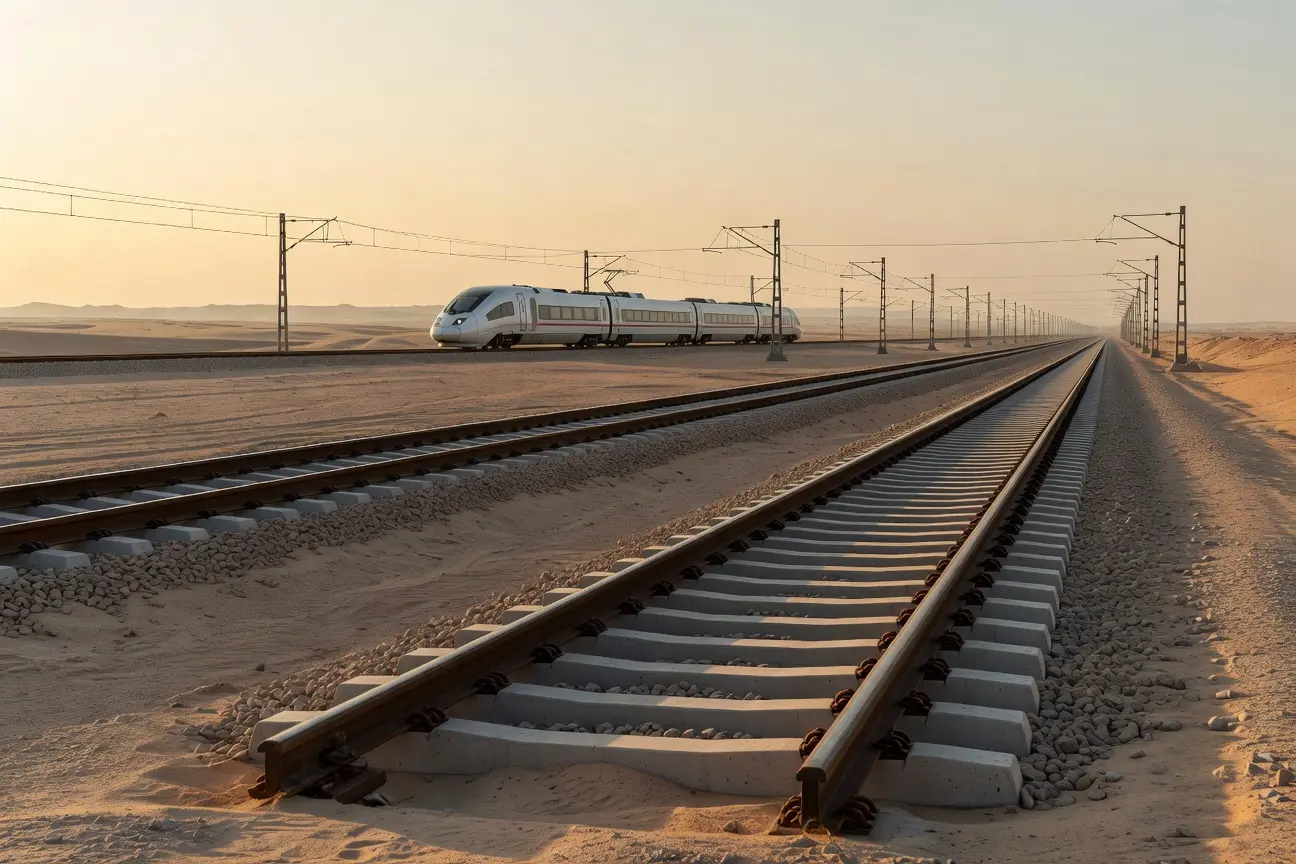
The German manufacturer unveiled the first Velaro high-speed train built for Egypt at InnoTrans, the Berlin rail trade fair, in September 2024. The design adapts the European Velaro platform for an operating environment its engineering teams had not previously built against: ambient air temperatures up to 50°C, fine wind-borne sand, and salt corrosion from both the Mediterranean and Red Sea coastlines.
The Velaro for Egypt is specifically adapted to the hot and sandy conditions in the country, with reinforced air filtration, surface coatings designed to resist abrasion, and modified cooling systems for the propulsion package.
That summary was published by the manufacturer when the trainset was presented, and it reflects a real engineering departure from Velaro builds running in Turkey, Germany and Spain.
The full delivery includes 41 eight-car high-speed sets, 94 four-car Desiro HC regional sets and 41 Vectron freight locomotives. The signaling backbone is the European Train Control System (ETCS) Level 2, the same digital interlocking standard used on the European Union’s TEN-T core network, which lets the system handle mixed passenger-and-freight operation on the same corridor with computer-supervised separation.
Where Egypt’s Project Sits in Africa’s Rail Push
Africa’s fast-rail map remains thin. Morocco’s Al Boraq line, launched in 2018, runs Tangier to Casablanca at top speeds of 320 km/h and remains the continent’s only operating high-speed service. Algeria has announced plans for a Mediterranean coastal corridor but has not begun construction. Nigeria and Kenya have built modern standard-gauge networks running at conventional speeds.
Other operators are working the same trade-corridor problem at conventional speeds: linking inland production zones to coastal ports. Ghana’s rail authority is expanding its lines to connect Tema and Takoradi to the interior. Across the Caspian, a different regional push has produced the new Poti-Baku Express block-train service across the Middle Corridor, a freight comparable Egypt’s planners can watch for container throughput and crossing-time benchmarks.
When Egypt’s full network opens, it will be the continent’s largest electrified passenger rail system by kilometres operated, more than three times the length of Morocco’s. That headline is the one the government wants. The harder question is whether the operating economics work at Egyptian per-capita income levels, where ticket affordability collides with the bus-and-diesel baseline that still carries most domestic intercity travel.
A 2027 Target That Keeps Moving
The completion target has slipped twice. When the consortium contract was first announced in 2021, early Egyptian statements pointed to a 2023 launch for the Green Line’s opening section. By the time the full order was finalized in May 2022, that target had moved to 2025. The current public timeline puts the Mediterranean-to-Red Sea route at 2027, with full three-line completion projected for the early 2030s.
Construction has advanced. The first Desiro HC test train ran on newly laid track west of Cairo in November 2024. Two electrical substations have been built and four transformers installed. The first Velaro for revenue service was presented in Berlin a few months later. None of those markers, taken individually, lock in a 2027 opening; taken together they make a 2028 slippage more plausible than an on-schedule hit.
A handful of calendar items will tell whether the schedule holds:
- Full delivery of the high-speed fleet from German factories and the start of trial runs on completed Green Line segments
- Energization of the full electrified overhead catenary on the first corridor end-to-end
- Egyptian regulator certification of ETCS Level 2 operational readiness on the Green Line
- Commercial-operation declaration from the National Authority for Tunnels
Each step has historically been the point where Egyptian megaproject timelines have given way, often by 12 to 18 months. The same pattern is worth watching now.
Frequently Asked Questions
What Is Egypt’s High-Speed Rail Project?
A 2,000-kilometre fully electrified network of three corridors connecting the Red Sea, the Mediterranean coast and Upper Egypt, designed for trains running at up to 230 km/h. It is being built by a consortium led by Siemens Mobility with Orascom Construction and The Arab Contractors handling civil works.
Who Is Building Egypt’s High-Speed Rail?
Siemens Mobility is the lead technology contractor, supplying trains, signaling and electrification. Orascom Construction and The Arab Contractors handle civil works. Deutsche Bahn and Egypt’s Elsewedy Electric will run operations and maintenance under a separate contract signed in November 2022.
When Will the Green Line Open?
The Green Line is officially targeted for 2027, though two prior slips (originally 2023, then 2025) make a 2028 opening plausible. Full three-line completion across the Blue and Red lines is currently projected for the early 2030s.
How Fast Will the Trains Travel?
The system is engineered for a 250 km/h design speed and a 230 km/h commercial operating speed. Eight-car high-speed sets handle long-distance runs; Desiro HC regional sets handle commuter and intercity service at lower speeds.
How Is the Project Being Financed?
A blend of supplier credit from the construction consortium, German export-credit guarantees and Egyptian sovereign borrowing. Total project cost runs to roughly US$23 billion. Egypt is also drawing on its ongoing Extended Fund Facility, last reviewed in February 2026 with a US$2.3 billion disbursement.
What carries this project from contracted line items to running trains is not the construction side, which has both German engineering capacity and Egyptian state political will behind it. It is the hard-currency cushion that needs to be in place when the operating bills start arriving. If canal recovery holds and the multilateral program anchor stays in place, the trains begin service into a sturdier economy than the one that ordered them. If either side slips, the same fleet arrives into the same FX squeeze that has shadowed every Sisi-era megaproject of the past decade.