
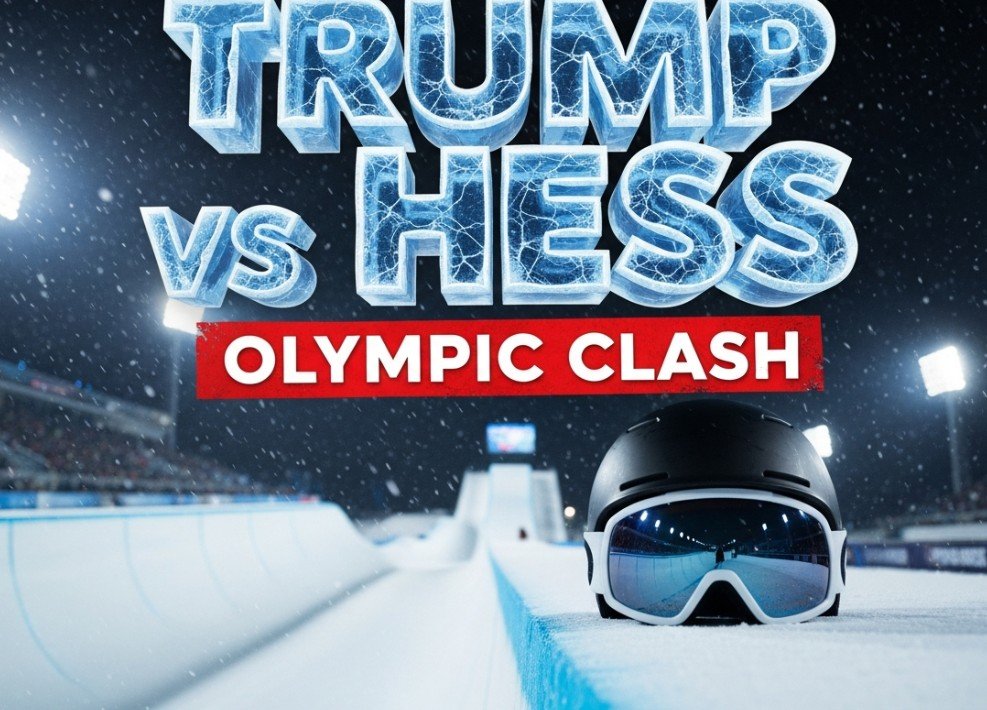
The intersection of sports and politics has ignited yet another firestorm at the Winter Games. President Donald Trump launched a scathing attack on U.S. Olympic freeskier Hunter Hess on Sunday. The former president called the athlete “a real loser” following comments Hess made about his moral conflict in representing the United States at the 2026 Milano Cortina Olympics. This latest clash highlights the deepening divide regarding patriotism and public expression on the world stage.
Tensions flared after Hess spoke candidly during a Friday news conference. When asked about the weight of wearing the stars and stripes, the skier admitted he struggled with the current state of affairs back home. Trump, known for demanding absolute loyalty from athletes representing the nation, did not let the comments slide. He took to his social media platform to demand the skier’s removal from the spotlight.
A Social Media Firestorm
The controversy exploded Sunday morning when President Trump posted a direct rebuke on Truth Social. His message was sharp and personal. He suggested that athletes who harbor doubts about the country should not have the privilege of competing.
“He is a real loser,” Trump wrote in the post that quickly went viral across X and Instagram.
Trump continued his digital barrage by questioning Hess’s place on the team. The post stated that if Hess does not want to represent the U.S. fully, “he shouldn’t have tried out for the Team, and it’s too bad he’s on it.”
The attack followed a familiar pattern for the former president. He has frequently targeted high profile athletes who express political dissent. Trump finished his post with a sentiment that resonated with his base.
Key Quotes from the Controversy:
- Donald Trump: “He is a real loser… it’s too bad he’s on it.”
- Hunter Hess: “It brings up mixed emotions to represent the U.S. right now.”
- Donald Trump: “Very hard to root for someone like this.”
This digital offensive has placed the spotlight firmly on the U.S. ski team. Team officials are now navigating a PR crisis right in the middle of the competition window.
The Interview That Started It All
The spark for this confrontation came from a press conference held on Friday. Hunter Hess, a freestyle skier known for his creativity and technical skill in the halfpipe, fielded questions about his Olympic journey. A reporter asked how it felt to represent the United States given the “things going on back home.”
Hess did not offer a standard media trained answer. Instead, he chose vulnerability.
“It brings up mixed emotions to represent the U.S. right now, I think,” Hess said. “It’s a little hard. There’s obviously a lot going on that I’m not the biggest fan of and I think a lot of people aren’t.”
The Bend, Oregon native clarified that his loyalty lies with the people, not necessarily the politics. He explained that his version of representation is personal.
“I think for me, it’s more I’m representing my, like, friends and family back home,” Hess explained. “The people that represented it before me, all the things that I believe are good about the U.S.”
He finished his thought by defining his own boundaries for patriotism.
“Just because I’m wearing the flag doesn’t mean I represent everything that’s going on in the U.S.,” Hess said.
This distinction between representing the people versus the government is a nuance that often gets lost in the heat of political discourse. For Hess, the Olympic stage is about athletic excellence and community, but for his critics, wearing the uniform requires total alignment with national leadership.
Athletes in the Political Crosshairs
This incident is not an isolated event. It is part of a decade long trend where the White House and the locker room collide. Trump has a long history of feuding with top tier American athletes who voice opposition to his policies or rhetoric.
We have seen this play out on the biggest stages before.
Previous Trump vs. Athlete Feuds:
- Megan Rapinoe (Soccer): Feuded over visiting the White House during the 2019 World Cup.
- Lindsey Vonn (Skiing): Faced criticism in 2018 after saying she hoped to represent the people of the US, not the president.
- LeBron James (Basketball): Frequently targeted for his social activism.
- Colin Kaepernick (Football): Became a central figure in Trump’s rallies regarding national anthem protests.
In each of these cases, the pattern is identical. An athlete expresses a personal value or criticism. The former president responds by attacking their talent, patriotism, or ratings. The fan base then splits into two vocal camps.
The difference with Hunter Hess is the timing. This is happening during the actual Games in Italy. The distraction factor is high. Coaches and teammates often struggle to keep focus when the notification bells start ringing with political updates.
Hess is a respected figure in the freeskiing community. He is known for his film “Magma” and his innovative approach to the sport. He is not a traditional political activist. This makes his comments even more notable to political observers. It shows that the feeling of unease has reached athletes who usually stick to their craft.
The Pressure of Milano Cortina
The backdrop for this verbal spar is the 2026 Winter Olympics in Milano Cortina. The pressure on these athletes is already immense without the added weight of a presidential feud.
Freestyle skiing requires absolute mental clarity. Events like the halfpipe demand precision, timing, and nerve. External distractions can be dangerous. A split second loss of focus can lead to injury.
Supporters of Hess argue that honesty is a form of patriotism. They claim that wanting the country to be better is a valid stance. They have flooded social media with the hashtag #StandWithHunter.
Critics argue that the Olympics should be a politics free zone. They believe that once you don the team uniform, you suspend personal grievances to present a united front to the world. They have used the hashtag #TeamUSAFirst to express their displeasure with Hess.
The U.S. Olympic & Paralympic Committee has historically tried to walk a fine line. They support free speech for athletes but also want to avoid diplomatic incidents. This latest flare up tests those boundaries.
The question remains how this will affect Hess’s performance. Some athletes thrive under pressure and use the criticism as fuel. Others find the negative attention draining. The world will be watching his next run not just for the tricks, but for the statement it makes.
In a rapidly polarizing world, the definition of what it means to be an American patriot continues to evolve. Hunter Hess just found himself at the very center of that debate.
President Donald Trump criticized U.S. Olympic skier Hunter Hess, calling him “a real loser” on Truth Social. The attack came after Hess stated he had “mixed emotions” about representing the U.S. at the 2026 Winter Games due to current events. Hess clarified he represents his friends and values, not necessarily the government. This incident mirrors past feuds between Trump and high profile athletes like Megan Rapinoe and Lindsey Vonn. The controversy has sparked a heated debate online regarding patriotism and free speech during the Olympics.