
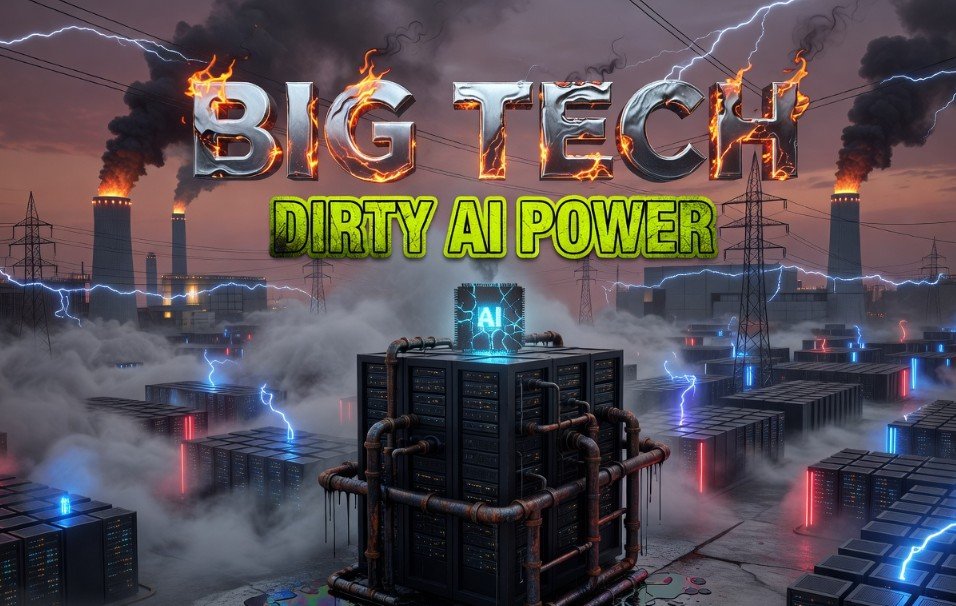
A bombshell new report has ripped the green mask off Big Tech. Amazon, Microsoft, Google, and Meta are burning more gas, coal, and diesel than ever to feed the hungry machines behind ChatGPT, Gemini, and Copilot. Hidden numbers, ballooning emissions, and a shocking data center buildout are now raising alarms across the globe.
Inside the Dirty Data Centre Report Shaking the AI World
The Green Web Foundation dropped its first ever State of the Fossil Free Internet study, and the findings are brutal. The non profit calls it the “Dirty Data Centre Edition” for good reason.
Researchers pulled from the foundation’s own database and more than 140 outside sources. They tracked roughly 1,300 hyperscale facilities now powering the AI boom. The verdict is stark.
Generative AI is eating the energy transition alive. These new models need far more computing muscle than older systems, and the power has to come from somewhere. Right now, that “somewhere” is mostly gas and coal.
“Google, Amazon, and Microsoft do not publicly disclose their energy use in a format that makes it possible to monitor or compare what types of energy they burn in specific regions.” Chris Adams, Technology and Policy Director, Green Web Foundation.
Meta’s Hyperion Project Triples Gas Plants in Louisiana
Nowhere is the contradiction louder than in rural Richland Parish, Louisiana. Meta’s planned Hyperion campus is now backed by ten new gas fired power plants, up from the original three.
That is not a typo. The company added seven more gas plants in a single deal with utility giant Entergy, announced on March 27, 2026.
The numbers behind Hyperion are staggering:
- $27 billion total project cost, up from the initial $10 billion pledge
- 2,250 acres of land in northeastern Louisiana
- 7.5 gigawatts of new gas capacity, enough to power 5 million homes
- 30% jump in the entire Louisiana grid capacity
- Power use roughly equal to the whole state of South Dakota
The Louisiana Public Service Commission fast tracked the approval. Local advocates say residents were given little time to push back.
Why Big Tech Is Hiding Its Real Energy Numbers
Here is where things get murky. Google, Amazon, and Microsoft control about two thirds of the world’s cloud infrastructure. All three have loud net zero promises. None of them break down power use by region or by AI workload.
Investors are now losing patience. More than a dozen shareholders filed resolutions ahead of the 2026 annual meetings, demanding site specific data on water and electricity use.
Meanwhile, reports show major US tech firms lobbied the European Commission to weaken data center emissions rules. The result is a law that lumps data into national totals, making it nearly impossible to link a specific facility to local pollution.
| Company | Discloses Data Center Energy by Site? | Reports AI Workload Emissions? |
|---|---|---|
| Amazon | No | No |
| Microsoft | Partial | No |
| Partial | No | |
| Meta | Yes, most detailed | Limited |
The Climate Cost of the Generative AI Race
The fossil fuel pivot is not just a Meta story. The International Energy Agency projects global data center electricity use will hit roughly 1,050 terawatt hours in 2026. If data centers were a country, they would rank as the fifth largest power user on Earth, sitting between Japan and Russia.
AI is the main engine behind the surge. Electricity used by AI accelerated servers is climbing about 30% per year. Conventional servers grow at only 9%.
The carbon footprint of AI alone could land between 32.6 and 79.7 million tons of CO2 emissions in 2025. Water use linked to cooling could top 760 billion liters in the same window.
A separate February 2026 study from Beyond Fossil Fuels and the Green Web Foundation found something even more damning. About 74% of Big Tech’s claims that AI helps fight climate change are unproven. Researchers could not find a single case where tools like ChatGPT, Gemini, or Copilot delivered verified, large scale emissions cuts.
What This Means for the Future of the Internet
The buildout is not slowing down. Capital spending by the five biggest US tech firms hit $400 billion in 2025. It is on track to climb another 75% in 2026.
For everyday users, every chatbot query, every AI image, and every voice clone carries a hidden carbon cost. That cost is rarely on the receipt.
Quick Facts Box
- 1,300+ hyperscale AI data centers worldwide
- 10 gas plants approved for Meta’s single Hyperion site
- $400 billion in tech capex in 2025 alone
- 74% of Big Tech AI climate claims found unproven
Communities living near these mega campuses are feeling the pinch first. Higher utility bills, strained water tables, and noisy diesel backups are already showing up in Louisiana, Virginia, and Arizona.
Regulators are scrambling to catch up. The GHG Protocol is finalizing its first major Scope 2 update since 2015, with new text due by mid 2026. Whether the changes force real transparency is still an open question.
The promise of AI was a smarter, cleaner future. Instead, the world is watching the biggest tech giants pour billions into the dirtiest fuels of the past, all while burying the receipts. Behind every glowing screen sits a smokestack somewhere, and the people living next to it are paying the price. If this story moved you, drop your thoughts in the comments below and share your view with friends and family using #DirtyDataCentre on X and Instagram.