
Honda just made a move that the US electric mobility space has been waiting years to see. The company officially announced plans to bring its Mobile Power Pack e: swappable battery system to the American market for B2B commercial integrations starting as early as June 2026, turning heads at one of the industry’s biggest clean transportation events.
What Exactly Is the Honda Mobile Power Pack e:
The Honda Mobile Power Pack is an exchangeable lithium-ion battery manufactured by Honda and Panasonic, intended to store power for personal mobility vehicles, including electric motorcycles and scooters.
But calling it just a scooter battery would severely undersell what it is. By leveraging its unique characteristics of being portable and swappable, the MPP can be used not only for Honda products but for a wide range of applications including electric mobility products of other OEMs, a household stationary battery, and a portable power source for outdoor uses.
In 2021, an updated Mobile Power Pack e: was released with an increased maximum storage capacity of 26.1 Ah at 50.26V. The pack itself is surprisingly practical. Honda has built a solid portable pack with a rugged frame that is shock, water, heat, and even EM resistant, while remaining relatively light at just over 20 lbs. That light weight helps make the MPP more easily swappable for use on a range of products while being comfortable enough to carry around and use as a portable power supply.
Here is a quick look at what the MPP brings to the table:
- Weight: Approximately 22 lbs (10 kg)
- Capacity: 1,314 Wh (26.1 Ah at 50.26V)
- Design: Easy-grip handle, centered for balance
- Durability: Resistant to shock, water, heat, and electromagnetic interference
- Smart Tech: Integrated battery management unit that monitors charging, discharge, and records performance data
The MPP also has an integrated battery management unit that controls charging and discharging to increase battery life and reduce degradation. That is a feature businesses running round-the-clock fleets will immediately appreciate.
Honda’s Big US Move Starts This June
Honda’s Mobile Power Pack e: is available for US market B2B product integrations in June. On display and new for the US market, Honda will begin offering the Mobile Power Pack e: for B2B commercial product integrations starting next month.
The doors opened at the Las Vegas Convention Center for ACT Expo 2026, and the industry wasted no time. North America’s largest fleet technology conference, now in its 16th year, drew more than 12,000 attendees for an opening day marked by new battery-electric trucks, hydrogen combustion vans, swappable batteries, and a compressed natural gas system making its North American debut.
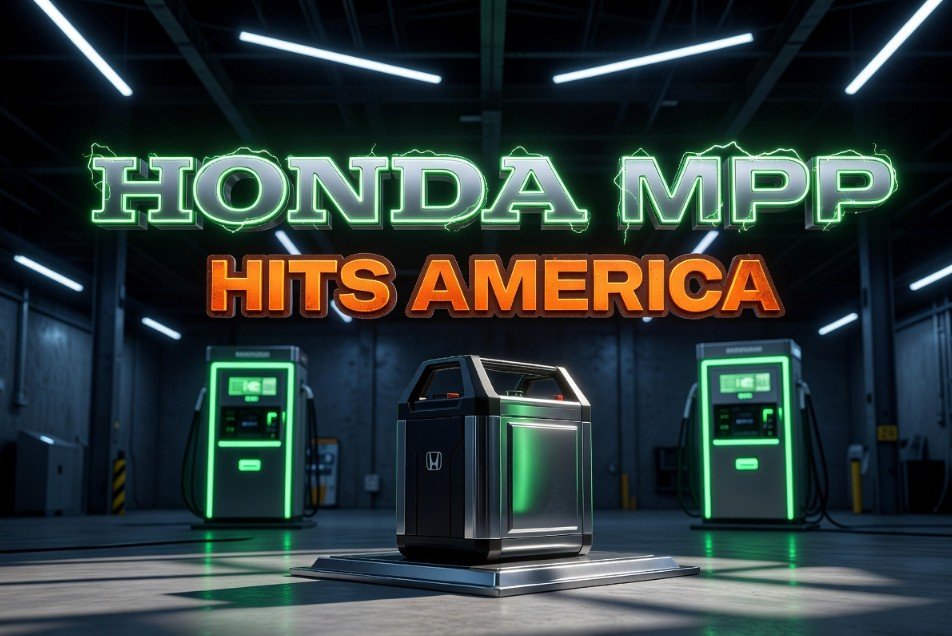
Honda is not targeting everyday consumers at this stage. The company has its sights set firmly on the commercial side first. Once it arrives, Honda will aim its MPP at addressing key friction points with e-mobility adoption such as long charging time, downtime concerns, and high battery costs in the power generation, small-scale construction equipment, agriculture, and material handling spaces.
Think about what that means in practice. A farm worker swapping a drained battery for a fully charged one in seconds rather than waiting hours for a charge. A warehouse crew keeping their equipment running through a full shift without plug-in downtime. That is the real-world promise Honda is making.
Another big win is the big vending machine that actually charges the MPPs. The Honda Mobile Power Pack Exchanger is designed to make it easy for users to stop by and exchange their drained battery for a new one.
The Bigger Vision Honda Has for eMaaS
Honda is not just selling a battery. It is pitching an entirely new way of thinking about energy and mobility together.
Honda has been pursuing the concept of “Honda eMaaS,” which combines the EaaS (Energy as a Service) that connects energy and services and the MaaS (Mobility as a Service) that realizes the freedom of mobility for people.
Honda envisions a world where utility companies, construction equipment brands, and even apartment dwellers would eventually be customers, along with anyone else who might want access to a compact portable battery. That is an ambitious and frankly exciting vision for where this tech can go.
The grid angle is particularly clever. Honda wants to attach these exchangers directly to the power grid, enabling them to store surplus electricity from the grid during off-peak hours, and later offload that electricity when demand spikes. By providing a buffer function to store surplus electricity in the MPP, and by using the stored electricity when power generation level is low, peak-load shifting is achieved, and the charging load on the grid is reduced. This makes it easier and increases the use of renewable energy, thereby contributing to the achievement of carbon neutrality.
Honda is increasing its reliance on renewable energy, including long-term agreements for wind and solar power in North America, now covering more than 80% of its electricity consumption. The MPP plugs directly into that broader sustainability strategy.
Honda has been working on its swappable-battery tech for a while now, showing it off in various applications like the brand’s electric lawn mowers, its electric scooters in Indonesia, and with OEM partnerships with rival brand Yamaha in Japan. Sweden serves as the fifth country for Honda to launch its battery-swapping technology, following Japan, India, Indonesia, and Thailand. The US would now mark a significant new frontier.
Can Battery Swapping Actually Break Through in America
The honest answer is: not without a fight. Battery swapping has long been a “great idea that never quite took off” story in the US. Tesla CEO Elon Musk famously trialed battery swapping for a short period in 2013 only to drop the idea. The landscape today, though, looks very different.
The technology allows for depleted batteries to be replaced with fully charged ones in under five minutes, significantly decreasing downtime for users. Compare that to a standard fast-charge session that still takes closer to 30 minutes, and the commercial case becomes hard to argue against.
The market numbers back this up.
| Market Metric | Data |
|---|---|
| Global Battery Swapping Market (2026) | $1.6 Billion |
| Projected Global Market (2033) | $12.7 Billion |
| Market CAGR (2026 to 2033) | ~35% |
| US Battery Swap Market Growth Rate | 28 to 33% CAGR to 2035 |
| Average Battery Swap Time | Under 5 minutes |
Battery pack standardization remains the single most significant structural barrier to scaled adoption in the United States. This is exactly where Honda’s push for an industry standard becomes so strategically important. Honda has been working toward the establishment of industry standards for portable and swappable batteries, based on which the company will expand the use of the MPP for more products, including products of other companies and household devices. This will enable them to strive for the realization of a battery sharing network for a broad range of products.
If Honda can sign enough B2B partners this year, it could plant the flag for a US battery swap standard before anyone else does. That first-mover advantage in the commercial space would be massive.
Companies interested in collaboration and partnership with Honda or with interest in the Mobile Power Pack e: may contact Honda directly at hydrogen@na.honda.com.
Honda’s arrival at the US battery swap market in June 2026 is more than just a product launch. It is a signal that one of the world’s largest automakers is done watching the sidelines. After years of proving the concept in Asia and Europe, Honda is bringing a battle-tested, practically designed swappable battery system to a market that has been hungry for exactly this kind of innovation. Whether it becomes the industry standard depends on how fast commercial partners get on board, but the foundation Honda has built globally is real, and the timing could not be more right. This is a technology story worth watching very closely over the next 12 months. What do you think? Is Honda’s swappable battery system the answer to America’s EV adoption problem? Drop your thoughts in the comments below.