Zixi and Comcast Technology Solutions said Thursday they have linked Zixi’s software platform to Comcast Media360, giving broadcasters a managed route off C-band satellite and onto IP based delivery. The announcement lands six days before the Federal Communications Commission (FCC) votes on how much of that same spectrum gets sold to wireless carriers.
Zixi’s chief executive calls the shift urgent, a decision customers are making now rather than later. Executives at satellite operator SES have spent months pushing back on that framing in FCC filings and on industry conference stages, arguing the actual clearing deadline sits closer to the next decade than the sales pitch implies.
How the Platforms Actually Connect
At the center of the deal is a technical link between Zixi’s software and Comcast Media360, the video management suite Comcast Technology Solutions (CTS) built for broadcasters juggling legacy TV, streaming and social distribution. CTS introduced Media360 in April 2025, bundling its Cloud Video Platform, MediaExpress and MediaOrigination services under one roof.
The new integration adds a distribution layer on top of that. CTS said Media360 now normalizes rights metadata against SCTE 224, the Society of Cable Telecommunications Engineers standard that governs blackout rules, alternate content and ad windows, letting programmers manage what airs where across broadcast and streaming outputs. Zixi’s ZEN Master software then orchestrates the live signal itself, switching sources on a schedule and supporting SCTE-35 ad cues across cloud and hybrid networks, the companies said.
Aldrich has said the platform supports 14 different live video transport protocols, with SRT the most common among customers today. The combined pitch is a single chain that can:
- Route live signals across cloud or hybrid networks without a satellite uplink
- Enforce blackout and rights rules automatically through SCTE 224 metadata
- Insert regional ads and swap content by market without added bandwidth
- Give affiliates a managed, round the clock service instead of building IP transport in house
CTS described the goal in its announcement of the integration as giving programmers a direct migration path from C-band satellite to IP based content distribution without losing the affiliate controls satellite has offered for decades.
“The C-band transition is not a distant deadline for our customers,” Marc Aldrich, chief executive of Zixi, said. “It is a decision they are making now.” He added that working with CTS means broadcasters do not have to trade rights compliance and reliability for IP flexibility.
Bart Spriester, senior vice president and general manager of streaming, broadcast and advertising at CTS, said broadcasters want more efficient ways to run linear channels while scaling distribution during the transition. Media360, paired with Zixi, gives them “a manageable path to IP” that also “unlocks new monetization opportunities,” he said.
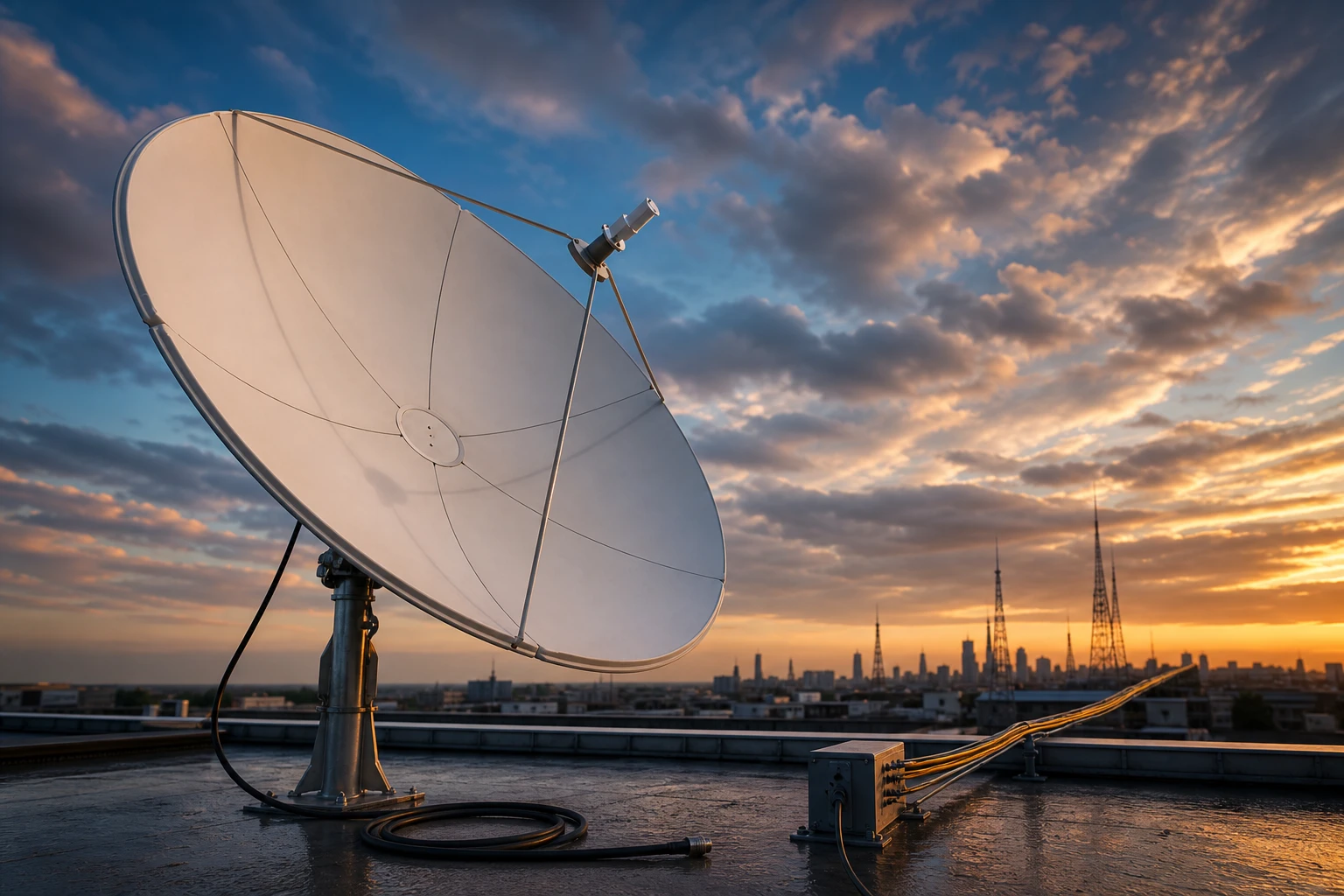
Five Days Until the FCC Sets the Real Clock
FCC Chairman Brendan Carr announced June 30 that the commission will vote July 22 on a draft order authorizing an auction of 160 megahertz of Upper C-band spectrum, the band programmers currently use to distribute network feeds to affiliates nationwide.
The draft order covers the 3.98 to 4.14 gigahertz range and combines it with the Lower C-band cleared in 2023 to form a contiguous 440 megahertz block, which Carr called a “super band” for next-generation wireless service. Congress required the FCC to auction at least 100 megahertz of Upper C-band spectrum by July 2027 under the One Big Beautiful Bill Act. The draft order clears 60 megahertz more than that floor.
- 160 megahertz of Upper C-band spectrum goes up for auction under the July 22 draft order
- 440 megahertz is the combined super band once paired with the already-cleared Lower C-band
- $264 billion in projected GDP gains, plus 1.5 million jobs and $388 billion in consumer surplus, according to the FCC’s own fact sheet
- July 4, 2027 is the statutory deadline for completing the auction itself
The order’s own target for finishing physical clearing, not just the auction, lands in December 2030 and July 2031, according to a legal analysis of the draft order by Davis Wright Tremaine. That is three to four years after the auction the FCC votes on this month.
Is the 2027 Deadline as Urgent as the Sales Pitch Says?
Not as urgent as vendor marketing suggests, according to the satellite industry’s own executives. The FCC’s July 2027 date is a statutory deadline to complete an auction, not a deadline for broadcasters to vacate the spectrum. Actual clearing, under the draft order, is not targeted to finish until 2030 or 2031, years after some vendors are telling programmers to move.
The gap produced open disagreement at the 2026 NAB Show in April, an annual broadcast technology conference in Las Vegas.
- SES, represented by Deepak Mathur, president of media vertical, says broadcasters are confusing an auction deadline with a repack deadline, and that misplaced urgency is shaping decisions that do not need to be made yet.
- Zixi and LTN, a rival managed IP delivery vendor, argue through executives Marc Aldrich and Rick Young that the transition will move quickly once FCC rules and the auction are locked in, and that broadcasters who wait risk a scramble later.
- The National Association of Broadcasters (NAB) warns that clearing beyond 100 megahertz would be more disruptive than the last repack, since incumbents were largely accommodated inside the very spectrum now targeted for auction.
A lot of customers seem to feel that the clearing has to happen by 2027. That’s totally not the case.
Mathur made the point during a NAB Show floor debate over transition timing in April, where he also said there was “a lot of misinformation and a lot of noise” shaping broadcaster decisions.
What Broadcasters Paid Last Time
| Auction | Spectrum Cleared | Proceeds | Relocation Payments | Clearing Deadline |
|---|---|---|---|---|
| Lower C-band (Auction 107, 2021) | 280 MHz (3.7 to 3.98 GHz) | $81.17 billion | $9.7 billion in accelerated payments to SES and Intelsat | Originally December 2025; finished by August 2023 |
| Upper C-band (pending) | Up to 160 MHz (3.98 to 4.14 GHz) | Undisclosed until the July 22 vote; FCC projects “billions” | SES alone estimates $3.6 billion in its own clearing costs | Auction by July 4, 2027; clearing targeted for 2030 to 2031 |
SES has already told the FCC what its share of the new bill could look like. In a June filing, the company estimated it would cost about $3.6 billion to clear 160 megahertz of the upper band, most of it tied to building five new hybrid Ku-band satellites with C-band uplinks, plus two in-orbit backups. Another $777 million would go toward a terrestrial network built to catch signal dropouts caused by Ku-band’s weakness in heavy rain.
Broadcast executives say the financial shape of this round looks different from the last one. The first repack was largely a hardware swap, encoders, filters and receivers paid for once. This one adds recurring costs for managed IP delivery and backup capacity, and NAB has asked the FCC to pay incumbents upfront rather than making them front the cost and wait years for reimbursement, as happened after the first auction.
The Networks Already Gone
Some programmers are not waiting for the FCC to decide anything.
- Tennis Channel moved its 24 hour network to a fully managed IP model with LTN in early 2025.
- Scripps launched its Scripps Sports Network on IP distribution in March 2026, carrying Major League Volleyball and WNBA programming.
- TelevisaUnivision and MSG Network shifted primary feeds to service-level-agreement based IP models to get off satellite constraints.
- PBS moved 330 member stations onto LTN’s IP platform to modernize its national interconnection system.
The shift mirrors a wider push toward IP-first production and delivery tools that vendors demonstrated at last year’s IBC media technology showcase in Amsterdam, where cloud based orchestration was a running theme.
The Last-Mile Problem Nobody’s Pitching
Vendors selling managed IP replacements mostly court the top of the market, national networks and their biggest affiliates, where fiber already reaches the door. Below that tier, the picture gets harder.
Harmonic, a rival video technology vendor, has said access, cost and management of the last mile are the biggest open problems for managed IP, since most major markets can reach partner networks but many rural areas cannot. NAB has echoed the concern in FCC filings, warning that alternative platforms “are neither universally available nor functionally equivalent, particularly for point-to-multipoint distribution, rural service, and live event coverage.”
Under the draft order the FCC votes on July 22, the auction itself closes by July 2027. The actual clearing target lands years later, in December 2030 and July 2031.
Frequently Asked Questions
What Is the C-Band Transition?
The C-band transition is the FCC’s multi-year effort to reclaim satellite spectrum in the 3.7 to 4.2 gigahertz range for 5G and 6G wireless use. The first phase cleared 280 megahertz between 2020 and 2023. The second phase, covering up to 160 megahertz more, goes to a commission vote on July 22, 2026.
Why Are Broadcasters Moving Off C-Band Satellite?
Programming demands have outgrown what remains of the satellite multiplex. Broadcasters are increasingly distributing 1080p60 HDR formats, which carry twice the frame rate of standard HD with better color range, and satellite capacity has not grown to match while spectrum keeps shrinking.
What Does the Zixi and Comcast Technology Solutions Deal Change?
It ties Zixi’s live orchestration software directly to Media360’s rights and metadata layer, so a broadcaster can, for example, black out a live feed automatically in one market while it keeps airing everywhere else, without manual intervention at each affiliate.
When Does the FCC Vote on the Next C-Band Auction, and What Happens After?
The vote is scheduled for July 22, 2026. The commission has said it will not release specific dollar figures for costs, incentives and rebates tied to the auction until after that vote takes place.
Is Ku-Band Satellite a Real Replacement for C-Band?
Partially. SES is proposing larger 3.7 meter receive antennas and higher-power satellites for high-rain zones to offset Ku-band’s historic weakness in bad weather, while LTN says its terrestrial IP service runs 40 to 60 percent cheaper than C-band satellite delivery.
How Fast Will Broadcasters Actually Have to Move?
Slower than vendor pitches suggest, but not slow enough to ignore. Synamedia, an encoding and rights technology supplier that says it currently handles about 45 percent of existing C-band channels, expects the first 100 megahertz to clear by the end of 2028, with a second tranche following by 2030.